
Featured
Assets Declaration Charges: Shun CCT, S’South Govs Tell CJN Onnoghen …FG’s Move, Denigration Of Judiciary, Constitution …Saraki, Dogara, NBA, Ohanaeze Kick …If Buhari Wants Crisis, We Are Ready -Secondus

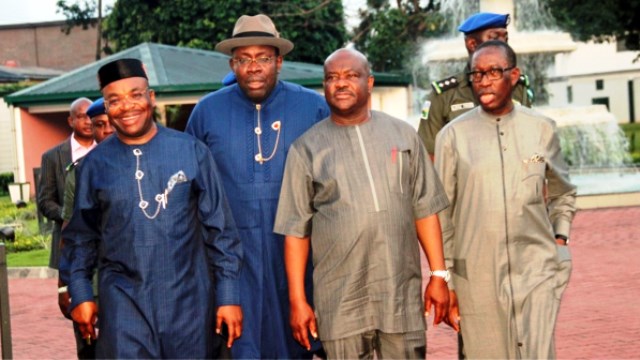
Governors of the South-South geo-political zone have described moves to arraign the Chief Justice of Nigeria, CJN, Walter Onnoghen before the Code of Conduct Tribunal, CCT, today by the Federal Government as a demonstration of lack of respect for the people of the Niger Delta region, the nation’s judiciary and democracy by President Muhammadu Buhari.
The governors stated this yesterday at the end of an emergency meeting held at the Bayelsa State Governor’s lodge, Maitama, Abuja.
In a communique read by Chairman of the South-South Governors’ Forum and Governor of Bayelsa State, Seriake Dickson, the forum condemned what it termed the flagrant disobedience of court orders by President Buhari-led administration, adding that the moves to arraign the CJN with barely a month to the 2019 polls is capable of heating the polity. The communique read in part:
“We note that the unfortunate action against the CJN further reinforces the perception that the Buhari administration has no regard for the sentiments of Nigerians, in particular the people of Niger Delta, and the rule of law “It is a fact that this administration has a penchant for flagrant disobedience of and disregard for legitimate and valid court orders.
“We expect President Buhari to know that democracy cannot survive without respect for the constitution, strict adherence to the rule of law, and separation of powers as enshrined in the constitution. “We note that under Section 158(1) of the 1999 Constitution, the National Judicial Council, NJC, has ample powers to deal exhaustively with matters pertaining to allegations of misconduct and discipline of Judicial officers.
“Specifically, the NJC has the powers and clear procedures for investigating allegations, and recommending appropriate sanctions or disciplinary measures against judicial officials as a matter of first instance before any further steps.
“The judicial pronouncements in the cases of FGN Vs Justice Sylvester Ngwuta of the Supreme Court (January 9, 2018) and Justice Ngajinwa Vs FGN 2017 at the CCT have given validation to the express provisions of the constitution on this issue.
“We note that the attempt to drag the CJN to the CCT is also a grave and dangerous escalation of the assault on institutions of state including the National Assembly and the judiciary “We believe that the President, Muhammadu Buhari has a constitutional responsibility and huge moral obligation to defend our democracy.
“we consider this step, which is directly aimed at humiliating the nation’s highest judicial officer and a prominent son of the region, as totally unacceptable as it is reflective of the South South story of endless marginalization and intimidation.
“The unceremonious removal of former Acting Director General of the Department of State Service, Mathew Seiyefa and his replacement is still very fresh.
“We strongly believe that the regrettable development at the Supreme Court at this critical time, when preparations for the general elections are wobbling (with serious concern about the Independent National Electoral Commission, INEC, and security agencies) is capable of causing avoidable anxiety, tension and possible breakdown of law and order in the country.
Legal luminary, Chief Afe Babalola (SAN), has described the proposed trial today of the Chief Justice of Nigeria, Justice Walter Onnoghen, at the Code of Conduct Tribunal over alleged failure to fully declare his assets as “denigration of the country’s Judiciary and Constitution.”
He also noted the constitutional provision which stipulates that any infraction by judges must first be investigated and then resolved by the National Judicial Council, “to the exclusion of any other body or authority.”
Babalola, in a statement yesterday entitled, Proposed arraignment of the Hon Justice Walter Onnoghen: Again, I say two wrongs do not make a right, said the law had made clear the processes for the trial of judicial officers and as well their removal, hence the need to desist from “contempt and denigration of the judiciary.”
Continuing, he argued, “Again, the point must be made clear that the Constitution clearly provides for the procedure with which the CJN can be removed from office.
“Section 292 (1)(a)(i) and 292 (1)(b) of the Constitution of the Federal Republic of Nigeria 1999 (As Amended) addressed it.”
For the President General of Umbrella organisation of Ndigbo, the Ohananeze, Chief John Nnia Nwodo yesterday warned the federal Government that they are heating up the polity by the needless action it’s taking against the Chief Justice of Nigeria, CJN.
The President General said that legal opinion did not support the action and therefore should not have been contemplated at all.
In a statement he signed, Nwodo said Ohaneze has received, with shock and disappointment, the decision of the Federal government of Nigeria, acting through the Code of Conduct Bureau, to prosecute the Chief Justice Of Nigeria.
The President General noted that Legal opinion abound that the action is premature and ill conceived following an extant Court Of Appeal decision which interprets the procedure for prosecuting judicial officers.
He said: “This procedure has not been followed. The fact that the National Judicial Council has been ignored is not just illegal but suggests deliberate court shopping and a predetermined objective.
Also, the Nigerian Bar Association has reacted to the charges filed by President Muhammadu Buhari’s government against the Chief Justice of Nigeria, Walter Onnoghen.
The Federal Government will today, January 14, 2019, arraign the CJN before the Justice Danladi Yakubu-led Code of Conduct Tribunal (CCT) in Abuja on charges of failures to declare his assets as required by law and for operating Bank Domiciliary Foreign Currency Accounts.
The charges against Justice Onnoghen were filed and served on him last Friday at his official residence in Abuja preparatory to his appearance at the tribunal.
Reacting, NBA in a statement signed by its General Secretary Jonathan Gudu Taidi described the move against Onnoghen as an assault, intimidation and desecration of the judiciary, which must stop.
The body questioned government’s position to embark on this “anomalous course of charging the CJN before the CCT without first presenting whatever facts it purportedly has against His Lordship to the NJC”
The statement read in part: “Assault, Intimidation and Desecration of the Judiciary Must Stop
Nigerians have witnessed again the targeted assault of the judiciary by agents of the Federal Government of Nigeria (“FGN”) epitomized by today’s media trial of the Chief Justice of Nigeria, Honorable Mr Justice Walter S N Onnoghen, GCON (“CJN”). According to media reports which have now been validated by the Statement of the Code of Conduct Tribunal (“CCT”) that was released today an application was “filed by the Code of Conduct Bureau to the CCT Chairman yesterday for the trial to commence against the Chief Justice of Nigeria on six count charges” and that the CCT “will commence the trial on Monday, 14th January 2019”. The Nigerian Bar Association unequivocally condemns this assault, intimidation and desecration of the Judiciary by FGN agencies and demands that it be stopped immediately.
Why has FGN decided to embark on this anomalous course of charging the CJN before the CCT without first presenting whatever facts it purportedly has against His Lordship to the NJC for its deliberation and determination? The Petition that triggered the CCB action was on its face received by the Bureau on 09 January 2019 and the Charge was promptly drafted and is dated the following day, 10 January 2019 – giving the CCB a record 24 hours for completion of its investigation and the drafting of the said Charge and ancillary processes! If one contemplates the fact that the CCT arraignment is scheduled to take place on 14 January 2019, we have in total a record number of 3 (three) working days between the receipt and processing of the petition, investigation, preparation of Charge and ancillary processes and the arraignment! Such unprecedented speed and efficiency in Nigeria’s criminal justice administration! It is clear, given the rush with which this matter was conducted by the CCB, that the NJC was not privy to it and did not conduct its mandatorily required disciplinary processes prior to the filing of the Charge before the CCT.
Meanwhile, President of the Senate, Dr. Abubakar Bukola Saraki, has advised the Federal Government to ensure that its plans to put on trial the nation’s chief judicial officer, Hon. Justice Walter Onnoghen, does not cause chaos and that the due process was not compromised.
Saraki in a statement signed by his Adviser (Media and Publicity), Yusuf Olaniyonu, in Ilorin yesterday, noted that he believes that if the Government truly has genuine reason to put the incumbent Chief Justice of Nigeria on trial, it should ensure that every step in the process is transparent and the normal process as provided by the law is followed to the letter.
He said a situation where the petition which triggered the trial was submitted to the Code of Conduct Bureau (CCB) on Wednesday January 8 and by January 10 on Friday, the Chief Justice was presented with it for his reply only for the charges to be drafted that same day and filed in the Code of Conduct Tribunal (CCT), all this taking place within three days and commencement of trial fixed for Monday, January 14, already indicate unnecessary haste and short-circuiting of the process of fair hearing.
In its reaction, the National Chairman of the Peoples Democratic Party (PDP), Uche Secondus, yesterday warned President Muhammadu Buhari not to plunge the nation into crisis saying his party is ready to resist him.
Secondus’ statement came on the heels of the upcoming arraignment of the Chief Justice of Nigeria, Walter Onnoghen before the Code of Conduct Tribunal over his failure to declare his assets.
The issue is currently generating heated debate in the polity.
Prince Secondus at a PDP presidential rally in Jos yesterday said the party would resist the president’s attempt to ‘attack’ the judiciary.
He said President Buhari was planning to rig the 2019 elections by first compromising the judiciary.
“Thirty days to the election, Buhari and APC want to destroy Nigeria. We (PDP) will not agree. If they want crisis, they will see it,” Secondus said.



Rivers State Governor, Sir Siminialayi Fubara, has dissolved the State Executive Council.
The governor announced the cabinet dissolution yesterday in a statement titled ‘Government Special Announcement’, signed by his new Chief Press Secretary, Onwuka Nzeshi.
Governor Fubara directed all Commissioners and Special Advisers to hand over to the Permanent Secretaries or the most Senior officers in their Ministries with immediate effect.
He thanked the outgoing members of the State Executive Council for their service and wished them the best in their future endeavours.
The three-paragraph special announcement read, “His Excellency, Sir Siminalayi Fubara, GSSRS, Governor of Rivers State, has dissolved the State Executive Council.
“His Excellency, the Governor, has therefore directed all Commissioners and Special Advisers to hand over to the Permanent Secretaries or the most Senior officers in their Ministries with immediate effect.
“His Excellency further expresses his deepest appreciation to the outgoing members of the Executive Council wishing them the best in their future endeavours.”
The Independent National Electoral Commission (INEC) yesterday told the National Assembly that it requires N873.78bn to conduct the 2027 general elections, even as it seeks N171bn to fund its operations in the 2026 fiscal year.
INEC Chairman, Prof Joash Amupitan, made the disclosure while presenting the commission’s 2026 budget proposal and the projected cost for the 2027 general elections before the National Assembly Joint Committee on Electoral Matters in Abuja.
According to Amupitan, the N873.78bn election budget covers the full conduct of national polls in 2027.
An additional N171bn is needed to support INEC’s routine activities in 2026, including bye-elections and off-season elections, the commission stated.
The INEC boss said the proposed election budget does not include a fresh request from the National Youth Service Corps seeking increased allowances for corps members engaged as ad-hoc staff during elections.
He explained that, although the details of specific line items were not exhaustively presented, the almost N1tn election budget is structured across five major components.
“N379.75bn is for operational costs, N92.32bn for administrative costs, N209.21bn for technological costs, N154.91bn for election capital costs and N42.61bn for miscellaneous expenses,” Amupitan said.
The INEC chief noted that the budget was prepared “in line with Section 3(3) of the Electoral Act 2022, which mandates the Commission to prepare its election budget at least one year before the general election.”
On the 2026 fiscal year, Amupitan disclosed that the Ministry of Finance provided an envelope of N140bn, stressing, however, that “INEC is proposing a total expenditure of N171bn.”
The breakdown includes N109bn for personnel costs, N18.7bn for overheads, N42.63bn for election-related activities and N1.4bn for capital expenditure.
He argued that the envelope budgeting system is not suitable for the Commission’s operations, noting that INEC’s activities often require urgent and flexible funding.
Amupitan also identified the lack of a dedicated communications network as a major operational challenge, adding that if the commission develops its own network infrastructure, Nigerians would be in a better position to hold it accountable for any technical glitches.
Speaking at the session, Senator Adams Oshiomhole (APC, Edo North) said external agencies should not dictate the budgeting framework for INEC, given the unique and sensitive nature of its mandate.
He advocated that the envelope budgeting model should be set aside.
He urged the National Assembly to work with INEC’s financial proposal to avoid future instances of possible underfunding.
In the same vein, a member of the House of Representatives from Edo State, Billy Osawaru, called for INEC’s budget to be placed on first-line charge as provided in the Constitution, with funds released in full and on time to enable the Commission to plan early enough for the 2027 general election.
The Joint Committee approved a motion recommending the one-time release of the Commission’s annual budget.
The committee also said it would consider the NYSC’s request for about N32bn to increase allowances for corps members to N125,000 each when engaged for election duties.
The Chairman of the Senate Committee on INEC, Senator Simon Along, assured that the National Assembly would work closely with the Commission to ensure it receives the necessary support for the successful conduct of the 2027 general elections.
Similarly, the Chairman of the House Committee on Electoral Matters, Bayo Balogun, also pledged legislative support, warning INEC to be careful about promises it might be unable to keep.
He recalled that during the 2023 general election, INEC made strong assurances about uploading results to the INEC Result Viewing portal, creating the impression that results could be monitored in real time.
“iREV was not even in the Electoral Act; it was only in INEC regulations. So, be careful how you make promises,” Balogun warned.
The N873.78bn proposed by INEC for next year’s general election is a significant increase from the N313.4bn released to the Commission by the Federal Government for the conduct of the 2023 general election.

President Bola Tinubu yesterday expressed grief over the death of a former President of the Academic Staff Union of Universities and one of Africa’s foremost literary scholars, Professor Emeritus Biodun Jeyifo.
Jeyifo passed away on Wednesday, drawing tributes from across Nigeria and the global academic community.
In a condolence message to the family, friends, and associates of the late scholar, Tinubu in a statement by his spokesperson, Bayo Onanuga, described Jeyifo as a towering intellectual whose contributions to African literature, postcolonial studies, and cultural theory left an enduring legacy.
He noted that the late professor would be sorely missed for his incisive criticism and masterful interpretations of the works of Nobel laureate, Professor Wole Soyinka.
The President also recalled Jeyifo’s leadership of ASUU, praising the temperance, foresight, and wisdom he brought to the union over the years.
Tinubu said Jeyifo played a key role in shaping negotiation frameworks with the government aimed at improving working conditions for university staff and enhancing the learning environment in Nigerian universities.
According to the President, Professor Jeyifo’s longstanding advocacy for academic freedom and social justice will continue to inspire generations.
He added that the late scholar’s influence extended beyond academia into political and cultural journalism, where he served as a mentor to numerous scholars, writers, and activists.
Tinubu condoled with ASUU, the Nigerian Academy of Letters, the Wole Soyinka Centre for Investigative Journalism, the University of Ibadan, Obafemi Awolowo University, Oberlin University, Cornell University, and Harvard University—institutions where Jeyifo studied, taught, or made significant scholarly contributions.
“Nigeria and the global academic community have lost a towering figure and outstanding global citizen,” the President said.
“Professor Biodun Jeyifo was an intellectual giant who dedicated his entire life to knowledge production and the promotion of human dignity. I share a strong personal relationship with him. His contributions to literary and cultural advancement and to society at large will be missed.”
Jeyifo was widely regarded as one of Africa’s most influential literary critics and public intellectuals. Among several honours, he received the prestigious W.E.B. Du Bois Medal in 2019.
-

 Sports2 days ago
2026 WC: Nigeria, DR Congo Awaits FIFA Verdict Today
-
Sports5 days ago
DG NIS Wants NSC Board Constituted, Seeks Increased In Funding
-

 Business5 days ago
Customs Seek Support To Curb Smuggling In Ogun
-

 Featured5 days ago
INEC Proposes N873.78bn For 2027 Elections, N171bn For 2026 Operations
-

 Sports5 days ago
SWAN Rivers Set-up Five Functional Committees
-
Sports5 days ago
NSC Disburses N200m Training Grants To 26 Athletes
-
Sports5 days ago
‘NTF Will Build On Davis Cup Success For Brighter Future’
-
News5 days ago
Police Bust Kidnapping Syndicate In PH