
Featured
N13.08trn Budget: 2nd Recession To Hit Economy Before Dec Ends -Buhari …N’Delta Amnesty Programme Gets N65bn

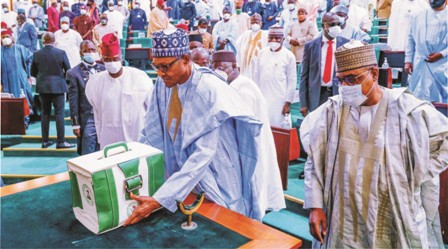
President Muhammadu Buhari, yesterday, predicted further hardship for Nigeria as he said the nation may face another recession before the end of the year, if serious and effective measures are not taken to ensure the nation’s financial security.
Buhari raised the alarm in his budget speech during the presentation of N13.08trillion budget for the 2021 fiscal year to a joint session of the National Assembly,.
He, however, vowed to pursue his administration’s goal of lifting 100million Nigerians out of poverty, even as he disclosed that the government has released N2.1trillion for capital projects in the 2020 budget.
President said about N3.85trillion has been earmarked for capital projects in the 2021 fiscal year, while the non-debt recurrent expenditure for next year would gulp N5.65trillion.
He said this was N1.15trillion higher than what was budget for capital in 2020.
The 2021 budget also has N100billion earmarked for Constituency projects of the lawmakers of both Chambers of the National Assembly, just as N128billion has been slated for statutory transfer to the National Assembly for payment of salaries and allowances next year.
This would, therefore, form part of the proposed N484.49billion transfers to other budget stakeholders.
A study of the 2021 budget breakdown as submitted by the President, indicated that the Ministery of Defense received the lion share of N840.56billion, followed by Ministry of Education, which received N545.10billion, while the Ministry of Health received N380.21billion in the 2021 Appropriation Bill.
According to the President, in line with the proposed borrowing plans to sustain the economy, the 2021 budget would operate at a deficit of N5.2trillion, just as N4.28trilion would be borrowed to finance the budget deficit.
The parameters and fiscal assumptions underpinning the 2021 appropriation, included: Benchmark oil price of $40 per barrel; daily oil production estimate of 1.86 million barrels (inclusive of Condensates of 300,000 to 400,000 barrels per day).
Exchange rate of N379 per $1; Gross Domestic Product growth projected at 3.0 per cent and inflation closing at 11.95 per cent.
The President said to maintain the peace in the Niger Delta region for economic and social activities to thrive, the provision of N65billion for the Presidential Amnesty Programme has been retained in the 2021 Budget.
“In addition, the sum of N63.51billion has been appropriated for the Niger Delta Development Commission (NDDC) and N24.27billion has been provided for the capital projects of the Ministry of Niger Delta Affairs. These allocations should further support the development of the region by facilitating the completion of important ongoing projects, such as the East-West Road”, he said
According to him, “Based on the foregoing fiscal assumptions and parameters, total federally distributable revenue is estimated at N8.433trillion in 2021. Total revenue available to fund the 2021 Federal Budget is estimated at N7.886trillion. This includes Grants and Aid of N354.85billion as well as the revenues of 60 Government-Owned Enterprises.
“Oil revenue is projected at N2.01trillion. Non-oil revenue is estimated at N1.49trillion. As you will observe, the format of the 2021 Appropriation Bill has been modified to include budgeted revenues, no matter how small, for each MDA, to focus on internal revenue generation. Accordingly, I implore you to pay as much attention to the revenue side as you do to the expenditure side.
“An aggregate expenditure of N13.08trillion is proposed for the Federal Government in 2021. This includes N1.35trillion spending by Government-Owned Enterprises and Grants and Aid funded expenditures of N354.85billion.
“For 2021, the proposed N13.08trillion expenditure comprises: Non-debt Recurrent Costs of N5.65trillion; Personnel Costs of N3.76trillion; Pensions, Gratuities and Retirees’ Benefits of N501.19billion; Overheads of N625.50billion; Debt Service of N3.124trillion; Statutory Transfers of N484.49billion; and Sinking Fund of N220billion (to retire certain maturing bonds).
“The 2021 Budget deficit (inclusive of Government Owned Enterprises and project-tied loans), is projected at N5.20trillion. This represents 3.64 percent of estimated GDP, slightly above the 3 percent threshold set by the Fiscal Responsibility Act, 2007. It is, however, to be noted that we still face the existential challenge of Coronavirus pandemic and its aftermath; I believe that this provides a justification to exceed the threshold as provided for by this law.
“The deficit will be financed mainly by new borrowings totalling N4.28trillion, N205.15billion from Privatization Proceeds and N709.69billion in draw-downs on multilateral and bilateral loans secured for specific projects and programmes.”
The sum of N484.49billion was provided in the budget proposal for Statutory Transfers representing an increase of N56.46billion (or 13 per cent) over the revised 2020 provision.
It includes: Niger Delta Development Commission (N63.51billion); North East Development Commission (N29.70billion); National Judicial Council (N110.00billion); Universal Basic Education Commission (N70.05billion); Independent National Electoral Commission (N40.00billion); National Assembly (N128.00billion); Public Complaints Commission (N5.20billion); Human Rights Commission (N3.00billion); and Basic Health Care Provision Fund (N35.03billion).
In the recurrent expenditures, the budget has N227.02billion for the Ministry of Interior; N441.39billion for the Ministry of Police Affairs; N545.10billion for Ministry of Education; N840.56billion for Ministry of Defence; and N380.21billion for Ministry of Health.
On debt servicing, Buhari said the Federal Government was committed to meeting its debt service obligations.
The budget provided N3.12trillion for this in 2021, representing an increase of N445.57billion from N2.68trillion in 2020.
He said a total of N2.183trillion has been set aside to service domestic debts, while N940.89billion has been provided for foreign debt service, just as N220billion is provided for transfers to the Sinking Fund to pay off maturing bonds issued to local contractors and creditors.
Speaking on overhead costs, the President said total overhead costs of MDAs and government owned enterprises are projected to rise to N625.50billion in 2021, mainly due to the inclusion of the overheads of an additional 50 government owned enterprises.
He added that overhead provisions have also been made for newly created agencies, urging MDAs to adhere to extant expenditure controls as a measure to keep a tab on running costs.
While indicating that an aggregate sum of N3.85trillion is expected to be available for capital projects in 2021, he gave the details as: N1.80trillion for MDAs’ capital expenditure; N745billion for Capital Supplementation; N355billion for Grants and Aid-funded projects; N20billion for the Family Homes Fund; N25billion for the Nigeria Youth Investment fund; N336billion for 60 Government Owned Enterprises; N247billion for capital component of Statutory Transfers; and N710billion for projects funded by Multilateral and Bilateral loans.
He said Capital expenditure in 2021 remains focused on the completion of as many ongoing projects as possible, rather than the commencement of new ones, adding “We have also made efforts to ensure equity in the distribution of projects and programmes in the proposed budget. I will be providing the National Assembly a list of some of the most critical projects which we must work collectively to ensure they receive adequate funding.
Highlights of the 2021 budget include: Power: N198billion (inclusive of N150billion for the Power Sector Recovery Plan); Works and Housing: N404billion; Transportation: N256billion; Defence: N121billion; Agriculture and Rural Development: N110billion; Water Resources: N153billion; Industry, Trade and Investment: N51billion; Education: N127billion; Universal Basic Education Commission: N70billion; Health: N132billion; Zonal Intervention Projects: N100billion; and Niger Delta Development Commission: N64billion.
According to the President, the sum of N420billion was also budgeted to sustain the Social Investment Programme, N20billion has also been set aside for the Family Homes Fund, Social Housing Programme. N75billion Survival Fund Programme to support and protect businesses from potential vulnerabilities. N100billion to households and small businesses; N100billion to the healthcare and pharmaceutical industry; and N1trillion to large agricultural and manufacturing businesses.
By: Nneka Amaechi-Nnadi, Abuja





Featured
Fubara Pledges Support For Corporate Organisations In Rivers …Says PPP Business Model Responsible For NLNG’s Success


Rivers State Governor, Sir Siminalayi Fubara, has pledged the continued support of his administration for the Nigeria Liquified Natural Gas (NLNG) Limited.
Fubara gave the assurance while receiving the new Managing Director and Chief Executive Officer of the NLNG, Mr Adeleye Falade, who paid him a courtesy visit at Government House, Port Harcourt.
He assured that his administration would continue to contribute its own quota in support of the NLNG.
According to him, the success of the organisation is equally the success of the government of Rivers State and the success of the Federal Government.
“Our duty is to make sure that we support whoever is operating in our state. We are the ones here. If we don’t support you and you don’t succeed, we also will not succeed and Mr President will also not succeed.
“So, the success of your establishment is the success of our state, and overall success of Nigeria. So you can count on our support. Wherever you think we need to come in to support you, please do not hesitate to call upon us.
“You just mentioned here that your predecessor left a handover note showcasing the level of support that he got from the state. It is not going to be different in your own case. I can assure you that. I will also ensure that other units of the government will liaise with you when necessary. So even if you can’t get to me, you can always get to them and if there is anything we can do to help your establishment succeed, we will do it for you,” he said.
The governor attributed the success of the NLNG to the Public Private Partnership ( PPP) business model adopted by the Federal Government and the multinational oil companies.
The NLNG is jointly owned by Nigerian National Petroleum Corporation (NNPC) with 49%, Shell Gas B.V. with 25.6%, Total LNG Nigeria Ltd with 15%, and Eni International with 10.4%.
The partnership model allows for shared risks, costs, and expertise in the LNG sector.
The governor noted that the NLNG has not only survived the difficult business environment but has made sustained progress in the nearly three decades of its existence.
According to him, the decision of the Federal Government to allow the multinational oil companies who have the needed expertise to run the establishment while government plays a supervisory role over it has largely been responsible for its success.
“I’m very proud to say that if there is one establishment that has shown resilience, that has survived in the face of all the political issues prevalent in this country, it is the NLNG. And what is the reason? The reason is very simple. Government has no business in business. That is the truth. Leave the business for those people who can operate it. Let the government play its supervisory role to ensure that there is compliance with the laws; ensure that standards are maintained and also ensure that the right people with the needed expertise are at the helm of affairs. That’s all. I think that is the reason why we still record a lot of successes in NLNG,” he said.
In his opening remark, the new NLNG boss, Mr Adeleye Falade, who led other top officials of the company on the visit, expressed appreciation to the governor for granting them audience, and appealed to the State Government to continue to support the organisation.
“We appreciate the opportunity to meet with you and deepen this important relationship.We deeply value the support the Rivers State Government continues to extend in fostering an enabling operating environment for businesses. NLNG remains deliberate in its contribution to Nigeria’s development, and Rivers State, our primary host, continues to be central to that commitment,” he said.
Falade said the company has continued to work with its host communities to strengthen their capacity to identify, prioritise, and deliver sustainable development initiatives that create lasting impact.
According to him, communities including Amadi-ama, Abua, Ekpeye, Okrika, Kalabari, and Emohua have continued to benefit from this model.
He said that beyond community infrastructure, the NLNG has sustained investments in economic empowerment through initiatives such as Vocational Innovation and Business Empowerment Scheme (VIBES) and Micro Small and Medium Enterprise (MSME) schemes.
These, he said, were designed to support small businesses, build capacity, and stimulate local enterprise across the state.
Among officials of the company who accompanied the Managing Director were General Manager, External Relations and Sustainable Development, Dr Sophia Horsfall; Manager, Government Relations, Mr Abdul Umar; Manager, Community Relations, Dr. Yemi Adeyemi; Head of Government Relations, Mr Mike Igoni; Head of Community Liaison and Engagement, Chief Ifeanyi Umeh.
Others are Technical Assistant to Executive Leadership, Mr Hassan Saleh; Senior Media and Publicity Advisor, Mr Emma Nwatu; Government Relations Advisor, Miss Homa Nmegbu; Senior Government Relations Advisor, Mrs Kate Allison, and Audio -Visual Advisor, Mr Dawood Ahmed.
The Federal Government has reassured Nigerians and the international community of the country’s stability following a recent advisory by the United States authorising the departure of non-emergency personnel from its embassy in Abuja.
The Minister of Information and National Orientation, Mohammed Idris, stated this in a statement issued yesterday by his media aide, Rabiu Ibrahim.
According to the minister, public institutions across the country remain fully operational, with no disruption to governance, economic activities, or daily life.
This followed the decision of the United States Mission in Nigeria to suspend visa appointments at its Embassy in Abuja.
The mission’s decision was contained in a post shared on its official X handle, yesterday.
It stated, “U.S. Embassy Abuja is closed for visa appointments. Applicants should check their email for details on rescheduled appointments.”
The mission, however, clarified that visa operations at the U.S. Consulate General in Lagos remain ongoing.
The development comes amid a broader security advisory issued by the United States, which authorised the departure of non-emergency staff from its Abuja embassy and expanded its Nigeria travel blacklist to 23 states.
The State Department issued the authorised departure order on Tuesday, alongside an updated travel advisory that added Plateau, Jigawa, Kwara, Niger and Taraba to its highest warning category, “Do Not Travel.”
While the overall advisory rating for Nigeria remains at Level 3, “Reconsider Travel,” the department warned that some areas face increased risks due to crime, terrorism, unrest, kidnapping and limited healthcare availability.
According to the advisory, Americans are often targeted for kidnapping and robbery, while terrorist attacks continue to pose a threat across multiple locations, including markets, religious centres, hotels and public gatherings.
It also raised concerns about the state of emergency healthcare in the country, noting that hospitals often require immediate cash payments, ambulance services are unreliable and poorly equipped, and blood supply systems are inconsistent.
Medical facilities in Nigeria, the advisory said, generally do not meet United States or European standards, adding that evacuation may be necessary in medical emergencies.
The advisory further urged US citizens in Nigeria to enrol in the Smart Traveller Enrollment Programme, avoid large gatherings, vary their routines and maintain evacuation plans that do not depend on US government assistance.
It also recommended that individuals establish “proof of life” protocols with family members in the event of kidnapping.
The blacklist is divided into regional clusters. Borno, Kogi, Yobe and northern Adamawa remain under the terrorism, crime and kidnapping category, with the State Department warning that terrorist groups continue to plan and carry out attacks, sometimes in collaboration with local gangs.
For Bauchi, Gombe, Kaduna, Kano, Katsina, Sokoto and Zamfara, the advisory points to widespread banditry, communal clashes and kidnapping, while noting that security operations may occur without warning.
In the South-East and Niger Delta, states including Abia, Anambra, Bayelsa, Delta, Enugu, Imo and Rivers (excluding Port Harcourt) are flagged for crime, kidnapping and civil unrest, with armed gangs and violent protests posing significant risks.
The latest update added Plateau, Jigawa, Kwara, Niger and Taraba to the “Do Not Travel” list, citing the spread of insecurity into new regions, particularly in the Middle Belt where farmer-herder conflicts have intensified.
The advisory described the security situation in these newly added states as unstable and unpredictable, with counter-operations by security forces likely to occur without prior notice.
Idris, however, described the US advisory as a routine precaution based on internal protocols, stressing that it does not reflect the overall security situation in the country.
“While we acknowledge isolated security challenges in some areas, there is no general breakdown of law and order, and the vast majority of the country remains stable,” Idris said.
He noted that ongoing security operations have recorded measurable gains across several regions, attributing the progress to coordinated military efforts, intelligence-led interventions, and strengthened inter-agency collaboration.
“Our security agencies remain actively engaged in protecting lives and property, and the results of these efforts are increasingly evident,” he added.
According to the minister, recent operations have disrupted criminal networks, curtailed the activities of armed groups, and improved safety in vulnerable communities.
Idris also maintained that Nigeria remains open for business, travel, and investment, adding that ongoing economic reforms are strengthening investor confidence and enhancing the country’s global standing.
He said, “International partners and investors continue to engage actively with Nigeria, reflecting confidence in the country’s stability and long-term prospects.”
The minister urged foreign governments to ensure that their advisories reflect current realities and ongoing progress in the country.
“We encourage our international partners to continuously engage with Nigerian authorities to obtain a more comprehensive and current understanding of the situation on the ground,” he said.
The Federal Government reiterated its commitment to sustaining security improvements and ensuring the safety of citizens and visitors, assuring that Nigeria remains a safe and welcoming destination.

Rivers State Governor, Sir Siminalayi Fubara, yesterday extended interim relief measures to the people of Bille Kingdom as the government intensifies efforts to address the ongoing environmental degradation affecting the area.
This was contained in a statement by the Head of Information and Public Relations Unit, Office of the Secretary to the State Government, Juliana Masi, yesterday.
The governor, during a working visit to Bille Kingdom in Degema Local Government Area, reassured residents of his deep concern for their health and well-being.
He reiterated his administration’s commitment to finding a lasting solution to the persistent gas emissions observed in the community’s land and water sources since November 2025.
Represented by the Secretary to the State Government, Dagogo Wokoma, the governor announced immediate interventions to address urgent needs.
Some of the relief measures include the provision of potable water and essential medical services through the release of ?100 million as palliative support for the affected community.
According to the SSG, “Governor Fubara remains deeply committed to the welfare of the people of Bille Kingdom. Although unable to attend in person due to pressing state engagements, he is fully aware of the situation and determined to tackle the root cause of the environmental challenge”.
The governor assured residents that the state government would not relent in its efforts to provide a permanent solution to the gas emissions, emphasizing that the current intervention is only a temporary measure to ease the suffering of the people.
He further urged members of the community to remain law-abiding and continue supporting his administration, noting that he has consistently demonstrated a track record of fulfilling his promises.
Earlier, the Chairman, Council of Chief for Bille Kingdom, Chief Bennet Dokubo, expressed joy over the State visit, describing Fubara as a leader who listens to the plight of the people.
He urged the governor to critically look into the gas emission which he described as dangerous to human health.
“If we take you into the river, we notice that the entire environment is bubbling and smelling.
“We most humbly urge you to critically look into this situation. This is something strange we have never experienced before. It is not good for human health,” the monarch stressed.
-
 Editorial4 days ago
Domesticate FG’s Exit Benefit Scheme
-

 News3 days ago
RSU Unveils Five-Year Strategic Dev Plan …Calls For Collective Commitment To Institutional Excellence
-
 News4 days ago
DHQ Confirms Deaths Of Terrorists, Soldiers In Borno Attack
-

 News4 days ago
Tinubu Commissions Bayelsa Gas Turbine, Other Projects Today
-
Business4 days ago
Niger Delta Investment Summit Targets $5bn Inflows, 500,000 Jobs
-
Sports4 days ago
Full Draw For 2026 U-17 AFCON
-
Nation3 days ago
Rumuji Youth Leader Condemns Protest, Disowns Alleged Government Empowerment Claim
-

 Nation3 days ago
Haniel Jack Foundation Awards Five Rivers Indigenes Scholarship