
News
Adeboye Leads Millions In Protest Against Insecurity …Demands Overhaul Of Security Framework …There’s War To Islamise, Wipe Out Christians, Enenche Alerts

The General Overseer of The Redeemed Christian Church of God, Pastor Enoch Adejare Adeboye, yesterday, led a procession of thousands of Christian faithful in a peace walk to end the spate of insecurity and killings in Nigeria.
Adeboye at the end of the church’s monthly Thanksgiving Service at its National Headquarters in Ebute-Meta, Lagos State, yesterday, commenced the protest from Ebute-Meta through Atan Cemetery in Yaba metropolis and back.
Clad in a green and white suite, Pastor Adeboye told the congregation before the commencement of the walk that the walk is in accordance with the three days fasting and prayer organised by the national body of Christian Association of Nigeria, CAN.
Praying for about 15 minutes for the country, Adeboye prayed that killings and insurgency will come to an end in the country.
Lamenting at the state of the nation’s economy, the man of God who also prayed for the restoration of the nation’s economy and growth in all areas said there was a time that naira was equal to a dollar in Nigeria.
In his words: “There are something that the government can do alone and there are others they cannot do alone, that is why we have to pray for the country that God should have mercy on Nigeria.
“Let there be peace and security in Nigeria. God sees all things and knows where the terrorists are fighting, we pray that God sends His light to Nigeria and expose the evildoers in the country. That God should uproot all their sponsors.
“We pray for abundance, growth in every area of our economy and that every branch that God has not planted in Nigeria be uprooted”.
The prayer walk was led by Adeboye with members of the Executive Council of church.
The walk started 10:45am at the frontage of the church walk in 2km through Redemption Street to Cemetery Street and Atan area.
Adeboye who led the 15 minutes’ walk carried a placard with the inscription ‘All Souls are precious to God’.
Members were praying and carrying placards with The inscriptions such as ‘We say no to killings, ‘We say no to terrorism, ‘Every life matters’, ‘Shed no blood, it cries to God’, ‘God hurts when his creatures hurt, all creatures are created equal’ ‘silencing others right is not right, among others.
Adeboye, has said every soul lost to insurgency is precious to God whether a Christian or a Muslim.
Prior to the walk, Adeboye led his congregation on prayers for the peace and security of the country, saying, “Lord, have mercy on Nigeria. Let there be peace and security in Nigeria. God sees all things and knows where the terrorists are hiding, we pray that God sends His light to Nigeria and expose the evildoers in the country”.
He said, “After the service, we are all going for a prayer walk. We’ll march according to age. There are some who would march around the church because of their age, and there are some who would march with me to Atan Cemetery and back.”
“Every soul is precious to God whether a Christian or a Muslim. Father, we declare no more death of the innocent in Nigeria”, he said.
The cleric prayed that God uproots all the sponsors of terrorism in Nigeria.
He said, “It is written that if my people who are called by my name can humble themselves and call on me, I will heal their land” making reference to 2 Chronicles 7:14.
Adeboye lamented that some countries now ban Nigerians from coming into their territories as he prayed for the restoration of the nation.
He preached briefly on ‘Songs of Victory’ with text from Psalm 18:1-3 after which he led the congregation on the prayer walk.
Adeboye, who had instructed all members of his church across Nigeria to embark on the protest, said, “the prayer walk was aimed at offering prayers and supplications unto God to save Nigeria from being consumed by insurgents, terrorists, bandits, kidnappers, armed robbers, militants and ritualists in all our states.”
The cleric displayed several placards saying, ‘No to further killings’, demanding that the federal and state governments should rise up to their civic responsibility of securing the lives and properties of citizens.
He also demanded that “the security infrastructure in our nation be overhauled and improved drastically” for the current security challenges to be a thing of the past.
Reacting to the US visa ban on Nigerians, Adeboye said, “Nigeria presents a high risk, relative to other countries in the world, of terrorist travel to the United States”.
The US also said Nigeria did not adequately share public-safety and terrorism-related information necessary for the protection of the national security and public safety of the US.
Although Nigeria is the only country in West Africa sanctioned by the US Department of Home Security, other countries on the list are Eritrea, Myanmar, Tanzania, Sudan and Kyrgyzstan.
Adeboye, who made his reaction known, yesterday during the church’s monthly Thanksgiving Service at the church’s National Headquarters in Ebute Meta, Lagos State, also led his congregation on a prayer walk, in accordance with the directive of the Christian Association of Nigeria, which had, in an effort to strengthen the nation’s security forces in the fight against insecurity, declared a three-day fasting and prayers to end with a prayer walk today, February 2.
The Christian Association of Nigeria (CAN) had declared a three-day fasting and prayer beginning January 31 to empower the government and the military forces in the fight against terrorism and the spate of killings in the country.
The CAN President, Dr Samson Ayokunle had ordered the spiritual exercise to end yesterday with a prayer walk.
Meanwhile, the Senior Pastor of Dunamis International Gospel Centre, Pastor Paul Enenche, has said that there is an ongoing war in Nigeria.
Enenche said the war was aimed at wiping out Christianity and Islamize the nation, but such would not happen.
He spoke while lamenting over the level of insecurity in the Northern part of the country which has led to the death of Chairman of the Christian Association of Nigeria in Michika Local Government Area of Adamawa State, Rev Lawan Andimi, and some university students.
Recall that Boko Haram had abducted Andimi and later beheaded
Reacting to Andimi’s execution CAN had accused the Buhari-led Federal Government of colluding with Boko Haram to kill Christians.
However, Enenche while addressing his members at the church headquarters in Abuja said: “There is war in the land and its war of attrition which is a prolonged conflict that has the aim of gradually reducing the strength of those you are fighting to reduce strength, effectiveness and weary them into submission.
“There is war in our nation, whether anybody would agree or not it’s a matter of either deception or wickedness but there is war. It’s a war between good and evil, light and darkness, those who love life and death, love and hate, Christ and the anti-Christ. The antichrist is not permitted to work when Christians are here.
“There are those burying their heads and pretending as if nothing is happening and unfortunately there are Christians who for the purpose of salary are defending killers, for the purpose of what to eat today, for the purpose of relevance that would soon pass.”
Enenche recalled how Boko Haram insurgents had allegedly abducted and killed Andimi, a bride preparing for her wedding and a student of the University of Maiduguri.
He said: “it’s no longer news that between Christmas and today that some people have been killed in the North-East. I heard of a lady about to get married who was abducted and eliminated. What is happening in this country is under-reported but every day for the thief and one day for the owner.
“The Chairman of the Christian Association of Nigeria in Michika, Adamawa State was abducted and decapitated this year. A young 200 level student of the University of Maiduguri was abducted and killed and his offence was that his going to school. Two other students in Mongu, Plateau State were executed on video and somebody is saying nothing.”
The clergyman also warned those in the Southern part of the country that they are not safe, adding that the authorities have failed to ensure the security of Nigerians.
Enenche, who was visibly angry, declared that Nigeria would not be Islamized under the current crop of gospel ministers who have continued to pray for the nation.
He assured Christians that the days of terrorism and those sponsoring it in Nigeria would soon be over.
“I want to tell people in the South-South, South-East, South-West that you are not safe, don’t think that because you are down there don’t let anyone deceive you. Church service can only happen when we are in a country that is safe and if you are looking to the authorities you are wasting your time.
“We have a God in heaven who will arise because we are dealing with a devil that is a permanent loser, it’s not on our watch that this nation will be Islamized that Christianity will be wiped out.
“The days of terrorism and those who support them are over forever. Nobody has a monopoly of wickedness, violence. We shall not be cowards in our nation and shall not sit and watch until we are finished like chicken.
“In some parts of the country, they formed a local vigilante and you say they can’t. You are not protecting people and you won’t let them protect themselves. Whichever way something is about to happen whichever way it goes. The time has come when village dame guns will finish their GPMGs
“Mysterious disaster shall befall them, you know they have been told that the number of people they kill will send them to hell which is their heaven,” he said.






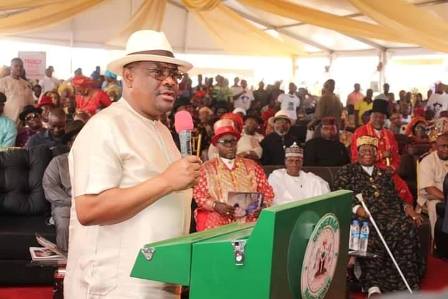
Rivers State Governor, Sir Siminalayi Fubara, has demanded quick and full resolution to the challenges arising from the gas leakage that occurred in Bille, Degema Local Government Area of the State.
The governor has also pledged to upgrade the Primary Healthcare Centre (PHC) in Bille with a view to addressing the health challenges confronting the community.
Fubara made the pledge on Wednesday at the Government House, Port Harcourt during an enlarged meeting of key stakeholders, comprising representatives of the Federal Government, the state government and leaders of the community.
The meeting was held to review the situation in the community and explore available opportunities to save the people from the adverse impacts of environmental pollution.
Addressing the journalists at the end of the meeting, the governor acknowledged the determination of the Federal Government and its agencies to get to the root cause of the problem in Bille and ensure that it is resolved permanently.
“The meeting is in respect of the situation in Bille. You’re aware that there is a case of gas leakage somewhere in Bille and the people have been making some requests that the government should come to their rescue to resolve the situation.
“As a state, we have gone to see the situation in the community, not alone but in conjunction with the industry operators and officials of the Federal Ministry of Petroleum Resources. What we are doing today is an enlarged meeting where all the parties are sitting together to look at the cause of the issue and the most possible way to get the problem resolved,” he said.
Fubara described the outcome of the meeting as successful, stressing that more action would be taken in the next couple of weeks to ensure that the issue is fully resolved.
The Minister of State, Petroleum Resources (Gas), Hon Ekperikpe Ekpo, who led the Federal Government’s delegation to the meeting, expressed appreciation to the governor for his warm hospitality and efforts to address the challenge in Bille community.
Ekpo explained that contrary to the perception in certain quarters, the Federal Government has not been silent over the “gas seepage” but has been working tirelessly towards finding a sustainable solution.
The minister explained that as soon as the incident was reported, the Federal Government deployed experts to the area to understudy the cause of the problem.
According to him, it was difficult at first to understand the cause of the problem since there were no oil or gas infrastructure within the vicinity of the incident, hence the need to conduct a more detailed investigation.
“The investigation is still going but we decided to do a follow-up visit to the area to talk to the people of Bille Community that we need collaboration on their part so that we would be able to arrive at a lasting solution.
“The safety of the people is paramount. We can understand their anxiety, the worry and the danger that this thing poses within the area, but the Federal Government is committed to finding a lasting solution to the problem. The primary responsibility of government is to take care of the welfare and security of the people and that is exactly why we are here to go and see things for ourselves,” he said.
The Chief Executive Officer (CEO), Nigerian Upstream Petroleum Regulatory Commission (NUPRC), Mrs Oritsemeyiwa Eyesan, also explained that as the regulatory agency at the centre of the issue, no effort will be spared in the task of resolving the issue.
Eyesan pledged that the NUPRC and operators in the industry were prepared to address the requests of the impacted people in terms of the provision of potable water and fire trucks to the community.
The Public Relations Officer, Council of Chiefs, Bille Kingdom, Chief Rena Dappa, had during the meeting, presented the challenges facing the community and pleaded for government’s support to save the lives and livelihoods of the people.

President Bola Tinubu has announced the launch of a training programme for 5,000 young Nigerians as meter installers and technicians under the Presidential Metering Initiative.
The President stated that the scheme is aimed at creating jobs, closing the country’s metering gap and improving electricity supply.
The President disclosed this in a statement on his verified X handle yesterday, describing the initiative, tagged “The Power Force,” as part of his administration’s Renewed Hope Agenda to expand employment opportunities for young people.
According to Tinubu, the programme will equip participants with practical technical skills and connect them to employment opportunities in Nigeria’s power sector.
“Through the Presidential Metering Initiative (PMI), which I established to close Nigeria’s metering gap, end estimated billing, protect consumers and strengthen the electricity market, we are opening a new pathway for 5,000 young Nigerians to be trained as meter installers and technicians under The Power Force. This programme is about jobs, skills and dignity,” he said.
Tinubu said the training would be open to eligible Nigerians who have completed their secondary school education, with a dedicated quota reserved for members of the National Youth Service Corps.
He noted that expanding electricity metering was critical to improving service delivery and promoting transparency in the power sector.
“When homes and businesses are properly metered, Nigerians can pay for what they actually use. When electricity distribution companies collect revenues more transparently and fairly, they are better able to reduce losses, maintain infrastructure, expand connections and invest in better service.
“This is how we build a power sector that is fairer to consumers, stronger for investors and better able to deliver reliable electricity to the Nigerian people,” the President said.
Tinubu said he had directed the Presidential Metering Initiative to work with the Federal Ministry of Youth Development, the National Power Training Institute of Nigeria, and other relevant stakeholders to commence the programme within the next 30 days.
He encouraged qualified young Nigerians to apply, saying the initiative would provide them with marketable skills while supporting efforts to eliminate estimated billing and improve electricity access nationwide.
“I encourage eligible young Nigerians to apply. Join The Power Force. Learn a skill. Earn with dignity. Help us end estimated billing and be part of the work to light up Nigeria,” he added.

The Federal Government has announced that the third evacuation flight for Nigerians voluntarily returning from South Africa will arrive Lagos today having departed Johannesburg at midnight yesterday with 271 returnees on board.
The Ministry of Foreign Affairs disclosed this in a statement issued yesterday by its spokesperson, Mr Kimiebi Imomotimi Ebienfa.
According to the ministry, the Air Peace-operated flight is expected to arrive at the Murtala Muhammed International Airport, Lagos, at about 5:30 a.m. on Friday, July 3, 2026.
It said the evacuation is part of the Federal Government’s ongoing efforts to facilitate the voluntary return of Nigerians from South Africa.
“The third evacuation flight operated by Air Peace will depart Johannesburg today by 12 midnight with 271 returnees. The estimated time of arrival in Lagos is 5:30 a.m. on Friday, July 3, 2026,” the statement read.
The latest batch of returnees follows earlier evacuation flights that brought hundreds of Nigerians back to the country under the Federal Government’s voluntary repatriation programme.
-
News3 days ago
Rivers Court Jails Man Seven Years For Defiling Minor …Directs N5 Million Upkeep For Victim
-
News3 days ago
Alleged Coup Plot: DSS Docks Five For Hiding Sylva’s Whereabouts
-
Niger Delta3 days ago
24 Nigerian Universities Make 2026 THE Rankings … 4 S’South Versitieis Pull Through
-
 News3 days ago
FG To Replace NYSC Khaki With Adire
-
News3 days ago
BOI Unveils Maiden Impact Report, Disburses N644.9bn In 2025
-
Women3 days ago
NAWOJ Seeks Partnership With Hotel Presidential On Summit
-

 News3 days ago
Fubara Seeks Full Resolution Of Bille Gas Leakage …Pledges Upgrade Of Community Health Centre
-
Niger Delta3 days ago
‘Ogbolo ’26’: Bayelsa Community Revives Heritage, Strengthens Unity