
Nation
THE STATES

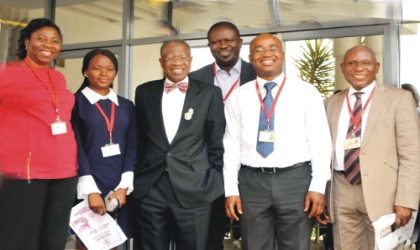
L-R: Saturday Punch Editor, Bisi Deji-Folutile, Sunday Punch Editor, Toyosi Ogunseye, Minister of Information, Alhaji Lai Mohammed, The Punch Editor, Martin Ayankola, Controller of Publication, The Punch Newspapers, Adeyeye Joseph and Chairman, Editorial Board of the Newspaper, Segun Adediran, during the visit of the Minister to the Newspaper’s Head Office in Lagos, yesterday
Adamawa
The National Emergency Management Agency (NEMA)
has organised a Christmas get-together for Internally Displaced Persons (IDPs) returnees in Yola, Adamawa State.
Our correspondent reports that the IDPs were largely Nigerians that recently returned from Cameroon Republic.
Speaking during the party, Mr Sa’ad Bello, the agency’s Coordinator in the state, said that the gesture was to give hundreds of the IDPs a sense of belonging.
“This is to show our love and sense of belonging to the IDPs, majority of whom are women and children,’’ he explained.
Bello said the ceremony was organised in all the four major designated camps at Damare, Fufore, Girei and Malkohi camps.
Bauchi
The Secretary, Bauchi State Agency for Nomadic Edu
cation (BASABNE), Alhaji Musa Hardo, has decried the poor condition of most nomadic schools in the state.
Hardo told newsmen in Bauchi that most of the schools were operating under trees and make-shifts improvised buildings provided by their host communities.
According to him, the agency presently has 265 schools, with an enrolment figure of 50,65 pupils and 1,074 teachers respectively.
He, however, said only few of the schools had one block of two classrooms each.
The secretary noted that some of the schools with permanent structures were dilapidated and yearning for renovation and additional classrooms.
FCT
President Muhammadu Buhari has expressed deep re
gret over the loss of lives following gas explosion at an industrial complex in Nnewi, Anambra State.
A statement issued in Abuja by the President’s Senior Special Assistant on Media and Publicity, Malam Garba Shehu, said the president was greatly shaken and shocked by such large-scale loss of human lives in a single industrial accident.
The president extended his condolences to the families of the victims, the people and the government of Anambra over what he described as “this unfortunate tragedy on Christmas eve’’.
The statement revealed that President Buhari also commisserated with the Lamido of Adamawa, Alhaji Barkindo Musdafa, over the death of his mother, Hajiya Adda Gombeji, who passed away at the age of 87.
“He has placed a call to condole with the Governor of the Central Bank, Godwin Emefiele, who has equally lost his own mother,” Garba said.
Gombe
No fewer than 35 inmates have regained their freedom
from Gombe Prisons following the payment of their fines by Gombawa Forum, an NGO.
Speaking at a forum to mark their release in Gombe, the Organising Secretary of the NGO, Malam Dahiru Saidu, said the gesture was to decongest the prison and reintegrate the inmates back to society.
He said the NGO paid fines totalling N300,000 on behalf of the inmates, adding that the gesture would equally reduce the burden on the prison authorities.
“Our aims and objectives are to improve positively on the lives of the people of Gombe State and to improve on the general living condition of the people to the best of our ability by advising government on its policies,’’ he said.
Jigawa
The Chairman of Nigeria Labour Congress (NLC) in
Jigawa State, Malam Usman Ya’u, has expressed joy over the State Government’s decision to continue payment of the 18,000 minimum wage.
Ya’u, who spoke with newsmen in Dutse said that the gesture would boost morale of civil servants in the state.
“As the head of NLC in Jigawa, I am very excited with the decision of the Jigawa State Government.
“This is because some state governors had a meeting where they said they cannot continue paying the minimum wage.
“So, on behalf of the entire civil servants of the state, I want use this opportunity to commend Badaru for his decision to continue paying the 18,000 minimum wage.
“It will go a long way in boosting our morale, It would also encourage service delivery in the state,” Ya’u said.
Kaduna
A group of Muslim women in Kaduna fed more than 500
Christian inmates in Kaduna prison in order to celebrate Christmas and to promote unity and togetherness among Nigerians.
The leader of the women group, Hajiya Maryam Abubakar, told newsmen in Kaduna that the gesture was to show love to Christians who were incarcerated.
Abubakar, who was received by officials of the prison, said that the food was cooked to join Christians in celebrating the birth of Jesus Christ.
She addded that “we are here to feed inmates who are incacerated in the spirit of togetherness and to join them in celebrating the birth of our noble Prophet Isa.”
Kano
Marketers caught diverting petroleum products in Kano
State will henceforth pay a fine of N150 per litre of the diverted product.
Chairman of the Taskforce on Distribution of Petroleum Products in the state, Alhaji Rabiu Bako, said this during a news conference in Kano.
Bako said the measure was to check the continued fuel shortages being experienced in the state.
Bako, who is also the Commissioner for Commerce in the state, said marketers had not heeded to earlier warnings to desist from sharp practices.
“The decision followed series of warnings by the Task Force to oil marketers in the state to desist from sharp practices and illegal increases in the pump price of Premium Motor Spirit (PMS),” he said.
He said any marketer found diverting petroleum products would be so sanctioned and also risk forfeiting such products.
Kebbi
Governor Atiku Bagudu of Kebbi State has called on
Christians and Muslims to imbibe the spirit of peaceful coexistence as exemplified by Prophet Muhammad and Jesus Christ.
This is contained in a statement issued by Alhaji Abubakar Muazu, the Press Secretary to the governor.
According to the statement, the governor made the call as part of activities to mark this year’s Maulud Nabiyy and Christmas in the state.
He advised adherents of both religions to propagate their faith peacefully, devoid of acrimony and ill will.
He enjoined people to live in peace, love of one another and uphold forgiveness at all times, especially as that would ensure rapid development of society and mankind.
Lagos
A Consultant Urologist, Dr Oseremen Shadrach-
Aisuodione, said that the country did not have enough urologists to attend to the healthcare needs and services of Nigerians.
Shadrach-Aisuodione, who works with College of Health Sciences, University of Abuja, made the call in an interview with newsmen in Lagos.
He said that there were not enough urologists considering the large population and that the insufficiency needed to be addressed for better service outcomes.
According to him, there are few number of urologists in Nigeria, currently put at less than 300 in a country of over 170 million people.
Ogun
The Ogun State Police Command says it is ready to part
ner with local hunters to provide adequate security in the state.
The Police Commissioner in the state, Abdulmajid Ali, said this while addressing the hunters at Odeda Police Divisional Headquarters in Odeda Council Area of the state.
Ali said the police had concluded plans to incorporate the hunters and other relevant groups in its security network for more effective policing of the state.
He said no serious police formation would jettison or underrate the role of hunters in intelligence gathering and effective policing of the community.
He assured the hunters of adequate support and protection if they (hunters) were law-abiding and operated within the ambit of the law.
Ondo
The Ondo State House of Assembly has commiserated
with the family of late Soji Akinkurolere, a former member of the assembly.
The House stated this during a ceremonial sitting in honour of the late member of the Seventh Assembly.
The sitting, which was presided by the Speaker, Jumoke Akindele, urged the children of the deceased to keep alive the legacy of their father, whom she said possessed wonderful qualities during his life time.
Akindele described the deceased as someone who didn’t bear grudges and said he discharged his duties effectively.
Earlier, Mr Ifedayo Akinsoyinu, Majority leader and member representing Ondo-West 2 constituency, said the deceased lived an exemplary life worthy of emulation.
Plateau
Governor Simon Lalong of Plateau State has urged eth
nic groups in the country to preserve their languages and save them from extinction.
Lalong made the call at the 2015 Gamai Cultural Festival in Shendam Local Government Area of the state, where he hails from.
He said that languages were vital tools for interacting and expressing ideas, emotions, knowledge, memories and values.
“Languages are also primary vehicles of cultural expressions and intangible cultural heritage, essential to the identity of individuals and groups.
“Safeguarding endangered languages is thus, a crucial task in maintaining cultural diversity, worldwide.
“The United Nations Education, Scientific and Cultural Organisation (UNESCO’s) recent reports on endangered languages shows that half of the 6,700 languages spoken all over the world are in danger of disappearing before the century ends.
Yobe
The Chief of Army Staff (COAS), Lt.-Gen. Tukur Buratai,
has assured residents of the North East of a more peaceful region in 2016.
He gave the assurance after his operational visits to troops locations in parts of Borno and Yobe states.
He said joint forces had within the timeframe given by President Muhammadu Buhari, decimated the Boko Haram sect and substantially destroyed its enclaves on Nigerian territory.
He added that “going by the present pace and momentum of the military operation, no insurgent or group will be able to operate freely by 2016.




The Hydrocarbon Pollution Remediation Project (HYPREP) has commemorated the 15th anniversary of the release of the United Nations Environment Programme (UNEP) Environmental Assessment Report on Ogoniland, reaffirming its commitment to restoring the environment and improving the livelihoods of affected communities.
In a statement signed by the Project Coordinator, Prof Nenibarini Zabbey, to commemorate the anniversary, HYPREP described the anniversary as a significant milestone in Nigeria’s environmental restoration efforts, noting that the project has made remarkable progress in implementing the recommendations of the landmark UNEP report released on August 4, 2011.
The UNEP report had revealed extensive oil pollution across Ogoniland, severe environmental degradation, and serious public health risks resulting from decades of petroleum operations. It also recommended an initial $1 billion fund to commence the cleanup of the affected communities.
According to HYPREP, the Federal Government formally launched the Ogoni clean-up in 2016, while the Project Coordination Office was established in 2017 to drive the implementation of UNEP’s recommendations.
Zabbey said the current administration has continued to prioritise the project under the Renewed Hope Agenda.
Providing an update on the cleanup, the Project Coordinator disclosed that 30 of the 65 contaminated sites identified by UNEP have been fully remediated, while work is ongoing at several medium- and high-risk locations. It also stated that more than 1.5 million mangrove seedlings have been planted as part of what it described as the world’s largest restoration of oil-degraded mangroves, with over 1,000 hectares of shoreline already rehabilitated.
Zabbey further revealed that 49 Ogoni communities have been connected to potable water schemes through multiple water projects and booster stations aimed at providing safe drinking water across the region.
In the health sector, he said the 100-bed Ogoni Specialist Hospital in Kpite and the 43-bed Cottage Hospital in Buan are nearing completion, adding that several existing health facilities have been upgraded with modern medical equipment, while five ambulances have been donated to improve emergency healthcare services. The Project Coordinator also disclosed that a three-year human health biomonitoring study is being conducted in collaboration with the World Health Organization’s International Agency for Research on Cancer (IARC).
On economic empowerment, Zabbey stated that the Project has created more than 8,000 direct jobs and trained thousands of Ogoni youths and women in various vocational and technical skills, including software development, cybersecurity, aviation, commercial diving, seafaring, mechatronics, and creative arts. The project also reported awarding scholarships to more than 1,000 students, providing grants to small businesses, and supporting persons living with special needs through skills acquisition programmes.
The statement further highlighted ongoing legacy projects, including the Ogoni Power Project and the Centre of Excellence for Environmental Restoration, which it said is about 96 per cent complete. HYPREP also welcomed the recent designation of the Ogoni Wetland as a Ramsar Site of International Importance and pledged to continue promoting biodiversity conservation and sustainable management of the ecosystem.
Marking the anniversary, Zabbey said the progress achieved over the past 15 years demonstrates the collective commitment of government, development partners, stakeholders, and local communities to restoring Ogoniland. He called for renewed collaboration to sustain the cleanup effort, promote environmental sustainability, and support the long-term development of the region. 3
-

 News2 days ago
RSG Targets Nine Million Residents in Mosquito Net Distribution Campaign
-

 Oil & Energy2 days ago
Aiyedatiwa Signs New Electricity Bill
-

 Oil & Energy2 days ago
NLNG Commissions Research And Innovation Centre In RSU
-

 Maritime2 days ago
Marine Minister Commends President Tinubu On NPERA Bill Assent
-

 News2 days ago
KenPoly Holds Eight Convocations, August 29
-

 News2 days ago
RSG Begins Another Phase of Projects Commissioning Today
-

 News2 days ago
RMAFC Completes Revenue Sharing Review, Proposes New Pay
-

 Maritime2 days ago
NAGAFF Petitions IGP Over Alleged Maritime Police Harassment