
Nation
THE STATES

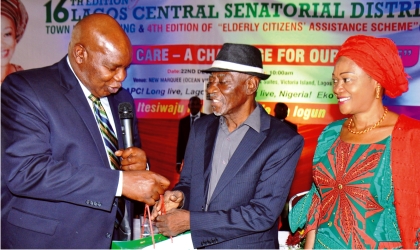
L-R: Lagos State Commissioner for Wealth Creation, Mr Tunde Durosinimi-Etti (left), presenting gifts to Elder Tayo Soyode, a recipient of Elderly Citizens Assistance Scheme, at the 16th edition of Lagos Central Senatorial District Town Hall meeting and 4th edition of Elderly Citizens’ Assistance Scheme in Lagos, yesterday. With them is convener, Senator Oluremi Tinubu.
Borno
The North-East Entrepreneurship Development
Centre (EDC), of Central Bank of Nigeria (CBN) has distributed 50 knitting machines to 50 Internally Displaced Persons (IDPs), trained under its Economic Empowerment Initiative Alhaji Idris Bawa.
The EDC Director of Programme, distributed the machines in Maiduguri.
He said the objective of the programme was to provide means of livelihood to the IDPs who had lost some of their worldly possessions.
He said the 50 women were part of the 2, 127 Borno IDPs so far trained in different skills by the centre under the programme.
“The programme started in March with 747 IDPs in Yola out of which 434 IDPs were Borno indigenes.
FCT
A strong political will and adequate funding are
critical elements required to develop Nigeria’s defence industry, says Prof. David Alabi of the Nigeria Defence Academy, Kaduna.
Alabi, a Professor of Political Science and Defence Studies, said this in an interview with newsmen in Abuja.
The don expressed regret that the 51-year-old Defence Industries Corporation (DICON), established in 1964, was producing only bullets, dicon salt and furniture.
According to him, its counterparts in Brazil and India are producing aircraft and Armoured Personnel Carrier (APC).
Alabi described the condition of DICON as “unfortunate’’ and “pitiable’’.
Kano
Chairman, Task Force on Distribution of Petro
leum Products in Kano State, Alhaji Rabiu Bako, has warned fuel marketers against diversion of the commodity.
Bako, who is also the Commissioner for Commerce gave the warning while briefing newsmen in Kano.
He said that any marketer found diverting petroleum products in the state would be sanctioned and risked forfeiting the products.
He said that the warning was necessary in order to ensure that all products reached their designated filling stations across the state.
The commissioner said that the state government deemed it necessary to set up the committee so as to ensure that the lingering fuel scarcity in the state was halted.
Katsina
Katsina State has fewer than 150 medical doc
tors to man its facilities, Governor Aminu Masari has said.
Masari made the disclosure in an interview with newsmen in Abuja.
He decried the deplorable state of health facilities in the state, saying that more than 90 per cent of them were in bad condition when he assumed office.
“Over 90 per cent of health facilities that we met, if you go there, you cannot know that they are hospitals.’’
He said that the government would embark on a four-year development plan of the health sector, starting with the rehabilitation of the three premier hospitals in the state.
He said the rehabilitation programme would be extended to seven other hospitals in Malumfashi and Dutsinma, among others.
“I think health is number three item on our priority list.
Kwara
National Agency for the Control of Aids (NACA),
says Kwara State is one of the states with lowest rate of HIV infection in the country.
NACA Chief Program Officer, Mr Tajudeen Arowolo stated this at the opening of a four-day free medical outreach organised by the agency at Oja Tuntun, Boboko in Ilorin recently.
Arowolo said that North Central geo political zone of the country was reputed to be the most endemic with the highest number of recorded cases of HIV.
“This is because of the high cases recorded in Benue, Plateau and Nasarawa states as well as the Federal Capital Territory (FCT).
“Out of the states in North Central, Kwara has the lowest rate of HIV cases and one of the lowest in the entire country”, Arowolo said.
Jigawa
No fewer than 370,000 members of the Peoples Demo
cratic Party (PDP) in Jigawa State have defected to the All Progressives Congress (APC).
The National Chairman of APC and eight governors on the party’s platform, received the defectors in Dutse recently, amid jubilation
Our correspondent reports that the governors present at the occasion were Alhaji Bindo Jibrila, Adamawa, Alhaji Abubakar Bello of Niger, Alhaji Atiku Bagudu of Kebbi, and Alhaji Bello Masari of Katsina.
Others were Alhaji Muhammed Abubakar, Bauchi, Alhaji Kasim Shetima, Borno, Alhaji Abdulazeez Yari, Zamfara, and Prof. Hafiz Abubakar, Deputy Governor of Kano State.
Receiving the defectors, the National Chairman of APC, Chief John Oyegun, said the calibre of the defectors was an indication that APC was on the right track.
Oyegun said that anyone who truly loved Nigeria and believed in the leadership of President Muhammad Buhari to lead the country to path of greatness was always welcome to the party.
Lagos
The Vice-Chairman, Kastina State Indigenes’ Associa
tion (South-West), Alhaji Musa Mua’zu, has commended Governor Akinwunmi Ambode of Lagos State for his dedication to confront security challenges in the state.
Mua’zu spoke against the backdrop of the state recent procurement of security equipment worth N4.8 billion which it donated to the Nigeria Police and the allocation earmarked for security in the state’s 2016 budget.
He told newsmen in Lagos that security was the most important need of the residents of the state.
“We must join others to commend Gov. Ambode for his efforts at improving security in the state because security of life and property of citizen is the primary responsibility of the government.
Nasarawa
Alhaji Murtala Sodangi (APC), representing Nasarawa
Central in the Nasarawa State House of Assembly, has distributed items worth N5.7 million to some unemployed youths and women in his constituency.
Sodangi, who is also the Chairman, House Committee on Urban Development, said his effort was geared toward empowering those concerned for them to be self-reliant.
He also expressed optimism that the gesture would enable the beneficiaries contribute their quotas to the development of the state.
Our correspondent reports that the items distributed include: 200 grinding engines, 150 sewing machines, 50 Knapsack sprayers, 40 gasoline engines, building materials and others.
The legislator also donated a KIA car to vigilante group in the area to its service there.
Ogun
The Grassroots Initiative for Poverty Eradication and
Liberation of the Poor (GIPELP), an NGO, has donated a utility-van worth N3.8 million to the Abeokuta Prisons, Oba, Ogun State.
The President of the NGO, Mr Aliu Kayode, expressed the hope that more inmates awaiting trial would have access to justice with the collaboration of all stakeholders.
Kayode advocated public-private partnership toward improving the welfare of inmates and vulnerable members of the society.
He said that the era of pointing accusing fingers at the government for the deplorable state of the nation was gone.
Individuals and groups should begin the process of contributing to the society as a way of complementing government’s efforts, he said.
“If we love our neighbours as ourselves, nobody will suffer in this country because we are blessed with so many wealthy citizens.
“We have realised that poverty is the root of crime in this country and our organisation is looking at how to contribute its quota toward reducing it,” he said.
Ondo
A total of 4,310 students of the Ondo State-owned
Adekunle Ajasin University, Akungba-Akoko (AAUA) graduated from the institution during its sixth convocation ceremony.
The convocation was held at the university’s campus at Akungba-Akoko in Ikare Local Government Area of the state.
Presenting the students for awards, Prof. Igbekele Ajibefun, Vice-Chancellor of the university, said 4,053 earned First Degrees, 107 obtained Diplomas, 130 took Master’s Degrees while 20 earned PhD degrees.
According to Ajibefun, 18 of the 4,053 in the First Degree category graduated with First Class; 787 earned Second Class Upper Division, 2,500 obtained Second Class lower Division; 702 made Third Class and 46 had pass.



The Hydrocarbon Pollution Remediation Project (HYPREP) has commemorated the 15th anniversary of the release of the United Nations Environment Programme (UNEP) Environmental Assessment Report on Ogoniland, reaffirming its commitment to restoring the environment and improving the livelihoods of affected communities.
In a statement signed by the Project Coordinator, Prof Nenibarini Zabbey, to commemorate the anniversary, HYPREP described the anniversary as a significant milestone in Nigeria’s environmental restoration efforts, noting that the project has made remarkable progress in implementing the recommendations of the landmark UNEP report released on August 4, 2011.
The UNEP report had revealed extensive oil pollution across Ogoniland, severe environmental degradation, and serious public health risks resulting from decades of petroleum operations. It also recommended an initial $1 billion fund to commence the cleanup of the affected communities.
According to HYPREP, the Federal Government formally launched the Ogoni clean-up in 2016, while the Project Coordination Office was established in 2017 to drive the implementation of UNEP’s recommendations.
Zabbey said the current administration has continued to prioritise the project under the Renewed Hope Agenda.
Providing an update on the cleanup, the Project Coordinator disclosed that 30 of the 65 contaminated sites identified by UNEP have been fully remediated, while work is ongoing at several medium- and high-risk locations. It also stated that more than 1.5 million mangrove seedlings have been planted as part of what it described as the world’s largest restoration of oil-degraded mangroves, with over 1,000 hectares of shoreline already rehabilitated.
Zabbey further revealed that 49 Ogoni communities have been connected to potable water schemes through multiple water projects and booster stations aimed at providing safe drinking water across the region.
In the health sector, he said the 100-bed Ogoni Specialist Hospital in Kpite and the 43-bed Cottage Hospital in Buan are nearing completion, adding that several existing health facilities have been upgraded with modern medical equipment, while five ambulances have been donated to improve emergency healthcare services. The Project Coordinator also disclosed that a three-year human health biomonitoring study is being conducted in collaboration with the World Health Organization’s International Agency for Research on Cancer (IARC).
On economic empowerment, Zabbey stated that the Project has created more than 8,000 direct jobs and trained thousands of Ogoni youths and women in various vocational and technical skills, including software development, cybersecurity, aviation, commercial diving, seafaring, mechatronics, and creative arts. The project also reported awarding scholarships to more than 1,000 students, providing grants to small businesses, and supporting persons living with special needs through skills acquisition programmes.
The statement further highlighted ongoing legacy projects, including the Ogoni Power Project and the Centre of Excellence for Environmental Restoration, which it said is about 96 per cent complete. HYPREP also welcomed the recent designation of the Ogoni Wetland as a Ramsar Site of International Importance and pledged to continue promoting biodiversity conservation and sustainable management of the ecosystem.
Marking the anniversary, Zabbey said the progress achieved over the past 15 years demonstrates the collective commitment of government, development partners, stakeholders, and local communities to restoring Ogoniland. He called for renewed collaboration to sustain the cleanup effort, promote environmental sustainability, and support the long-term development of the region. 3
-

 News2 days ago
RSG Targets Nine Million Residents in Mosquito Net Distribution Campaign
-

 Oil & Energy1 day ago
Aiyedatiwa Signs New Electricity Bill
-

 Oil & Energy1 day ago
NLNG Commissions Research And Innovation Centre In RSU
-

 Maritime1 day ago
Marine Minister Commends President Tinubu On NPERA Bill Assent
-

 News2 days ago
KenPoly Holds Eight Convocations, August 29
-

 News2 days ago
RSG Begins Another Phase of Projects Commissioning Today
-

 News2 days ago
RMAFC Completes Revenue Sharing Review, Proposes New Pay
-

 Maritime1 day ago
NAGAFF Petitions IGP Over Alleged Maritime Police Harassment