
Nation
Farmers,Herders Crisis: ‘Over 300,000 People Displaced In Four States’

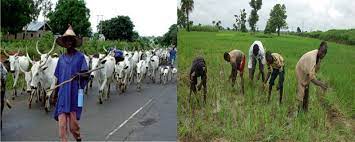
Zinariya Consult, a research development and policy advocacy actor said it was estimated that more than 300,000 people were displaced in four states due to the farmers and herders crisis in Nigeria.
One of the lead researchers commissioned for the work by Zinariya Consults, Dr Joseph Ochogwu, and Associate Research Professor with the Institute for Peace and Conflict Resolution revealed this while presenting the policy brief.
The research presentation which listed the states as Benue, Plateau, Nasarawa and Taraba held on Thursday in Abuja with the topic: “Trends and Dynamics of Conflict between Farmers and Pastoralists in Nigeria’s Benue Valley.
According to Ochogwu, Nigeria’s Benue valley comprising Benue, Plateau, Taraba, Nasarawa, Adamawa and Kaduna have experienced escalating tensions between farmers and herders.
This he said had led to deaths, loss of livelihoods, displacements and disruption of states’ economy within the area.
He said that the conflict which was primarily a contest over land and water was threatening the country’s food security and stability.
“The current crisis has assumed ethnic and religious dimensions.
“From 2001 to 2018, about 60,000 deaths were recorded in multiple clashes, it is estimated that more than 300,000 were displaced across states, 176,000 in Benue, about 100,000 in plateau, and 100,000 in Nasarawa and about 19,000 in Taraba.
“These displacements were mainly due to the surge of attacks and counter-attacks by the headers and farmers communities, in Benue alone, it is estimated that the crisis led to more than N400 billion economic losses resulting from destruction of properties.
“Between 2017 and May 2020, 645 attacks were carried out, 2,539 people were killed and 254 kidnappings were recorded in various states in Nigeria.’’
Ochogwu said that key findings of the research included trends and pater of the conflict, gender dimension of the conflict, demographic shift, mental health and psychological support, and community resilience among others.
He noted that between 2018 and 2019, access to water and grazing land became more competitive.
This, Ochogwu noted led to frequent arguments, adding that there was distrust due to differences in ethno-religious and cultural identities and values.
He said that the research made some recommendations to address the farmers and herders crisis in Nigeria which were informed by critical analysis of the trends and dynamics of the conflict in Benue, Plateau and Taraba states.
He said that governments at all levels should work together to deploy a joint task force comprising of Army, Navy, Airforce, Police, para-military and civil institutions to restore law and order and build the population’s confidence in the government.
Ochogwu said that the complex nature of the conflict required participatory, inclusive, coordinated and sustainable solutions.
He urged the state governments to strengthen the already existing community policing structure such as vigilantes for intelligence gathering.
According to him, the research recommended that development partners should partner with the government and community-based organisations to ensure that women are mainstreamed in peace building programmes.
He said that the governments in key states should work with Civil Society Organisations, media organisations, gender and peace building experts to develop programmes using conventional media, and social media among others to deconstruct social norms.
Ochogwu urged the Federal Government to order the investigation of all recent violence between farmers and pastoralists and expedite the trails of individuals or groups found to have participated, sponsored or involved in violence.
He said that the research recommended that governments should work together to tackle youth unemployment and underemployment.
Ochogwu said that state governments in Benue, Plateau and Taraba should recognise the critical role of religious and traditional institutions in peace building in the communities and include them in direct government and policy formulation process.
He said that formal multi-stakeholders alternative resolution mechanism should be set up at the state and council levels, adding that projects on social protection after conflicts such assets transfers and capacity building for income diversification should be supported by government.
The research was carried out by Zinariya with support from Global Rights and Open Society Initiative for West Africa (OSIWA).



The Ibanibo Haniel Jack Foundation has awarded scholarships to five Rivers State indigenes in different tertiary institutions.
The scholarship programme was announced on Easter Sunday by Rev. Dr. Samuel Wachukwu, who is also the presiding pastor of Redeemer Baptist Church, at No. 44/46 Lumumba Street, Mile Two Diobu, in Port Harcourt.
Speaking, the chairman of the occasion, Barrister Karibi George, advised the recipients to justify the scholarship by ensuring that they put in their best and finish at the expected time.
George reminded them that opportunity comes but once and they should take advantage of the opportunity that comes their way judiciously.
“Those of you who are beneficiaries of this scholarship should also remember to help others and the resurrection of our Lord Jesus Christ.
“I advise you to justify the opportunity given to you and make the man who gave you the scholarship, yourself, and your family proud,” Barrister George said.

He explained that the scholarship spans undergraduate and postgraduate levels in various high institutions in Nigeria. He thanks Sir Jack for the gesture.
The scholarship is to promote education in our society, most especially for Rivers indigenes, and equally assist those who cannot immediately afford tuition fees.
It will interest you to know that
The scholarship was borne out of God’s blessings, and this is a way to give back to the society. Besides, two of the beneficiaries are direct employees of the chairman of the foundation, sir.
Ibanibo Haniel Jack, who is also the chief executive officer (CEO) of White House Hotel, in Port Harcourt.
Chief Prezi Diffa, while presenting the awards, commended Sir Ibanibo Haniel Jack, who has deemed it necessary to give back to society.
Chief Diffa equally advised the beneficiaries to take their academics seriously and count themselves lucky.
“The man who has given you this scholarship wants to better your lives, so please put in every effort to ensure you finish the school with flying colors,” Chief Diffa said.
The beneficiaries are Isoboye Haniel Douglas, Naomi Douglas, Charles Batubo, Ajé Sokari, and
Dakoru Owen Amachree.
Tonye Orabere
-
 Editorial2 days ago
Domesticate FG’s Exit Benefit Scheme
-

 News1 day ago
RSU Unveils Five-Year Strategic Dev Plan …Calls For Collective Commitment To Institutional Excellence
-

 News2 days ago
DHQ Confirms Deaths Of Terrorists, Soldiers In Borno Attack
-

 News2 days ago
Tinubu Commissions Bayelsa Gas Turbine, Other Projects Today
-
Rivers2 days ago
Dep Gov Seeks Collaboration, Transparency Between RIVCHPP, PHCMB
-
Nation1 day ago
Rumuji Youth Leader Condemns Protest, Disowns Alleged Government Empowerment Claim
-
Business2 days ago
Niger Delta Investment Summit Targets $5bn Inflows, 500,000 Jobs
-

 Featured2 days ago
FG Reaffirms Nigeria’s Stability As US Embassy Suspends Visa Appointments In Abuja Office