
Featured
Coronavirus Pandemic: NCDC, NLNG, MAN Hail Wike’s Stance Against Spread …As Lebanese Community Donates To RSG

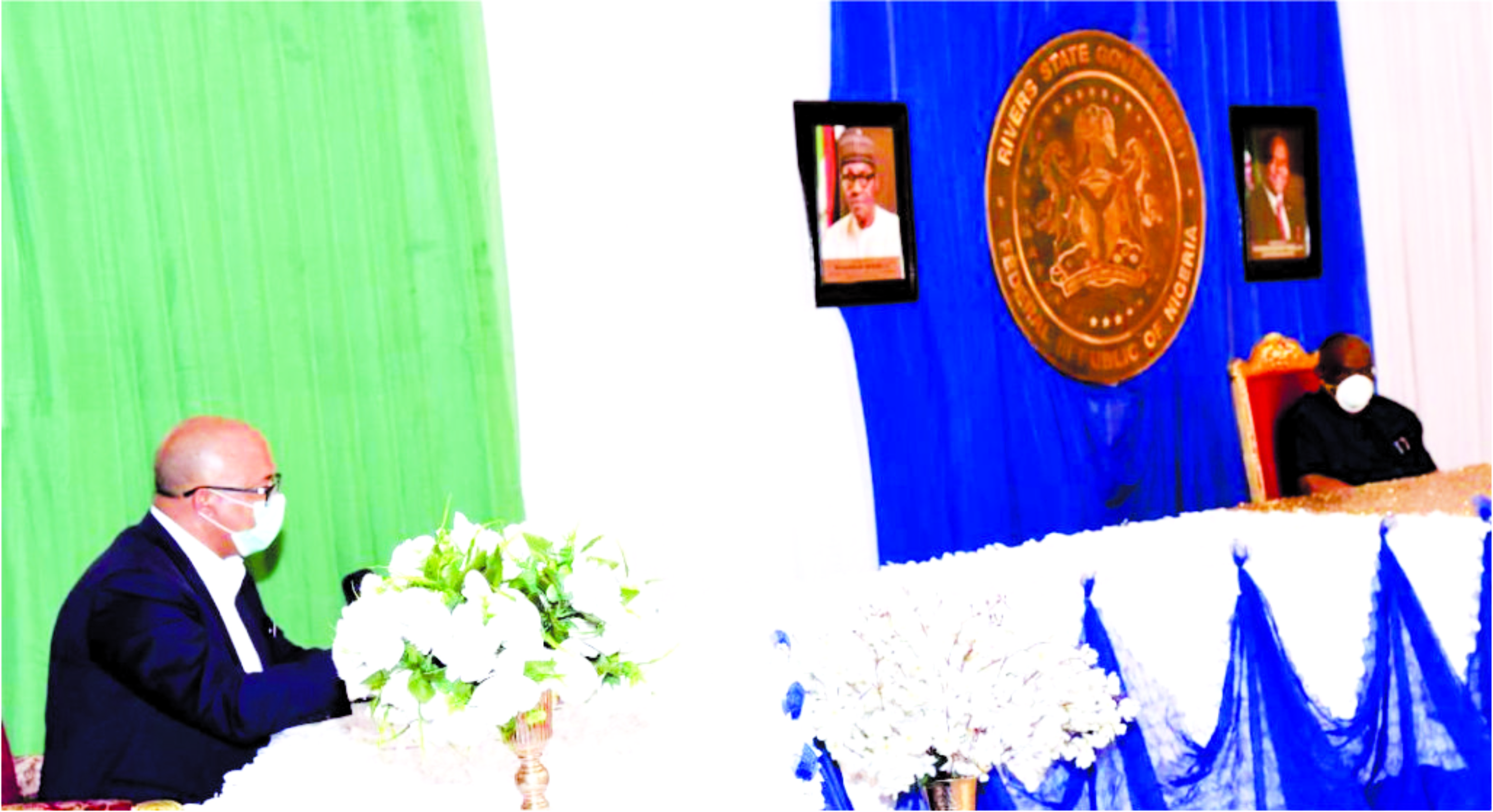
The Director General of the Nigeria Centre for Disease Control (NCDC), Dr. Chikwe Ihekweazu, has commended the Rivers State Governor, Chief Nyesom Wike, for his firm, strong, committed and personal leadership to check the spread of the novel Coronavirus disease in Rivers State.
Speaking during a meeting between Rivers State governor and officials of NCDC at the Government House, Port Harcourt, yesterday, Ihekweazu said that Rivers State was important in the fight to stop the spread of the virus.
Ihekweazu said: “This is a working visit. I want to thank you for your firm, strong, committed and personally-led response to Covid-19 in Rivers State.
“Rivers is one of the most important gate-ways into the country and one of the most important economies in the country. So, Rivers is important, not only to you but to the entire country.
“We thank you very much for your leadership and we need your leadership to continue in order for us to continue doing our work nationally.”
The NCDC director general said that his team was in Rivers State to engage with the state Public Health Team to consolidate on the successes on the fight against Coronavirus.
“This is actually a joint team. I have come with the officer in charge of World Health Organisation (WHO). We have come together to offer our support.
“Your Excellency, you have an excellent public health team to which I have an excellent working relationship with. We have a close technical working relationship.
“The purpose of this visit is to engage with the team and understand their challenges and continue driving that close coordination,” he said.
Ihekweazu noted that because of the unique nature of the virus, all stakeholders must work in unity, stressing, “The unique nature of this virus is that it is a global pandemic. None of us can do this on our own. No country can do this on its own.
“We share information across the states to make sure that everyone is informed as they can possibly be. We share Information on new developments, strategies, what works and what doesn’t work.
“Whether it is in detection, prevention and treatment, our role as NCDC is to make sure that our technical colleagues are able to respond at all levels and are supported in any way with the expertise they need.”
He said that because the prolonged lockdown cannot continue indefinitely, stakeholders must begin to work towards gradually reopening the economy without endangering the population.
The NCDC leader also urged the private sector to focus more on helping the states to build their capacity to respond to the virus.
Responding on behalf of the Rivers State Government, the Health Commissioner, Prof Princewill Chike said that Governor Nyesom Wike has strengthened the public health system of the state to fight Coronavirus.
Chike said that before the Coronavirus pandemic, the Rivers State Government was already battling Lassa fever, Monkey Pox and HIV/AIDS.
He said as a result of the proactive leadership of the governor, the state has no current confirmed case of Ccoronavirus, adding that the two cases in the state have been treated and discharged.
“Since January, Rivers State has had two cases of Coronavirus; a 19-year model and a 62-year old retiree. They have been treated and discharged. All the 214 persons that had contact with them were placed under surveillance. Except for two cases, all other contacts have exited Isolation,” he said.
The commissioner noted that the proactive approach of the governor in tackling Coronavirus centres on early detection, prevention and treatment.
Chike said: “We give kudos to our governor for his proactive approach at tackling Coronavirus. It has been successful. The Rivers State Executive Council set up a sensitization committee to sensitise and inform the people on ways to prevent the spread of Coronavirus.”
The Rivers State Government said that it has PCR machines, but added that they were devoted to the treatment of other major ailments before the outbreak of Coronavirus.
The commissioner said that another set of PCR machines to be devoted to the testing and treatment of Covid-19 was on its way to the state, and also announced that all public hospitals in different local government areas of the state have Covid-19 centres, developed by the Wike-led administration.
He said: “They have been developed to hold suspect cases before the intervention of the State Rapid Response Team on Covid-19.”
The Rivers State Government called on the Federal Government to take immediate steps to stop oil companies from violating the state Executive Order on restriction of movement.
Chike said: “The way some oil companies breach the Executive Order issued by the Rivers State governor to restrict movement in and out of the state can jeopardise the fight against Coronavirus. The Rivers State Government needs the support of the Federal Government in this regard.”
The Rivers State Government also requested the establishment of a functional infectious diseases laboratory to handle Coronavirus testing, emphasising that even though it was in the process of setting up its major laboratory, the strategic place of Rivers State as the nation’s oil and gas hub requires a federal testing centre.
Similarly, the Nigerian Liquefied Natural Gas (NLNG) has commended the Rivers State Governor, Chief Nyesom Wike for taking proactive steps to protect Rivers people from Coronavirus.
This is as the Manufacturers Association of Nigeria (MAN), Rivers and Bayelsa State Chapter also praised Wike for setting up measures to check the spread of Coronavirus in the state.
They spoke in Port Harcourt, last Friday, while presenting palliatives for Rivers people to the Rivers State Government.
The General Manager Corporate Services, NLNG, Sir Joseph Alagoa, said that the Rivers State Government has done well in the fight against Coronavirus.
Alagoa said: “Permit me on behalf of the Nigerian Liquefied Natural Gas (NLNG) to commend the Rivers State governor on the proactive steps he has taken in tackling the Covid-19 pandemic.
“We also commend him for ensuring that the people of Rivers State are protected from its spread.
“While we applaud your efforts, we also recognise that the state government cannot go it alone. It is also important for the private sector and individuals to provide support.”
The NLNG made donations to the Rivers State Government to assist it in the fight to check Coronavirus.
“We will be donating two pickup vans, five ventilators, 30 monitors and 17,000 pieces of Personal Protective Equipments (PPEs).
“In addition, we will be donating equipment and materials worth $1million to upgrade specific facilities at the Rivers State University Teaching Hospital.
“In addition to that, we will be refurbishing and setting up 10-bed Isolation and holding Centre at the Bonny Zonal Hospital, and this will cost $1.05million.
“This centre will be equipped with all the necessary medical equipment to ensure that it is fully functional in the event that Covid-19 becomes present in the Bonny area.
“We will be donating food items valued at over $250,000 to our host communities as palliatives. We are doing this to guarantee the safety of lives and property. In total, what we have donated is about $2.8million,” he said.
Alagoa called on all stakeholders to work together at this crucial time.
He said: “This is to show our stand and determination to work with the Government of Rivers State and also the people of Rivers State at this time that all hands need to be on deck to work together to tackle this challenge.
“These are trying times, and we all need to stay together, standing together and most importantly, supporting each other at this trying time.”
The Chairman of Manufacturers Association of Nigeria (MAN), Rivers and Bayelsa State, Senator Adawari Pepple lauded the governor for taking the right steps for the state.
Pepple said: “So far, all the steps that have been taken by the Rivers State Government have been very positive. We are glad to note that we haven’t recorded more incidents than what we have.
“Even those who were declared positive have now been treated, and they are negative. This is worth celebrating.”
MAN assured the Rivers State Government that it would support its efforts at offering palliatives to the people, adding, “We have come to lend our support to Rivers State Government in its fight to check the spread of Coronavirus.”
Also, last Friday, one of the largest shopping complexes in Africa, Next Cash and Carry donated different foodstuffs and beverages to the Rivers State Government.
The Chief Financial Officer, Next Cash and Carry Ltd, Sir Nnaedozie Okwoli, lauded the governor for the fight to check the spread of Coronavirus.
Responding, the Chairman of Rivers State Covid-19 Palliatives Committee, Amb Desmond Akawor, thanked the donors for supporting the Rivers State Government to reach out to her people.
Akawor said: “Today, Next Cash and Carry has scored a major point by donating these items to a friend in need. The efforts of Governor Wike have yielded efforts as the state for now has nobody with the virus.
“But there are consequences for the lockdown. The shops and markets are not there. He has set up committees to buy off foodstuffs from farmers and fishermen, and then, distribute to the less privileged.”
Also speaking, the Commissioner for Health, Prof Chike Princewill assured that all the donations would be judiciously used by the Rivers State Government for the benefit of Rivers people.
Similarly, the Rivers State Government says the stringent measures it has taken since the outbreak of the Coronavirus in the country are targeted at preventing its community spread which would be difficult to manage.
The Secretary to the State Government, Dr. Tammy Danagogo, made the assertion shortly after taking delivery of four truckloads of bags of rice and noodles donated by the Lebanese Community in support of the ongoing distribution of palliatives to natives of the state.
Danagogo, while appealing for the support of the media in sustaining public enlightenment and awareness about the virus, warned that the facilities put in place would not be sufficient should the virus degenerate to a pandemic through community spread.
The Chairman of the Lebanese Community in Rivers State, Charles Solomon, said he was satisfied with measures taken so far by the state government to curtail the spread of the virus in the state.



Governor of Rivers State, Sir Siminalayi Fubara, has reaffirmed the unwavering commitment of his administration to peace, unity, security, and inclusive development as Rivers State marked its 59th anniversary, last Wednesday.
In a goodwill message issued on Wednesday to commemorate the anniversary, Governor Fubara stated that despite the challenges faced over the years, the people of Rivers State have continued to demonstrate resilience, strength, and an enduring spirit of unity that has sustained the state since its creation.
The Governor noted that the strong bond of brotherhood among the various ethnic nationalities of the state, including the Ijaw, Ikwerre, Ogoni, Etche, Ekpeye, Andoni, Kalabari, and others, remains one of Rivers State’s greatest strengths and a critical foundation for peace, stability, and progress.
He further observed that Rivers State has remained a major driver of Nigeria’s economy for decades, not only because of its abundant oil and gas resources, but also because of the exceptional contributions of its people across diverse sectors including academia, jurisprudence, business, entertainment, public service, and sports.
Governor Fubara assured the people that his administration will continue to prioritize policies and programmes that promote peace, protect lives and property, and expand development across all parts of the state. He emphasized that governance must be people centered and impactful, with equal attention given to every Local Government Area of the state.
The Governor also paid tribute to the elders and founding leaders of the state for preserving the spirit of unity and coexistence over the years, while urging the youths to remain hopeful, responsible, and actively committed to building a greater Rivers State through innovation, hard work, and patriotism.
He equally acknowledged the invaluable role of women in strengthening families, communities, and society, describing them as indispensable partners in the continued growth and stability of the state.
Governor Fubara called on all Rivers people to use the occasion of the anniversary as a moment of reflection and renewed commitment to peaceful coexistence, mutual respect, dialogue, and collective progress, stressing that the unity and future of Rivers State must always rise above personal interests and political differences.
Rivers State was created on May 27, 1967, by General Yakubu Gowon.


The Rivers State Government has distributed science equipment and materials to all senior secondary schools across the state to support students during the ongoing West African Examinations Council exams and to strengthen practical learning.
Flagging off the distribution at the Rivers State Senior Secondary Schools Board premises in Port Harcourt, on Monday, the State Commissioner for Education, Dr. Peters Nwagor, said the move demonstrates Governor Siminalayi Fubara’s commitment to improving education standards in the State.
Nwagor said the materials were approved and provided by the state government specifically to boost the teaching and learning of science subjects, describing science education as the foundation for technological advancement, innovation, and national development.
“No society can compete globally without deliberate investment in science and technology,” the Commissioner stated.
He commended the governor for consistently prioritising the education sector by providing tools needed for effective teaching and hands-on learning.
The Commissioner directed principals to ensure that the equipment are used strictly for practical lessons in their schools, warning that any principal or administrator found diverting, hoarding, or selling the materials wil face disciplinary action under public service regulations.
Nwagor also warned against examination malpractice, saying any principal found aiding or encouraging malpractices will be decisively sanctioned.
“We must collectively restore the dignity and credibility of our educational system,” he said.
Also speaking, Chairman, Rivers State Senior Secondary Schools Board, Tony Egwurugwu, urged school heads to make judicious use of the materials for students’ benefit.
He thanked the State Government for providing the resources, and assured that monitoring mechanisms would be put in place to ensure the materials serve their intended purpose.
In his own remarks, a Board Member for Technical Education, Nwisabari Bani Samuel, expressed appreciation to the governor for prioritising education and acknowledged the Commissioner’s role in advancing education development in the State.
He said the distribution covers all senior secondary schools in the State and is intended to improve students’ performance in both internal and external science examinations.
Akujobi Amadi
-

 Politics2 days ago
APC PRIMARIES: FUBARA’S WITHDRAWAL, HISTORIC SACRIFICE FOR NATIONAL STABILITY ……. GROUP
-

 News3 days ago
Court Sentences Seven To Death Over Murder Of Cleric In Rivers
-
News12 hours ago
105 Nigerians Killed In S/Africa In Seven Years
-
News11 hours ago
Obuah’s Victory Excites Former Lawmaker as APC Primaries Conclude in Rivers West
-

 Sports2 days ago
PH Arsenal Community Set For Streets Procession, Saturday
-

 Politics2 days ago
IPAC Flays INEC Over Election Guidelines Judgement
-

 Politics2 days ago
NDC To Adopt Electronic Voting For Future Primaries
-

 Sports2 days ago
Stakeholders Laud GTI On NPFL Partnership