
Nation
THE STATES

The Network of People Living with HIV/AIDS in
Nigeria (NEPLWHAN) has urged the Bauchi State House of Assembly to pass anti-discrimination and stigmatisation bill into law.
The state chairman of the association, Malam Usman Zico, made the call on Thursday in an interview with newsmen in Bauchi.
Zico called on the house to pass the proposed law before the end of the current legislative assembly and present administration in the state.
He said that the bill should also be guided with penalties and fines for offenders as measures to stop acts of stigma and discrimination against his members.
According to him, the law would protect the dignity of people living with the virus.
“The State House of Assembly should look into the discrimination and stigmatisation bill, so that it becomes law before the end of the present administration and penalties be stated on any one found wanting either in public places or in gatherings,’’ he said.
Benue
The All Progressives Congress (APC) in Benue State,
said it would sue two radio stations in the state for libel.
The party’s Organizing Secretary, Mr Tutus Zaam told newsmen in Makurdi that it would drag Radio Benue and Ashi Waves to court as soon as the strike by judiciary workers was over.
Our correspondent reports that Radio Benue is owned by the state government, while Ashi Waves, based in Katsina-Ala, is owned by Dr Terkula Suswam, the elder brother to Gov. Gabriel Suswam.
The organising secretary alleged that the two stations have been “broadcasting libelous information about the party and its candidates on the forthcoming elections in the state.”
Zaam said that the APC had already contacted its lawyers, and would file the necessary papers before court after the nationwide strike.
Ekiti
The wife of Ekiti State Governor, Mrs Feyisetan
Fayose, has donated cash gifts to 20 patients at the State University Teaching Hospital, Ado-Ekiti.
The donation was part of activities marking her 51st birthday, which started last week Thursday.
Making the donation during a visit to the hospital in company of other government functionaries, she said the money was from her personal purse.
Fayose said that the gesture was borne out of her love and passion for the less privileged in the society.
She noted that the donation was also to support the governor at making life more meaningful for the people.
FCT
The Chief of Defence Staff, Air Chief Marshal Alex
Badeh, on Thursday said the military had provided enough welfare package for the families of fallen heroes.
Badeh made this known in an interview with newsmen on the sidelines of the Armed Forces Remembrance Day celebration in Abuja.
He said: “The armed forces generally have so much welfare package for the loved ones left behind by the fallen heroes.
“The Federal Government introduced group life insurance for them that are different from the ones the services do.
“We try to take care of everyone left behind though we can’t say that we’ll solve everybody’s problems but we’ll do what we can within the law.’’
Katsina
A fire outbreak has destroyed more than 100 shops at
Magama-Jibia border market, Jibia Local Government Area of Katsina State.
Eye witnesses told newsmen in Jibia that the fire started around 4:00 a.m.
They said the outbreak was suspected to have been caused by an insane person while warming himself due to the intense harmattan cold.
The fire destroyed property including foodstuffs, clothes and other household items worth millions of Naira.
The Chairman of the Council, Alhaji Aminu Lawal, told newsmen that the incident was a setback to business activities in the area.
Kogi
The Independent National Electoral Commission
(INEC) has commenced distribution of permanent voter cards in all the 239 wards in Kogi State.
This was disclosed in a statement in Lokoja by the Public Relations Officer of INEC in Kogi, Mr Mathew Ameh.
Ameh said that the distribution of the cards at ward level was in line with the decision of the organisation to decentralise the distribution of the cards.
The statement urged all registered voters in the state to go to their various polling units to collect the cards, saying that adequate manpower had been deployed to ensure the success of the exercise.
It also said that its headquarters in Lokoja and offices in all the 21 local government areas of the state would remain opened to genuine complaints from members of the public.
Lagos
The Lagos State University (LASU) said that three
seasoned broadcasters had been deployed to the LASU Radio 95.7FM by the state government for excellent broadcast.
The latest edition of the bulletin of the institution made available to newsmen in Lagos identified the broadcasters as Messrs Oluwatunmise Banjoko, George Abayomi and Adeniyi Lawal.
Banjoko, a staff of EKO FM, had worked in various departments of the organisation before his deployment to the institution’s radio station as the Studio Manager.
In the same vein, Abayomi, a seasoned journalist with 11 years experience with the Radio Lagos/EKO FM, is now the LASU Radio’s News Editor.
The bulletin said that Lawal was redeployed as the institution’s radio Studio Engineer as he was grounded in the art of studio engineering.
Osun
The presidential candidate of the All Progressives
Congress (APC), Gen. Muhammadu Buhari, has promised to create job opportunities through agriculture and mining, if elected.
Buhari made the promise while addressing a rally in Osogbo.
According to him, my administration will focus on agriculture and mining as a way to secure jobs for able Nigerians.
“There is a circle of insecurity, unemployment and corruption in the country which I will break when elected next month’’, he said.
He, however, called on Nigerians and party faithful to collect their PVCs and ensure that their votes count during the polls.
Oyo
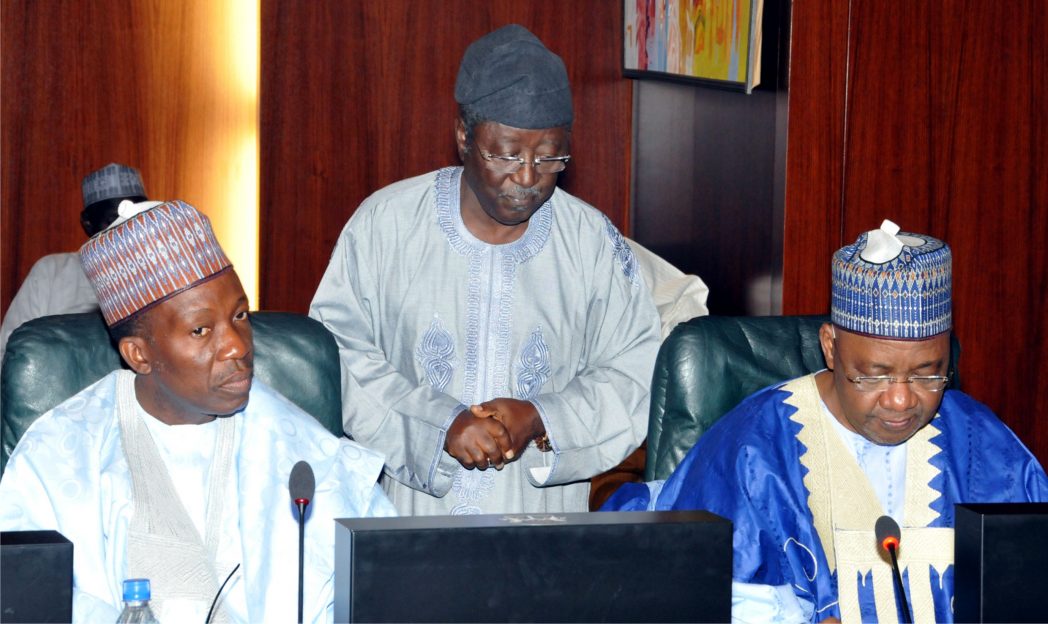
L-R: Minister of National Planning Commission, Mr Sulaiman Abubakar, Governor Jonah Jang of Plateau State and Vice President Namadi Sambo, at the National Economic Council meeting in Abuja.
A former governor of Oyo State, Chief Adebayo Alao-Akala, said on Wednesday that he left N12 billion in the state’s treasury while leaving office.
Alao-Akala said this in a statement signed by his Director of Public Affairs, Mr Oludare Ogunlana, and made available to newsmen in Ogbomoso.
He described as “untrue’’ the allegation leveled against him by Gov. Abiola Ajimobi that he “ wasted’’ N3 billion in a week.
“I left N12 billion in the state’s coffers without any loan or debt,’’ he said.
The former governor also urged Ajimobi to explain how he spent the reported N100 billion the Minister of Finance, Dr Ngozi Okonjo-Iweala, said the state had collected as allocation.
Alao-Akala also said that neither his wife nor children were arrested both within and outside the country for money laundering or financial recklessness.
Plateau
As corps members engaged in electoral duties prepare for the exercise, Mr Abdulrazaq Salawu, the NYSC Coordinator in Plateau State, on Wednesday cautioned politicians against bribing them to compromise on electoral principles.
“We want to advise politicians against seeking to bribe their way to victory by trying to buy corps members assigned to handle the elections.
“Corps members are young people and politicians should not corrupt or spoil their innocent minds,’’ Salahu said in Jos during a visit to the Jos Zonal Office of the News Agency of Nigeria (NAN).
He said some desperate politicians were always out to influence the outcome of elections by seeking to compromise its handlers and advised corps members to be on the watch out for such characters.
“We have briefed corps members and will continue to do so. The name and image of the NYSC is at stake and must be protected by turning down and possibly reporting such attempts to buy their consciences.




The Hydrocarbon Pollution Remediation Project (HYPREP) has commemorated the 15th anniversary of the release of the United Nations Environment Programme (UNEP) Environmental Assessment Report on Ogoniland, reaffirming its commitment to restoring the environment and improving the livelihoods of affected communities.
In a statement signed by the Project Coordinator, Prof Nenibarini Zabbey, to commemorate the anniversary, HYPREP described the anniversary as a significant milestone in Nigeria’s environmental restoration efforts, noting that the project has made remarkable progress in implementing the recommendations of the landmark UNEP report released on August 4, 2011.
The UNEP report had revealed extensive oil pollution across Ogoniland, severe environmental degradation, and serious public health risks resulting from decades of petroleum operations. It also recommended an initial $1 billion fund to commence the cleanup of the affected communities.
According to HYPREP, the Federal Government formally launched the Ogoni clean-up in 2016, while the Project Coordination Office was established in 2017 to drive the implementation of UNEP’s recommendations.
Zabbey said the current administration has continued to prioritise the project under the Renewed Hope Agenda.
Providing an update on the cleanup, the Project Coordinator disclosed that 30 of the 65 contaminated sites identified by UNEP have been fully remediated, while work is ongoing at several medium- and high-risk locations. It also stated that more than 1.5 million mangrove seedlings have been planted as part of what it described as the world’s largest restoration of oil-degraded mangroves, with over 1,000 hectares of shoreline already rehabilitated.
Zabbey further revealed that 49 Ogoni communities have been connected to potable water schemes through multiple water projects and booster stations aimed at providing safe drinking water across the region.
In the health sector, he said the 100-bed Ogoni Specialist Hospital in Kpite and the 43-bed Cottage Hospital in Buan are nearing completion, adding that several existing health facilities have been upgraded with modern medical equipment, while five ambulances have been donated to improve emergency healthcare services. The Project Coordinator also disclosed that a three-year human health biomonitoring study is being conducted in collaboration with the World Health Organization’s International Agency for Research on Cancer (IARC).
On economic empowerment, Zabbey stated that the Project has created more than 8,000 direct jobs and trained thousands of Ogoni youths and women in various vocational and technical skills, including software development, cybersecurity, aviation, commercial diving, seafaring, mechatronics, and creative arts. The project also reported awarding scholarships to more than 1,000 students, providing grants to small businesses, and supporting persons living with special needs through skills acquisition programmes.
The statement further highlighted ongoing legacy projects, including the Ogoni Power Project and the Centre of Excellence for Environmental Restoration, which it said is about 96 per cent complete. HYPREP also welcomed the recent designation of the Ogoni Wetland as a Ramsar Site of International Importance and pledged to continue promoting biodiversity conservation and sustainable management of the ecosystem.
Marking the anniversary, Zabbey said the progress achieved over the past 15 years demonstrates the collective commitment of government, development partners, stakeholders, and local communities to restoring Ogoniland. He called for renewed collaboration to sustain the cleanup effort, promote environmental sustainability, and support the long-term development of the region. 3
-

 News2 days ago
RSG Targets Nine Million Residents in Mosquito Net Distribution Campaign
-

 Oil & Energy2 days ago
Aiyedatiwa Signs New Electricity Bill
-

 Oil & Energy2 days ago
NLNG Commissions Research And Innovation Centre In RSU
-

 Maritime2 days ago
Marine Minister Commends President Tinubu On NPERA Bill Assent
-

 News2 days ago
KenPoly Holds Eight Convocations, August 29
-

 News2 days ago
RSG Begins Another Phase of Projects Commissioning Today
-

 News2 days ago
RMAFC Completes Revenue Sharing Review, Proposes New Pay
-

 Maritime2 days ago
NAGAFF Petitions IGP Over Alleged Maritime Police Harassment