
Nation
THE STATES

Gombe
An Islamic cleric, Malam Salihu Tafawa-Balewa,
has advised traditional and religious leaders, as well as elders in Gombe State to caution candidates for the February elections to maintain peaceful campaigns.
He gave the advice in an interview with newsmen in Gombe.
He said leaders’’ fatherly advice was necessary for maintaining peace, understanding and unity before, during and after the elections in the state and across the country.
He added that “leaders and elders must caution candidates in their areas; candidates must be advised to know and understand that at the end of the elections, only one person will emerge as winner.
“There is need for them to conduct their political activities peacefully so that at the end, people will not have problems between them and their supporters.’’
Kano
The Managing Director of Kano State Roads
Maintenance Agency (KARMA), Mr Abubakar Jibril, said the agency had rehabilitated 42 township roads in the state between January and December 2014.
He told newsmen in Kano that the rehabilitation work was carried out in seven local government areas of the state.
He said the agency was established by the Kano State Government to repair dilapidated township roads across the 44 local government areas of the state.
He added that the agency was also mandated to maintain the roads, as well as clear the drains in local government areas.
Kebbi
The All Progressives Congress (APC) governorship
candidate in Kebbi State, Senator Atiku Bagudu, has appealed to voters in the state to vote wisely and shun financial inducement during the February general elections.
Bagudu, who made the appeal in Dakingarim, Suru Local Government Area at the inauguration of his campaign team, urged the electorate to vote for candidates whose party’s manifestos are people-friendly.
“Your permanent voter card is your right; you must not trade it for material and financial gains, ‘’ he said.
Bagudu called on registered voters in the state to collect their permanent voter cards and vote for APC candidates.
Kwara
A pharmacist, Lanre Alege, has urged Nigerians to be wary of seven dangerous acts after meal.
Alege, who is of the University of Ilorin Teaching Hospital (UITH), spoke while delivering a lecture at the Kwara Stadium Complex during the monthly keep fit exercise for members of staff of the tertiary health institution.
Acts to avoid, he said, included smoking after meals, eating fruits immediately after meals, drinking tea, loosening the belt, taking bath as well as walking about and sleeping immediately after meals.
“When you eat your fruits with meals, the fruit sticks in the stomach along with the content of the meal and cannot reach the intestine in time.
“Lying there, they get spoilt and spoil the remaining food in the stomach too,’’ he said.
Nasarawa
Some residents of Nassarawa State have said that
the Presidential candidate of the All Progressives Congress (APC), Gen. Mohammadu Buhari can change Nigeria for good.
They gave their opinions in separate interviews with newsmen in Lafia.
The APC gubernatorial running mate in the state, Mr Silas Agara, said Buhari “is an upright person who has nothing to gain in deceiving Nigerians.”
“If you study him as a person, you will notice clearly that this man has one goal in mind and that is to rescue Nigerians from recession, corruption and so many other problems that are facing us.
“Even the opposition admits that he is a man of trust and incorruptibility, and that is why they are very worried now.’’ he said.
Niger
Niger State APC Gubernatorial Candidate, Alhaji
Abubakar Bello, says he will have zero tolerance for corruption in the state, if elected governor on February 28.
Bello made the pledge on Sunday while addressing newsmen in Minna
“ I will have zero tolerance for corruption, and one way I will address corruption is to lead by setting a good example for others,” he said
He also said that he would not probe past administrations, to save vital time needed to deliver dividends of governance to the people.
“Probe is not a priority for me, because it will take up the timeý I would have used to work for the good people of the state.”
Ondo
The Director of Planning, Research and Statistics at
the Teaching Service Commission (TESCOM) in Ondo State, Mr Olusola Akanle, has reiterated government’s commitment to regular inspection and monitoring of public secondary schools.
Speaking with newsmen in Akure, Akanle said the major problem in public secondary schools was lack of adequate monitoring.
“We have told the principals that when we are not there, they are our representatives and should make sure that the teachers are on their toes.
“Responsible teachers do not have to wait for the principal to tell them their duties since they are sufficiently trained, experienced and should be dedicated to their duties.”
Sokoto
The Chairman, Sabon Birni Local Government Council in
Sokoto State, Alhaji Idris Gobir, has solicited the support of religious and traditional rulers in mobilising the electorate to collect their Permanent Voter Cards.
Gobir told newsmen in Sokoto that religious leaders should inform the people through their sermons the benefits of the voter cards.
He described the PVC as “the weapon needed by the electorate to elect candidates that will meet their expectations through the provision of the dividends democracy.’’
He said, “good governance will only be possible if the electorate participate in all the electoral processes.’’
Gobir advised the electorate in the area not to sell their voter cards and shun all forms of violence before, during and after the general elections.
Taraba
The governorship candidate of the All Progressives
Congress (APC) in Taraba State, has appealed to the electorate to give her the mandate to make the difference.
Alhassan made the appeal in an interview in Jalingo after a reception in her honour by supporters and party faithful.
She said men had ruled the state since its creation in 1991 but had not recorded the desired impact on the lives of the common people.
She added that “I want to appeal to the people of Taraba State to try a woman for once and I can assure you that you will see a great difference.’’
Alhassan, who denied allegations that she was still in the Peoples Democratic Party (PDP), said she had submitted her PDP membership card to the party’s state Chairman, Mr Victor Bala and had picked up that of APC, which she said was her current party.
Zamfara
The Peoples Democratic Party (PDP) gubernatorial
candidate, Alhaji Mamuda Shinkafi , has promised to improve education, healthcare services and security in Zamfara State, if elected.
Shinkafi, who was the former governor of the state under the ANPP, made the promise in Gusau at the flag-off of his campaign.
“It is unfortunate that instead of the state to be progressing in the areas of education, healthcare, and security, it is undergoing serious backwardness.”
According to him, when he left office in 2011, the state government had over 100 medical doctors and now has less than 40 doctors.
“My administration, if re-elected in February, will give priority to education, healthcare, security, harness mineral resources, as well as improve farming activities in the state,’’ he said.
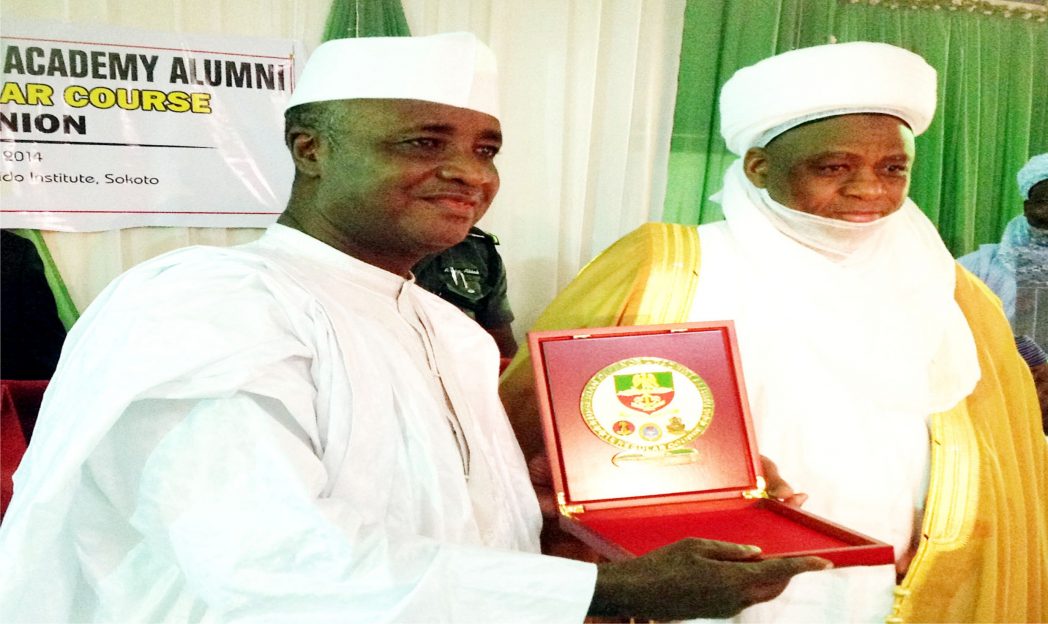
Governor Aliyu Wamakko of Sokoto State (left), receiving a souvenir from Sultan of Sokoto, Alhaji Sa’ad Abubakar 111 for attending the Nigerian Defence Academy Alumni 18th Regular Course Re-union in Sokoto.



The Hydrocarbon Pollution Remediation Project (HYPREP) has commemorated the 15th anniversary of the release of the United Nations Environment Programme (UNEP) Environmental Assessment Report on Ogoniland, reaffirming its commitment to restoring the environment and improving the livelihoods of affected communities.
In a statement signed by the Project Coordinator, Prof Nenibarini Zabbey, to commemorate the anniversary, HYPREP described the anniversary as a significant milestone in Nigeria’s environmental restoration efforts, noting that the project has made remarkable progress in implementing the recommendations of the landmark UNEP report released on August 4, 2011.
The UNEP report had revealed extensive oil pollution across Ogoniland, severe environmental degradation, and serious public health risks resulting from decades of petroleum operations. It also recommended an initial $1 billion fund to commence the cleanup of the affected communities.
According to HYPREP, the Federal Government formally launched the Ogoni clean-up in 2016, while the Project Coordination Office was established in 2017 to drive the implementation of UNEP’s recommendations.
Zabbey said the current administration has continued to prioritise the project under the Renewed Hope Agenda.
Providing an update on the cleanup, the Project Coordinator disclosed that 30 of the 65 contaminated sites identified by UNEP have been fully remediated, while work is ongoing at several medium- and high-risk locations. It also stated that more than 1.5 million mangrove seedlings have been planted as part of what it described as the world’s largest restoration of oil-degraded mangroves, with over 1,000 hectares of shoreline already rehabilitated.
Zabbey further revealed that 49 Ogoni communities have been connected to potable water schemes through multiple water projects and booster stations aimed at providing safe drinking water across the region.
In the health sector, he said the 100-bed Ogoni Specialist Hospital in Kpite and the 43-bed Cottage Hospital in Buan are nearing completion, adding that several existing health facilities have been upgraded with modern medical equipment, while five ambulances have been donated to improve emergency healthcare services. The Project Coordinator also disclosed that a three-year human health biomonitoring study is being conducted in collaboration with the World Health Organization’s International Agency for Research on Cancer (IARC).
On economic empowerment, Zabbey stated that the Project has created more than 8,000 direct jobs and trained thousands of Ogoni youths and women in various vocational and technical skills, including software development, cybersecurity, aviation, commercial diving, seafaring, mechatronics, and creative arts. The project also reported awarding scholarships to more than 1,000 students, providing grants to small businesses, and supporting persons living with special needs through skills acquisition programmes.
The statement further highlighted ongoing legacy projects, including the Ogoni Power Project and the Centre of Excellence for Environmental Restoration, which it said is about 96 per cent complete. HYPREP also welcomed the recent designation of the Ogoni Wetland as a Ramsar Site of International Importance and pledged to continue promoting biodiversity conservation and sustainable management of the ecosystem.
Marking the anniversary, Zabbey said the progress achieved over the past 15 years demonstrates the collective commitment of government, development partners, stakeholders, and local communities to restoring Ogoniland. He called for renewed collaboration to sustain the cleanup effort, promote environmental sustainability, and support the long-term development of the region. 3
-

 News2 days ago
RSG Targets Nine Million Residents in Mosquito Net Distribution Campaign
-

 Oil & Energy2 days ago
Aiyedatiwa Signs New Electricity Bill
-

 Oil & Energy2 days ago
NLNG Commissions Research And Innovation Centre In RSU
-

 Maritime2 days ago
Marine Minister Commends President Tinubu On NPERA Bill Assent
-

 News2 days ago
KenPoly Holds Eight Convocations, August 29
-

 News2 days ago
RSG Begins Another Phase of Projects Commissioning Today
-

 News2 days ago
RMAFC Completes Revenue Sharing Review, Proposes New Pay
-

 Maritime2 days ago
NAGAFF Petitions IGP Over Alleged Maritime Police Harassment