
Nation
THE STATES

Borno
The Borno State Police Command said it had put in place
all necessary machinery for peaceful conduct of the February general elections in the state.
The Police Commissioner in the state, Mr Clement Adoda, stated at a sensitisation meeting with officials of political parties in the state that the command was also looking at possibilities of seeking additional personnel from other states to beef up security during the polls.
The commissioner also said that the military could be drafted to provide additional support should the situation degenerate.
“The military is always on standby in every situation. “But if there is the need for the military assistance to civil authority during the elections, be rest assured of our preparedness to invite them,” Adoda said.
He said that the meeting was aimed at enlightening politicians on the need to avoid violence during the polls.
FCT
Civil Society Organisations (CSOs) have frowned at the
monumental fraud and looting of the oil treasury without significant action to identify, prosecute and punish culprits.
Convener of Protest To Power Movement (P2PM), Mr Jaye Gaskia, made this known in Abuja at a news conference recently.
The conference was jointly organised by the Civil Society Legislative Advocacy Centre (CISLAC), P2PM and State of the Union Coalition (SOTU) to mark three years of fuel subsidy protest.
He said treasury looting could not have happened without the collaboration and protection of highly placed political officials.
According to Gaskia, the NNPC, Department of Petroleum Resources (DPR), Petroleum Product Pricing Regulation Agency (PPPRA), Federal ministries of Petroleum and Finance were not left out of the looting.
He said that no official had been implicated or disciplined on this issue.
He said any claim paid on subsidy since the downturn of oil prices in the international market would be regarded as fraudulent payment because the landing cost of fuel had reduced.
According to him, Nigeria is sufficient in producing refined oil in the country but our crude oil is being refined overseas due to corruption.
Kaduna
The Federal Government has said it had released N3
billion for disbursement to victims of 2011 post-election violence in Kaduna State.
The Vice President, Namadi Sambo made the disclosure at the 40th anniversary of Emir of Zazzau, Alhaji Shehu Idris, on the throne held at the Emir’s palace, Zaria, Kaduna State.
Sambo, who was represented by Governor Muktar Yero of Kaduna State, said the money which was already in the coffers of the state government would be disbursed to the affected victims accordingly.
He stressed the need for people to live in peace with one another to enable government at all levels to provide the dividend of democracy to the electorate.
While congratulating the Emir for attaining 40 years on the throne, Sambo attributed the success recorded by the Emirate to patience, fairness, justice and truthfulness.
Kano
The Kano State Government has approved over N17 mil
lion for the purchase of JAMB forms and training of candidates who will benefit from the forms, the Commissioner for Justice, Mr Maliki Umar, said.
Umar made the disclosure in Kano while briefing newsmen on the outcome of the state’s Executive Council Meeting.
He said the council had also approved over N186 million for the upkeep of public and voluntary schools in the state.
He added that “the council also approved N2.1 million for renovation of dental centre and eye clinic at Murtala Muhammed Specialist Hospital.’’
Katsina
The Katsina State Inter-faith Committee has denied the
destruction of a Church in Matazu Local Government Area by the Katsina Urban and Regional Planning Development Authority (KURPDA).
The Chairman of the committee, Alhaji Isah Dodo stated this in Matazu during a visit to the area.
He said that the committee was mandated by the state government to investigate and ascertain the true picture of the matter.
He explained that the affected area was a pathway between a school and staff quarters of the church.
Dodo further explained that the church decided to fence the school and the staff quarters, thereby, blocking the pathway which had been in existence for more than 20 years.
Kebbi
The Kebbi State branch of the Miyetti Allah Cattle Breed
ers Association of Nigeria (MACBAN) has commended the Kebbi Government for the establishment of the Ministry of Animal Husbandry and Fisheries.
In a statement issued in Birnin Kebbi the Chairman of the association, Alhaji Muhammad Gwandu said that the new ministry would go a long way to boost livestock and fisheries production in the state.
The statement added that the new ministry would also boost family’s income, generate employment and improve nutrition in-take of the people of the state.
Ondo
The new Vice-Chancellor of the Adekunle Ajasin
University, Akungba Akoko (AAUA), Ondo State, Prof. Igbekele Ajibefun, has assumed duty.
The Deputy Vice-Chancellor (Administration), Prof. Francis Oyabade, led other principal officers and students of the institution to receive Ajibefun at the Senate Chambers where prayers were offered for a successful tenure.
The vice-chancellor, who was accompanied by his wife, Bosede, expressed gratitude to God for the appointmen,t and thanked Governor Olusegun Mimiko for appointing him to serve the state at another level after completing his tenure as the rector of the state polytechnic.
Ajibefun promised to justify the confidence reposed in him by driving the university toward fulfilling the vision and mission of its founding fathers.
Plateau
The Plateau State Head of Service (HOS) Ezekiel Dalyop
has described the biometric of the state workforce as ‘a huge success.’
Speaking with newsmen in Jos, Dalyop said the exercise which commenced in 2012 was tasking.
He said: “As a pioneering exercise, the biometric has not been easy but it has been a huge success in the sense that we have been able to identify clearly those who are genuine workers. “As at the state level, we have almost concluded the entire exercise.
“The report of the appeal panel on the exercise had been reviewed by another committee and has been submitted to the government.
Dalyop said the exercise was aimed at sanitising the state workforce, leave a legacy behind by identifying genuine workers.
“At the first count, we arrived at 11,000 workers certified as genuine, leaving about 6,000 plus workers who needed to answer questions raised by the committee.
Sokoto
The Sokoto State police command in has warned politi
cal parties against the illegal use of sirens.
Spokesman for the Command, DSP Al-Mustapha Sani, gave the warning in a statement in Sokoto on Wednesday, following complaints about the use of sirens by some candidates.
The statement stated that “ in Sokoto State, only the governor, his deputy, the speaker of the state House of Assembly, CP, AIG, the Brigade Commander and the Sultan are legally allowed to use the sirens while on movement. Anyone outside this exclusive list who uses sirens does so illegally and stands to face the consequences according to the laws of the land.”
The statement also warned political parties against moving with youths wielding various types of weapons during their activities
Zamfara
The Zamfara State Universal Basic Education Board
(SUBEB) has commenced training of 150 teachers on Information and Communication Technology (ICT) and its applications to education.
Public Relations Officer of the board, Alhaji Kabir Mayanchi, who made the disclosure in Gusau, said the training was to assist the primary and junior secondary school teachers to improve their knowledge of ICT.
He added that the training became necessary considering the fact that majority of primary school teachers in the state lacked basic requirement of computer literacy.
The image maker expressed optimism that the training would enhance the quality of education and boost the acquisition of basic ICT skills by teachers.
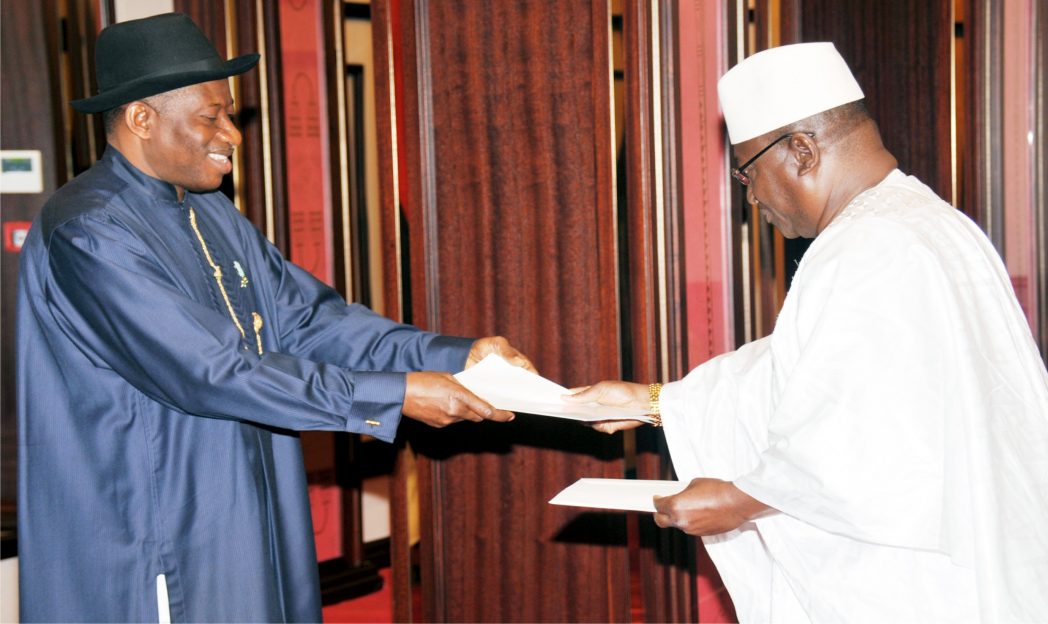
President Goodluck Jonathan (left) receiving letter of credence from the new Ambassador of Guinea Conakry, Mr Gaoussou Toure, in Abuja recently




The Hydrocarbon Pollution Remediation Project (HYPREP) has commemorated the 15th anniversary of the release of the United Nations Environment Programme (UNEP) Environmental Assessment Report on Ogoniland, reaffirming its commitment to restoring the environment and improving the livelihoods of affected communities.
In a statement signed by the Project Coordinator, Prof Nenibarini Zabbey, to commemorate the anniversary, HYPREP described the anniversary as a significant milestone in Nigeria’s environmental restoration efforts, noting that the project has made remarkable progress in implementing the recommendations of the landmark UNEP report released on August 4, 2011.
The UNEP report had revealed extensive oil pollution across Ogoniland, severe environmental degradation, and serious public health risks resulting from decades of petroleum operations. It also recommended an initial $1 billion fund to commence the cleanup of the affected communities.
According to HYPREP, the Federal Government formally launched the Ogoni clean-up in 2016, while the Project Coordination Office was established in 2017 to drive the implementation of UNEP’s recommendations.
Zabbey said the current administration has continued to prioritise the project under the Renewed Hope Agenda.
Providing an update on the cleanup, the Project Coordinator disclosed that 30 of the 65 contaminated sites identified by UNEP have been fully remediated, while work is ongoing at several medium- and high-risk locations. It also stated that more than 1.5 million mangrove seedlings have been planted as part of what it described as the world’s largest restoration of oil-degraded mangroves, with over 1,000 hectares of shoreline already rehabilitated.
Zabbey further revealed that 49 Ogoni communities have been connected to potable water schemes through multiple water projects and booster stations aimed at providing safe drinking water across the region.
In the health sector, he said the 100-bed Ogoni Specialist Hospital in Kpite and the 43-bed Cottage Hospital in Buan are nearing completion, adding that several existing health facilities have been upgraded with modern medical equipment, while five ambulances have been donated to improve emergency healthcare services. The Project Coordinator also disclosed that a three-year human health biomonitoring study is being conducted in collaboration with the World Health Organization’s International Agency for Research on Cancer (IARC).
On economic empowerment, Zabbey stated that the Project has created more than 8,000 direct jobs and trained thousands of Ogoni youths and women in various vocational and technical skills, including software development, cybersecurity, aviation, commercial diving, seafaring, mechatronics, and creative arts. The project also reported awarding scholarships to more than 1,000 students, providing grants to small businesses, and supporting persons living with special needs through skills acquisition programmes.
The statement further highlighted ongoing legacy projects, including the Ogoni Power Project and the Centre of Excellence for Environmental Restoration, which it said is about 96 per cent complete. HYPREP also welcomed the recent designation of the Ogoni Wetland as a Ramsar Site of International Importance and pledged to continue promoting biodiversity conservation and sustainable management of the ecosystem.
Marking the anniversary, Zabbey said the progress achieved over the past 15 years demonstrates the collective commitment of government, development partners, stakeholders, and local communities to restoring Ogoniland. He called for renewed collaboration to sustain the cleanup effort, promote environmental sustainability, and support the long-term development of the region. 3
-

 News2 days ago
RSG Targets Nine Million Residents in Mosquito Net Distribution Campaign
-

 Oil & Energy2 days ago
Aiyedatiwa Signs New Electricity Bill
-

 Maritime2 days ago
Marine Minister Commends President Tinubu On NPERA Bill Assent
-

 Oil & Energy2 days ago
NLNG Commissions Research And Innovation Centre In RSU
-

 News2 days ago
KenPoly Holds Eight Convocations, August 29
-

 News2 days ago
RSG Begins Another Phase of Projects Commissioning Today
-

 News2 days ago
RMAFC Completes Revenue Sharing Review, Proposes New Pay
-

 Maritime2 days ago
NAGAFF Petitions IGP Over Alleged Maritime Police Harassment