
Nation
THE STATES

Adamawa
Former EFCC boss, Nuhu Ribadu has promised not to
disappoint the leadership of the PDP if he emerged as the next Adamawa State governor come October 11.
He made the promise last Monday in Abuja, while submitting his expression of interest and nomination form to contest the forth coming Adamawa governorship election on the platter of PDP.
He submitted his document to the National Organising Secretary, Alhaji Abubakar Mustapha.
“I remain ever grateful, I assure you that I will not disappoint you, I will not let you down on the cherished hope and trust you invested in me,’’ he said.
Ribadu described the submission of the form as an epoch-making event in his life.
He added that he decided to contest the election because his associates and Adamawa PDP stakeholders convinced him to do so.
“My decision to contest the Adamawa governorship election under the platform of the PDP is a turning point in my life and my career in public service.
Borno
Governor Kashim Shettima of Borno State has advised
residents of the state to remain calm following alleged proclamation of Islamic State in Gwoza by Boko Harm insurgents.
This is contained in a statement by Shettima in Maiduguri.
The governor was reacting to a video released by the terrorists on their operations in Borno.
“With very due respect, I cannot comment on the authenticity or otherwise of that video. I will leave that to security experts.
“I also cannot disclose measures being adopted by security agencies on whatever development in Gwoza or any part of Borno. “I can assure the good people of Borno and other members of the public that the State Government is actively in touch and supporting security agencies deployed to the state.
“We are not just studying the situation with collaborative tact and urgency but indeed appropriate measures are being taken by the right authorities’’, he said.
Ekiti
Peoples Democratic Party in Ekiti State has accused the
Governing Council of Ekiti State University, Ado-Ekiti, of siphoning fund through frivolous awards of contracts.
In a statement in Ado-Ekiti on Tuesday, the state’s Publicity Secretary, Kola Oluwawole, alleged that the institution planned to award phoney contracts worth N2.5bn later this week.
He said, “As the party that will form the incoming administration in the state, the PDP has to draw the attention of the people of the state to official misconduct going on in EKSU.
“The Governing Council of the institution has not met for over six months now and a meeting has been fixed for Thursday where phoney contracts valued at N2.5bn will be awarded.
“The contracts were not advertised for tender, there was no bidding process. The contracts never passed through due process as expected, but they want to award them.
“It is disheartening that such actions are being perpetrated in a citadel of learning, a university for that matter. This is coming against the backdrop of the illegal employment of over 1,000 workers in the institution, and all these taking place after the incumbent governor was defeated in the June 21 election.”
FCT
A former National Chairman of the Peoples Democratic Party,
Alhaji Bamanga Tukur, has warned those changing their membership of political parties to desist from it.
He said such action was capable of derailing the country’s democracy.
Tukur, who is Nigeria’s Ambassador-at-large, expressed misgivings on the state of instability in political parties in Nigeria, especially with unrestrained manner of defection by members of different parties in the country.
He said the trend which has already been making mockery of Nigeria’s politics was capable of derailing democracy if not checked on time.
Tukur spoke in Abuja on Tuesday at his private residence, when some PDP youth leaders from the North-Central, led by Mr. Yalla Ibrahim, paid him a private visit.
Jigawa
The Jigawa State Government says it has trained 238
traditional rulers on alternative dispute resolution.
The Chairman, Jigawa Justice Sector and Law Reform Commission, Justice Tijjani Abubakar, made the disclosure at a one-day conference on Traditional Justice System in Dutse.
Abubakar explained that the monarchs were trained on Nigeria’s legal system, record keeping, human rights issues and development of code of ethics.
He said another batch of 191 traditional rulers comprising council members and district heads from the five emirates council were currently being trained across the state.
Kwara
The Kwara State Governor, Alhaji Abdulfatah Ahmed, has
said good governance and delivery of dividends of democracy to the people by political leaders and not empty promises are what would ensure re-election.
Speaking at the Kwara State Signage and Advertisement Agency stakeholders’ forum in Ilorin on Tuesday, Ahmed who was represented by his deputy, Mr. Peter Kisira, urged politicians and their supporters to avoid violence.
He said it was important for political parties, politicians and other political actors to comply with rules for outdoor advertising and signage in the state to maintain integrity and professionalism in the sector.
The governor warned that any group or anyone who defaced or destroyed any approved billboard would be breaking the law and would be dealt with accordingly.
Plateau
The Joint Union of Plateau State owned Tertiary Institutions,
JUPTI has raised alarm over the exodus of experienced professionals who have abandoned the institutions for greener pasture.
The union urged the state government to look into the situation to prevent further deterioration, appealing to stakeholders to prevail on government to do what is right for the schools.
The Joint Union accused the state government of negligence of the institutions thereby forcing credible hands in departments like Engineering, Sciences and the Humanities to be lost to other institutions.
Addressing journalists yesterday in Jos, the Chairman of JUPTI who is also the Chairman, Plateau State Polytechnic Chapter of Academic Staff Union of Polytechnic, ASUP, Mr. Victor Dawurung said the people of Plateau State should not blame the Union as its seeks to resume its earlier suspended strike action.
His words, “It is time for us to tell the world what the State-owned institutions is going through. You would recall that on the 13th May, 2013, we suspended the strike we embarked upon on the 22nd February, 2013 following the personal intervention of the State Head of Service.
Sokoto
Coalition of Sokoto State Youth and Students Leaders,
CSYSL, has called on youths in the state to stop further protest against state government’s plans to borrow money for developmental purposes, noting that the state is empowered by the law to borrow for such purpose.
It also described an earlier protest in the state as the handiwork of enemies of the government, advising that youths should avoid being used to achieve political ends.
This was disclosed in a statement by Messrs. Kassim Nakura, Deputy Coordinator Zone A, National Association of Nigerian Students,NANS; Abdulrahaman Aliyu, General Coordinator, Coalition of Sokoto Youth Associations; Abubakar Salame, Vice President, North-West, National Youth Council; Abdulrahaman Bawa, Deputy Speaker Northern Youth Assembly and Suleiman Mamud, Youth Initiative for Development and Accountability.
The statement reads: ‘’It is surprising that some youths are engaging in activities that are capable of tarnishing the image of Sokoto State over an issue that has constitutional backing.
Taraba
A Chief Magistrate’s Court in Jalingo, Friday adjourned
the case between the Taraba State University and staff members of the State College of Education, Zing, over the occupation of staff quarters till August 25 for further hearing.
The university is praying the court to grant it permission to evict the staff members of the college from the quarters, arguing that all the structures of the college, including the quarters, had been given to the university by the state government.
When the case came up for hearing, counsel to staff members of the college, Saleh Wakili, tendered an application, asking the court to join the Taraba State government and the college of education in the case, saying they were the owners of the disputed property.
Yobe
The All Progressives Congress (APC) in Yobe State
yesterday said that the dismissal of alleged impeachment plot against Governor Ibrahim Gaidam by the state lawmakers has diffused tension among the citizenry.
Yobe state Secretary of the party, Alhaji Abubakar Bakabe, made the submission in a statement made available to journalists.
“The party commended the timely response of the legislators to the allegation and also passed a vote of confidence on the governor,” Bakabe said.
“As the ruling party in the state, APC has a sitting governor, three senators, six members of House of Representatives, 24 members of the State House of Assembly and 17 local government chairmen.
He listed the projects to include roads, healthcare delivery, functional education and employment opportunities for the benefit of the people.
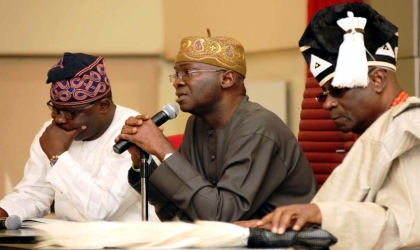
L-R: Lagos State Commissioner for Local Government and Chieftaincy Affairs, Mr Ademorin Kuye, Governor Babatunde Fashola and Oba Rilwan Akiolu of Lagos, at a meeting of traditional rulers with the governor in Lagos, yesterday.



The Ibanibo Haniel Jack Foundation has awarded scholarships to five Rivers State indigenes in different tertiary institutions.
The scholarship programme was announced on Easter Sunday by Rev. Dr. Samuel Wachukwu, who is also the presiding pastor of Redeemer Baptist Church, at No. 44/46 Lumumba Street, Mile Two Diobu, in Port Harcourt.
Speaking, the chairman of the occasion, Barrister Karibi George, advised the recipients to justify the scholarship by ensuring that they put in their best and finish at the expected time.
George reminded them that opportunity comes but once and they should take advantage of the opportunity that comes their way judiciously.
“Those of you who are beneficiaries of this scholarship should also remember to help others and the resurrection of our Lord Jesus Christ.
“I advise you to justify the opportunity given to you and make the man who gave you the scholarship, yourself, and your family proud,” Barrister George said.

He explained that the scholarship spans undergraduate and postgraduate levels in various high institutions in Nigeria. He thanks Sir Jack for the gesture.
The scholarship is to promote education in our society, most especially for Rivers indigenes, and equally assist those who cannot immediately afford tuition fees.
It will interest you to know that
The scholarship was borne out of God’s blessings, and this is a way to give back to the society. Besides, two of the beneficiaries are direct employees of the chairman of the foundation, sir.
Ibanibo Haniel Jack, who is also the chief executive officer (CEO) of White House Hotel, in Port Harcourt.
Chief Prezi Diffa, while presenting the awards, commended Sir Ibanibo Haniel Jack, who has deemed it necessary to give back to society.
Chief Diffa equally advised the beneficiaries to take their academics seriously and count themselves lucky.
“The man who has given you this scholarship wants to better your lives, so please put in every effort to ensure you finish the school with flying colors,” Chief Diffa said.
The beneficiaries are Isoboye Haniel Douglas, Naomi Douglas, Charles Batubo, Ajé Sokari, and
Dakoru Owen Amachree.
Tonye Orabere
-

 News5 days ago
RSU Unveils Five-Year Strategic Dev Plan …Calls For Collective Commitment To Institutional Excellence
-

 News5 days ago
Tinubu Commissions Bayelsa Gas Turbine, Other Projects Today
-
Nation5 days ago
Rumuji Youth Leader Condemns Protest, Disowns Alleged Government Empowerment Claim
-

 Nation5 days ago
Haniel Jack Foundation Awards Five Rivers Indigenes Scholarship
-

 Featured5 days ago
Fubara Pledges Support For Corporate Organisations In Rivers …Says PPP Business Model Responsible For NLNG’s Success
-

 News5 days ago
Ogbakor Etche Demands Justice Over 1990 Umuechem Genocide
-

 Niger Delta5 days ago
CSOs, Bille Community Urge Solution To Persistent Underwater Gas Eruption
-
 News5 days ago
You Can Now Print Your Exam Slips, JAMB Tells 2026 UTME Candidates