
Education
Reactions Trail Poor WAEC SSCE Results

Two weeks after the release
of the 2014 May/June Senior School Certificate Examination (SSCE) by the West African Examinations Council (WAEC), reactions have continued to trail the mass failure recorded in the performances of candidates.
Nigerians have expressed fears and indeed, loss of confidence at the secondary school levels of the education sector following the successive decline in the performances of candidates in the last five years.
Some principals, teachers and other stakeholders who spoke to The Tide on the mass failure attributed the cause to laxity and negligence in the parts of the various components of the sector with a call on all sides to rise to the occasion and nib the situation on the bud.
The Principal, Community Secondary School, Nkpor, Rumuolumeni, Mrs Whiliki J. A. stated that for Rivers State in particular the teachers are doing their best and blamed the situation on the students.
In her words “the teachers especially the newly employed came in with zeal and ready to work. They have fulfilled their part of the show but the students are not ready to learn and even read. They don’t know the difference between reading for examination and other things”.
Whiliki also blamed the situation on parents saying “parents are not helping matters either. They compel these students to use the time for their reading to sell for them not minding that these children have exams at hand. Teachers cannot do it all alone. If the parents fail to play their own part, then it won’t work”.
Expressing hopes of no further decline, she urged parents to partner with teachers and government whom she stated are faithful on their parts to encourage the students towards achieving excellent results in their both internal and external exams.
Another principal of Itans Academy, Iriebe, Mr Mike Uchenna was of the view that teachers have not exercise their best in turning out well read students who could face the WAEC exams independently.
Uchenna also stated that the supervisors and invigilators were almost serving as ‘threat’ to the students saying “the way they go about the invigilating thing put these students off their balance and they can no longer concentrate to write the exams which also contribute to this failure.
A teacher of Economics and Mathematics at the Community Secondary School, Amadi-Ama, Mrs Ikpoki Jonathan maintained that there are too many sides to the coin.
According to her, “one of the reasons is the government’s refusal to look into the welfare of these teachers particularly in the public schools. There is no conducive atmosphere for these teachers to carry out their teaching works.
Also, invigilators are asked to pay between 40 and 50 thousand naira for them to invigilate and so they in turn compel the students to pay same for the exams. Therefore, the children no more read but depend on the money they have paid”.
She continued “unfortunately, most of the people they used for this malpractice are jack of all trade with no definite area of specialisation and so, they can’t get it all right”.
An official of WAEC who pleaded anonymity opined that critical look at the failure reveals that it comes mainly from the Public School Sector.
“The Private Schools particularly with boarding system, take their time to train these students to read. There is no parental interference and the students are doing well.
Government needs to do a lot more for these public schools because right now, malpractice is what is killing these students. They have no confidence in themselves and so cannot pass the exam”.
It would be recalled that the WAEC penultimate Monday announced the release of the May/June 2014 results.
The Head of WAEC, National office, Lagos Mr Charles Eguridu while announcing the results revealed that out of 1,692,435 candidates who sat for the exam, 529,425 of them obtained credits in five subjects and above including English language and mathematics, a figure which he said represented 31.28 per cent, a poor performance in the overall percentage.
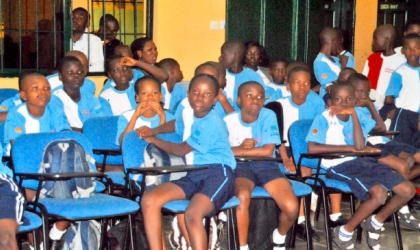
Cross section of Shell flag-off campaign on safe route to school at St. Andrew’s State School, Mile 1, Diobu, Port Harcourt, recently.



The River State Commissioner for Education, Dr Peters Nwagor has called on media practitioners in Rivers State to deploy their various communication platforms toward promoting government programmes and policies aimed at achieving sustainable development in the education sector. Dr. Nwagor made the appeal when members of the Etche Ethnic Practicing Journalists (EEPJ) paid him a courtesy visit in Office in Port Harcourt. The Commissioner emphasized the strategic role of the media in shaping public perception, promoting government initiatives, and supporting policies capable of improving the quality of education and human capital development in the state. According to him, constructive media engagement remains essential in creating public awareness on educational reforms, students’ welfare, infrastructural improvements, and other interventions being implemented by the state government. Speaking on the recent appro

-

 Politics3 days ago
APC PRIMARIES: FUBARA’S WITHDRAWAL, HISTORIC SACRIFICE FOR NATIONAL STABILITY ……. GROUP
-

 News3 days ago
Court Sentences Seven To Death Over Murder Of Cleric In Rivers
-
News13 hours ago
105 Nigerians Killed In S/Africa In Seven Years
-
News12 hours ago
Obuah’s Victory Excites Former Lawmaker as APC Primaries Conclude in Rivers West
-

 Sports2 days ago
PH Arsenal Community Set For Streets Procession, Saturday
-

 Politics3 days ago
IPAC Flays INEC Over Election Guidelines Judgement
-

 Politics3 days ago
NDC To Adopt Electronic Voting For Future Primaries
-

 Politics3 days ago
Otu Vows To Recall Indolent, Arrogant Cross River Legislators