
Education
Amaechi And His Educational Transformation: 2013Score-Card

Highlights:
Issuance of letters of appointment and deployment 13, 201 teaching and non-teaching staff to public primary and secondary schools across Rivers State
completion of 500 model primary and secondary schools
Introduction of School Based Management Committee (SBMC)
Port Harcourt Technical &Vocational Centre takes off with an agreement signed by RSG and Zentstelle fur die Weiterbildung im Handwerk (Central Agency for Continuing Education and Training in Skilled Craft of Germany
Extension of foreign scholarship award to indigent Rivers youth in rural communities
European Business Assembly declares Rivers State University of Science and Technology (RSUST) best Regional University
Governor Amaechi bags Vanguard Personality of the Year Award because of his outstanding performance especially in the education sector
Upon assumption of
office as the executive governor of Rivers State on October 26, 2007 Right Hon Chibuike Rotimi Amaechi made a solemn promise to the people of Rivers State. Amaechi’s promise is encapsulated in his famous mission statement which reads;
“Our mission is to serve our people with humility and render transparent and accountable stewardship anchored on integrity and good governance. We shall use our God given resources to improve the quality of life of our present and future generations, and harmonious society under God.”
Of all the efforts the Rotimi administration has made in the last six years to fulfill its promise to the people, one area stands out as the melting pot of his achievements. It is the educational sector especially primary education.
Although functional primary school education is recorgnised by all as the foundation of any viable education system, successive governments in Rivers State and the country at large failed to appreciate the flagrancy of the danger posed to society by its collapse. Even where some administrations did, they made feeble and ineffectual efforts at tackling the years of putrefaction at that level of the educational system.
At that time, salaries and allowances of teachers were irregular, school buildings were either totally collapsed or in danger of doing so. School children were left at the mercy of the elements coupled with physical insecurity. Kidnapping of pupils and their teachers became the order of the day. Not many schools in the rural communities could boast of up to five teachers. These resulted in the massive withdrawal of children from public schools by parents. Of course, one room private schools in uninhabitable environments mushroomed in all nooks and crannies.
The Rt. Hon Chibuike Rotimi Amaechi led administration took an unprecedented bold step by announcing the take-over of the payment of primary school teachers in the state. This followed an education summit that made startling revelations on the appalling state of primary school education in Rivers State. The government proposed to build 720 primary schools and some model secondary schools. As at the end of 2013, over 500 of these schools have been completed.
The primary schools have football fields with synthetic tracks, larger capacity halls, sick bays with modern medical equipment, libraries and power generating sets, modern computer laboratories with projectors and internet facilities. The head teacher’s offices are also furnished and equipped with functional computers to make teaching and learning easier and faster for the pupils for whom Chibuike Amaechi had declared free and compulsory education. Every child of school age is provided with text books, school uniforms, and physical education (PE) wears, school bags, shoes, sandals and a pair of stockings.
At the secondary school level, it is also of interest that the dormitories are now constructed as rooms with two-bed spaces, wardrobe, reading tables and chairs with the floors completely tiled.
“How else could pupils and students of those model schools be comfortable? It shows that Governor Chibuike Amaechi, means well for the people of Rivers State.” Philip Okpara, a pupil of Model Secondary School, Eleme has said.
Before now, some pupils and students in some schools sat on the floor because, there were no desks. Many of the pupils sat under trees to learn. There were not enough teachers to handle some key subjects’ areas in some schools.
Today, the story is different. The desks at the new model primary and secondary schools are of international standard. The present administration moved some teachers from where they were not contributing optimally to schools that lacked teachers and where they could be more productive.
Toward ensuring quality teaching, 13,201 teaching and non-teaching staff recruited by the government were issued with their letters of appointment and deployed to public primary and secondary schools across Rivers State while others including head teachers and principals were trained and retrained with the collaboration of the British Council.
Within the year, 40 teachers were trained in English Language skills by the government in collaboration with etisalat (a Telecommunication Firm) and the British Council in Nigeria.
According to the Commissioner for Eduction, Dame Alice Lawrence-Nemi, government is pursuing the upgrading of old public schools in Rivers State.
As part of programmes to restore academic excellence and cultivate good learning and discipline in schools, the state government continued to organize science quiz and debate competitions to improve pupils and students vocabulary from time to time including French holiday lessons and tours. Also, many Rivers indigenes have been granted scholarship to study overseas.
The Amaechi Government has upgraded the former Rivers State Collage of Education to a University of Education, while construction work at the new site of the Rivers State University of Science and Technology is gearing up at the Greater Port- Harcourt City.
According to government’s mission statement on the relocation, “the new University would be a leading centre of academic excellence in Africa and beyond; a world–class University with world-class facilities, which would be manned by a team of committed administrators, academics and researchers of high caliber, who share the founding vision of making the new university to rank among the best 1,000 universities in the world by 2020”
The government assured that by the time this objective is achieved, RSUST would be equal to none in Nigeria and in Africa.
On the education of children who are tucked away in remote areas and who usually migrate to different locations of fishing settlements with their parents, the state government has ensured that their education was enhanced under the migrant fishermen scheme. Boats and canoes have been handed over to the head teachers of the migrant schools to ease their transportation.
The year 2013 also witnessed the commencement of academic activities in some of the new model secondary schools. The state government has already surrendered the management of the schools. The commissioner for Education , Dame Alice Lawrence –Nemi, explained that the managers are from a big consortium known as Educomps, who specialize in managing schools around the world, (especially in England, India and the United States of America). The major criteria for admission of students into the schools, is merit, after undergoing series of examinations which would be supervised by the school managers. Also the recruitment of teachers was based on merit.
According to the permanent secretary, Ministry of Education Mr. Richard Ofuru, the recruitment covers all subjects taught in both primary and secondary schools while the non academic staff recruitment was for laboratory technicians and security personnel. The applicants were subjected to a screening examination.
In the words of the governor, “we are employing 10,000 teachers and Rivers State alone cannot give us 10,000 teachers. So it was open to everybody that was qualified and lives in the state”.
The education Commissioner, said the new model schools would be for both the rich and the poor. It should be interesting to us in River state that people come from others states to see and emulate this successful gesture by the present administration.
Some of the model secondary schools are
i. Model Secondary School Ebubu, Eleme
ii. Model Secondary School Oyigbo
iii. Model Secondary School Omuma
iv .Model Secondary School Emohua
v. Model Secondary School Asari toru
vi. Model Secondary School Andoni
vii. Model Secondary School Degema
viii. Model Secondary School PHALGA
ix. Model Secondary School Isiokpo, Ikwerre
x. Model Secondary School Ubima, Ikwerre
xi. Model Secondary School Obio/Akpor
According to Mr. Rich Amos, a retired teacher, the decision of the Rivers State Government to include non- indigenes in the state recruitment exercise will contribute positively to the manpower development of the citizenry because those who are qualified would give what they have.
He said the gesture also indicate that the government is not biased. According to him, any non-indigene employed into the Rivers State civil service can earn a living and pay his rent and tax through the salaries he would receive.
Also expressing his views, a teacher in Port-Harcourt, Mr Joshua Idu, said “when you look at the environment of the new model schools, you would be convinced that the government of Rivers State is serious in its bid to revolutionise the education sector. A striking feature of the new model primary schools is the emphasis placed on Information and Communication Technology (ICT). The schools are equipped with ICT infrastructure and instructors are also employed to handle them and to couch the teachers and the pupils. A computer instructor at the Community Primary School, Olanada in Port-Harcourt, Mr. Victor Okon, explained that two instructors are enough to handle computer education in one school.
Mr. Victor Okon, who is a staff of Link serve computers in charge of the training, stated that the use of projectors would make it easier to teach the pupils stressing that initially it was difficult because of the different backgrounds they come from.
“The pupils now know what computer is and some can operate it effectively and even create some graphic designs as well as log into various portals using the internet.” He stated.
Another teacher, Mrs Charity Emmanuel, explained that before now, the classes were overcrowded but in the new schools we have limited number of pupils about 30 per class. ‘Management of the classes has become much easier.’ She noted that the number of pupils in a class facilitates teaching and learning because there is a closer interaction between the teacher and the pupils.
The second head teacher of CPS Olanada, Mrs Edna Benjamin said government really needed to employ more hands especially because of the introduction of new studies such as computers, projectors and video.
Mrs. Benjamin advised that specialists in those areas should be employed to make the system real and effective adding that the additional subjects are a burden to the teachers since one teacher has to handle all the subjects.
Another teacher, Mrs Iwu said that time had come when teachers should teach according to their area of specialization at the primary school level as it is done at the secondary school level noting that it is better to build the children right from the primary stage. She suggested areas of study such as mathematics, English Language, French, and Computer appreciation should have separate specialist teachers.
In her view, a primary 6 pupil in Port-Harcourt, Miss Chinwendu Collins expressed appreciation to the governor of Rivers State, for building new model schools, donating of text books, bags, shoes and pairs of stockings to the pupils.
Another significant inroad towards the building of a virile education system that allows the nurturing of the intellectual capacity of the child from the earliest stage is the venture into kindergarten education. This aspect is being championed by the wife of the Governor Her Excellency Judith Amaechi under her Economic Support Initiative (ESI). ESI now holds an annual seminar to help build capacity and intensify research in the area. Many of such schools have sprung up across the state and have become a new educational attraction for both the poor and the rich.
The unprecedented investment by the Amaechi administration and the uncommon transformation that has taken place so far has not gone unnoticed. The state has won several awards from several organisations across the globe. The climax of such recognitions came with the nomination of Port Harcourt as the world book capital for 2014.
Like the Italian-born emperor Frederick II (1194 – 1250) stated in the Foundation charter of Naples University, the Amaechi administration can claim and say, “We keep the students within view of their parents; we save them many toils and long journeys; we protect them from robbers. They used to be pillaged while traveling abroad; now, they may study at small cost and short wayfaring, thanks to our liberality.”
Desmond Osueke/Chris Oluoh
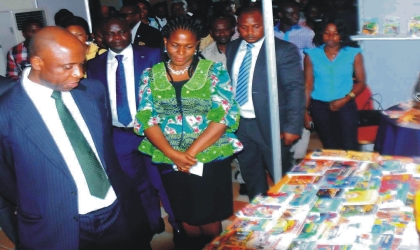
Governor Chibuike Amaechi of Rivers State (left), with Director, Port Harcourt Book Festival, Mrs Koko Kalango (2nd left), at the opening of Port Harcourt Book Festival in Port Harcourt, recently.



The River State Commissioner for Education, Dr Peters Nwagor has called on media practitioners in Rivers State to deploy their various communication platforms toward promoting government programmes and policies aimed at achieving sustainable development in the education sector. Dr. Nwagor made the appeal when members of the Etche Ethnic Practicing Journalists (EEPJ) paid him a courtesy visit in Office in Port Harcourt. The Commissioner emphasized the strategic role of the media in shaping public perception, promoting government initiatives, and supporting policies capable of improving the quality of education and human capital development in the state. According to him, constructive media engagement remains essential in creating public awareness on educational reforms, students’ welfare, infrastructural improvements, and other interventions being implemented by the state government. Speaking on the recent appro

-
News2 days ago
Obuah’s Victory Excites Former Lawmaker as APC Primaries Conclude in Rivers West
-

 Politics4 days ago
APC PRIMARIES: FUBARA’S WITHDRAWAL, HISTORIC SACRIFICE FOR NATIONAL STABILITY ……. GROUP
-

 News4 days ago
Court Sentences Seven To Death Over Murder Of Cleric In Rivers
-
News2 days ago
105 Nigerians Killed In S/Africa In Seven Years
-

 Sports4 days ago
PH Arsenal Community Set For Streets Procession, Saturday
-

 Niger Delta2 days ago
Royal Father Endorses PH Arsenal Community, Pledges To Support
-

 Politics4 days ago
IPAC Flays INEC Over Election Guidelines Judgement
-

 Politics4 days ago
NDC To Adopt Electronic Voting For Future Primaries