
Aviation
How Air Traffic Controllers Paralyse Flight Operations

Thursday April 16,
2015, has entered the record book of the Aviation Industry in Nigeria, when Air Traffic Controllers, under the aegis of National Air Traffic Controllers Association of Nigeria (NATCA) made good their threat to paralyse flight operations if management failed to address their concerns when they embarked on a six –hour warning strike.
The Air Traffic Controllers’ reason for the strike was hinged on alleged poor air navigation equipment and inadequate welfare package for staff.
The workers achieved the purpose for which the strike was called by registering their displeasure and to allow the public appreciate their grievances. The strike, while it lasted caused flight delays prompting some airlines to cancel their flights to some destinations.
The management of the Nigerian Airspace Management Agency (NAMA) under whose domain the issues were located sent senior officials to the towers to control flight movement to curb the adverse effect of the strike.
Recall that the air controllers had threatened to go on strike about three times in this year. According to sources, the warning strike was a prelude to indefinite industrial action scheduled to begin April 20, 2015.
In a statement made available to the press, and signed by the General Manager, Public Affairs, Mr Olajumoke Adetona, NAMA said it had been consulting with the air traffic controllers and that the agency has approved the controllers’ demands.
On their part, the National President of NATCA, Mr Victor Egaru, said that the management of NAMA approved all their demands but the Minister ofAviation, Chief Osita Chidoka, lacked the polticial will to implement the demands.
The strike action which started in the morning of April 16, throughout the country lasted for six-hours and by 1.00pm, the situation had returned to normal as the controllers resumed work, but the airlines had a hard time coordinating their flight operations and therefore had to reschedule or cancel flights.
A source said the management has commenced discussions with members of the NATCA on how to resolve the issues affecting welfare and work equipment, adding that the Managing Director of NAMA, Ibrahim Abdulsalam, was in Abuja to meet relevant ministry of aviation officials on how to resolve the impending industrial action by air traffic controllers.
Similarly, members of the National Association of Air Traffic Engineers (NAATE) have equally decried the absence of space parts for equipment across airports in the country.
Speaking at the 33rd NAATE day celebrations in Lagos, the National President of NAATE, Ebenezer Makanjuola, explained that the lack of spare parts has negatively affected the performance of equipment in all the airports.
“Our greatest challenge today is spare parts, spare parts for our navigational and communication equipment, we are facing this problem today because of the lacuna in the system and government is aware of it,” said Makanjuola.
Last year at its annual general meeting in Kano, members of NATCA, in a communiqué, complained of epileptic air navigation equipment at airports nationwide, even as they equally complained of intolerable working condition.
The association urged the government to call to order, some principal officers of NAMA who they allege were hell bent on destroying the agency by working against the air traffic control which represents the primary function and major sustenance of the agency.
According to NATCA, since the NAMA management has decided to disregard the agreement, it willingly signed with NATCA/ATSSAN on January 18, 2015 and owing to the fact that the time agreed elapsed on March 1, the ATCs in NAMA has no option than to commence strike to attract the attention of stakeholders.
In the statement, the association said, “it is against the background of no action plan and political will to implement the agreements earlier reached with our association and others that the corresponding action by air traffic controllers in Nigeria took place.
“The action will last six hours only as a warning sign but is in preparation for a major and total industrial action which shall commence on April 20, if relevant government bodies continue to treat air traffic controllers’ issues with levity and neglect. Already tempers are high but industrial peace and harmony must be the concern of everybody”.
In the same vein, last year, the association also complained about epileptic and alarming failure of air navigation equipment, which has increased the work load of both air traffic controllers and pilots.
According to a statement signed and issued by the president and general secretary of NATCA, Mr Victor Egaru and Olawode Banjo respectively, the association said it is disheartening that in the last two months, the Communication, Navigation and Surveillance/Air Traffic Management (CNS/ATM) equipment has been epileptic.
“Presently, the Instrument Landing System (ILS) serving the Lagos Runway 18R has been unserviceable for close to three months, while the one serving the Second Runway 18L has been epileptic for more than one month.
Furthermore, they said that the distance measuring equipment located with the VOR in Lagos has been out of service for a long time. Equipment in many airports including communication facilities suffer the same fate.
They argued that at NAMA headquarters and at station levels provision of operational vehicles for ATC operations, including runway inspection which required dedicated and specialized vehicles, has been unattended to by air navigation service providers.
The ATCs explained that some employees in the agency have spent so much time and energy they would have expended in making facilities function optimally to feed the public with falsehoods as to the semi-ability of the CNS/ATM equipment to cover their ineptitude.
The statement said, “we can however say categorically that it is either the personnel responsible for the equipment are incompetent or the incessant failures are as a result of acts of sabotage on their part”.
They recalled what would have been an incident involving a presidential jet on February 18, this year when on a final approach to land, the glide scope of the runway 18L in Lagos went off owing to its epileptic nature since January 30, 2015.
The association said despite all these failures in equipment, the controllers still worked daily under difficult conditions to keep the airspace safe.
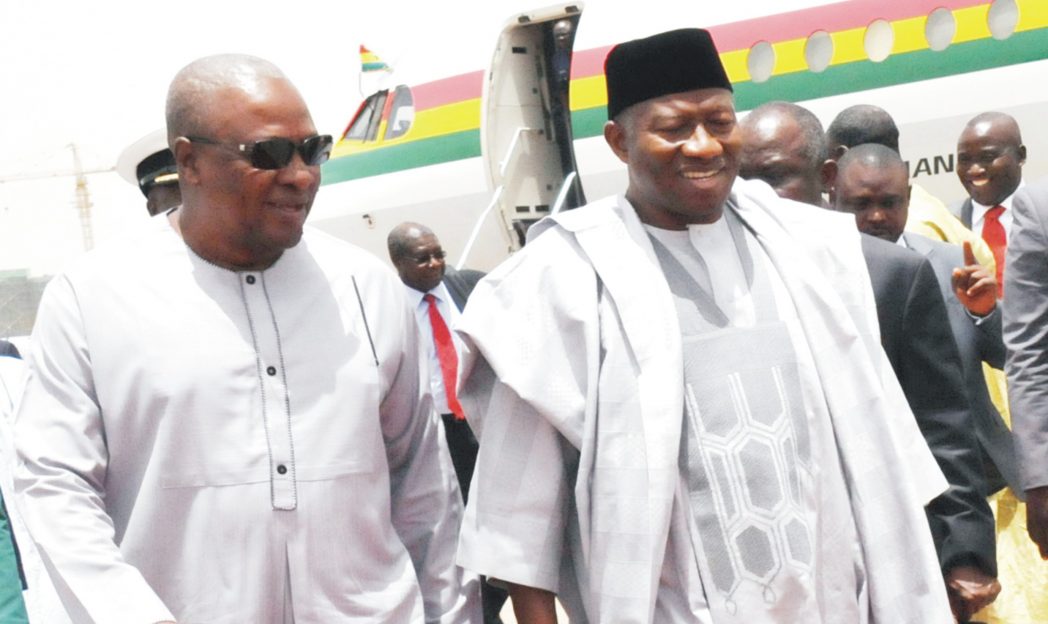
President Goodluck Jonathan (right) with the visiting President John Mahama of Ghana, at the Nnamdi Azikiwe International Airport, Abuja, recently. Photo: NAN




-

 News4 days ago
RSG Targets Nine Million Residents in Mosquito Net Distribution Campaign
-

 Oil & Energy4 days ago
Aiyedatiwa Signs New Electricity Bill
-

 Oil & Energy4 days ago
NLNG Commissions Research And Innovation Centre In RSU
-

 Maritime4 days ago
Marine Minister Commends President Tinubu On NPERA Bill Assent
-

 News4 days ago
KenPoly Holds Eight Convocations, August 29
-

 News4 days ago
RSG Begins Another Phase of Projects Commissioning Today
-

 News4 days ago
RMAFC Completes Revenue Sharing Review, Proposes New Pay
-

 Maritime4 days ago
NAGAFF Petitions IGP Over Alleged Maritime Police Harassment