
Featured
Collapse Of APC Structure, A Boost For Rivers PDP Fortune -Wike

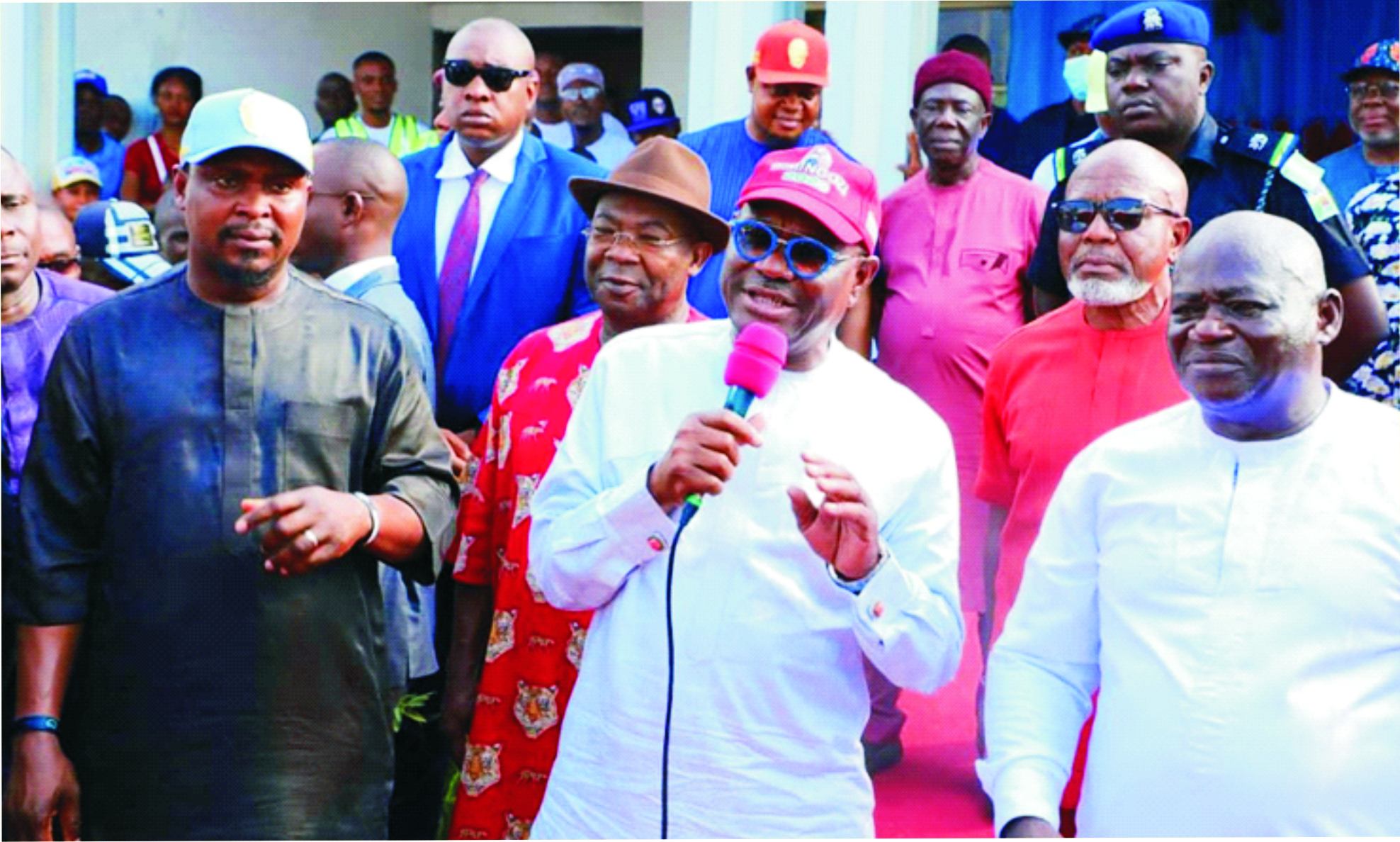
Rivers State Governor, Chief Nyesom Wike, says the electoral fortune of the Peoples Democratic Party (PDP) in the forthcoming governorship election of 11th March 2023, has been boosted.
This is because of the eventual collapse of the party structure of the All Progressives Congress (APC) into PDP in Ahoada East Local Government Area of Rivers State
Governor Wike spoke at a brief reception in Ehuda Town in Ahoada East Local Government Area, where Mr. Eric Apia, formally denounced his membership of the APC.
Mr. Apia, until his defection to PDP, was the leader of APC in Ahoada East LGA and the party’s House of Representatives candidate for the National Assembly election that held on 25th February, 2023.
Governor Wike noted the tough political tackles that Mr Apia posed while he held sway as the formidable grassroot leader of the APC.
Such political asset, Governor Wike said, is what the PDP had harvested, which marks the eventual death of APC in the area.
The implication, Governor Wike stated is that more votes will be secured for the PDP since all Mr. Apia’s supporters have now pledged their loyalty, and are ready to deliver votes that will make the PDP governorship candidate, Sir Siminialayi Fubara, to win the governorship election.
Governor Wike expressed his delight over the union that has made them one political family and assured that they will work together for the development of Ekpeye kingdom and the State in general.
The Rivers State governor also announced the award of contract for 10 Kilometers of internal roads in Ehuda Town to further enhance the inner aesthetic of the emerging Ahoada City.
Governor Wike said he will send the State’s Commissioner for Works to work with the leadership of the community in determining the roads to be constructed.
The governor , who also assured them of awarding the contract for the reconstruction of the Girls’ High School in Ahoada East Local government Area, explained that the architectural work had already been completed by his administration.
Governor Wike reiterated that he does not bear anyone in the State grudge for voting for Labour Party presidential candidate, Peter Obi and APC presidential candidate, Asiwaju Ahmed Bola Tinubu because he had been an ardent advocate of power shift to the south.
In his speech, Mr. Eric Apia said he had toiled so hard to keep the APC alive and formidable in Ahoada East Local Government Area.
He explained that while he and his supporters were in APC, they held the grassroot voters in firm grip because the people believed in them.
But now that they have joined the PDP, Mr. Apia said, he and his supporters will bring on board the same political enthusiasm to work for the PDP, which will make future elections in the area seamless.
He particularly assured that they work to deliver winning votes that will make Sir Siminialayi Fubara, the next governor of Rivers State.



Governor of Rivers State, Sir Siminalayi Fubara, has reaffirmed the unwavering commitment of his administration to peace, unity, security, and inclusive development as Rivers State marked its 59th anniversary, last Wednesday.
In a goodwill message issued on Wednesday to commemorate the anniversary, Governor Fubara stated that despite the challenges faced over the years, the people of Rivers State have continued to demonstrate resilience, strength, and an enduring spirit of unity that has sustained the state since its creation.
The Governor noted that the strong bond of brotherhood among the various ethnic nationalities of the state, including the Ijaw, Ikwerre, Ogoni, Etche, Ekpeye, Andoni, Kalabari, and others, remains one of Rivers State’s greatest strengths and a critical foundation for peace, stability, and progress.
He further observed that Rivers State has remained a major driver of Nigeria’s economy for decades, not only because of its abundant oil and gas resources, but also because of the exceptional contributions of its people across diverse sectors including academia, jurisprudence, business, entertainment, public service, and sports.
Governor Fubara assured the people that his administration will continue to prioritize policies and programmes that promote peace, protect lives and property, and expand development across all parts of the state. He emphasized that governance must be people centered and impactful, with equal attention given to every Local Government Area of the state.
The Governor also paid tribute to the elders and founding leaders of the state for preserving the spirit of unity and coexistence over the years, while urging the youths to remain hopeful, responsible, and actively committed to building a greater Rivers State through innovation, hard work, and patriotism.
He equally acknowledged the invaluable role of women in strengthening families, communities, and society, describing them as indispensable partners in the continued growth and stability of the state.
Governor Fubara called on all Rivers people to use the occasion of the anniversary as a moment of reflection and renewed commitment to peaceful coexistence, mutual respect, dialogue, and collective progress, stressing that the unity and future of Rivers State must always rise above personal interests and political differences.
Rivers State was created on May 27, 1967, by General Yakubu Gowon.


The Rivers State Government has distributed science equipment and materials to all senior secondary schools across the state to support students during the ongoing West African Examinations Council exams and to strengthen practical learning.
Flagging off the distribution at the Rivers State Senior Secondary Schools Board premises in Port Harcourt, on Monday, the State Commissioner for Education, Dr. Peters Nwagor, said the move demonstrates Governor Siminalayi Fubara’s commitment to improving education standards in the State.
Nwagor said the materials were approved and provided by the state government specifically to boost the teaching and learning of science subjects, describing science education as the foundation for technological advancement, innovation, and national development.
“No society can compete globally without deliberate investment in science and technology,” the Commissioner stated.
He commended the governor for consistently prioritising the education sector by providing tools needed for effective teaching and hands-on learning.
The Commissioner directed principals to ensure that the equipment are used strictly for practical lessons in their schools, warning that any principal or administrator found diverting, hoarding, or selling the materials wil face disciplinary action under public service regulations.
Nwagor also warned against examination malpractice, saying any principal found aiding or encouraging malpractices will be decisively sanctioned.
“We must collectively restore the dignity and credibility of our educational system,” he said.
Also speaking, Chairman, Rivers State Senior Secondary Schools Board, Tony Egwurugwu, urged school heads to make judicious use of the materials for students’ benefit.
He thanked the State Government for providing the resources, and assured that monitoring mechanisms would be put in place to ensure the materials serve their intended purpose.
In his own remarks, a Board Member for Technical Education, Nwisabari Bani Samuel, expressed appreciation to the governor for prioritising education and acknowledged the Commissioner’s role in advancing education development in the State.
He said the distribution covers all senior secondary schools in the State and is intended to improve students’ performance in both internal and external science examinations.
Akujobi Amadi
-
News1 day ago
Obuah’s Victory Excites Former Lawmaker as APC Primaries Conclude in Rivers West
-

 Politics3 days ago
APC PRIMARIES: FUBARA’S WITHDRAWAL, HISTORIC SACRIFICE FOR NATIONAL STABILITY ……. GROUP
-

 News4 days ago
Court Sentences Seven To Death Over Murder Of Cleric In Rivers
-
News1 day ago
105 Nigerians Killed In S/Africa In Seven Years
-

 Sports3 days ago
PH Arsenal Community Set For Streets Procession, Saturday
-

 Politics3 days ago
IPAC Flays INEC Over Election Guidelines Judgement
-

 Politics3 days ago
NDC To Adopt Electronic Voting For Future Primaries
-

 Niger Delta1 day ago
Royal Father Endorses PH Arsenal Community, Pledges To Support