
Politics
Senate In Stormy Session Over Buhari’s N23.7trn ‘Ways And Means’

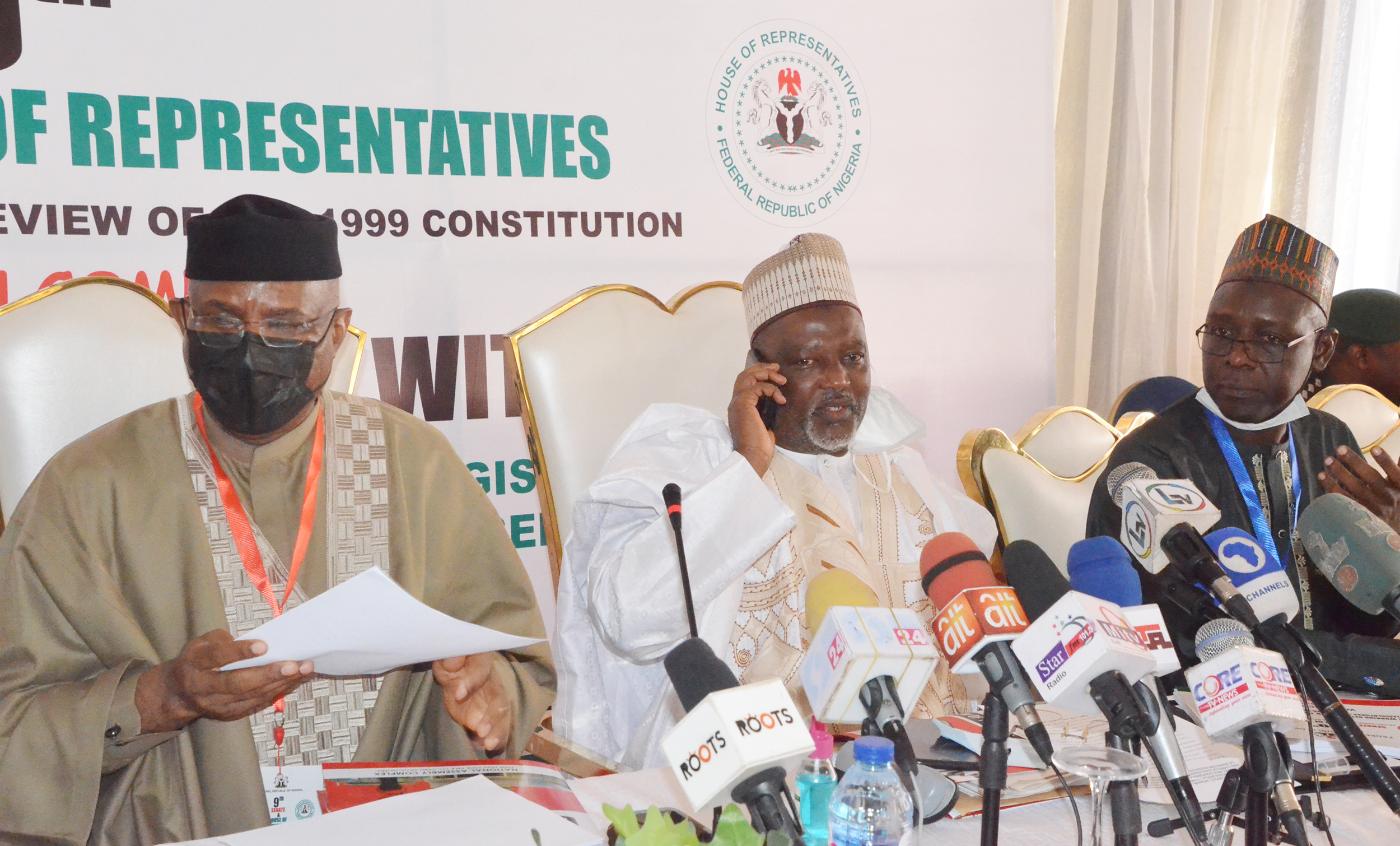
The Senate was in disarray for several hours, on Wednesday, over how to restructure the payment of N23.7 trillion “Ways and Means” secured from the Central Bank of Nigeria, CBN, in the last 10 years.
President of the Senate, Senator Ahmad Lawan, forced the lawmakers to go into a closed-door session to stop the chaos from degenerating into a brawl.
“Ways and Means” are loans or advances by the CBN to the Federal Government to enable it to cater for short-term or emergency finance to fund delayed government expected cash receipt of fiscal deficits.
Trouble started when Chairman of Senate Committee on Finance, Senator Olamilekan Adeola (APC, Lagos West), came up with a report on Ways and Means 2022 as requested by President Muhammadu Buhari, last week.
Soon after Adeola’s presentation, Senator Apiafi (PDP, Rivers West), raised a point of order, with very strong argument that President Buhari’s request was unconstitutional and what the Senate was about to do by considering the request was unknown to Nigerian law.
Tension engulfed the Senate when the Senate President, Lawan, ruled her out of order on the grounds that the report should be presented and read by the committee chairman for lawmakers to contribute to the debate.
President Buhari had last week written to the Senate, requesting the approval of restructuring of N23.7 trillion Ways and Means advances given to the Federal Government by the CBN.
The President in a letter read by Senate President during the Plenary session last Wednesday, explained that the ways and means balances as of December 19, 2022, were N23.7 trillion.
President Buhari further stated in the letter that he had approved the securitisation of the Ways and Means balances along the following terms: Amount N23 .7 trillion; Tenure 40 years; Moratorium on principal repayment, three years; and Pricing interest rate nine percent.
The Senate had in line with parliamentary procedure, given the request expeditious consideration by passing it for second reading and mandating its committee on Finance to work on it.
Lawan’s ruling annoyed Senator Apiafi and some senators, thereby leading to a charged atmosphere in the chamber.
At this point, Senator George Sekibo (PDP, Rivers East) raised a point of order, calling on Lawan to step down consideration of the report until lawmakers get more details on what the funds were used for.
In a strong move to stop approval of the report without scrutiny, Senator Sekibo rose through constitutional orders by citing Sections 80, 83, Section113(1) of the 1999 Constitution and Section 38 of the CBN Act to kick against the request.
Sekibo said: “We came into this chamber today and were given the report on N23.7trillion, which has been spent in the past 10 years. Whether it is 10 years or five years, whatever it is, the issue is that such payment, when the loans are taken, the Senate should be informed, we should be abreast with the information that such money is going to be taken because it is being taken on behalf of the people of Nigeria and we are entrusted with the power to make laws.
“According to the constitution, we can appropriate. They brought this up without details for us to approve.
“Section 80 of the 1999 constitution as amended provides that all revenues or other monies raised or received by the federation, not being revenue and other monies payable under this constitution or any Act of the National Assembly into any other public fund of the federation established for a particular purpose, shall be paid into and form one consolidated revenue fund of the Federation.
“No money shall be withdrawn from the consolidated revenue fund of the Federation except to meet expenditure that is charged upon the fund or where the issue of those monies has been authorised by an appropriation act, supplementary act or an act passed in pursuance of Section 81 of the constitution”.
“No money shall be withdrawn from any account other than the consolidated revenue fund of the Federation unless the issue of those monies has been authorised by the Act of the National Assembly.
“Section 80 (4) no money shall be withdrawn from the consolidated revenue fund or any other fund of the Federation except by the approval of the National Assembly, except in the manner prescribed by the National Assembly
“Section 83 the National Assembly may make provision for the establishment of Federation fund for.the Federation and for authorising the President if satisfying that there had arisen an urgent unforeseen expenditure to make advances to meet the needs.
“Section 38 of the CBN Act states ‘any money collected by the federal government as loan or emergency fund in form of Ways and Means Advances must be refunded before collection of another one.’
“Mr President, the relevant laws quoted clearly show that the N22.7triillion Ways and Means Advances already spent by Federal Government without informing the National Assembly was wrong and it will be unfair as representatives of Nigerians to approve this request.”
The Senate, thereafter, went into a closed-door session for one and half hours and the request was stepped down at the end of the day for lack of details.


Delegates at the convention, held at the Eagle Square, also produced a new national working committee (NWC) through a consensus arrangement endorsed by stakeholders.
Dr Ben Nwoye was named deputy national chairman (south), replacing Mr Emma Eneukwu, following consultations within the party.
Sources within the party said the decision was influenced by zoning considerations and consultations among party leaders, with Mr Peter Mbah, Enugu State governor, playing a significant role in ensuring Dr Nwoye’s inclusion.
In his acceptance speech, Prof. Yilwatda said his re-election was a call to greater service and pledged commitment to unity within the ruling party.
“We are ready to serve, ready to lead, and we are ready to build the party, together with the nation,” he said.
He added that the new leadership would not “fail or falter” in carrying out its responsibilities.
President Bola Tinubu, Vice-President Kashim Shettima, governors, members of the national assembly, and other party leaders graced the convention.
FULL LIST OF APC NWC
• National chairman — Nentawe Yilwatda
• Deputy national chairman (north) — Ali Bukar Dalori
• Deputy national chairman (south) — Benjamin Obi Nwoye
• National secretary — Surajudeen Ajibola Basiru
• Deputy national secretary — AbdulKarim Abubakar Kana
• National legal adviser — Murtala Aliyu Kankia
• National treasurer — Uguru Mathew Ofoke
• National financial secretary — Haruna Ginsau
• National organising secretary — Muhammad Sulaiman Argungu
• National welfare secretary — Donatus Enyinnah Nwankpa
• National publicity secretary — Felix Morka
• National auditor — Abubakar Maikafi
National women leader — Mary A. Idele
• National youth leader — Dayo Israel
• National leader (persons with disabilities) — Durotolu Oyebode Bankole
• Deputy national financial secretary — Hammam Adamu Ali Kumo
• Deputy national organising secretary — Emeka Okafor
• Deputy national women leader — Zainab Abubakar Ibrahim
• Deputy national publicity secretary — Meseko Durosinmi Josiah
• Deputy national welfare secretary — Christopher Michael Akpan
• Deputy national auditor — Olugbenga Olayemi
• Deputy national legal adviser — Ibrahim Salawu
• Deputy national treasurer — Ben Akak
• Deputy national youth leader — Jamaludeen Kabiru
• National ex-officio (north-central) — Opawoye Oluwatoyin Bunmi
• National ex-officio (north-east) — Adamu Jallah
• National ex-officio (north-west) — Kano Muhammed Jamu Yusuf
• National ex-officio (south-east) — Ikechukwu Umeh
• National ex-officio (south-south) — Francis Kolokolo.
-
Opinion2 days ago
Ozoro Festival: Tradition or Tyranny?
-

 News3 days ago
RSG Reiterates Commitment To Youth Dev
-

 Oil & Energy2 days ago
Transcorp Energy, Renewvia Partner On Renewable Energy Gap
-
Politics2 days ago
RIVERS WOMEN RALLY SUPPORT, CONTINUOUS PRAYERS FOR TINUBU
-
Politics2 days ago
AKPABIO, DIRI, OBOREVWORI, OTHERS VOW TO REELECT TINUBU …AS GIADOM RETAINS APC ZONAL CHAIR
-

 Business2 days ago
NSCDC Discloses Illegal Dump Site In Ikwerre Community
-
Politics2 days ago
Viral 2027 Nomination Forms Price List Fake, Misleading – APC
-

 Business2 days ago
Yenagoa’s Radisson Hotel Ready December — NCDMB, Other