
Featured
Wike Challenges FG On Foreign Loans …As Mimiko Inaugurates Rumuola Flyover

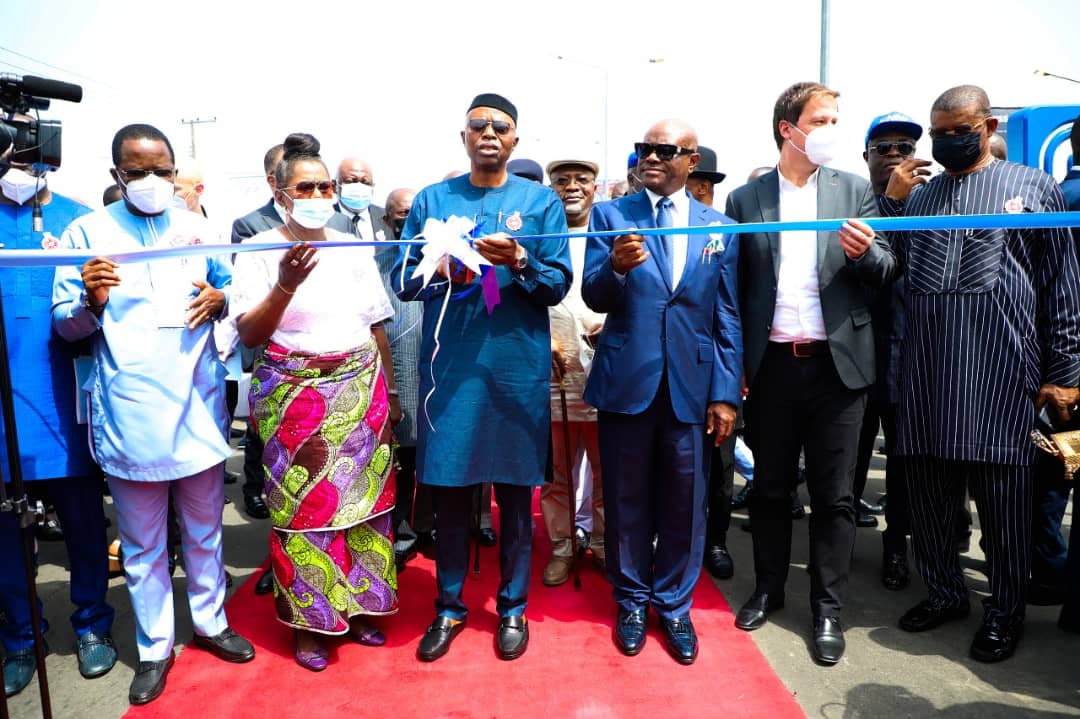
Rivers State Governor, Chief Nyesom Wike said that Nigeria has enormous resources, if well managed, can change, not only the fortunes of the country but the life of every Nigerian.
He has, therefore, challenged the Federal Government to show evidence where it has deployed all the money borrowed from external creditors.
Wike made the challenge at the inauguration of the Rumuola Flyover Bridge that was performed by the former Governor of Ondo State, Dr. Olusegun Mimiko, yesterday, in Port Harcourt.
The governor stated that his administration was propelled by love and commitment to service, which was why it is working assiduously and deploying the state’s resources judiciously, for the good of Rivers people.
“It is very clear that governance is not by magic. It is all about commitment. It’s all about your love for your people and your country.
“This country has enormous resources to change the lives of our people. Nobody should give excuses. Like we would always say, if you don’t have it, you don’t have it.
“So, all these stories that you borrowed money from here, and there, let us see what the money is being used for. If we borrowed money, we are showing Rivers people what we used that money to do.”
Wike said he is preoccupied with the duties of governance and rendering service to the people who elected him.
According to him, his best reply to the opposition is the evidence of the quality projects that his administration has continued to deliver.
It is clear to them, he said, that the Peoples Democratic Party (PDP) controlled state government has performed creditable well.
Aside the numerous roads completed and ongoing, Wike explained that his administration has within two years period delivered nine flyover bridges, which are handled by Julius Berger Nigeria Plc.
“This government has done well. This PDP government has done well.
“Our contractor is Julius Berger Nigeria Plc. We are competing with Federal Government that is using Julius Berger. Ask them how much it is to pay Julius Berger.”
He further continued: “None of these flyovers cost us less than N7billion. Now, the average of N7biilion into nine and the other roads done by Julius Berger Nigeria PLC and the quality they give; I’m happy and proud to associate myself with a company that gives the best as far as construction is concerned. I can move about in this state and country proudly.”
Speaking further, Wike warned criminal elements who steal manhole covers on major roads and on the flyovers bridges to desist from their nefarious activities.
He described those criminals and their sponsors as enemies of the state because they are sabotaging the good works that have been achieved to make motoring pleasurable with the state’s resources.
“Let me warn those who steal the cover of the manholes. You know when you take actions, people bring ethnic colouration. Those of you who are stealing the cover of manholes, if you like come from anywhere, if anybody want to sabotage us, we will tell you how saboteurs are treated.
“We cannot do this road construction and you come to sabotage us by stealing to disappoint us, to make people have accident.”
Wike also spoke about the need for his successor to be one who will not only sustained the current pace of development but outperform him.
He pointed out that such person must rise above selfish pedestal and be ready to defend, and protect the interest of the state against all odds.
Performing the project inauguration, former governor of Ondo State, Dr. Olusegun Mimiko, said that Wike has proved himself worthy his sobriquet: “Mr. Projects!”.
According to him, those who feel unsettled by Wike’s words and actions cannot take away the fact that he conceives projects, plan projects, delivers projects because he loves projects.
“Some see governance or being in government as an end in itself, you have deployed your limitless energy, by these accomplishments, to demonstrate that governance is a means to an end; the improvement of the lives of our people.”
Mimiko also spoke about the need to restructure Nigeria because it was an imperative means to a just, more productive and more prosperous nation.
He noted that restructuring is also about policies and actions towards getting Nigerian children off the streets into schools for the right kind of education.
According to him, it is also about improved subnational accountability in tackling youth unemployment and general alienation and many more.
“It is also not about Niger Delta oil and gas alone. After all, with the present state of climate change consciousness and concomitant investment in renewables, fossil fuels may sooner than later become truly fossil and out-dated.
“It is about ensuring that all our God-given minerals, e.g., Gold in Zamfara or Osun is optimally exploited for the people, and not unaccountably, by, and for a few elites and their rampaging foreign collaborators.
“It is about a decentralized security architecture that will ensure nimble, versatile, accountable and optimally responsive formations.”
Providing the description of the project, Rivers State Commissioner for Works, Hon. Elloka Tasie-Amadi said the Rumuola Flyover Bridge project that was awarded on July 2, 2020, to Julius Berger Nigeria PLC was completed by August, 2021.
Tasie-Amadi pointed out that within the period the civil works lasted, there were road closures, traffic diversions, grid locks, deployment of equipment and workers.
He also stated that there were inconveniences caused to commuters, support from many good people, particularly the community, and of course payments to the contractors but all of that are over.
“This flyover measures 532m from ramp-to-ramp with the suspended section being 292m long. Service lanes on either side of the bridge are 8.3m wide and 858.4m long. The entire project is adorned with street lighting and traffic control fixtures.
“The foregoing are all visible including the 24 piers under the bridge (24 columns if you may).”
Tasie-Amadi said, before the project commenced, there was only a single carriage bridge which became grossly inadequate for the volume of traffic.
“To address the situation,” he said, “a second bridge was built, service lanes completely reconstructed and expanded and all elements required to ease commute and pedestrian activities were incorporated into the project. That also included but not limited to refurbishment of the old bridge and adjoining streets.
“Please, permit me to cease this opportunity to urge road users and the relevant agencies to ensure compliance with codes and strict adherence to road and traffic signs erected around the area, most notable amongst these are signs which make it unlawful to stop on the bridge and high speed lanes and which require that all commercial vehicles use only the service lanes. The bridge is essentially off limits to commercial vehicles”, he added.



Governor of Rivers State, Sir Siminalayi Fubara, has reaffirmed the unwavering commitment of his administration to peace, unity, security, and inclusive development as Rivers State marked its 59th anniversary, last Wednesday.
In a goodwill message issued on Wednesday to commemorate the anniversary, Governor Fubara stated that despite the challenges faced over the years, the people of Rivers State have continued to demonstrate resilience, strength, and an enduring spirit of unity that has sustained the state since its creation.
The Governor noted that the strong bond of brotherhood among the various ethnic nationalities of the state, including the Ijaw, Ikwerre, Ogoni, Etche, Ekpeye, Andoni, Kalabari, and others, remains one of Rivers State’s greatest strengths and a critical foundation for peace, stability, and progress.
He further observed that Rivers State has remained a major driver of Nigeria’s economy for decades, not only because of its abundant oil and gas resources, but also because of the exceptional contributions of its people across diverse sectors including academia, jurisprudence, business, entertainment, public service, and sports.
Governor Fubara assured the people that his administration will continue to prioritize policies and programmes that promote peace, protect lives and property, and expand development across all parts of the state. He emphasized that governance must be people centered and impactful, with equal attention given to every Local Government Area of the state.
The Governor also paid tribute to the elders and founding leaders of the state for preserving the spirit of unity and coexistence over the years, while urging the youths to remain hopeful, responsible, and actively committed to building a greater Rivers State through innovation, hard work, and patriotism.
He equally acknowledged the invaluable role of women in strengthening families, communities, and society, describing them as indispensable partners in the continued growth and stability of the state.
Governor Fubara called on all Rivers people to use the occasion of the anniversary as a moment of reflection and renewed commitment to peaceful coexistence, mutual respect, dialogue, and collective progress, stressing that the unity and future of Rivers State must always rise above personal interests and political differences.
Rivers State was created on May 27, 1967, by General Yakubu Gowon.


The Rivers State Government has distributed science equipment and materials to all senior secondary schools across the state to support students during the ongoing West African Examinations Council exams and to strengthen practical learning.
Flagging off the distribution at the Rivers State Senior Secondary Schools Board premises in Port Harcourt, on Monday, the State Commissioner for Education, Dr. Peters Nwagor, said the move demonstrates Governor Siminalayi Fubara’s commitment to improving education standards in the State.
Nwagor said the materials were approved and provided by the state government specifically to boost the teaching and learning of science subjects, describing science education as the foundation for technological advancement, innovation, and national development.
“No society can compete globally without deliberate investment in science and technology,” the Commissioner stated.
He commended the governor for consistently prioritising the education sector by providing tools needed for effective teaching and hands-on learning.
The Commissioner directed principals to ensure that the equipment are used strictly for practical lessons in their schools, warning that any principal or administrator found diverting, hoarding, or selling the materials wil face disciplinary action under public service regulations.
Nwagor also warned against examination malpractice, saying any principal found aiding or encouraging malpractices will be decisively sanctioned.
“We must collectively restore the dignity and credibility of our educational system,” he said.
Also speaking, Chairman, Rivers State Senior Secondary Schools Board, Tony Egwurugwu, urged school heads to make judicious use of the materials for students’ benefit.
He thanked the State Government for providing the resources, and assured that monitoring mechanisms would be put in place to ensure the materials serve their intended purpose.
In his own remarks, a Board Member for Technical Education, Nwisabari Bani Samuel, expressed appreciation to the governor for prioritising education and acknowledged the Commissioner’s role in advancing education development in the State.
He said the distribution covers all senior secondary schools in the State and is intended to improve students’ performance in both internal and external science examinations.
Akujobi Amadi
-
News2 days ago
Obuah’s Victory Excites Former Lawmaker as APC Primaries Conclude in Rivers West
-

 Politics4 days ago
APC PRIMARIES: FUBARA’S WITHDRAWAL, HISTORIC SACRIFICE FOR NATIONAL STABILITY ……. GROUP
-

 News4 days ago
Court Sentences Seven To Death Over Murder Of Cleric In Rivers
-
News2 days ago
105 Nigerians Killed In S/Africa In Seven Years
-

 Sports4 days ago
PH Arsenal Community Set For Streets Procession, Saturday
-

 Politics4 days ago
IPAC Flays INEC Over Election Guidelines Judgement
-

 Niger Delta2 days ago
Royal Father Endorses PH Arsenal Community, Pledges To Support
-

 Politics4 days ago
NDC To Adopt Electronic Voting For Future Primaries