
Featured
NASS Opposition To E-Transmission Of Poll Results, Coup Against Nigerians, Wike Insists

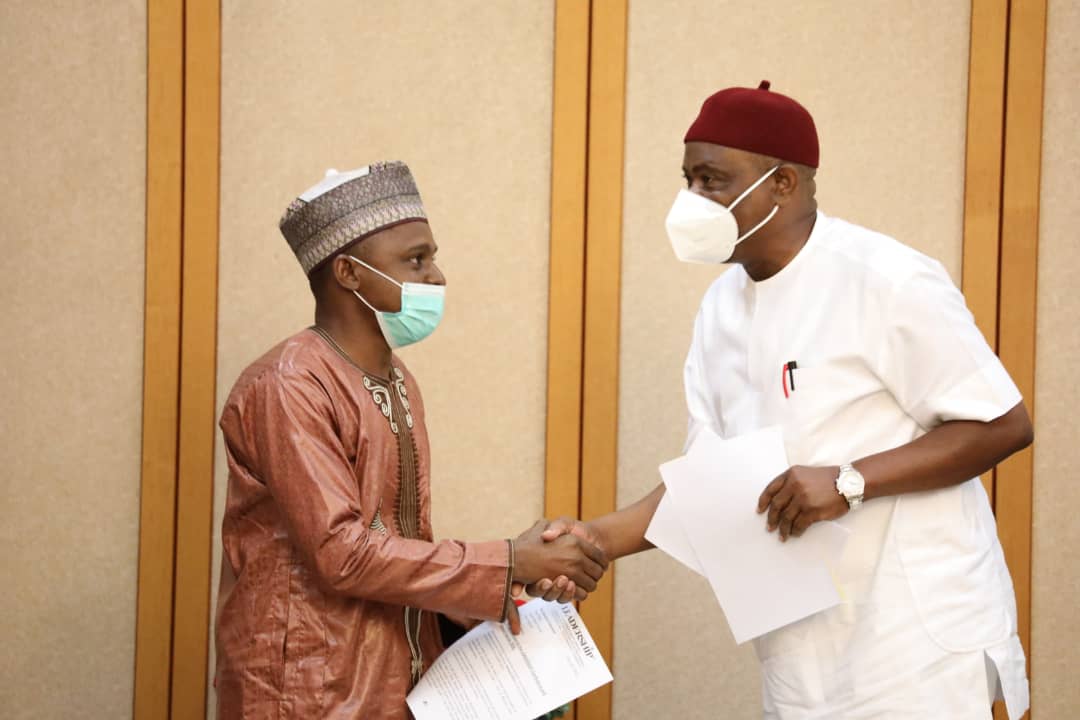
The Rivers State Governor, Chief Nyesom Wike says the rejection of electronic transmission of election results by All Progressives Congress (APC) members in the National Assembly, was tantamount to a coup against Nigerians desirous of free, fair and credible elections.
The governor noted that President Muhammadu Buhari’s failure to prevail on APC members in the National Assembly to support the inclusion of electronic transmission of election results in the amended Electoral Act proves that he does not intend to leave a legacy of transparent electoral process.
He stated this during the official presentation of letter of nomination to him as “the 2020 Governor of the Year Award” by the management of the Leadership Media Group at the Government House, Port Harcourt, yesterday.
Wike remarked that the current National Assembly capitalised on the seeming political indifference of Nigerians to deliberately vote against the inclusion of electronic transmission of election results in the amended Electoral Act.
The governor, described National Assembly members who voted against transmission of election results electronically as enemies of the country, because their action was detrimental to the growth and consolidation of the country’s democracy.
“Those who voted against e-transmission of results should be ashamed of themselves. They never mean well for this country. If you are a member of the National Assembly, and you voted against electronic transmission of results, your children should call you and say ‘daddy, are you well’?
“I can’t believe anybody who went to school in this digital period, will vote against electronic transmission of results. What kind of country is this? What kind of National Assembly members do we have?”
Wike declared that the rejection of electronic transmission of election results by APC lawmakers, even when the Independent National Electoral Commission (INEC) had affirmed that it has the capacity to electronically transmit results, was tantamount to a coup against the citizens of the country.
“It is a coup against the people, and when you plot a coup, you know the consequences of plotting a coup. National Assembly members have plotted coup against Nigerians, and Nigerians should hold them responsible. All they are planning is to rig election, because they know Nigerians have abandoned them”, the governor said.
The Rivers State governor said he had expected President Buhari, who had openly declared that he respects former President Goodluck Jonathan, for not compromising the 2015 general election, to build on the electoral legacy of his predecessor.
“If Jonathan did not believe in the transparency of the election, he would not have allowed card reader to be used. So, he introduced the card reader as a sitting President, knowing fully well that that could be an albatross to him. But he said no, I want us to move to the next level.”
Wike stated that though President Buhari had repeatedly declared that he will ensure the conduct of free, fair and credible election in 2023, he doubts his sincerity, particularly for failing to rein in those APC members who voted against electronic transmission of election results.
“Mr President cannot tell us that sincerely, he wants to conduct free, fair, credible elections. Let nobody deceive you. It is very clear that there is no sure intention at all.”
The governor, who stated that he has never and will never influence any media organisation to nominate him for an award, advised media groups against bestowing awards on non-performing political office holders.
According to him, giving awards to undeserving governors, for instance, is an act of corruption.
Wike commiserated with the family and management of the Leadership Media Group over the death of the founder of the newspaper, Sam Nda-Isaiah, and urged them to use the newspapers as a voice for the people.
“Let me thank the leadership of the newspaper for finding us worthy or qualified to be nominated for the Governor of the Year Award. Therefore, we dedicate this award to the glory of God Almighty and to the people of the state.”
He said it was gladdening that there were people somewhere who recognise the efforts he and members of his team were making to change the narrative in terms of governance in the country.
To this end, he reiterated that the award would energise his administration to even work harder for the state.
Responding, the Group Managing Director of Leadership Newspapers, Mu’azu Elazeh, said they were in Port Harcourt to formally present Governor Wike the letter of his nomination as the ‘Leadership Governor of the Year’, and then to invite him to attend Leadership Conference slated for September.
“When the Board of Editors of Leadership met for this nomination, because it is something we do every year, when your name was mentioned, I think it is the only name that received unanimous endorsement because of your practical approach to leadership and governance; because of your focus in infrastructural development which is resetting the business and economy of Rivers State”, Elazeh said.
Similarly, the Executive Director, Leadership Media Group, Abraham Nda-Isaiah said this was the first time in the history of Leadership Newspapers that a governor has been nominated twice in the life of an administration.
He recalled that Wike was first nominated for the award in 2017.



Governor of Rivers State, Sir Siminalayi Fubara, has reaffirmed the unwavering commitment of his administration to peace, unity, security, and inclusive development as Rivers State marked its 59th anniversary, last Wednesday.
In a goodwill message issued on Wednesday to commemorate the anniversary, Governor Fubara stated that despite the challenges faced over the years, the people of Rivers State have continued to demonstrate resilience, strength, and an enduring spirit of unity that has sustained the state since its creation.
The Governor noted that the strong bond of brotherhood among the various ethnic nationalities of the state, including the Ijaw, Ikwerre, Ogoni, Etche, Ekpeye, Andoni, Kalabari, and others, remains one of Rivers State’s greatest strengths and a critical foundation for peace, stability, and progress.
He further observed that Rivers State has remained a major driver of Nigeria’s economy for decades, not only because of its abundant oil and gas resources, but also because of the exceptional contributions of its people across diverse sectors including academia, jurisprudence, business, entertainment, public service, and sports.
Governor Fubara assured the people that his administration will continue to prioritize policies and programmes that promote peace, protect lives and property, and expand development across all parts of the state. He emphasized that governance must be people centered and impactful, with equal attention given to every Local Government Area of the state.
The Governor also paid tribute to the elders and founding leaders of the state for preserving the spirit of unity and coexistence over the years, while urging the youths to remain hopeful, responsible, and actively committed to building a greater Rivers State through innovation, hard work, and patriotism.
He equally acknowledged the invaluable role of women in strengthening families, communities, and society, describing them as indispensable partners in the continued growth and stability of the state.
Governor Fubara called on all Rivers people to use the occasion of the anniversary as a moment of reflection and renewed commitment to peaceful coexistence, mutual respect, dialogue, and collective progress, stressing that the unity and future of Rivers State must always rise above personal interests and political differences.
Rivers State was created on May 27, 1967, by General Yakubu Gowon.


The Rivers State Government has distributed science equipment and materials to all senior secondary schools across the state to support students during the ongoing West African Examinations Council exams and to strengthen practical learning.
Flagging off the distribution at the Rivers State Senior Secondary Schools Board premises in Port Harcourt, on Monday, the State Commissioner for Education, Dr. Peters Nwagor, said the move demonstrates Governor Siminalayi Fubara’s commitment to improving education standards in the State.
Nwagor said the materials were approved and provided by the state government specifically to boost the teaching and learning of science subjects, describing science education as the foundation for technological advancement, innovation, and national development.
“No society can compete globally without deliberate investment in science and technology,” the Commissioner stated.
He commended the governor for consistently prioritising the education sector by providing tools needed for effective teaching and hands-on learning.
The Commissioner directed principals to ensure that the equipment are used strictly for practical lessons in their schools, warning that any principal or administrator found diverting, hoarding, or selling the materials wil face disciplinary action under public service regulations.
Nwagor also warned against examination malpractice, saying any principal found aiding or encouraging malpractices will be decisively sanctioned.
“We must collectively restore the dignity and credibility of our educational system,” he said.
Also speaking, Chairman, Rivers State Senior Secondary Schools Board, Tony Egwurugwu, urged school heads to make judicious use of the materials for students’ benefit.
He thanked the State Government for providing the resources, and assured that monitoring mechanisms would be put in place to ensure the materials serve their intended purpose.
In his own remarks, a Board Member for Technical Education, Nwisabari Bani Samuel, expressed appreciation to the governor for prioritising education and acknowledged the Commissioner’s role in advancing education development in the State.
He said the distribution covers all senior secondary schools in the State and is intended to improve students’ performance in both internal and external science examinations.
Akujobi Amadi
-
News20 hours ago
Obuah’s Victory Excites Former Lawmaker as APC Primaries Conclude in Rivers West
-

 Politics3 days ago
APC PRIMARIES: FUBARA’S WITHDRAWAL, HISTORIC SACRIFICE FOR NATIONAL STABILITY ……. GROUP
-

 News3 days ago
Court Sentences Seven To Death Over Murder Of Cleric In Rivers
-
News21 hours ago
105 Nigerians Killed In S/Africa In Seven Years
-

 Sports3 days ago
PH Arsenal Community Set For Streets Procession, Saturday
-

 Politics3 days ago
IPAC Flays INEC Over Election Guidelines Judgement
-

 Politics3 days ago
NDC To Adopt Electronic Voting For Future Primaries
-

 Politics3 days ago
Ex-IGP Defects To SDP After APC Primary Fiasco