
Featured
RSG Debunks Receipt Of N78bn Refund From FG …Dissolves Taskforce On Illegal Street Trading, Motor Parks …Pulls Out Of FG’s Public Works Programme

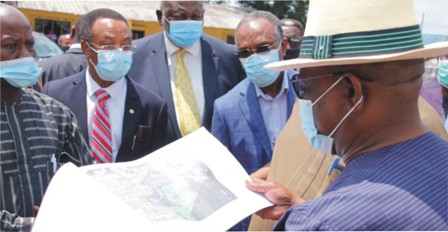
Rivers State Government has debunked the misconception that it has received N78 billion refund from the Federal Government.
The State Commissioner for Information and Communications, Pastor Paulinus Nsirim, made the clarification yesterday in a Radio Programme.
Pastor Nsirim explained that there is a huge difference between approval and release of funds.
“As at today, the Rivers State Government is yet to receive the N78 billion. There is so much misconception out there. There is a difference between approval and release of funds.
“When the money is released it cannot be a secret because in government circles such an information cannot be hidden.
“Let me state categorically that if the money is received today, it will be made public. So, this idea of peddling propaganda that the money has been received by mischief makers is quite unfortunate,” he stated.
He also used the opportunity to clear the air on the questions being asked in several quarters over what the State Government needs more loans for when it has N78 billion, saying, “you cannot plan with what you do not have.”
The Commissioner also assured Rivers people that when the refund is finally received, the State Government would use it judiciously for the benefit of the people.
“If the refund is received they can always count on Governor Nyesom Wike to use it judiciously to increase the infrastructural development of the State.
In another development, the State Government has approved the dissolution of the State Taskforce on Illegal Street Trading and Motor Parks with immediate effect.
A statement signed by the Commissioner for Information and Communications, Pastor Paulinus Nsirim said “consequently, the Special Assistant to the Governor in charge of the Task Force, Mr. Bright Amaewhule has been relieved of his appointment”.
The statement continued that “members of the Taskforce are hereby directed to return the operational vehicles and Identity Cards of the body to the Office of the Secretary to State Government not later than 4pm tomorrow, Wednesday, August 12, 2020.
“They will be paid their salaries as they return the vehicles and Identity Cards. Government will reconstitute the Taskforce after proper orientation and training”.
Meanwhile, the Rivers State Government has pulled out of the Special Public Works Programme of the Federal Government where 774,000 unskilled Nigerians were supposed to be employed.
Nominee of the Rivers State government in the committee, Erastus Awortu, made the decision of the state known in a letter addressed to the Minister of State for Labour and Productivity, Festus Keyamo, SAN.
Awortu, who is also the Special Adviser to Governor Nyesom Wike on NDDC, alleged that the implantation of the programme, which was designed to employ 1,000 persons per local government area, has been hijacked by the All Progressives Congress (APC) in Rivers State.
The Rivers State nominee described the Special Public Works Programme as a scam.
Awortu said in the letter, “At the beginning, some guidelines were set on how the slots should be shared among the various interest groups. The various interest groups are 35 and have representatives in the committee but unfortunately, that is not being done by the committee. The guidelines are not being followed.
“The committee has been asking people to process their applications but we found out that they also gave out forms to APC members in the state. Which means they already know those they will shortlist for the programme and they are only stressing other people to apply. They are doing that to justify that due process is being followed but that is not the case.
“I find it very misleading and as the representative of the governor, I will not be part of that kind of process where the populace will be made to apply for what is not available. It is an absolute scam.
“Accordingly, I want to say that since the slots are not defined as per the guidelines that the state is willing to allow the programme be run fully as an APC empowerment programme for their members and cease to be part of it forthwith,” Awortu said.
The Chairman of the Special Public Works Programme in River State, Dr Innocent Barikor, had on a radio programme over the weekend in Port Harcourt, said the committee had no plans to undermine the state government in the implementation of the programme.
According to the letter made available to The Tide, Awortu copied the Rivers State Governor, Chief NyesomWike and the Chairman of the Public Works Programme, Dr Innocent Barikor, in the withdrawal letter.



Governor of Rivers State, Sir Siminalayi Fubara, has reaffirmed the unwavering commitment of his administration to peace, unity, security, and inclusive development as Rivers State marked its 59th anniversary, last Wednesday.
In a goodwill message issued on Wednesday to commemorate the anniversary, Governor Fubara stated that despite the challenges faced over the years, the people of Rivers State have continued to demonstrate resilience, strength, and an enduring spirit of unity that has sustained the state since its creation.
The Governor noted that the strong bond of brotherhood among the various ethnic nationalities of the state, including the Ijaw, Ikwerre, Ogoni, Etche, Ekpeye, Andoni, Kalabari, and others, remains one of Rivers State’s greatest strengths and a critical foundation for peace, stability, and progress.
He further observed that Rivers State has remained a major driver of Nigeria’s economy for decades, not only because of its abundant oil and gas resources, but also because of the exceptional contributions of its people across diverse sectors including academia, jurisprudence, business, entertainment, public service, and sports.
Governor Fubara assured the people that his administration will continue to prioritize policies and programmes that promote peace, protect lives and property, and expand development across all parts of the state. He emphasized that governance must be people centered and impactful, with equal attention given to every Local Government Area of the state.
The Governor also paid tribute to the elders and founding leaders of the state for preserving the spirit of unity and coexistence over the years, while urging the youths to remain hopeful, responsible, and actively committed to building a greater Rivers State through innovation, hard work, and patriotism.
He equally acknowledged the invaluable role of women in strengthening families, communities, and society, describing them as indispensable partners in the continued growth and stability of the state.
Governor Fubara called on all Rivers people to use the occasion of the anniversary as a moment of reflection and renewed commitment to peaceful coexistence, mutual respect, dialogue, and collective progress, stressing that the unity and future of Rivers State must always rise above personal interests and political differences.
Rivers State was created on May 27, 1967, by General Yakubu Gowon.


The Rivers State Government has distributed science equipment and materials to all senior secondary schools across the state to support students during the ongoing West African Examinations Council exams and to strengthen practical learning.
Flagging off the distribution at the Rivers State Senior Secondary Schools Board premises in Port Harcourt, on Monday, the State Commissioner for Education, Dr. Peters Nwagor, said the move demonstrates Governor Siminalayi Fubara’s commitment to improving education standards in the State.
Nwagor said the materials were approved and provided by the state government specifically to boost the teaching and learning of science subjects, describing science education as the foundation for technological advancement, innovation, and national development.
“No society can compete globally without deliberate investment in science and technology,” the Commissioner stated.
He commended the governor for consistently prioritising the education sector by providing tools needed for effective teaching and hands-on learning.
The Commissioner directed principals to ensure that the equipment are used strictly for practical lessons in their schools, warning that any principal or administrator found diverting, hoarding, or selling the materials wil face disciplinary action under public service regulations.
Nwagor also warned against examination malpractice, saying any principal found aiding or encouraging malpractices will be decisively sanctioned.
“We must collectively restore the dignity and credibility of our educational system,” he said.
Also speaking, Chairman, Rivers State Senior Secondary Schools Board, Tony Egwurugwu, urged school heads to make judicious use of the materials for students’ benefit.
He thanked the State Government for providing the resources, and assured that monitoring mechanisms would be put in place to ensure the materials serve their intended purpose.
In his own remarks, a Board Member for Technical Education, Nwisabari Bani Samuel, expressed appreciation to the governor for prioritising education and acknowledged the Commissioner’s role in advancing education development in the State.
He said the distribution covers all senior secondary schools in the State and is intended to improve students’ performance in both internal and external science examinations.
Akujobi Amadi
-
News2 days ago
Obuah’s Victory Excites Former Lawmaker as APC Primaries Conclude in Rivers West
-

 Politics4 days ago
APC PRIMARIES: FUBARA’S WITHDRAWAL, HISTORIC SACRIFICE FOR NATIONAL STABILITY ……. GROUP
-

 News4 days ago
Court Sentences Seven To Death Over Murder Of Cleric In Rivers
-
News2 days ago
105 Nigerians Killed In S/Africa In Seven Years
-

 Sports4 days ago
PH Arsenal Community Set For Streets Procession, Saturday
-

 Politics4 days ago
IPAC Flays INEC Over Election Guidelines Judgement
-

 Niger Delta2 days ago
Royal Father Endorses PH Arsenal Community, Pledges To Support
-

 Politics4 days ago
NDC To Adopt Electronic Voting For Future Primaries