
News
PDP Is Dead In Enugu – APC …As PDP NWC Dissolves Ebonyi, Adamawa Excos

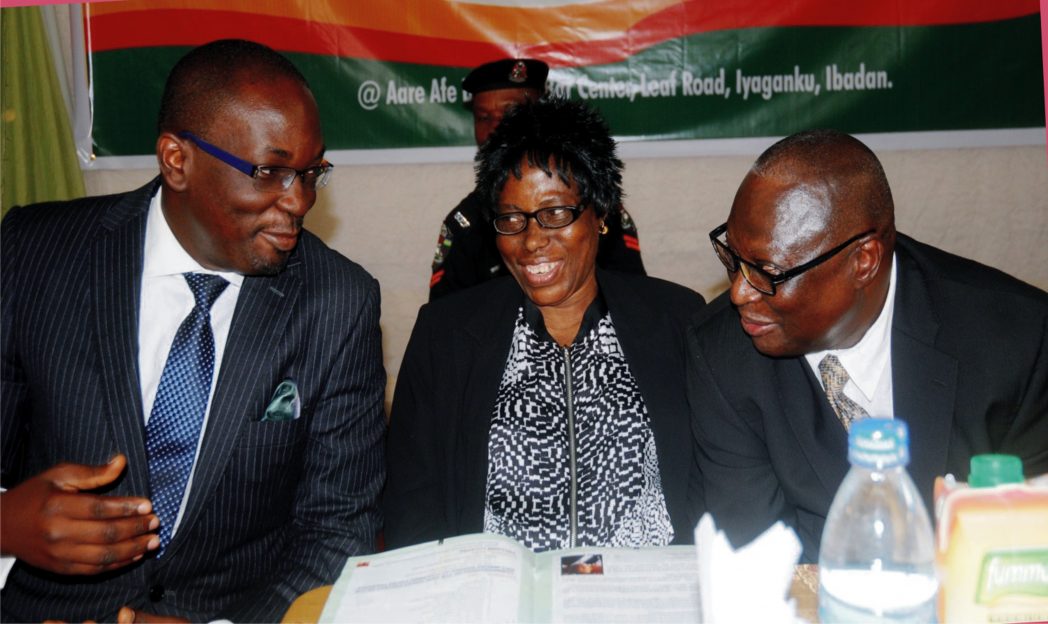
L-R: Oyo State Chairman of the Nigeria Bar Association, Mr Seun Abimbola, Chief Judge of Oyo State, Justice Badejoko Adeniji and Justice Mukthar Abimbola during the lecture on the ‘’future of Law and Legal Practice in Nigeria’’ in Ibadan, recently.
The All Progressives Congress on Tuesday said the protracted crisis in the Enugu State Chapter of the Peoples Democratic Party means that the ruling party will not be able to present a candidate in the state in 2015.
The chairman of the APC in Enugu State, Dr. Ben Nwoye, said this at a news conference where he rejoiced over what he described as the “death of the PDP” in the state.
A bitter struggle between two factions, loyal to Governor Sullivan Chime and Deputy Senate President, Senator Ike Ekweremadu, respectively, over the control of the party structure, has grounded the PDP in Enugu State, a few months to the polls.
The Chime camp, which insists that Chief Ikeje Asogwa is the chairman of the party, and the Ekweremadu faction, led by Elder David Aja, who was endorsed by the National Working Committee as acting chairman, have both gone to court to obtain court orders restraining each other from acting as the leadership of the PDP in the state.
Currently, there are strong indications that the Chime faction, which also obtained a court order that stopped the national secretariat of the party from acting on the delegates list presented by the Ekweremadu group, is shopping for an alternative political party platform to realise their aspirations in 2015.
There were unconfirmed reports that the Chime camp met on Tuesday to deliberate over a possible move to the All Progressives Grand Alliance.
Addressing journalists against the backdrop of the unfolding developments, as well as the controversy over the N11bn loan approved for Chime by the state house of assembly, Nwoye declared that the Enugu State PDP would not recover from the crisis.
The Enugu APC chairman noted that a member of the House of Representatives, Hon. Ifeanyi Ugwuanyi, who was endorsed by Chime as the PDP consensus candidate, is making moves to join another political party in order to realise his gubernatorial hopes.
It is believed that the Ekweremadu faction, which is currently in charge of the party machinery, was not favorably disposed to Ugwuanyi’s ambition.
“APC is mourning the PDP in Enugu State, PDP as a political party in Enugu State is gone. “Gburugburu (Ugwuanyi) is looking for another platform.
“The Ekweremadu group has used their legal prowess in Abuja to tie down PDP while the Chime group has tied down PDP in Enugu State.
“So it means that PDP will not be able to present a candidate in Enugu State in 2015.
“We are now mourning the demise of the PDP – the prayers of the people have finally worked,” Nwoye said.
The APC chieftain noted that the opposition party was not responsible for the misfortune of the PDP in Enugu State.
Rather, he blamed the development on the PDP ruling class, who he said have failed Nigerians while enriching themselves.
He alleged that the N11bn loan approved for the Chime administration was fraught with irregularities and must be stopped by the Economic and Financial Crimes Commission.
Accusing the banks involved in the loan – UBA and GTB – of conniving with the administration to “wipe away” and “siphon the future revenue of Enugu State.”
Nwoye urged Enugu State indigenes to stop banking with the two financial institutions.
In the same vein, an APC gubernatorial aspirant, Barr. Okey Ezea, faulted the state assembly for approving the loan.
Ezea, who said he would not honour the loan if elected in 2015, said the facility did not comply with provisions of the Fiscal Responsibility Act.
“That approval is null and void and of no effect and if the banks go ahead to advance that money, they will be doing so at their own risk because the court of law may declare it null and void, and the incoming government may not be bound to repay that loan,” Ezea said.
Ezea added that the 2013 report of Debt Management Office indicated that Enugu State has a debt profile of over N12bn as of December 31, 2013, and warned that if the governor obtains the fresh N11bn loan, he would bequeath a N23bn debt on the incoming administration.
Meanwhile, the national leadership of the Peoples Democratic Party has dissolved the party’s executives in Ebonyi and Adamawa States.
The decision to sack the executives was taken at the meeting of the National Working Committee of the party, which was held in Abuja on Tuesday.
National Publicity Secretary of the party, Chief Olisa Metuh, disclosed this while briefing journalists at the end of the meeting.
He said, “In order to maintain discipline and to show the supremacy of the party and in furtherance of running a lawful, orderly and responsible state organs of our party, the NWC has decided to dissolve the state executive committees of Adamawa and Ebonyi States for grave and inimical conduct and act capable of disorganising and undermining good conduct of the party in the states.
“We urge members in those states to disregard the publications of the result of the Ward congresses made by those two state executives. Our members should disregard them as not being authorised and not coming from a proper custody. ” he said.


Against the backdrop of rising economic challenges and global uncertainties, the President of the Christian Association of Nigeria (CAN), Archbishop Daniel Okoh, has called for calm, unity, and responsible leadership as Christians across the country mark Palm Sunday, yesterday.
In a statement released yesterday, Okoh reflected on the significance of Palm Sunday, saying that it is a moment that symbolises peace, humility, and hope, even in times of tension and uncertainty.
He further explained that Jesus entered Jerusalem with calm resolve, not as a display of force, but with a message of peace and purpose.
The CAN President noted, “The message of the Christian observance is particularly relevant as many Nigerians grapple with economic hardship, including rising cost of living, increasing fuel prices, and escalating food costs.”
He attributed part of the economic pressure to global developments, especially geopolitical tensions involving Iran, Israel, and the United States that are already impacting energy markets and, by extension, everyday life in Nigeria.
He stressed that across the country, families are feeling the weight of these times, with transport costs rising, food prices climbing, and daily life becoming more difficult.
He stated that Nigerians are primarily concerned with survival and stability, appealing to leaders at all levels to be mindful of the tone and impact of their words and actions.
According to him, when life feels uncertain, people need reassurance, they need stability and the confidence that those in authority understand their struggles. He stressed that the lessons of Palm Sunday should guide leadership, as true leadership is defined not by force or rhetoric, but by empathy, restraint, and a commitment to the common good.
He stressed that it is a time for decisions that ease burdens, calm anxieties, and bring people together, and called on the Church and Nigerians of all faiths to embrace their responsibility in promoting peace and unity.
He said Palm Sunday serves as a reminder of a time when people from diverse backgrounds came together in shared hope and purpose, pointing out that the same spirit is needed now to stand for peace, strengthen unity, and support one another, especially in a season that could easily tilt towards tension.
Okoh encouraged young Nigerians and those most affected by the current economic realities not to lose hope, acknowledging that while the challenges are real, they are not insurmountable.

The Acting Provost of the Rivers State College of Health Science and Management Technology, Dr. (Mrs.) Peace Chigozirim Amadi has refuted claims circulating in the media suggesting that laboratory equipment went missing from the college.
In a recent statement, Dr. Amadi described the reports—particularly those attributed to certain publications—as false and misleading. She emphasized that all laboratory equipment at the college remain intact.
“I am here to set the record straight. No laboratory equipment disappeared from my college. Nothing is missing,” Dr. Amadi said, challenging anyone with contrary claims to provide evidence, including the names of the equipment and their supposed locations.
She further noted that the college recently underwent an accreditation exercise, during which significant investments were made in laboratory equipment. According to Dr. Amadi, these items are fully accounted for, and the college maintains a robust security system to protect its assets.
“Everything is intact. Nothing disappeared. The information being circulated is false and should be discarded,” she reiterated.
Beyond addressing the allegations, Dr. Amadi also called on media practitioners to exercise professionalism and verify stories before publication. “I want to plead with journalists to always verify their stories. Junk journalism does not help anyone. No matter the information you receive, it is important to hear the other side before publishing,” she said.
While social media posts have occasionally raised concerns about various issues in the region’s health education sector, including extortion and examination malpractice at related institutions, there is no independent evidence from credible news sources confirming that equipment went missing from Rivers State College of Health Science and Management Technology.
The college, a public tertiary institution based in Port Harcourt, Rivers State, is accredited to offer a variety of health-related programs, including Nursing, Midwifery, Laboratory Technology, and Environmental Health. It has consistently emphasised integrity, safety, and transparency in its operations.
Dr. Amadi’s statement seeks to reassure the public, students, and stakeholders that the college remains secure, well-managed, and free from the alleged equipment losses, while urging journalists to prioritise accuracy in reporting.

The Chairman of the Arewa Traditional Council of Chiefs in Rivers State, Alhaji Hussaini Isa Madaki, has commended Governor Siminalayi Fubara of Rivers State for his efforts in sustaining peace and security of lives and property across the state.
Madaki, who is also the Sarkin Hausawa in Rivers State, described the governor as a leader who has embraced the Hausa community as part of the larger family in the state.
Speaking with journalists at his office in Port Harcourt during the 2026 Eid al-Fitr celebration, Madaki noted that Governor Fubara has demonstrated fairness and inclusiveness by not segregating any ethnic group, particularly the Hausa community.
He added that the governor’s peaceful disposition has positioned Rivers State as one of the most accommodating and peaceful states in the country.
Madaki further assured that the Hausa community would continue to give maximum support to the Fubara-led administration until the end of its tenure.
He also urged members of the community to remain peaceful and law-abiding as they go about their lawful activities.
On community development, Madaki disclosed that district and ward heads have been appointed and crowned across Hausa settlements in the State to ensure proper coordination and profiling of residents. According to him, the initiative is aimed at strengthening security, enhancing identification, and improving crisis management at the grassroots level.
He explained that the move became necessary due to recurring security concerns, including disturbances allegedly caused by some scavengers and cart pushers.
Madaki called on the newly appointed leaders to promote inclusiveness, harmony, and peaceful coexistence in the discharge of their responsibilities.
Those appointed include Alhaji Abubakar as Port Harcourt City District Head; Alhaji Buba Usman (Eleme axis); Malam Adamu (Eagle Island); Alhaji Tanlasuki (Gborokiri Yam Zone); Abdullahi (Rumukwurushi); Adamu Suleiman (Aboloma); and Useni Umaru (D-Line).
He appealed to Governor Fubara to formally recognise the efforts of the Hausa leadership structure in the State and extend further support in the spirit of inclusivity and unity.
-
Opinion2 days ago
Ozoro Festival: Tradition or Tyranny?
-

 News3 days ago
RSG Reiterates Commitment To Youth Dev
-

 Oil & Energy2 days ago
Transcorp Energy, Renewvia Partner On Renewable Energy Gap
-
Politics2 days ago
RIVERS WOMEN RALLY SUPPORT, CONTINUOUS PRAYERS FOR TINUBU
-
Politics2 days ago
AKPABIO, DIRI, OBOREVWORI, OTHERS VOW TO REELECT TINUBU …AS GIADOM RETAINS APC ZONAL CHAIR
-

 Business2 days ago
NSCDC Discloses Illegal Dump Site In Ikwerre Community
-
Politics2 days ago
Viral 2027 Nomination Forms Price List Fake, Misleading – APC
-

 Business2 days ago
Yenagoa’s Radisson Hotel Ready December — NCDMB, Other