
Nation
THE STATES

FCT
President Goodluck Jonathan has condemned the last
Friday assassination of the Emir of Gwoza, Alh Idrissa Timta, by the insurgent group, Boko Haram.
Special Adviser to the President on Media and Publicity, Dr Reuben Abati, disclosed this on Saturday, in an interview with the State House correspondents in Abuja.
He said the president had also spoken about those who were willing to renounce terrorism and those who were willing to embrace peace,
According to him opportunities have been created for them through the Presidential Committee on Dialogue and Peaceful Resolutions of Conflict in the North Eastern part of Nigeria.
Jigawa
A group, the Education Sector Support Programme in
Nigeria (ESSPIN) is to conduct a head count of out-of-school children in Auyo Local Government Area of Jigawa.
The Coordinator of the programme, Malam Danladi Abubakar, made the disclosure last Saturday during an advocacy visit to Auyo, Jigawa.
ESSPIN is a key education intervention programme, supported by the British Department for International Development (DFID).
The programme is designed to support the development of basic education, nomadic and adult literacy programmes.
Kano
The Kano State Government has commended the
remarkable improvement in the level of compliance to the monthly sanitation exercise in the state.
The Commissioner for Environment, Alhaji Abdullahi Abbas, who gave the commendation while speaking with newsmen shortly after the exercise in Kano last Saturday. He said that the level of compliance was unprecedented as fewer defaulters were recorded as against the previous exercises.
Ten mobile courts that operated under the state Task Force Committee on Sanitation for the month of May arrested 180 defaulters.
Also, the courts received the sum of N443, 750 being fines received from defaulters to the exercise in various parts of the state during the month.
Katsina
The Emir of Katsina, Alhaji Abdulmumini Kabir last
Saturday urged the populace to always do the right thing for the country to overcome its challenges.
He said in Katsina when he conferred the traditional title of ‘Kaugaman Katsina’ on the Acting Chairman, Federal Inland Revenue Service, Alhaji Kabir Mashi, that without attitudinal change, the nation’s economic and social challenges would be difficult to surmount.
The emir also urged the populace to continue to pray for peace in the country, and continue to support efforts by government to address the nation’s challenges and also called on religious leaders to avoid utterances capable of bringing about disunity among the people.
Kogi
Governor Idris Wada of Kogi State has promised that
his administration would ensure that politicking in the state would be devoid of rancour and violence ahead of 2015 general elections.
Wada who gave the promise in a statement issued in Lokoja last Sunday by the Press Secretary to the Deputy Governor, Mr Michael Abu, said that the administration would ensure peaceful coexistence among political parties in the state, which he said, had always been the cardinal focus of his administration.
He said that politicking should be development and people oriented and not destructive, he added
Kwara
The Association of Public Health Physicians of Nigeria
(APHPN), in collaboration with the Nigerian Tobacco Control Research Group, last Saturday, urged the Federal Government to increase tax on tobacco products.
The National Chairman of the Association, Prof. Tanimola Akande, made the call during a news conference organised to mark the “World No Tobacco Day’’ in Ilorin.
Akande also urged the Senate and the House of Representatives to “quickly do the needful” in harmonising and passing a comprehensive tobacco control bill.
Niger
The Etsu Nupe, Alhaji Yahaya Abubakar, has commended a UK-based NGO, Africa Healthcare Development Trust (AHDT), for offering free medical treatment to over 3000 patients in his domain.
Abubakar who made the commendation Sunday in his Wadata Palace in Bida while receiving members of the NGO said the gesture had helped to improve the health of the less privileged in the society in addition to bringing relief and succour to families of the beneficiaries.
He said the complementary role of NGO was worthy of emulation by other prominent sons and daughters of Nupe land.
A spokesman for the group, Dr Aminu Usman, had earlier commended Niger State Government for funding part of the programme and the Bida Emirate for providing enabling environment for the team to offer the services.
Nasarawa
Governor Umaru Al-Makura of Nasarawa State said that
his administration was using security vote to pay over 1,400 youths engaged by the state government under the Nasarawa Youth Empowerment Scheme (NAYES).
The Governor disclosed this in Lafia on Sunday, while speaking to journalists shortly after inspecting some abandoned road projects initiated by the previous administration in Adudu, Keana and Agyaragu.
Al-Makura said that the gesture became necessary following the zero allocation to the scheme in the 2014 budget proposal approved by the PDP controlled Nasarawa State House of Assembly.
Ogun
The Ogun State Government said last Saturday that it
had committed N21.6 billion to subvention to its tertiar institutions in the last three years.
Amosun said the government had also purchased 54-seater TATA Buses, Hilux Patrol Vehicles, Ambulances and 18-seater buses for the two state universities and Moshood Abiola Polytechnic.
He disclosed that the government had also spent N3.25 billion on the purchase of textbooks and instructional materials which were distributed freely to pupils in public primary and secondary schools.
Osun
The Osun State Government said last Saturday that it
would establish an automotive specialist institute to be named Bola Ige Mechatronics Institute (BIMI) at the Osun College of Technology, Esa-Oke.
Director, Bureau of Communications and Strategy, Office of the Governor, Mr Semiu Okanlawon, said in a statement in Osogbo, that the institute, when completed, will be the first of its kind in the country.
He said the institute would specialise in modern technology in vehicles such as combined electro-mechanical system with full automated control known as “Mechatronics.”
Plateau
Coordinator, Millennium Development Goals (MDGs)
in Plateau State, Mr Peter Gai, said the goals would soon begin free medical service at the grassroots across the state.
In an interview in Jos on Sunday, Gai said the service would provide diagnoses and treatments for various diseases.
He, however, said that the exercise would be done in some selected health centres in the three senatorial districts of the state.
Gai said the exercise was an effort at meeting some key goals of the MDGs, insisting that only patients at the grassroots would benefit from the free medical service.
“It will involve a holistic medical examination, treatment of different ailments and administration of drugs. “Those ailments that are beyond the medical team on the field would be referred to hospitals for proper treatment,” he said.
Sokoto
The Nigeria Security and Civil Defence Corps (NSCDC)
command in Sokoto State has deployed security men in plain-clothes to the border between the state and Niger Republic to prevent arms importation into the country.
The corps Commandant in Sokoto, Alhaji Aliyu Yemal, said in Sokoto on Saturday that the command was working with other security agencies to check arms importation and ensure those engaged in such acts were arrested.
Yemal said the command was also working with local government chairmen and community leaders that share border with neighbouring Niger Republic in that regard.
The commandant solicited for the support of the people, especially those in rural areas, to cooperate with the officers in
efforts to prevent illegal importation of arms for the good of the country.
Taraba
The Kefas Agbu Foundation, a charitable organisation,
has awarded scholarship to 16 youths from Taraba to study various courses in the U.S., UK, Russia and Italy.
National coordinator of the foundation’s scholarship scheme, Mr Lukas Agbu, disclosed this at a ceremony in honour of the beneficiaries last Saturday in Jalingo.
He said the scheme was initiated by Lt Col Agbu Kefas (rtd), Chairman, Nigeria Maritime Administration and Safety Agency (NIMASA) to ensure education-for-all in the country.
Agbu said the scholarship which would be offered on a continuous basis would soon extend to other parts of the country.
Also, Alhaji Muhammed Wangara, the chairman of the occasion, advised the beneficiaries to shun anti-social behaviour while pursuing their studies.
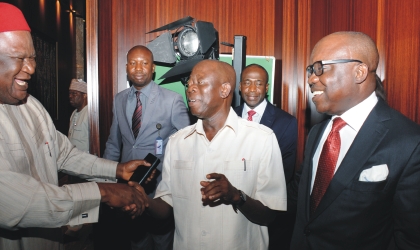
L-R: Secretary to the Government of the Federation, Senator Anyim Pius Anyim, Governor Adam Oshiomhole of Edo State and Governor Emmanuel Uduaghan of Delta State, during the meeting of President Jonathan with governors from oil producing states in Abuja, recently. Photo: NAN




The Hydrocarbon Pollution Remediation Project (HYPREP) has commemorated the 15th anniversary of the release of the United Nations Environment Programme (UNEP) Environmental Assessment Report on Ogoniland, reaffirming its commitment to restoring the environment and improving the livelihoods of affected communities.
In a statement signed by the Project Coordinator, Prof Nenibarini Zabbey, to commemorate the anniversary, HYPREP described the anniversary as a significant milestone in Nigeria’s environmental restoration efforts, noting that the project has made remarkable progress in implementing the recommendations of the landmark UNEP report released on August 4, 2011.
The UNEP report had revealed extensive oil pollution across Ogoniland, severe environmental degradation, and serious public health risks resulting from decades of petroleum operations. It also recommended an initial $1 billion fund to commence the cleanup of the affected communities.
According to HYPREP, the Federal Government formally launched the Ogoni clean-up in 2016, while the Project Coordination Office was established in 2017 to drive the implementation of UNEP’s recommendations.
Zabbey said the current administration has continued to prioritise the project under the Renewed Hope Agenda.
Providing an update on the cleanup, the Project Coordinator disclosed that 30 of the 65 contaminated sites identified by UNEP have been fully remediated, while work is ongoing at several medium- and high-risk locations. It also stated that more than 1.5 million mangrove seedlings have been planted as part of what it described as the world’s largest restoration of oil-degraded mangroves, with over 1,000 hectares of shoreline already rehabilitated.
Zabbey further revealed that 49 Ogoni communities have been connected to potable water schemes through multiple water projects and booster stations aimed at providing safe drinking water across the region.
In the health sector, he said the 100-bed Ogoni Specialist Hospital in Kpite and the 43-bed Cottage Hospital in Buan are nearing completion, adding that several existing health facilities have been upgraded with modern medical equipment, while five ambulances have been donated to improve emergency healthcare services. The Project Coordinator also disclosed that a three-year human health biomonitoring study is being conducted in collaboration with the World Health Organization’s International Agency for Research on Cancer (IARC).
On economic empowerment, Zabbey stated that the Project has created more than 8,000 direct jobs and trained thousands of Ogoni youths and women in various vocational and technical skills, including software development, cybersecurity, aviation, commercial diving, seafaring, mechatronics, and creative arts. The project also reported awarding scholarships to more than 1,000 students, providing grants to small businesses, and supporting persons living with special needs through skills acquisition programmes.
The statement further highlighted ongoing legacy projects, including the Ogoni Power Project and the Centre of Excellence for Environmental Restoration, which it said is about 96 per cent complete. HYPREP also welcomed the recent designation of the Ogoni Wetland as a Ramsar Site of International Importance and pledged to continue promoting biodiversity conservation and sustainable management of the ecosystem.
Marking the anniversary, Zabbey said the progress achieved over the past 15 years demonstrates the collective commitment of government, development partners, stakeholders, and local communities to restoring Ogoniland. He called for renewed collaboration to sustain the cleanup effort, promote environmental sustainability, and support the long-term development of the region. 3
-

 News2 days ago
RSG Targets Nine Million Residents in Mosquito Net Distribution Campaign
-

 Oil & Energy2 days ago
Aiyedatiwa Signs New Electricity Bill
-

 Oil & Energy2 days ago
NLNG Commissions Research And Innovation Centre In RSU
-

 Maritime2 days ago
Marine Minister Commends President Tinubu On NPERA Bill Assent
-

 News2 days ago
KenPoly Holds Eight Convocations, August 29
-

 News2 days ago
RSG Begins Another Phase of Projects Commissioning Today
-

 News2 days ago
RMAFC Completes Revenue Sharing Review, Proposes New Pay
-

 Maritime2 days ago
NAGAFF Petitions IGP Over Alleged Maritime Police Harassment