
Sports
No Framework For Sports Dev – Dr Anugweje

Sports in Nigeria has
over time elicited different reactions from different quarters – in fans, stakeholders and ordinary Nigerians. From the days of past glories to the abysmal performance of the country at the last Olympic Games.
With London 2012 and the recent triumphs of the Super Eagles at the 2013 Africa Cup of Nations and the Golden Eaglets at the Under-17 World Cup in the United Arab Emirates, UAE, Nigeria’s development and strides in the sports sector have been viewed from different windows.
However, a Medical Doctor, Dr Ken Anugweje, football coach, sports technocrat and administrator, a university teacher and one of the pioneer sports physicians in the country spoke to The Tide on the state of sports in Nigeria.
He delved into many aspects and x-rayed some of the major factors holding Nigeria back from advancing to the next level in sports development, expanding the frontiers of events and achievements and taking advantage of resources, human and material available to the country.
Dr Anugweje believes that the sports industry has grown in Nigeria in terms of facilities and athletes having the opportunity to become professionals, working and earning a living within and outside the country. But he stated that there are no yardsticks to measure or compare sports in different eras as most of the assumptions are in the realms of speculations.
“Generally, when people talk about sports and try to compare sports in decades past and now, they usually focus on achievements, for instance , what have the Super Eagles been able to win recently, what did they win the other time”. ‘No, I don’t see sports like that. There was a recent argument that if the class of 1994 Super Eagles were to be around today, they could have won the World Cup in Brazil. But there are very many differences between different eras that comparisons would be like comparing apples and oranges, it’s not really possible”, he said.
Currently, the sports technocrat, who has led the University of Port Harcourt to five consecutive Nigeria University Game, NUGA Victories and three West African Games. WAUG triumphs, believes that Nigeria is still dominating Africa in athletics, especially, the sprints with the Blessing Okagbares, Ogo Oghenevbkoros.
But we seem to be standing still in development, especially in other sports such as boxing, weight lifting, swimming, team sports and even football.
“That is where the problem lies”, said Dr Anugweje. “It is not that we have not been competing in those sports, it is not that we’re retrogressing, it may well be that we are standing still while other countries are moving ahead.
The point is that we don’t have the framework to develop sports in the country further than where it is . We don’t have the right policies. But whenever you ask the sports administrators what their challenges are, they’ll never tell you about policies, they’ll never tell you about framework, they’ll tell you about funding. If you sink all the money in the world into sports and you don’t have a clear-cut policy or framework, you’ll never succeed”.
He lamented that sports journalists, who are supposed to be pushing for developmental policies are stuck in some clichés, ‘Oh, we’ll get back to the drawing board”, Oh, we’ll return sports to the schools’.
Where is the drawing board, why can’t we get done with the drawing board? And where are the schools?, he asked rhetorically.
“School sports may have worked for us in the past, but they cannot work anymore, he said. “There are, for instance, 35 sports in this country in the National Sports Festival, are you telling me that you are going to employ 35 Coaches/Games Masters in the primary schools, or the secondary schools, it doesn’t work anymore.
‘Rather, what works now are special schools dedicated to sports, what we call sport schools and they call them academies in Europe and America.
‘So, if you have properly manned academies, not the ones people want to use and confuse others here, but properly manned academies, you can begin to make progress. An effective academy is run without compromising the progress education of such chaps. By the ages of five to seven most footballers are already in the books of clubs.
Somebody like David Beckham was in the books of Manchester United at the age of seven, Byan Giggs at 10, and Paul Scholes at nine, so that twice a week you go and get instructions/training at the highest level.
“If, for instance, former Sharks FC Coach, Mr Monday Sinclair decides to set up a football academy, he can take some of his former players to act as coaches and demonstrators and he’ll run an efficient academy.
If he wants a midfielder and feels that his former player, Rowland Orufe performed very well in that area, he could bring him in to manage that department. He could be working with only three or four players in that department.
On why sports academies in Nigeria do not do well, Dr Anugweje retorted, “There is no academy in Nigeria”. But when reminded that there are some organizations that go by that name, he said; ‘yes, if I call myself a king, does it make me a king? You hear about Arsenal Academy, Manchester United Academy, PSG, Real Madrid academies, you never hear about Itugo Samchez academy or SOI Campbell academy, that’s what I am talking about. No academy will ever succeed in any sport unless it is housed under a bigger umbrella such a club, that’s what I am saying. In football, you don’t just take a child and teach him only how to head or trap a ball, or the goalkeeper coach teach him how to dive. No, you must also inculcate decision making, so you need somebody who has played at a very high level in that position to rearrange the thinking of that player. What you find in Nigeria is about 30, 40 or more children under the tutelage of one or two persons .
Responding to a question on why Nigeria has failed to build on winning the Under-17 World Cup, a record four times, he said, “We have won the U-17 World Cup so many times now that we shouldn’t rejoice when we win it again, we should be looking up to higher things”. The reason why we have not taken our U-17 success to the senior team could be (1) That our players do not develop the way we expect they ought to the top level. Then, you ask, why don’t they develop? Is it that they are too old?. Is it that when they won the U-17, they played against younger players?
Remember that each time we had won the U-17 competition our opponents usually complain that they were playing against men and not boys, it cannot be a coincidence, we must look into it.
Regrettably, the countries that often do well at the world cup proper are those that hardly excel at the U-17 level. They see age group competition as developmental, they are not desperate to win”.
“Our Eaglets may have been playing against youngsters who were still growing, that’s why those we beat then progress to their national teams and remain consistent.
‘You see, the thing about age in sports is that between the ages of 20 and 23, every human being would have reached the end of growth, so there is no physical difference anymore. That is why no matter how we tried, we hardly won the U-20 World Cup, because once it gets beyond that, then nothing, all advantages are eliminated, even if you field a 40 year-old”.
He blamed the press for being part of the problem and pressure that make Nigerians see youth competitions as very big deals.
“I blame the press. There is no reason for the press to report an Under -17 match. Go to any Newspaper in England and America, you’ll never see any report more than a tiny writing on the bottom page of a newspaper mentioning just the score of an U-17 match. But here, when they are called to camp, the press follow them around, and everybody thinks it is an important competition. It is elevated to something very big.
‘The European countries we beat assemble themselves two-three weeks to competition because they’re not going with the mind set to win, it is a developmental process. When per chance they win and return to their country, no fanfare. The boys from Switzerland that won the U-17 in 2009 in Abuja, were given only wrist watches and handshakes with their president. Today, where are they? They form the bulk of the 2014 World Cup in Brazil.
‘Where are our own boys? Where is Stanley Okoro and the rest of them? The Spain team going to the 2014 World Cup has players from the World Youth Championship, WYC, Nigeria ’99, the only Nigerian player they may recognise is Joseph Yobo. My friend John Aranka, who was in the Flying Eagles of 1999, I saw him the other day, if you are told that he played with Iker Casillaso, Andrew Iniesta, Ashley Cole etc, you’ll not agree, will you”? he asked.
The Doctor also discussed swimming and why Nigeria has not been getting it right. According to him, there is no racial influence in swimming and the belief that blacks are not suited for the sport is misleading.
“They talk about physique, that the Europeans and Americans are best suited to swimming, they talk about buoyancy, that the whites have higher percentage of red muscles than blacks and all that. But the point about swimming is that there are evolutions to get the perfect body shape, anthropometry for every sport.
‘For swimming the required shape is a tall spindly person with broad arms, long legs and big feet big feet are very important because those feet act like a paddle for the swimmer, that is the general concept. Then secondly, you don’t become a good competitive swimmer because you come from a riverine area, that is a big misconception.
‘Michael Phelps of USA does not come from a riverine area and most top swimmers in the world are not from such areas. The point is, how early are you exposed to water. If a growing boy with the description I have given lives next door to a swimming pool, he becomes a swimming champion.
‘Nobody learns swimming in the river or ocean but we were doing that here because we never had swimming pools, so, the earlier swimmers came from where the children were exposed to water. But, the typical Ijawman is endomorphic (rounded shape, with grace and elegance like a king) and a typical swimmer has the physique of General Muhammadu Buhari, broad shoulder, tall, long arm and legs, that is the concept.
‘So, if the Blacks in America have the same mindset and time as the Whites and take their little kids to the pool, they may turn out to be good swimmers, it has nothing to do with black or white”.
Dr Anugweje further debunked the cliché, ‘comparative advantage in sports, saying that nothing prevents one from venturing into any sport provided you have the coaching and you can afford the facility. “Who says that if you go to Hausa land, you cannot get children who can partake in Equestrian sport, the Royal children in England used to represent England in equestrian sport because they are exposed to horses early, just like the northerners, Fulanis. But here our people are not interested in sports.
‘So, there’s nothing like comparative advantage in sports, it depends on your policy, focus and commitment. If our prisons were better organised, the little kids they send to prison or remand homes could provide us with a large pool of boxers in this country. For every sport, you need to have the innate talent before you can develop it, and the talent for boxing is just very simple, the ability to inflict pain on somebody and the ability to receive and bear pain. Check the history of American Sports.
Particularly, boxing, virtually all their eminent boxers came from the prisons or ended there, the Sony Listons, Mike Tysons etc. They go in and out of prison because they are naturally bullies and can bully opponents into submission”.
“Look at South Africa during the Apartheid era, the blacks there focused mainly on boxing and most black world boxing champions you had in Africa came from South Africa. A small community in Accra, Ghana called Bukuon has had more than 10 World Boxing Champions because it is a rough neighbourhood. There used to be a rickety ring in the centre of the settlement and whenever children were fighting they were given gloves and pushed into the ring, so through the fights, they develop.
‘Now, the Kenyans are coming, they are entering into new areas in athletics apart from the long distance races. They are now doing the 400 and 200 metres because they have discovered that their Luwo tribe are like us, with thick white muscles, while leaving the Masais to concentrate on long distance. So, when you find out such people, you channel them into the sports they are suited for”.
He called on the authorities in Rivers State to pay special attention to the youth and people of Okrika because of their inherent sports talent.
“I have always told people in this State (Rivers) that they are wasting time not focusing on Okrika. There must be a large gene pool in Okrika because it is not by coincidence that the Owubokiris, Amiesimakas, Dakas. Atorudibos, Iworimas, Kios, Dikibos, Inyengiyikabos etc came from that area. In 1999, when I won gold medal for University of Port Harcourt in the WAUG in Benin Republic over 60 per cent of my teams starting line up were Okrika boys, ThankGod Fibika, the Okiri brothers, etc and I didn’t care. ‘So, there must be something there, either genetically or in their diet, we must go there to find out, there is nothing like comparative advantage, it is what you put in that you’ll get out”.
Reacting on what should be done to unearth and recreate the Chidi Imos, Innocent Egbunikes, Mary Onyalis. Falilat Ogunkoyas et al of yore, Dr Anugweje said, “There’s nothing we can do, when those people were performing at their level, the rest of the world was also grooming their own athletes in the same way. Now, they have changed and we are still doing things the same old way. We have to embrace the modern ways, adopt and execute our policies and the talents would come through.
‘What we are saying is, what are the sports associations, coaches doing? Here, for instance, you’ll hear that Super Eagles Coach, Stepten Keshi should go and look for talents, and I ask, which talents?
‘It is the responsibility of State Sports Associations to call national coaches and say, look, in this area under my jurisdiction, there’s a chap you should have a look at. I’m sure you’ve heard of a certain Arsene Wenger calling England Coach, Roy Hodgson that Jack Wilshere was ready for the World Cup. If we bring it down here, that is what it ought to be. You groom somebody and then call the authorities’ attention to the talent”.
On the continued relevance of the National Sports Festival, NSF, Dr Anugweje said that the concept of the NSF is good but the execution has been faulty.
“In 1995, I made a proposal about National Championship”, he said. “What I proposed was to run manageable competitions that would be very productive, for instance, you have 30 sports, you take 10 or five events to Lagos, another 10 or five to Enugu, another set to Port Harcourt and so on and they compete under a controlled atmosphere. At the end of it all, you can add all the medals from the different venues and announce the state that has won, if you must.
In that way, the states that hosted the different events would have used the opportunity to develop their facilities and the standard of competition would be very high.
‘The NSF as it is currently, is like madness, so many people at a place at the same time, so many problems, issues, it is like a jamboree. Most people go there to eat, drink and merry. The policy of competing at the festival is good but the execution is poor, also, the criteria are not very clear. You have states parading athletes they did not groom, leading to the highest bidder having the upper hand, that does not augur well for proper development.
‘In fact, the only state developing sports now in Nigeria is Cross River. They are doing good things at the grassroots level and have won the school sports competitions in recent times by a mile. They also won the recent National Youth Games by a mile. All the little boys, who are bullies are now boxers in the state. They have a Cuban coach and Cuba is the best in amateur boxing in the world, their boxers fought in all the finals in the last schools sports competition.
So, you see how the people are moving, that is the way to go”.
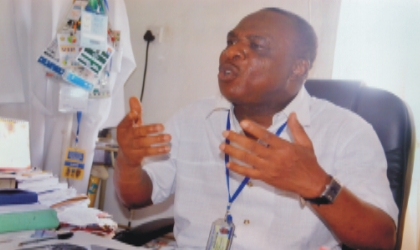
Dr Anugweje explaining a point during the interview. Photo: Chris Monyanaga



Brian Brobbey scored a dramatic 90th-minute winner as Sunderland came from behind to beat Newcastle United in a thrilling Tyne-Wear derby at St James’ Park.
Newcastle had been on target for their first home victory in this fixture since 2010 when Anthony Gordon gave the hosts a ninth-minute lead.
Sunderland played out from the back but defender Luke O’Nien’s pass was intercepted by Nick Woltemade and he gave it to Gordon, who did the rest to score his 17th goal of the season.
The hosts almost made it 2-0 just before the break, but Sven Botman headed against the post following a cross from left-back Lewis Hall, one of five Newcastle players to be included in Thomas Tuchel’s latest England squad.
Goalkeeper Aaron Ramsdale, another called up by Tuchel, did not get great distance on a punch, the ball was played back into the box, Brobbey chested it goalwards and Dan Burn cleared off the line, only for Chemsdine Talbi to fire in the rebound.
Noah Sadiki had a chance to put Sunderland ahead, only for him to shoot at Ramsdale.
Yet it did not prove costly as Brobbey scored the late winner, to the delight of the away fans, when he converted a rebound from close range after Ramsdale saved his first attempt.
The result gives Sunderland their first league double over Newcastle since 2014-15.

Rangers International technical adviser Fidelis Ilechukwu has credited his recent stint with the Super Eagles under head coach Eric Chelle as a major factor behind the club’s resurgence in the Nigeria Premier Football League title race, Tidesports source reports.
Speaking ahead of Rangers’ matchday 31 fixture against El Kanemi Warriors in Enugu, Ilechukwu said the experience gained at international level has significantly influenced his approach, particularly in the areas of intensity, discipline and overall team structure.
“Change is constant in life. After working closely with Eric Chelle, the mentality I got from him is not an easy one. The training sessions are super intense, about 80 per cent of what we do now is heavy training,” he said.
Ilechukwu maintained that the discipline and structure he adopted during his time with the national team have translated directly into improved performances at the club level.
“I think my return has had a positive impact defensively, offensively, everything. The preparation, the pep talks, the quality, it gives confidence. I came back with an advantage,” he said.
Rangers have enjoyed a remarkable run since his return from the 2025 Africa Cup of Nations, losing just once in 11 matches, with six wins, four draws and seven clean sheets propelling them firmly into contention.
They currently sit second on the table with 50 points, just one behind leaders Rivers United, with eight matches remaining in the season.
Despite their strong position, Ilechukwu insisted his side will not be weighed down by pressure as the title race intensifies.
“There is no different message, we don’t want to be under pressure because of the league. We take it one game after the other, after this game we talk about the next one,” he said.
He added that his players possess the necessary qualities to compete at the highest level.
“They understand what it takes to win. They have the attitude, the capacity, the character, and they understand what we want. To me, we are always ready,” he said.
While acknowledging the strength of Rivers United, Ilechukwu maintained that the title race remains open heading into the final stretch of the campaign.
“They are the strongest team, but you never can tell what will happen. We are also strong. In the remaining games, we will fight more and stay at the top of our game but without pressure,” he said.
Having guided Rangers to the NPFL title in the 2023/24 season, Ilechukwu is now aiming to secure his second league crown in three years as the Enugu side continue their pursuit of the title.

Odegbami described CAF’s decision to overturn the Jan. 18 final result as “bizarre, condemnable and unjustifiable.”
As reported by Tidesports source on Saturday, he noted that Senegal were crowned champions and celebrated globally before the verdict was reversed on technical grounds.
“It is unheard of in football history. You cannot take away a trophy won on the pitch two months after,” he said.
Odegbami said the decision had sparked outrage among football fans and stakeholders worldwide.
“This judgment has shaken CAF’s credibility. It is not surprising the world is up in arms,” he added.
The ex-Nigerian Football Legend questioned the motive behind the decision, describing it as risky and unpopular.
“What could have driven such a decision that undermines the spirit of the game?” he asked.
Odegbami said although football regulations may not cover every situation, rare cases require wisdom.
“This AFCON case demands that rules and common sense must align,” he said.
He recalled that Senegal were crowned by CAF and FIFA officials before a global audience.
“Two months later, CAF delivered what I call a ‘poisoned verdict’ through its Appeals Committee,” he said.
Odegbami explained that Morocco’s protest, earlier dismissed, was later upheld on appeal.
“The decision to reverse a final match result is one of the most unpopular ever,” he said..
He said the rules on walkouts are clear but must be applied with context.
According to him, Senegal players walked off after a late penalty was awarded to Morocco, staying away for 17 minutes.
“Ordinarily, that attracts forfeiture, but the referee allowed play to resume, which changed everything,” he said.
Odegbami noted that petitions can alter results but argued that the AFCON final was different.
“If this were a qualifier, nobody would question the CAF’s decision. But this was the final,” he said.
He stressed that the trophy had been awarded and celebrations concluded before the reversal.
“There was no room for post-match litigation in a final of this magnitude,” he said.
Odegbami maintained that the referee’s decision to restart play nullified the forfeiture clause.
“The match resumed, Morocco missed the penalty, Senegal scored and won fairly,” he said.
He insisted that CAF had no justification to overturn the result after recognising a winner.
“Punish any infractions if necessary, but do not tamper with a concluded final,” he said.
Odegbami urged CAF to review its regulations and restore Senegal as champions.
“For now, CAF should retrace its steps and return the trophy to Senegal,” he advised.