
Nation
THE STATES

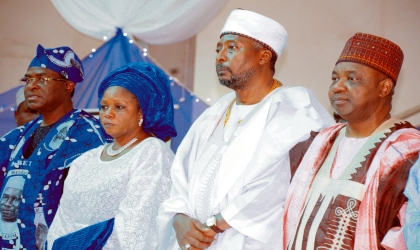
L-R: Governor Isa Yuguda of Bauchi State, widow of the former Governor of Kaduna State, Mrs Amina Yakowa, chairman of the occasion, Alhaji Manir Ja’afaru and Vice President Namadi Sambo, at the one year Memorial Anniversary of the former Governor in Kaduna last Saturday. Photo: NAN
Benue
The Benue State Coordinator, All Farmers Association
of Nigeria (AFAN), Mr Kunti Adamu, has called on the government to provide loans and inputs to farmers, to assist them to embrace mechanised farming.
Kunti made the call in an interview with newsmen last Thursday in Makurdi.
He stated that if loans were given to farmers, this would encourage them to venture into large-scale farming, to boost food production in the country.
He also appealed to the government to organise workshops on quarterly to educate farmers on the latest developments in the agriculture sector.
Ekiti
The Director-General, Ekiti State Council for Arts and
Culture, Mrs Yetunde Fosudo, has lamented non-participation of states and low turn-out of foreign countries at the ongoing 2013 Ekiti Festival.
Fosudo told newsmen in Ado-Ekiti on the sideline of the ongoing festival that only two countries and 16 local governments were at the festival.
She said that only Senegal and Mali were participating in the festival, adding that she was disappointed with the low turnout of foreign participants.
Fosudo also expressed concern about the non-participation of states.
“There is no single state that participated in this year’s edition of the festival,’’ she said.
FCT
Three drivers were arraigned before a mobile court in
Abuja, charged with various road traffic offences.
The drivers are Nurudeen Kareem of Mpape, Abuja, and Samaila Mohammed of FCDA Quarters, Garki, Abuja and Alfred Sunday, an official of Zenith Bank, Garki, Abuja.
Kareem was charged with driving an overloaded vehicle, Mohammed was charged with driving without fastening the seatbelt, while Sunday was charged with using his mobile phone while driving.
All the accused pleaded guilty to the offences and the magistrate, Mr Emmanuel Iyana, ruled that the offenders should pay N10,000, N5,000 and N4,000 fines respectively or have their cars impounded.
Kaduna
Northern artists in the country last Thursday converged
in Kaduna to celebrate creativity of the music industry in the North.
The event that was organised by Top Entertainment attracted fun-loving people from across the city.
Artists that performed at the event are, Emilly, Henzee, Marvellous, Skinny Boy, and comedian Mc Basket Mouth.
Mr Ibrahim Jika, Chief Executive Officer of Top Entertainment, told newsmen that the idea was to bring music promoters, marketers and upcoming artists together to give young artists the opportunity to exhibit their talents.
Katsina
Governor Ibrahim Shema of Katsina State last Thurs
day signed a law which prescribed 14 years’ imprisonment, without option of fine, for those found guilty of homosexuality, lesbianism and sexual harassment.
The State House of Assembly recently amended Sections 284 and 285 of Penal Code Law, Cap. 96, Laws of Katsina State, 1991, to provide for stiffer punishment for those found engaged in the illegal acts.
The law states: “Whoever has carnal intercourse against the order of nature with any man, woman or animal, shall be punished with 14 years’ imprisonment and liable to N10,000 fine.
“Any woman, who employs means of satisfying her sexual desire through bodily contact with another woman or otherwise, with or without her consent, shall be liable to 14 years’ imprisonment together with N10,000 fine.
Kebbi
The Kebbi State Ministry of Environment said last Thurs
day that it would conduct an environmental audit to ensure compliance with Environmental Impact Assessment guidelines.
The Permanent Secretary in charge of the ministry, Alhaji Sanusi Katune, gave the hint in an interview with newsmen in Birnin Kebbi.
Katune observed that many construction companies failed to comply with the legal requirements of conducting Environmental Impact Assessment (EIA) before executing their projects.
Lagos
The Petroleum and Natural Gas Senior Staff Association
of Nigeria (PENGASSAN) says the delay in the enactment of the Petroleum Industry Bill is crippling investments in the oil and gas sector.
The National Public Relations Officer of PENGASSAN, Mr Oluseyi Gambo, made the observation in an interview with newsmen last Thursday in Lagos.
He said the inaction on the bill had limited foreign investment in the industry.
Gambo said the association was optimistic that the bill would become a law to fast track development in the oil and gas sector.
Nasarawa
Nasarawa State Government has called for support from
Lafia Emirate Council in its effort to tackle the problem of erosion and flooding in the state.
The state Commissioner for Environment and Natural Resources, Alhaji Adamu Muazu, made the call during a courtesy call on the Emir of Lafia, Dr Isa Mustapha, in Lafia last Thursday.
Muazu said the recent disaster prompted him and his management team to embark on advocacy visit to the Emir of Lafia and the affected areas, to find solution to the problem. At the emir’s palace, Muazu said he came to seek for royal blessings and support from the emirate council to curb the problem of flooding that had ravaged the metropolis.
Niger
A Minna Chief Magistrates’ Court last Thursday ordered
the remand in prison custody of a 17 year old student, Abubakar Suleiman for act of indecency.
The accused was arraigned in court on a one count charge of act of gross indecency contrary to Section 285 of the Penal Code. The Prosecutor, Sgt. Gunduma Ibrahim, had told the court that one Rabia Ibrahim, of Sani Mambo Street, Suleja, reported the matter at the station on December 1.
Ibrahim said that on November 30, the accused entered the complainant’s residence and met her three years old daughter inside the house.
Ondo
Governor Olusegun Mimiko of Ondo State last Thurs
day said the state government had taken steps to ensure that farmers enjoyed the full benefits of cocoa production.
Mimiko made this known when he was honoured as the Nigeria Cocoa Ambassador by the Cocoa Farmers Association of Nigeria (CFAN).
The association also recognised the Minister of Agriculture, Dr Akinwumi Adesina, as a merit award recipient.
Mimiko, who thanked CFAN for the honour, said efforts were on to ensure that farmers were not short-changed in the entire cocoa chain, production to marketing levels.
Osun
An Osogbo Grade II Customary Court last Thursday
dissolved a 22-year-old marriage between Ruth Abimbola and her husband, Elijah on grounds of unfaithfulness and marital unrest.
The President of the court, Chief Bolarinwa Popoola, who dissolved the marriage, held that the respondent’s absence in court was an indication that he had no interest in the relationship.
“The marriage, is therefore, dissolved and the court grants the custody of the four children to their father as they are of age,’’ he ordered.
Oyo
An Ibadan-based lawyer, Mr Muhammed Jubril, last Thursday urged the National Assembly to enact laws that would make the Economic and Financial Crimes Commission (EFCC) completely independent.
He made the call, while speaking with newsmen in Ibadan.
Jubril said that the EFCC, since its establishment in 2003, would have performed better without undue interference from the Federal Government.
“Unfortunately, the EFCC is today seen as a tool in the hands of the government to hunt a selected few who are not in the good books of the government.
Zamfara
A Base Ammunition Depot of the Nigerian Army, Gusau, said it had repatriated 226 foreign donkeys to Niger Republic.
The Commandant of the depot, Major Hamman Saleh, told journalists while loading the donkeys at the Tsafe military check point, Zamfara, that the donkeys were intercepted in the bush on Monday along with their 49 owners.
Saleh said due to the security challenges in the country, the donkeys and their owners were apprehended and searched to detect possible concealed weapons.
He, however, said that only axes and cutlasses were found in their possession, adding that the intruders, however, gained entry into the country illegally.

Rivers state Deputy Governor Professor Ngozi Nma Odu has commended “The Port Harcourt City One Love,”a Port Harcourt based humanitarian orgnisation For it’s commitment towards alleviating the sufferings of the poor and vulnerable in the society.
Professor Ngozi Nma Odu said this while speaking at this year’s edition of “operation feed the needy” a yearly outreach program of “The Port Harcourt City One Love ” in Port Harcourt.
The Deputy Governor said by feeding more than sixty thousands hungry people within the past six years, the Port Harcourt City One Love Movement has distinguished itself as a club that cares for the less privilege in the society.
She commended the , organization for listing eleven thousand persons to be fed in the current exercise.
Meanwhile The Port Harcourt City One Love has planned a permanent solution to the problem of feeding the poor in the state.
The leader of the group Mr Idaere Gogo Ogan who said this in an interview with newsmen during the distribution of food items to the poor and vulnerables in Port Harcourt said the organization is planning a permanent food kitchen where poor and vulnerable persons can work in anytime and get fed.
Idaere Gogo Ogan said more than sixty thousands poor and vulnerable persons across Port Harcourt City and environs have been fed since the inception of “The operation feed the needy” program six years ago,adding that so far sixty thousands poor and vulnerable persons have beneffited.
He described the group as a platform to promote friendship, brotherhood, community development empathy and feeding the less privilege and hungry people
“That’s what we are doing today here,so we started the exercise six years ago”.he said.
Ogan said the effort was a private sector driven initiative but added “it also involves people in Government because the platform does not recognize any division,we bring everybody together in unity , friendship and brotherhood”he said.
He said the effort will go along way in alleviating hunger especially following the prevailing hunger in the country.
According to him “you know the country is very tough, people are hungry people are starving, there is a whole lot of economic hardship,so for us, this is just our own way of reaching out, our own social contribution to what is very difficult”he said.
Over eleven thousand persons were fed in the just concluded exercise.
Areas of coverage include, Isaac Boro park, Port Harcourt prison/Macoba, Borokiri/Enugu waterside Bundu areas Waterlines and others.
Some of the beneficiaries including an 80 years old widow commended the movement for the annual programm and urged other organizations to emulate them
John Bibor,/Esuuk Oyet/Suotor Memoye /Jeremiah Hannah
Nation
We’ll Partner Private Sector to Industrialize Rivers State – Fubara …Hints Revitalization of Ahoada, Trans Amadi Industrial layout

“Inclusive growth requires access to capital and the right conditions for businesses to deploy that capital effectively. Women-led enterprises are critical to economic activity, yet they face structural barriers.
“This intervention aims to help close that gap by providing financing that supports job creation, business expansion, and long-term sustainability for women entrepreneurs”, Edun said.
Group Head, SheVentures and Impact Segments at First City Monument Bank (FCMB), Nnenna Jacob-Ogogo said access to affordable finance remains a major constraint for women entrepreneurs.
-

 Featured5 days ago
WASSCE: RSG Distributes Science Materials To Secondary Schools
-
Sports5 days ago
Football Pundit Lauds Chelle’s Effort In Monitoring Nigeria League Players
-
News5 days ago
RSG Reaffirms Commitment To Quality Education
-

 Niger Delta5 days ago
Fubara Charges Graduands On Discipline, Professionalism … As IAUE Holds 44th Convoc
-

 News1 hour ago
Afenifere Raises Alarm Over Attacks On Oyo Schools …Says Yorubaland Now Under Siege
-

 News2 hours ago
Fubara, Wife Hail Tinubu’s Renewed Hope Initiative …As Over 6,800 Families Benefit From Largesse In Rivers
-

 News1 hour ago
FG To Unveil Radio Station For Adult Education
-

 News1 hour ago
Isaac Boro Memorial: N’Delta Still Bleeds For Justice -MOSIEND