
Nation
THE STATES

Adamawa
A People’s Democratic Party (PDP) Board of Trustees
member, Prof. Jibril Aminu, last Monday, called for provisions in the constitution to check defection by elected political office holders in the country.
Aminu, a former Senator, said at a rally in Yola that the ongoing constitution review should consider forcing elected office holders to leave office whenever they defected from the party that brought them to office.
He also called for the removal of immunity clause and the inclusion of stiffer penalty for corruption practice.
Ekiti
The Director-General, Ekiti State Centre for Arts and
Culture, Mrs Yetunde Fosudo, said that cultural festivals could be utilised to enhance the wellbeing of the people.
She said this in an interview with newsmen in Ado-Ekiti.
Fosudo said that cultural festivals were a potent means of celebrating the people and their cultural heritage.
“Culture is a way of life of the people and their communities.
“Cultural festivals serve as means whereby people display and showcase their culture and ways of life to the world,’’ she said.
FCT
The Registrar-General, Corporate Affairs Commission
(CAC), Alhaji Bello Mahmud, said in Abuja that the CAC’s goal was to be able to register companies within two hours, anywhere in Nigeria.
Mahmud in a lecture: Nigeria’s New Business Environment and CAC’s Intervention,’’ said it had been able to reduce the period of registration of companies from five days to 24 hours.
The registrar-general, at the 3rd Annual Seminar for Trade and Investment Correspondents and Editors, said that its activities had helped to expose “the wonder banks“ in the country.
“Our collaboration with the EFCC, the Central Bank of Nigeria (CBN) and other financial agencies have exposed over 370 `wonder banks` out of 400 ones that were investigated.
Gombe
The Gombe State Government has empowered 233
trainees in various skills with equipment and funds in Dukku and Yamaltu-Deba Local Government Areas of the state.
The beneficiaries were trained under the Conditional Cash Transfer (CCT) scheme of the Millennium Development Goals (MDGs) Office.
Special Adviser to Governor Ibrahim Dankwambo on MDGs, Alhaji Adamu Audi, announced this at the graduation ceremony of the trainees in Deba, headquarters of Yamaltu-Deba Local Government Area.
Jalingo
The Industrial Training Fund (ITF) last Monday said that
it had trained 1000 youths on welding, cell phone repairs and yam flour processing in Taraba.
The ITF Area Manager, Yola Office, Alhaji Saleh Garba, said in an interview in Jalingo that the training started in September and was held in Jalingo, Wukari and Bali local government areas.
Garba said that the objective of the training was to empower the youths to start their own businesses so as to reduce attention on civil service.
“The reality is that there is too much competition in acquiring a public service job these days.It is in the interest of the youth to embrace entrepreneurship; by so doing, they will certainly be self-reliant,” Garba said.
Jigawa
A member representing Dutse Constituency in Jigawa State House of Assembly, Alhaji Adamu Sada, has donated an 18-seater Peugeot bus to people with disabilities in the state.
Sada, who was on wheel chair while presenting the bus, said the gesture was to ease the peoples’ movement.
He said “the bus donation will ease the movement of my brothers and sisters that were living with disabilities like me.’’
The lawmaker said movement was one of the greatest challenges of such group of persons, adding that the bus would enable them to move freely within and outside the state.
Kaduna
Vice President Namadi Sambo has described late former
Governor Patrick Yakowa of Kaduna State as selfless and patriotic leader.
Sambo said this at a one-day public lecture to commemorate the first year memorial of the former governor.
He said Yakowa rendered patriotic service to the state and country as a whole. “He dedicated his entire life to the advancement of mankind.’’
“He brought to bear his experience on any assignment given to him’’, he added.
Sambo said the gathering of personalities from all walks of life was a testimony of the lives Yakowa touched positively throughout his life time.
Kano
Some former employees of Nigeria Airways in Kano State
staged a peaceful protest over non-payment of their entitlements for 20 years.
The protesters, who thronged their former office on Bank Road in Kano at about 2p.m., carried placards with inscriptions as: “pay us our entitlements’’, “we are dying.’’
The National Vice Chairman, Nigerian Union of Pensioners, Airways Branch, Alhaji Mohammed Adamu, said the protest was informed by the failure of the Government to pay their entitlements.
According to him, over 900 of their members have so died of frustration while a number of them are still battling with one sickness or the other at home.
Kwara
Not less than 1, 755 teaching and non-teaching staff,
across the 16 local government areas of Kwara State, converged on Ilorin to sit for the 2013 promotion examination.
The Executive Chairman, Kwara State Teaching Service Commission, Alhaji Umar Aboki, told newsmen that the promotion examination was to ensure that the teachers were able to impart quality knowledge on their students.
He said that the conduct of promotion examinations was a constitutional provision.
“This is a democratic government where every segment of the society should benefit from the dividends of democracy.
“Through promotion, civil servants would benefit from the dividends of democracy,” he said.
Lagos
A former Chairman of the Lagos chapter of the Nigerian
Institute of Public Relations (NIPR), Mr Jide Ologun, has urged the electorate to ask politicians credible questions about the 2015 election.
Ologun spoke with newsmen in Lagos recently.
“Definitely, the elections will hold but I am appealing to the electorate to ask questions concerning where Nigeria will be in 20 years.’’
Nasarawa
The Nasarawa State Government in collaboration with
the Industrial Training Fund (ITF) said 1000 youths were trained on various vocational skills under the National Industrial Skills Development Programme (NISDP).
Governor Umaru Al-Makura made this known at the graduation of the trainees in Wamba on Monday.
Al-Makura said the state government was poised to curb restiveness through a robust youth empowerment programme.
He said that vocational skill acquisition was crucial to the nation’s transformation agenda, adding that it would engender a technology-driven economy and fast track diversification from oil.
The governor said the youth were trained in furniture making, welding and fabrications as well as electrical installation.
Osun
Governor Rauf Aregbesola of Osun State last Monday
presented a bill for the creation of 27 additional local government development councils in the state to the state House of Assembly.
Presenting the bill, Aregbesola said the essence of the creation of more councils was to bring government closer to the people at the grassroots.
He said that the current councils in the state could not bring the desired results.
The governor said this was because they were too large to achieve what the administration intended to achieve through the councils.
Oyo
The National Missioner, Ansar-ud-deen Society (ADS),
Sheikh Abdur-Rahman Ahmad, has declared that the Boko Haram insurgency is a collective embarrassment to all faiths in the country.
Ahmad, who spoke with newsmen, in Ogbomoso, Oyo State, said the group represented no religious interest, adding that their objective had yet to be known.
He said that it was difficult to know in whose interest they were fighting as they had attacked all faiths.
“I state unequivocally that Islam is different from Boko Haram. We don’t know who they are, their sponsors and why they are killing people.
Sokoto
The All Farmers Association of Nigeria (AFAN), Sokoto
State chapter, said it had concluded plans to start giving tractors to large-scale farmers in the state as loans.
The Chairman of the association, Alhaji Murtala Gagado, made the disclosure in a telephone interview with newsmen in Sokoto State.
He said the association, in conjunction with a Kaduna-based firm, Kaka Nigeria Ltd., was set to give out 50 tractors, worth N340 million, to large-scale farmers as loan.
According to him, each tractor will be given to the beneficiaries on loan at the cost of N6.8 million.
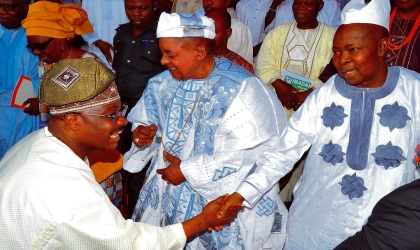
L-R: Governor Abiola Ajimobi of Oyo State, Alafin of Oyo, Oba Lamidi Adeyemi 111 and Aare Musulumi of Yorubaland, Alhaji Abdulazeez Arisekola-alao, at a reception to mark Governor Ajimobi’s 64th birthday in Ibadan last Monday.
Photo: NAN




The Hydrocarbon Pollution Remediation Project (HYPREP) has commemorated the 15th anniversary of the release of the United Nations Environment Programme (UNEP) Environmental Assessment Report on Ogoniland, reaffirming its commitment to restoring the environment and improving the livelihoods of affected communities.
In a statement signed by the Project Coordinator, Prof Nenibarini Zabbey, to commemorate the anniversary, HYPREP described the anniversary as a significant milestone in Nigeria’s environmental restoration efforts, noting that the project has made remarkable progress in implementing the recommendations of the landmark UNEP report released on August 4, 2011.
The UNEP report had revealed extensive oil pollution across Ogoniland, severe environmental degradation, and serious public health risks resulting from decades of petroleum operations. It also recommended an initial $1 billion fund to commence the cleanup of the affected communities.
According to HYPREP, the Federal Government formally launched the Ogoni clean-up in 2016, while the Project Coordination Office was established in 2017 to drive the implementation of UNEP’s recommendations.
Zabbey said the current administration has continued to prioritise the project under the Renewed Hope Agenda.
Providing an update on the cleanup, the Project Coordinator disclosed that 30 of the 65 contaminated sites identified by UNEP have been fully remediated, while work is ongoing at several medium- and high-risk locations. It also stated that more than 1.5 million mangrove seedlings have been planted as part of what it described as the world’s largest restoration of oil-degraded mangroves, with over 1,000 hectares of shoreline already rehabilitated.
Zabbey further revealed that 49 Ogoni communities have been connected to potable water schemes through multiple water projects and booster stations aimed at providing safe drinking water across the region.
In the health sector, he said the 100-bed Ogoni Specialist Hospital in Kpite and the 43-bed Cottage Hospital in Buan are nearing completion, adding that several existing health facilities have been upgraded with modern medical equipment, while five ambulances have been donated to improve emergency healthcare services. The Project Coordinator also disclosed that a three-year human health biomonitoring study is being conducted in collaboration with the World Health Organization’s International Agency for Research on Cancer (IARC).
On economic empowerment, Zabbey stated that the Project has created more than 8,000 direct jobs and trained thousands of Ogoni youths and women in various vocational and technical skills, including software development, cybersecurity, aviation, commercial diving, seafaring, mechatronics, and creative arts. The project also reported awarding scholarships to more than 1,000 students, providing grants to small businesses, and supporting persons living with special needs through skills acquisition programmes.
The statement further highlighted ongoing legacy projects, including the Ogoni Power Project and the Centre of Excellence for Environmental Restoration, which it said is about 96 per cent complete. HYPREP also welcomed the recent designation of the Ogoni Wetland as a Ramsar Site of International Importance and pledged to continue promoting biodiversity conservation and sustainable management of the ecosystem.
Marking the anniversary, Zabbey said the progress achieved over the past 15 years demonstrates the collective commitment of government, development partners, stakeholders, and local communities to restoring Ogoniland. He called for renewed collaboration to sustain the cleanup effort, promote environmental sustainability, and support the long-term development of the region. 3
-

 News2 days ago
RSG Targets Nine Million Residents in Mosquito Net Distribution Campaign
-

 Oil & Energy2 days ago
Aiyedatiwa Signs New Electricity Bill
-

 Maritime2 days ago
Marine Minister Commends President Tinubu On NPERA Bill Assent
-

 Oil & Energy2 days ago
NLNG Commissions Research And Innovation Centre In RSU
-

 News2 days ago
KenPoly Holds Eight Convocations, August 29
-

 News2 days ago
RSG Begins Another Phase of Projects Commissioning Today
-

 News2 days ago
RMAFC Completes Revenue Sharing Review, Proposes New Pay
-

 Maritime2 days ago
NAGAFF Petitions IGP Over Alleged Maritime Police Harassment