
Politics
Still On Life Pension For Politicians


In recent times, some state houses of assembly moved for the process of enacting legislation to provide monthly life pensions for legislators.
Houses of Assembly in Kano and Bayelsa States have even passed a bill to that effect and the bills are awaiting governors’ assent.
Bayelsa House of Assembly proposes N500, 000 monthly pension to the Speakers of the assembly, Deputy Speakers; N200, 000 each and members N100, 000 each, although Governor Seriake Dickson of the State has yet to assent to the bill.
Kano State House of Assembly has a similar bill awaiting Governor Abdulahi Ganduje’s assent, while Ekiti State House of Assembly is reported to have been working in that regard.
Although none of the state governors has approved the bill, the proposed law continues to attract reactions from the public.
A large segment of the public notes that any push to make the bill for life pension for political office holders will prompt other states and Federal Government to do same to the detriment of the masses.
A stalwart of the Abundant Nigeria Renewal Party, Mr Sesugh Akume, says it is inappropriate for some political office holders to institute a pension scheme for themselves after leaving office.
He explains that political positions ought to be a privilege and opportunity to serve the people and not as a career one can retire with a pension.
“The idea of severance packages and life pensions for elected officials is wrong and without merit,’’ he observes.
In his view, an economist, Prof. AbdulGafar ljaiya, says paying life pension to political office holders will cripple the anti corruption campaign of the present administration.
Ijaiya, from University of Ilorin, insists that political office holders, irrespective of years they occupy offices, do not qualify for pensions under the constitution.
“The political office holders taking pensions are thieves and corrupt officers who are retarding the nation’s economic growth and development,’’ he says.
Ijaiya is of the opinion that majority of the politicians has retired from their primary job where they draw pensions.
Similarly, financial experts, Mr Adetunji Adepeju and Mr Samson Olalere, argue that granting life pension to political office holders will put undue pressure on the economy.
“Life pension for political office holders in Nigeria is not needed, especially if you look at the executive.
“The maximum time you can spend in office is eight years, do you want to compare that with civil servants some of whom spend 35 years in the course of their career.
“The economic realities in Nigeria cannot support such idea of life pension,’’ Olalere says.
Adepeju says, “rather than take pension from government coffers after leaving office, let political office holders engage in pension scheme and draw from their monthly income.’’
However, the Branch Manager of Leadway Assurance Company in Ibadan, Mr Adekunle Akinpelu, observes that political office holders can also benefit from contributory pension scheme if while in office they sign up with pension fund administrators.
But the Secretary of the Nigeria Union of Pensioners in Oyo, Mr Olusegun Abatan, insists that life pensions for political office holders are immoral and ungodly.
“How can a politician that serves for four years want to get life pension when a civil servant that works for 35 years is owed 60 months of unpaid pension arrears,’’ Abatan asks.
In his view, the Chairman of Nigeria Union of Pensioners in Ondo Chief Raphael Adetuwo, advises that government should rather empower the Revenue Mobilisations, Allocation and Fiscal Commission to place all political office holders in the country on the same salary scale as civil servants.
He says:”The humongous salaries and allowances of public office holders, especially senators and House of Representatives members need to be reviewed.
“How can these people be collecting such huge money in a country where 80 per cent of the population are battling to meet their daily need?’’
A salary Grade Level 15 civil servant at the Okitipupa Local Government Council , Mr Obadele Meroyi, observes that “most of the political office holders who possess mere school certificate, are collecting salaries, allowances and packages far better than a professor and a salary Grade Level 17 civil servant.
“Giving them life pension automatically means legalising corruption and paying people who are doing absolutely nothing more than those doing the real job’’, he observes.
However, Assemblyman Tunbosun Oyintiloye of the Osun House of Assembly notes that before the bill for life pension for political office holders can be passed, it is necessary to find out what are the best international practices in developed democracies.
According to the lawmaker, such law might be a welcome development to the beneficiaries but there is need to be cautious of what its impact will be on the economy.
But the Head of Political Science Department, Obafemi Awolowo University, Ile-Ife, Prof. Olajire Bamisaye, says placing political office holders on life pension will have a drag on the national economy.
Chief Executive Officer, Active Support for Rural People Initiative, a non-governmental organisation in Kebbi, Malam Ibrahim Ngaski, explains that “the implication of approving pension for politicians is that the funds meant for developing rural communities will be diverted to their pension payment.
“Rather than clamour for undeserved pension, political office holders should help to sanitise existing pension schemes so that contributors will be able to access their money immediately after retirement.’’
A civil servant in Kano, Malam Ali Sani,warns that any attempt to introduce life pension for political office holders in the state will be resisted, while Malam Hassan Aminu, a civil servant in Kano, advises Nigerians to move against the plan.
Former Governor of old Sokoto, Malam Yahaya Abdulkarim, recalls that government funds are meant for development and ought to be channelled through proper ways that will facilitate development in all sectors not on pensions for politicians.
In his view, a lecturer at Umaru Musa Yar’Adua University, Katsina, Dr Suleiman Lawal, observes that any attempt to implement pension for politicians is injustice and will end up creating serious financial crisis in the affected states.
Further to this, Centre for Change Initiative, a civil society organisation, describes the proposed life pensions for political office holders as an imposition of the burden of their lifetime survival on innocent taxpayers.
The president of the group, Dr Joe Okei-Odumakin, insists that such pensions for lawmakers will take a toll on the welfare of the people.
Expressing concern on the development, Chairman, Lagos Civil Service Union, Mr Laide Bakare, advises that proposed laws in favour of pension for politicians ought to be discouraged.
“Whoever has served the people should leave honourably and go back to his job or other jobs; serving Nigeria for eight years and demanding a life pension is highly insensitive to the plight of Nigerians.
“Political office holders such as governors are contracted to do their assignments through elections and so, they should not enjoy pensions like regular civil servants,’’ he says.
Also, Director, Centre for Pension Rights Advocacy, Mr Takor Ivor, observes that the proposed life pension for political office holders is inappropriate.
He calls on the legislators at the federal and state levels to rather propose bills that can advance the country’s socio-economic development.
The Committee for the Defence of Human Rights, Lagos State Chapter, as well, calls on the public to rise up against the campaign for life pension for politicians.
“In any state where this is passed into law, the people of that state should rise and protest and the entire Nigerian masses should rise against such; it is a scam of the highest order.
Irrespective of the critics’ argument, concerned Nigerians observe that question as to whether or not life pensions should be granted to politicians is still being discussed among stakeholders in the South-South geopolitical zone of the country.
A lecturer in the Department of Economics, University of Calabar, Dr Peter Uwem, therefore, calls on state governors in Nigeria to refuse assent to any bill on life pension for politicians initiated by lawmakers.
“How can they ever imagine a life pension for themselves when some states cannot afford to clear the meagre amount of pensions and gratuities owed their civil servants?
“Any state governor that approves life pension for lawmakers is calling for crisis because what these politicians earn while in office is enough to take care of them.
“Some of them spend 12 years with jumbo allowances throughout, why then should they still be asking for life pension,’’ he asks.
“I see no reason why politicians who serve for a short period of time should be given life pension when compared to civil servants.
“Government should make political offices, especially the legislature to be a part time, this would be the best for our growing political nation, Mrs Esther Okon, a civil servant in Cross River, also observes.
Similarly, a pension fund manager, pleading anonymity, expresses dissatisfaction over moves by some legislators to make laws allowing political office holders in Nigeria to be entitled to life pensions.
He describes the proposal as obnoxious, noting that such pension bills, especially the one recently moved by legislators in Bayelsa, if passed into law, will further drain the country of its scarce resources.
A pensioner, Mr Forsebry Ere, observes that the move by the Bayelsa lawmakers to have life pension is uncalled for.
“The first thing to consider is that political office is not the regular 35-year civil service job or attaining 60 years of age in service before retirement.
“What should bother the lawmakers ought to be embarking on developmental projects such as primary healthcare and improvement on public schools, among others,’’ Ere says.
In his opinion, a civil servant in Bauchi, Mr Muhammad Ningi, explains that although the constitution mandated politicians to make laws, moving for life pension for political office holders is unpatriotic.
Instead of pushing for life pension for politicians, a pensioner in Yola, Bello Joseph, advises politicians, as representatives of the people, to impress it on government at all levels to settle the entitlements of pensioners.
However, retired staff of Dutse Local Government Education Department, Malam Muhammad Barau, has a different opinion.
Kayode Olaitan



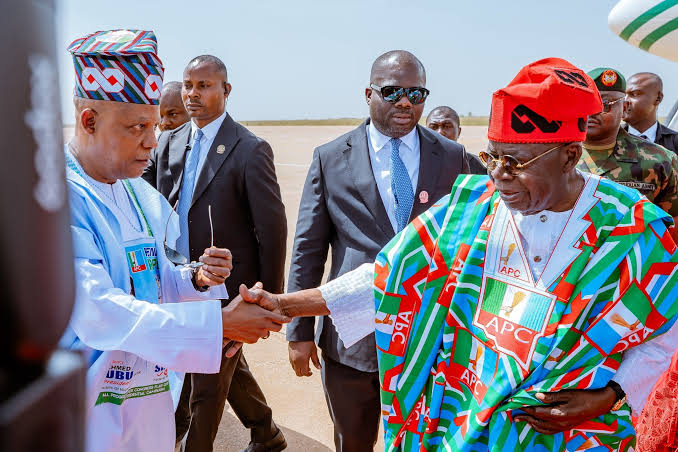
The campaign rally, held at the Kaduna Township Stadium, attracted Vice-President Kashim Shettima, APC governors, party leaders, federal and state lawmakers, political stakeholders and supporters from across the country.
The flag-off marks the beginning of the APC’s drive to secure a second presidential term for President Tinubu, with the party expected to promote its achievements, defend its economic reforms and outline its policy priorities under the proposed Renewed Hope 2.0 agenda.
Kaduna’s selection for the campaign launch underscores the strategic importance of the North-West, a region with a substantial voting population and considerable influence on presidential election outcomes.
The APC faces a significant challenge in Kaduna, where the Peoples Democratic Party’s presidential candidate, Alhaji Atiku Abubakar, defeated President Tinubu in the 2023 election. The rally therefore provides the ruling party an opportunity to strengthen its grassroots structures and regain electoral support in the state.
Addressing supporters, Vice-President Shettima appealed to Northern voters, highlighting President Tinubu’s political relationships with prominent Northern leaders, including Alhaji Abubakar, Mallam Nuhu Ribadu and the late President Muhammadu Buhari.
The Vice-President’s appeal reflects the APC’s determination to consolidate its support in the North as the party intensifies preparations for the presidential contest.
The Renewed Hope 2.0 agenda is expected to feature prominently in the campaign, providing a platform for President Tinubu to explain his administration’s economic policies and outline plans for another term.
However, the President’s record on economic reforms, rising living costs, petrol prices, employment, infrastructure and insecurity is expected to attract considerable scrutiny during the electioneering period.
-

 Education2 days ago
FCE Yola Graduates 3,555 Teachers , Seeks Upgrade to University
-

 Sports2 days ago
Nigerian Trio Target Titles At PFL Africa Finals
-

 Niger Delta2 days ago
Diri Restates Stance On Lagos-Calabar Coastal Highway
-

 Niger Delta2 days ago
C’River, NUJ Pay Tribute To Late Guardian Editor
-

 News2 days ago
NDLEA Recovers Tons Of Illicit Drug Consignments In Nine States
-

 Opinion2 days ago
Checking Voter Apathy In Nigeria’s Electoral Process
-

 Politics2 days ago
2027: DICKSON’S EX-ALLY VOWS TO WORK AGAINST NDC INTEREST IN BAYELSA
-

 Politics2 days ago
2027: GROUP PLEDGES 40,000 SUPPORTERS FOR COALITION CANDIDATES IN RIVERS