
Nation
THE STATES

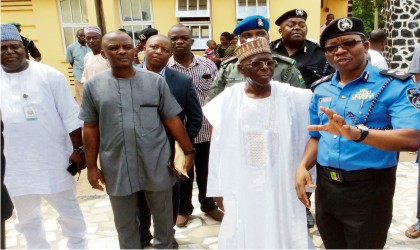
Kogi State Police Commissioner, Mr Adeyemi Ogunjemilusi (right), explaining a point to Governor Idris Wada (2nd-right), during his visit to the Police Headquarters in Lokoja last Monday. With them are the Chief of Staff to the Governor, Alhaji Nasiru Yunusa (left) and the Personal Assistant, Mr Unekwu Sule.
Adamawa
The American University of Nigeria (AUN) in Yola has
created new study-abroad windows to enable highly motivated students to seek experience and active educational responsibility beyond Nigeria.
The University President, Dr Margee Ensign, announced the new windows in Yola last Thursday in a statement signed by Mr Daniel Okereke, the university’s Director of Communications and Public Relations.
Okereke quoted Margee as saying the windows would start in September.
He stated that “the Global Liberal Arts Alliance is an alliance of 27 liberal arts universities, including AUN, in 15 countries.
Borno
Governor Kashim Shettima of Borno State said that the
Federal Government has taken over the funding of the 22 Internally Displaced Persons (IDP) camps in the state.
The governor said this while breaking Ramadan fast at the Yerwa Girls College IDP camp in Maiduguri.
A statement issued by Mallam Isa Gusau, the Special Adviser to Shettima on Communication and Strategy, stated that the governor commended President Muhammadu Buhari for the decision.
Gusau quoted the governor as saying that the funding began few weeks after the assumption of office of Buhari.
He quoted Shetimma as saying that the state had already started feeling the impacts of Buhari’s administration.
According to him, with the emergence of Buhari as president, the Federal Government, through the National Emergency Management Agency, (NEMA,) has taken over so many responsibilities in the camps.
Ekiti
The Ekiti State House of Assembly has confirmed a re
tired teacher, Mrs Olubunmi Olayinka, three former legislators — Bisi Kolawole, Lanre Ogunsuyi and Kehinde Odebunmi as commissioners.
Others include the current Vice-Chairman of the Peoples Democratic Party (PDP) in Ekiti, Mr Taelolu Otitoju, as well as Mr Samuel Ayodeji, Mr Kolapo Kolade, Dr Olurotimi Ojo, Mr Olugbenga Olajide and Mr Victor Egunjobi.
Names of the nominees were presented by Governor Ayo Fayose and cleared by the 26-member PDP House at its plenary sitting held in Ado-Ekiti, presided over by the Speaker, Mr Kola Oluwawole.
The Leader of Business of the House, Mr Ekundayo Akinleye (Ijero), who moved the motion for screening and confirmation of the nominees, reminded them to comply with the Code of Conduct as regards declaration of their assets.
FCT
Former Director-General of the Raw Materials Research
and Development Council (RMRDC), Prof. Peter Onwualu, has urged universities nationwide to establish research centres in their faculties.
Onwualu, who is now a visiting professor to the National Universities Commission (NUC), told newsmen in Abuja that such centres would boost research and innovation.
“One other thing that needs to be done is to encourage the establishment of centres of excellence and research units within faculties. “In other words, in addition to traditional departments, you can actually have special institutes or special research centres that focus on key national problems”, he said.
Gombe
The Governorship Election Petition Tribunal in Gombe State
has granted the request of the APC and its governorship candidate, demanding a forensic examination of documents used during the 2015 Governorship election.
Chairman of the tribunal, Justice Mathew Adewara, granted the request in his ruling on an application filed by the APC.
He said the tribunal would allow the forensic examination of the document to enable the petitioners (APC and its gubernatorial candidate) have necessary materials for the purpose of the presentation of their petition in the case.
The chairman, however, refused to grant the second request of the petitioners demanding for a recount of votes cast during the elections.
Jigawa
Some farmers in Hadejia, Jigawa State, have advocated
for introduction of modern preservation techniques to check spate of food poisoning.
A cross section of the farmers made the call in an interview with newsmen in Hadejia.
The farmers also called for a training programme to expose them to proper application of chemicals on agricultural produce.
Alhaji Abdulkadir Daudu, a bean grower, said the measure would encourage the use of safer techniques in food preservation.
Daudu said that poor farmer education and absence of such facilities were responsible for high cases of food poisoning.
Kano
The FRSC in Kano State has said that it had facilitated
the establishment of road safety clubs in 140 primary and secondary schools in the state.
The spokesman of the commission in the state, Kabiru Ibrahim, disclosed this in an interview with newsmen in Kano.
He said the road safety clubs were established to sensitise students on road traffic rules and regulations.
‘’This is part of our renewed effort to ensure that road accidents are reduced on our highways through sensitisation carried out by the clubs.
‘’We want children who ride bicycles to school to have sense of sharing the road with other road users and to differentiate between right and wrong so as to avoid unforeseen accidents,’’ he said.
Ibrahim said the commission had also embarked on massive enlightenment campaign in secondary schools on national safety under its “ Catch Them Young Programme.’’
Lagos
The Lagos State Chapter of the Poultry Association of
Nigeria (PAN), has called on the state government to enact a law to compel poultry farmers to register with it.
The association’s General Secretary, Mr Olugbenga Ogunsetan, told newsmen in Lagos that such a move would enable the body to have a comprehensive data bank of its members.
Ogunsetan said that would help the association in its distribution of bird-cages to poultry farmers and to estimate the number of chicks and eggs produced by them annually in the state.
“As of now, there is no data base of poultry farmers in the state and so government needs to compel poultry farmers to register with the association. “A data base will help the association to interface with government for policy formulation,” Ogunsetan said.
Ogunsetan also said that the data would be collected from each local government area in the state. According to him “the data will give us the dimension of the farm holdings which will translate in the input to be used and that will help the industry.
Ogunsetan speaking further said that the current price increase and scarcity of eggs was because the poultry farmers were currently selling off their layers.
Plateau
Director-General, Federal Radio Corporation of Nigeria
(FRCN), Alhaji Ladan Salihu, has accused the international media of “worsening and prolonging the insurgency in the North-East’’.
“The international media unnecessarily prolonged the Boko Haram violence by its reckless approach that treated it as just a headline-grabbing conflict,’’ Salihu told newsmen in Jos.
According to him, the international media “deliberately refused to see the violence as an internecine conflict demanding all hands toward ending it’’.
He particularly accused the international media of “failing to give appropriate, fair and balanced reportage that will attract cohesive international attention to end the hydra-headed monster called terrorism’’.
Sokoto
An Islamic scholar, Sheikh Kabiru Gombe, has advised
youths to shun social vices and be responsible citizens.
Gombe gave the advice at a Ramadan fast commentary on the Holy Qur’an, held at Savanna Bank Mosque, Sokoto.
He said Islam promotes peace and urged young people to work hard and embrace religious tolerance.
The cleric also called on youths to adhere to the teachings of the Holy Prophet Muhammad (SAW).
Taraba
No fewer than 110,849 people are living with HIV and
AIDS in Taraba State, Mr Edward Ogenyi, National Coordinator, Network of People Living with HIV/AIDS in Nigeria (NEPWHAN), has revealed.
Ogenyi made this disclosure in Jalingo at the commencement of a five-day Demand Generation Activities for HIV and AIDS Service Uptake in Taraba State.
He said the activities marked the first phase of implementation of the President’s Comprehensive Response Plan (PCRP) for HIV and AIDS, funded by NACA/SURE-P HIV/AIDS Programme, launched in July, 2013.
Yobe
The Sector Commander, Federal Road Safety
Corps(FRSC) in Yobe State, Mr Yusuf Garba, has said the agency had no equipment to evacuate accident wreckages on highways in the state.
He told newsmen in Damaturu that vehicles involved in accident along highways in the state constituted threat to motorists.
“The sector does not have equipment to clear tankers, trailers and other long vehicles involved in accident and occupying portions of the highways. “Road users on the busy Kano-Maiduguri road are threatened by such vehicles, especially during rainy and when over taking,” he said.
Zamfara
The Malaria Action Programme for States (MAPS), an NGO,
says that 97 per cent of Nigerians are prone to malaria attack.
A consultant with the project, Mr Umar Garba, said this in Gusau while briefing stakeholders on the importance of using treated mosquito nets.
The consultant also said that the malaria scourge had resulted in the reduction of the nation’s annual GDP by one per cent.

Nation
Rumuaholu Community Denies Land Grabbing Allegations, Accuses Obio/Akpor Chairman of Interference in Land Dispute


The Rivers State Commissioner for Education, Dr. Peters Nwagor, has commended the orderly conduct of the ongoing 2026 West African Senior School Certificate Examination in the state and urged schools to sustain the standard.
Dr. Nwagor gave the commendation on Tuesday during a monitoring tour of selected secondary schools in Port Harcourt and environs where the WAEC exam is ongoing.
The commissioner, who was accompanied by directors and monitors from the Ministry of Education, said he was impressed with the peaceful atmosphere at the centres visited.
“The students conducted themselves properly and wrote their papers under conducive conditions. Invigilators and supervisors also performed their duties professionally,” he stated.

Nwagor noted that the Rivers State Government had invested heavily to ensure the smooth and credible conduct of the examination across the state
He urged candidates to reciprocate government’s effort by shunning all forms of examination malpractice and focusing on their studies.
“Government has done so much to ensure successful examinations in our schools. Students should take advantage of it by remaining focused,” the commissioner said.
While no case of malpractice was recorded in the centres inspected, Dr. Nwagor warned that any principal, teacher, invigilator, or official caught aiding malpractice would face strict sanctions in line with regulations.
He also commended school administrators, teachers, WAEC officials, and security personnel for upholding the integrity of the process.
Centres visited included County Grammar School, Ikwerre/Etche; Government Comprehensive Secondary School, Borokiri; Government Secondary School, Borokiri; and Pabod Model Secondary School.
-
Nation5 days ago
Asarama Kingdom Condemns Gruesome Murder of A Commercial Vehicle Driver
-
Rivers5 days ago
Monarch Raises Alarm Over Defamatory Politics … Urges For Unity In Ogoni
-
News5 days ago
Nigeria, Ethiopia Seal Agreement To Transfer 100 Nigerian Prisoners
-
News5 days ago
Nigeria No Longer Safe For Drug Cartels – Marwa
-
News5 days ago
Xenophobia: 268 Nigerian Returnees Arrive In Lagos From S’Africa
-

 News5 days ago
FG Declares Today Public Holiday To Mark Democracy Day
-
Women5 days ago
Nigerian Women And Dividends Of Democracy
-
Business5 days ago
FG Approves $1 Bn AFCFTA Credit Facility For Nigerian Exporters