
News
PENGASSAN Begins 3-Day Warning Strike

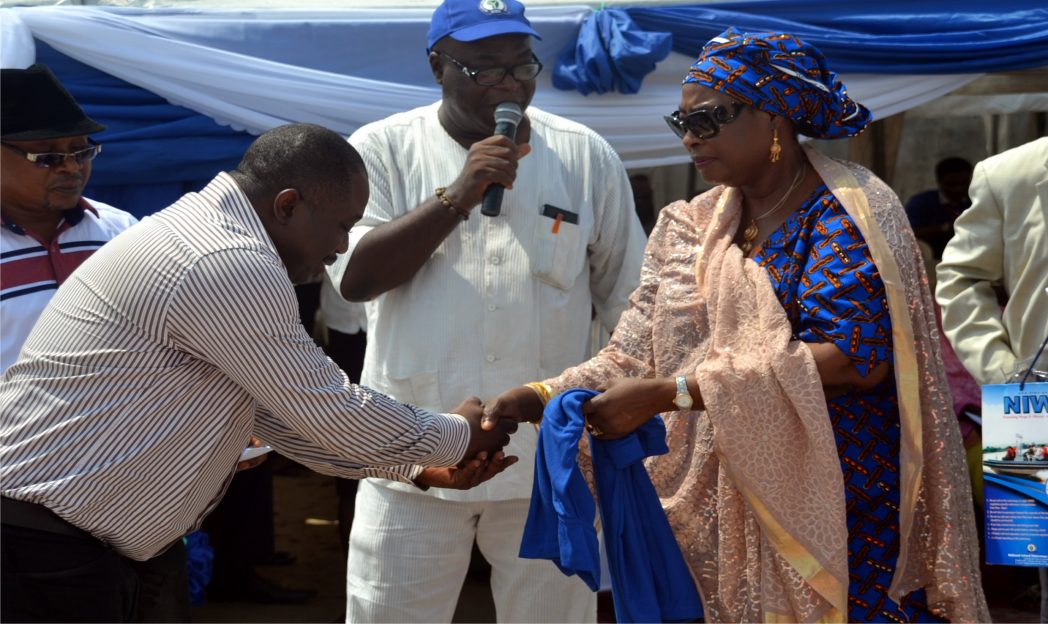
Managing Director, Hajiya Inna Maryam Ciroma (right) congratulating the vice chairman of Maritime Workers Union. Rivers State Council, Comrade Godwin Dominic at the 2014 NIWA safety awareness campaign, at Port Harcourt NIWA Dockyard, Marine Base while General Manager, Corporate Affairs, NIWA, Mr Tayo Fadile (middle) watch. Photo: Nwiueh Donatus Ken
The Petroleum and Natural Gas Senior Staff Association of Nigeria (PENGASSAN) and the National Union of Petoleum and Natural Gas (NUPENG) began a three-day warning strike today, over anti-labour practices in the oil and gas sector of the nation’s economy.
The anti-labour activities listed by the oil workers include unjust delay in the passage of the Petroleum Industry Bill, retardation of staff promotion in the Petroleum Technology Development Fund, non-standardisation of nomenclature and collective bargaining agreement of the Nigerian Nuclear Regulatory Agency in line with what obtains in other agencies in the oil and gas industry, refusal of the Management of Addax/Petrostuff Nigeria Limited and Chevron/Sudelletra to recall sacked staff, Petrobras management’s unprocedural release of staff and its refusal to renew expired Collective Agreement, the unjust termination of the appointment of the Port Harcourt Zonal Secretary and Treasurer of PENGASSAN and NUPENG respectively
Oil workers under the aegis of the Petroleum and Natural Gas Senior Staff Association of Nigeria have concluded plans to shut down all oil and gas installations in the country due to the anti-labour activities of some employers in the sector.
The anti-labour activities listed by the oil workers include unjust delay in the passage of the Petroleum Industry Bill, retardation of staff promotion in the Petroleum Technology Development Fund, non-standardisation of nomenclature and collective bargaining agreement of the Nigerian Nuclear Regulatory Agency in line with what obtains in other agencies in the oil and gas industry, refusal of the Management of Addax/Petrostuff Nigeria Limited and Chevron/Sudelletra to recall sacked staff, Petrobras management’s unprocedural release of staff and its refusal to renew expired Collective Agreement, the unjust termination of the appointment of the Port Harcourt Zonal Secretary and Treasurer of PENGASSAN and NUPENG respectively.
Other issues are the perilous state of the nation’s strategic and industrial roads and highways, non-beneficial deductions of National Housing Fund from workers, un-abating measures of addressing pipeline vandalism and crude oil theft and divestments by International Oil Companies without clear guidelines to check the resultant arbitrary job losses, heightening insecurity of PENGASSAN members/families in the troubled parts of Northern Nigeria.
According to a statement issued by the PENGASSAN Secretariat on Sunday, plans are at the final stage with its sister union, the Nigerian Union of Petroleum and Natural Gas Workers, to mobilise members for a nationwide industrial action that will disrupt operations in the oil and gas sector until the Federal Government showed genuine intention to earnestly attend to and resolve the issues.
PENGASSAN noted that the 14-day ultimatum given by its National Executive Council meeting of October 30, 2014 to the Federal Government and other concerned employers’ and agencies and further ratified by the Joint NEC of both NUPENG and PENGASSAN on October 31, 2014, had since expired without any meaningful resolution or commitment from either the government or the concerned employers’ and agencies at resolving the issues.
The statement hinted that all levels of the Union have been fully sensitized and mobilised for the inevitable industrial actions that will affect every value chain in the upstream, midstream and downstream of the oil and gas industry.
The union explained that the purported termination of the appointment of its Port Harcourt Zonal Secretary, the Nupeng Zonal Treasurer was an ill-conceived act of victimization by their employers and which the NNPC, Federal Ministries of Petroleum Resources and Labour and Productivity, the Department of State Services, the Department of Petroleum Resources have advised the company’s management against, but remained unbending.
On crude oil theft and acts of vandalism, PENGASSAN alleged high level collaboration of the security agencies, politicians and highly placed Nigerians in the buccaneering racket of oil and gas installations and the resultant crude oil theft, adding that the ugly trend signifies a looming extinction of the oil and gas industry with attendant job losses.
This further endangers the national economy with the persistent drop in crude oil prices, the union said.
The association called on the Federal Government to mobilise contractors to site for immediate repair of all perilous roads leading to all oil and gas installations in the country, especially the Shaguolo/Alternative Road to the PPMC depot in Warri, Delta State; Eleme/Onne Road, in Rivers State; Apapa/Ijora/Wharf Road and Tin Can Island Road, both in Lagos State; and the Port Harcourt/Enugu Road.
The association described the deduction from workers’ salaries for the National Housing Fund as sheer exploitation and demanded that the deduction should be stopped forthwith, saying that it would be forced to resort to whatever necessary labour action it deems appropriate to protect its members from further exploitation of the non-beneficial policies that has served no member’s interest in the sector.
The national body of the apex union in the oil and gas industry have also mobilised its members to various Internally Displaced Persons’ centres across the nations to deliver relief materials and alternative conditions of living, especially for women and children.
It stressed that anything short of purposeful dialogue to resolving the issues will spark the fully mobilized action.
The Association’s position was made known by Comrade Igwe Achese, the Chairman of the Joint Council of NUPENGASSAN.



The Rivers State chapter of the All Progressives Congress Christian Leaders Forum has expressed strong confidence in the capacity of All Progressives Congress (All Progressives Congress) candidates in the state to deliver effective governance if elected into office in the coming elections.
The State Coordinator of the forum, Archbishop Lucky Aroh, made this known during a breakfast and thanksgiving meeting held in Port Harcourt, where leaders gathered to pray for the stability of the party and the safety of its candidates ahead of the 2027 general elections.According to him, the meeting was convened to seek divine intervention for peace, unity, and security among APC candidates across Rivers State.
“Today we are praying for APC stability in Rivers State and the security of our candidates that have been elected to contest the 2027 elections. It is a breakfast meeting,” Aroh said.
He further expressed optimism that the party’s candidates would not disappoint the people if entrusted with leadership responsibilities.
“They will not fail when elected into office. We are here as fathers of the land to let them know, and I must tell you the truth that these are the authentic people that will do well in Rivers State,” he added.
Speaking earlier, the National Chairman of the forum, Professor Olanrewaju Abraham, commended the Rivers State chapter for organizing the programme, noting that the national body of the forum believes strongly in the power of prayer.
He stated that political leadership provides an opportunity to influence society positively, including advancing moral and spiritual values, while expressing confidence that APC candidates at all levels would emerge victorious in the upcoming elections.
Also speaking, the Rivers State Women Leader of the APC, Hon. Darling Amadi, praised the forum for its commitment to prayers for peace, stability, and the protection of party candidates.
Represented by the Deputy Women Leader of the party in the state, she described the initiative as commendable and urged other political and support groups within the party to emulate the gesture in promoting unity and stability.
By: John Bibor, Menebe Emmanuel & Fortune Paibi
Prominent businessman and philanthropist, Elder Anthony Osagwe-Ogo, was celebrated in grand style as he marked his 70th birthday anniversary, with distinguished Nigerians, business leaders, and golf enthusiasts gathering to honour his remarkable contributions to society.
The colourful celebration took place at the Port Harcourt Golf Club, where friends, associates, and well-wishers converged to pay tribute to the revered elder statesman.
Chairman of the occasion, High Chief (Dr.) Ikenna Okafor, described the celebrant as a detribalised Nigerian whose generosity, humility, and commitment to humanity have earned him admiration across different communities and backgrounds.
According to Dr. Okafor, Pa Osagwe-Ogo’s impact on society and the development of his community remains unparalleled. He noted that members of the golfing community are proud to be associated with a father figure who consistently promotes the welfare and well-being of those around him.
He further stated that the history and growth of the Port Harcourt Golf Club cannot be told without acknowledging the significant role played by the celebrant, whose wisdom, encouragement, and leadership have helped sustain the club over the years.
“We are here to celebrate a man who has impacted humanity positively, a peace-loving individual and an epitome of hope for the younger generation. We pray to emulate his virtues. Today, we celebrate a bridge-builder, a trailblazer, and an iconic leader whose life continues to inspire many,” Dr. Okafor said.
He expressed delight at the large turnout of guests from various walks of life, describing it as a testament to the respect and affection Pa Osagwe-Ogo commands within and beyond Rivers State.
In his response, the celebrant, Pa Anthony Osagwe-Ogo, expressed profound gratitude to God for preserving his life and granting him the privilege of attaining the milestone age of 70.
He also thanked members of the Port Harcourt Golf Club, family members, friends, and associates for identifying with him during the celebration and for their unwavering support over the years.
The event featured the cutting of the birthday cake, presentation of awards to deserving members of the club, goodwill messages, and moments of celebration among guests.
The ceremony was attended by notable personalities from the business community, the golfing fraternity, and other sectors, all of whom joined in celebrating the life and legacy of the respected elder statesman.
Rivers State Governor, Sir Siminalayi Fubara, and the Permanent Secretary of the Rivers State Ministry of Information and Communications, Dr. Honour Kuru Sirawoo, have been honoured with awards of recognition in connection with the 2026 Democracy Day celebrations held in Port Harcourt.
The awards, which formed part of activities marking Nigeria’s Democracy Day on June 12, were formally presented on Tuesday at the Ministry of Information and Communications in Port Harcourt.
Presenting the awards was Hon. Abdul Hameed Oladipupo Alli, popularly known as “Mr. Nigeria,” Publisher of Asiwaju Trumpet Magazine and Achievers World International Magazine.
Governor Fubara was recognised for his efforts in sustaining peace, stability, and a conducive political atmospherJohn Bibor / Menebe Emmanuel / Fortune Paibie in Rivers State. The organisers noted that his administration has fostered harmony and strengthened civic participation across the state.
Dr. Sirawoo, on the other hand, was honoured for his exemplary administrative leadership and significant contributions to effective information management within the Ministry of Information and Communications.
Representing Dr. Sirawoo at the presentation ceremony, Dr. Christian Davies received the award on his behalf and expressed gratitude for the recognition. He described the honour as a reflection of Dr. Sirawoo’s unwavering commitment to professionalism, excellence, and dedicated public service.
Dr. Davies assured the organisers that the award would be formally conveyed to the Permanent Secretary.
The event also featured the presentation of commemorative publications highlighting major governance and civic milestones in Rivers State, including Easter celebrations, Workers’ Day activities, the Governor’s third anniversary in office, and Democracy Day programmes.
Organisers of the awards commended the Rivers State administration for what they described as sustained peace, political stability, and improved civic engagement, noting that these achievements have contributed significantly to the state’s continued development.
By: Jessica Sambol