
Nation
THE STATES

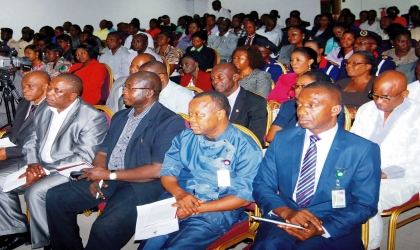
Cross section of federal civil servants in Rivers State during an interactive session in Port Harcourt last.
Photo: NAN
Benue
A Makurdi High Court has sentenced Jacob Atongo,
a 100-level Sociology student of Benue State University, to death by hanging for armed robbery.
In his judgment, Justice Adam Onum, held that he was satisfied with the confession of the accused to the charges and therefore, found him guilty.
Onum sentenced the accused to death by hanging, insisting that the sentence prescribed under the law for the offence must be followed.
Atongo conspired with two others and robbed Stephen Akuma, and several others at gun point on June 26, 2012.
FCT
The Federal Government has been urged to set up
Inter-Ministerial ICT project clearance desk to address duplication of projects and programmes among Ministries, Department and Agencies in the country.
The President, Abuja Chapter, Information System Audit and Control Association (ISACA), Mr Ikani Yunusa, made the call at the 5th Annual International Conference in Abuja recently.
Yunusa said the desk was important to eliminate duplication of projects, waste of public funds and unnecessary financial burden on the tax payers.
“I was worried when I learnt of the Federal Road Safety Commission and the Nigeria Police Force competing for who should set up a central Database for Vehicle registration for the country. That shouldn’t be.
Kaduna
Kaduna State Government says it will train 7,600
youths and women in various skills under the Subsidy Reinvestment and Empowerment Programme (SURE-P).
Governor Mukhtar Yero, who stated this at the beginning of the training in Kaduna, explained that the programme would improve the welfare of Nigerians via the provision of infrastructure, jobs and wealth creation.
“We have a total of 7,600 youths and women drawn from the 23 local government areas of the state. 1,500 will be trained under women empowerment, 2,300 under youth development and 2,300 under agriculture,’’ he said.
Yero said that the youth empowerment training would cost the government N42.9 million, while its women empowerment component would cost N39.9 million.
Kano
Kano State Commissioner for Special Duties Mr Idris
Dambazau, says government has completed the construction of 1,500 houses for flood victims in 2012.
Dambazau told newsmen in Kano that the figure was out of the 3,000 houses it was building for victims in three local government areas.
He said the houses were constructed at the cost of N2.4 billion in Warawa, Kunci and Makoda local government areas.
Dambazau said the state government found it necessary to construct the houses so as to relocate the victims from the river banks and other flood prone areas.
Katsina
Governor Ibrahim Shema of Katsina State, has
approved the appointment of Alhaji Aminu Danbaba, as Executive Chairman of the state Universal Basic Education Board (SUBEB).
This is contained in a statement issued by the Permanent Secretary, Special Services, Alhaji Rabi’u Rumah, in Katsina.
Until his appointment, Danbaba was the executive director of the state Pilgrims Welfare Board.
He replaces Dr Suleman Dikko, who was recently appointed by President Goodluck Jonathan as the Executive Secretary of the Universal Basic Education Commission (UBEC).
Kwara
The Fadama III Project has empowered more than
50,000 farmers in Kwara State, the Project’s Coordinator in the state, Mr Yusuf Agbabiaka, said.
Agbabiaka told newsmen in Ilorin that about 1, 228 Fadama user groups had been registered under the project in the state.
He said the beneficiaries had benefited from various agricultural support facilities at subsidised rate, including assorted agricultural inputs.
“They (Fadama user groups) have benefited so much in terms of access to fertiliser, agro chemicals, improved seeds, agric equipment and implements, among others.
Lagos
The Federal Road Safety Commission (FRSC) in
Lagos recently organised a retreat for its officers with the aim of reviewing road safety strategies for improved performance.
The commission organised the one-day retreat for its officers in Zone 2, comprising Lagos and Ogun.
The commission used the opportunity to review the zone’s performance in the third quarter of this year.
The Zonal Commander, Mr Ademola Lawal, charged the officers to be determined to drastically reduce road accidents at the end of the year.
Ondo
Ekiti State Governor Dr Kayode Fayemi, has
advised the youth, especially those who were unemployed, to embrace entrepreneurial skills that would make them to become self-reliant.
The governor gave the advice in Ise-Ekiti at the closing ceremony of the Batch “C’’ NYSC Orientation Programme in the NYSC Permanent Orientation Camp.
Fayemi said that the youth, particularly corps members, should take advantage of available training and skills development programmes that would make them productive.
“I urge you to take advantage of the Skills Acquisition and Entrepreneurship Development Programme of the NYSC and prepare for your future.
Osun
The Osun State Government has approved N4.5
billion as car refurbishing loan for the 9,435 workers in the state civil service, the Commissioner for Finance, Dr Wale Bolorunduro, has said.
Bolorunduro, who made the disclosure in Osogbo at a press conference, said that officials of labour unions in the civil service would determine the number of workers that would benefit from the loan.
He said the officials would also manage the account where the loan is domiciled and its disbursement.
Bolorunduro said that N1.2 billion would be needed to pay the first batch of beneficiaries of the loan adding that N1.4 billion had been reserved for payment of the second batch of beneficiaries.
Oyo
The Court of Appeal in Ibadan has adjourned the
case between the Oyo Government and Alhaji Lateef Akinsola, the ex-chairman of the National Union of Road Transport Workers (NURTW), to January 15, 2014.
The government had filed an appeal against the judgment of a federal high court to reinstate Akinsola, also known as “Tokyo’’, as the union’s chairman.
Mr M.A. Ganiyu, counsel to the state government, told the court that he had filed and served an application, dated November 26, just before the court commenced sitting.
“The application, which was filed today, is for an extension of time to appeal,” he said.
However, Mr Abiodun Amole, counsel to Akinsola, did not raise any objection.
Zamfara
The Zamfara State Police Command has confirmed
the stealing of 20 camels by suspected gunmen at Kawaye village of Anka local government area of the state.
The command’s Public Relations Officer (PPRO), DSP Lawal Abdullahi, said this in Gusau while addressing newsmen in Gusau.
He said the Divisional Police Officer (DPO) of the area had been instructed to arrest the suspects.
The police spokesman gave assurance that the police would continue to ensure the continuous protection of persons and their property.

Nation
Rumuaholu Community Denies Land Grabbing Allegations, Accuses Obio/Akpor Chairman of Interference in Land Dispute


The Rivers State Commissioner for Education, Dr. Peters Nwagor, has commended the orderly conduct of the ongoing 2026 West African Senior School Certificate Examination in the state and urged schools to sustain the standard.
Dr. Nwagor gave the commendation on Tuesday during a monitoring tour of selected secondary schools in Port Harcourt and environs where the WAEC exam is ongoing.
The commissioner, who was accompanied by directors and monitors from the Ministry of Education, said he was impressed with the peaceful atmosphere at the centres visited.
“The students conducted themselves properly and wrote their papers under conducive conditions. Invigilators and supervisors also performed their duties professionally,” he stated.

Nwagor noted that the Rivers State Government had invested heavily to ensure the smooth and credible conduct of the examination across the state
He urged candidates to reciprocate government’s effort by shunning all forms of examination malpractice and focusing on their studies.
“Government has done so much to ensure successful examinations in our schools. Students should take advantage of it by remaining focused,” the commissioner said.
While no case of malpractice was recorded in the centres inspected, Dr. Nwagor warned that any principal, teacher, invigilator, or official caught aiding malpractice would face strict sanctions in line with regulations.
He also commended school administrators, teachers, WAEC officials, and security personnel for upholding the integrity of the process.
Centres visited included County Grammar School, Ikwerre/Etche; Government Comprehensive Secondary School, Borokiri; Government Secondary School, Borokiri; and Pabod Model Secondary School.
-

 Niger Delta4 days ago
Warri Airport Manager Disputes Air Peace Bird Strike Claim
-

 News4 days ago
Nigeria Won’t Surrender Any Territory To Criminals -Tinubu
-

 News4 days ago
FG Begins Trial Of Over 600 Terrorism Suspects
-

 Politics4 days ago
Parties’ Deregistration: How Justice Lifu Overruled Appeal Court Justices
-

 Rivers4 days ago
79th IAUE Inaugural Lecture: Prof Anero Advoctes Tuition-Free Education For Children
-

 Politics4 days ago
ADC: Okonkwo Rejects Amaechi As Presidential Running Mate, Withdraws Support
-

 Politics4 days ago
2027: Tinubu’s Projects Give APC Edge In South East – Yilwatda
-
News4 days ago
Forum Expresses Confidence In APC Candidates’ Performance In Rivers