
Nation
THE STATES

Borno
The Deputy Governor of Borno State, Alhaji Zannah
Mustapha, has commended the efforts of security agencies to end insurgency in the country.
Mustapha made the commendation in an interview with newsmen in Maiduguri.
He expressed optimism that the insurgency would end soon “going by the successes recorded by the military in its bid to flush out the insurgents”.
Mustapha said last week’s attack on Biu by the insurgents was a sign of desperation, noting that they had failed in previous attempts to gain entry into the town, hence the use of suicide bomb attack.
He commended youth vigilantes, local hunters and members of the community for keeping vigil against the insurgents especially in Biu.
“The military has been working in concert with vigilantes and other groups in safeguarding lives and properties in Biu.
“As it is now, it is very difficult for the insurgents to carry out attacks easily, so they have resorted to using female suicide bombers,” he said.
FCT
The Independent National Electoral Commission (INEC)
has advised politicians to invest their time and resources in positive strategies of winning elections rather than buying Permanent Voter Cards (PVCs) from prospective voters.
The Deputy Director, Voter Education and Publicity, INEC, Mr. Nick Dazang, gave the advice in an interview with newsmen in Abuja following a claim that politicians were buying cards and collecting their numbers.
Dazang said it was also advisable for politicians to use their time well in other endeavours that would help the political processes instead collecting Voter Identification Number (VIN) of registered voters.
He said buying people’s PVCs would be of no help as the cards could not be used by another person other than the original owners.
“Politicians should encourage those who have not collected to go and collect their PVCs.
“I don’t know of any implication of collecting people’s VIN numbers; they are just wasting their times,” he said.
Kebbi
The Independent National Electoral Commission (INEC),
National Commissioner, Hajia Amina Zakari, has reiterated the commission’s determination to announce the presidential and governorship elections within 48 hours after voting.
She stated this in Birnin Kebbi, Kebbi, during a public sensitisation and practical demonstration of accreditation and election processes.
Zakari said that the demonstration was to enable the commission to make amendments in areas of difficulty.
According to her, the demonstration will also enable electoral officers to be familiar with the process of accreditation and smooth election.
She appealed to registered voters to ensure they were in queue on time for accreditation, assuring them that collation of votes would be done properly after voting.
Kogi
The Abuja Electricity Distribution Company (AEDC) has
again explained that the rationing of power in Lokoja and other areas of its coverage was necessitated by low volume energy available for distribution.
The Manager, Public Relations of AEDC, Mr Ahmed Shekarau, said this while fielding questions from newsmen in Lokoja.
Shekarau said that it was not the wish of the company to ration power supply in its coverage area but was being forced to do so.
“The AEDC is being allocated 11.5 per cent of total energy available daily for distribution to customers nationwide.
“This volume, which reaches 450 mega watts even at peak generation periods, is insufficient to meet the demands of the company’s customers in FCT, Kogi, Nasarawa and Niger States.
“The AEDC is, however, optimising its load-shedding to address part of the problem in the short term.
Lagos
A lawmaker representing Egbeda/Ona-Ara Federal
Constituency in Oyo State, Olayemi Busari, said that he donated four 500 KVA transformers to communities in his constituency on February 14.
Busari, an Accord Party (AP) member, told newsmen in Lagos that the projects were part of the promises he made to the people during his electioneering campaigns.
He said that the benefiting communities were Aba Otun Area Ward 8 and Oke- Imole in the Olunloyo area of the Ona-Ara Local Government Area.
Others were the Amosun Community Ward 7 and Ogunkola Avenue, Hope area, Alakia, Old Ife road in the Egbeda Local Government Area of Oyo State.
Busari said that he donated the transformers on Valentine’s Day, to show his love for his people, and urged them to reciprocate the love by supporting his candidacy in the March 28 elections.
Nasarawa
A nutritionist at the Dalhatu Araf Specialist Hospital, Lafia,
Nasarawa State Mrs. Julie John, has advised mothers to give proper diet to their babies to avoid malnutrition.
John gave the advice in an interview with newsmen in Lafia.
According to her, after six months of exclusive breast feeding, mothers are expected to start introducing highly nutritious foods to their babies so as to avert malnutrition.
“From birth to six months, we encourage mothers to go on exclusive breast feeding.
“Where the problem starts is the six months that the mother is supposed to introduce other feeds to her baby. That is when most of the time we have problems of malnutrition,’’ she said.
Ogun
The Federal Road Safety Corps (FRSC) said that it was
collaborating with Ogun Traffic Compliance and Enforcement Corps (TRACE) to reduce gridlocks in Sango-Ota and its environs.
The Sango-Ota Unit Commander of the FRSC, Mr Olonisaye Olufemi, disclosed this to newsmen in Ota.
He noted that heavy traffic gridlocks were being experienced at the Toll-gate, Ojuore, Sango-Ota under bridge, especially on Sundays when worshippers going to Living Faith Church, Ota, drove against the traffic.
“The worshippers contributed immensely to gridlocks between 5.30 a.m. and 2 p.m. by increasing vehicle movement to the areas,” Olufemi said.
On his part, the Zonal Commander of TRACE, Mr Adekunle Ajibade, said that it would deploy manpower to those trouble areas to assist FRSC staff to decongest traffic jams.
Ajibade said that it would also bring a tow truck that would be used to clear obstruction by vehicles, especially commercial buses.
Osun
Osun State Deputy Governor, Mrs. Titi Laoye-Tomori,
has ordered the closure of Government Technical College, Osogbo, and Osogbo High School, indefinitely over disturbances by the students.
Our correspondent reports that some students of Government Technical College, Osogbo and Osogbo High School embarked on a protest recently.
This is contained in a statement signed by Permanent Secretary, Ministry of Education Mr Lawrence Oyeniran, .
The statement said that the closure was to curtail any further disturbances in the schools.
It advised parents and guardians to warn their children and wards to stay away from acts capable of causing public disturbance.
Oyo
Oyo State Coordinator, National Agency for Food
and Drug Administration and Control (NAFDAC), Mr. Benjamin Haruna, said that the agency had sanctioned more than 1,000 offenders in the state.
Haruna disclosed this to newsmen in Ibadan at a send-forth organised for him by the staff and stakeholders of NAFDAC in the state.
According to him, the offences ranged from series of unregistered products, sales of outright fake products, parallel importation and unsatisfactory factory productions.
Haruna said that the agency would not relent in its effort to combat unwholesome and fake products.
Yobe
The National Council of Women Society (NCWS) has
urged women in Yobe to aspire for more elective positions to ensure that their voice was heard in the democratic process.
The state President of the society, Hajiya Halima Joda, made the call in an interview with newsmen in Damaturu.
“I want to use this medium to call on all women in Yobe State to mobilise both rural and urban women to take active participation in the political process.
“Considering our numerical strength if we properly harness our potential, we can aspire for more elective positions and win,’’ Joda said.
Joda said that active participation of women in politics would eliminate all forms of marginalisation and intimidation against women seeking elective positions in the state.
The president said that when women hold elective positions it would enable them to mainstream gender issues in government policies.
She noted that women were underrepresented in the state despite their proven abilities as leaders and agents of change, and their right to participate equally in democratic governance.
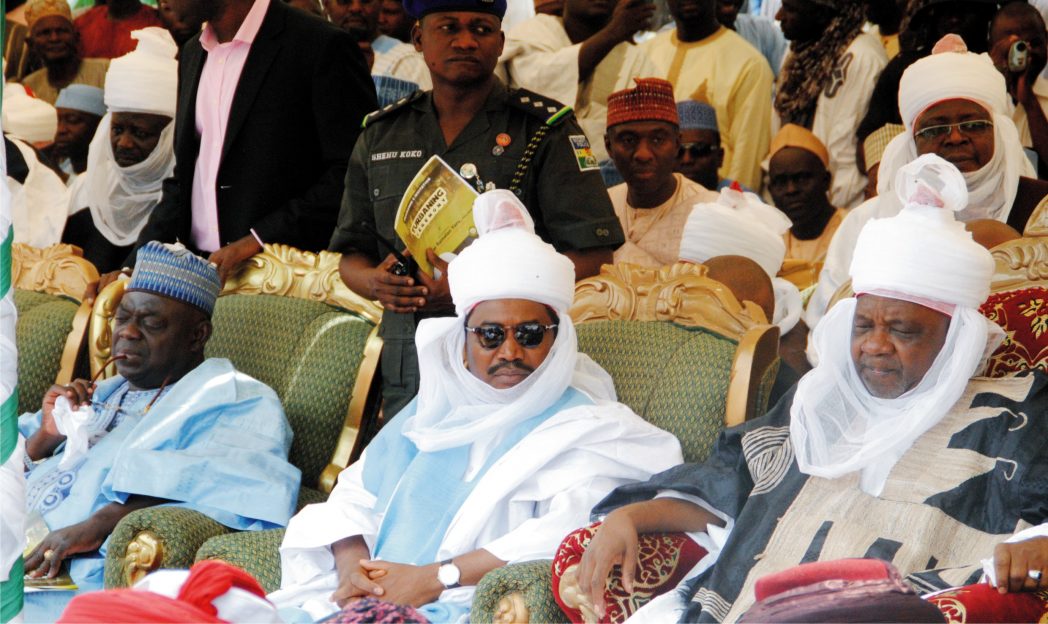
L-R: Governor Babangida Aliyu of Niger State; Governor Ibrahim Shema of Katsina State and Vice-President Namadi Sambo, at the turbaning of Governor Muhtar Yero of Kaduna State as Dallatun Zazzau in Zaria, Kaduna State recently.



Rivers State University and the Otonti Nduka Foundation for Values Education jointly hosted a two-day National Conference on 8 and 9 May 2026 to examine the state of values in Nigeria.
The two days conference held at Rivers State University convocation arena brought together academics, policymakers, legal experts and education leaders under the theme _“Trends and Challenges in Upholding Values in Nigeria.”_
The gathering focused on policy gaps, curriculum reform, and the role of ethics in public service and education.
The event opened on Friday with remarks from Vice Chancellor Prof. Chief Isaac Zeb-Obipi, who stressed the need to address declining moral and civic values across Nigeria’s education and public sectors. A book of abstracts for the plenary sessions was also presented to participants.
Key speakers included former Attorney General Chief Dr Kanu Agabi, SAN; NERDC Executive Secretary Prof. Shehu Salisu; Prof. Hauwa Imam, FNAE, of the University of Abuja; former Rivers SUBEB Chairman Ven Dr Fyneface Akah, ; former NIMASA DG Dr Hon. Dakuku Adol-Peterside; and RSU Director of ICT Prof. Sunny Orike.
Discussions centered on integrating values education into schools, tertiary institutions and public institutions, alongside the impact of technology on moral development among young Nigerians. Panel and plenary sessions produced practical recommendations for curriculum and policy reform.
On Saturday, the foundation marked its centenary with the unveiling of the book _Otonti Nduka in History_, launched by Chief Engr. Grant Offor, FNSE. The Nigerian Academy of Education held a ceremonial procession led by its President Prof. Olu Jegede and the Ikwerre Professors Forum.
In a communiqué, participants called for stronger collaboration between government, civil society and academia to mainstream values education nationwide. They recommended reviewing teacher training curricula and expanding digital platforms to promote ethical civic engagement, with the foundation pledging to share the outcomes with education authorities for implementation.
Dignitaries present included Ogbakor Ikwerre Worldwide as Chief Host, Prof. Emeritus Chief T. Uzodimma Nwala, the Ikenga 1 of Mbaise and first philosophy student of Prof. Otonti Nduka, alongside scholars and community leaders.
Amadi Akujobi

The Shell Nigeria Gas Limited, in partnership with the Manufacturers Association of Nigeria, has reaffirmed support for efforts to expand gas distribution infrastructure in Rivers State as part of initiatives aimed at improving access to affordable, cleaner and more reliable energy for industries across the South-South region.
The commitment was highlighted during the SNG–MAN Business Forum held in Port Harcourt, where stakeholders from the industrial and public sectors examined the role of natural gas in driving industrialisation, boosting local production and strengthening energy security.
Speaking at the forum on behalf of the Managing Director of Shell Nigeria Gas Limited, the company’s Head of Gas Distribution, Mr. Chukwuka Amos Ejesi, described natural gas as a critical component of Nigeria’s energy mix and a key driver of sustainable industrial growth.
According to him, Nigeria’s gas development agenda has reached a stage where policy direction must be matched with practical implementation capable of addressing the energy challenges confronting manufacturers.
He noted that pipeline gas offers industries a cleaner, more dependable and cost-effective energy alternative capable of supporting uninterrupted operations, reducing emissions and improving production efficiency.
“Gas is the backbone of manufacturing, and we are encouraged by the growing recognition among stakeholders of the need for cleaner and more reliable energy solutions,” he said.
Ejesi stressed the need for sustained collaboration among energy providers, government institutions and industrial stakeholders to maximise the country’s gas resources for economic development.
He added that improved gas infrastructure would strengthen manufacturing value chains, enhance productivity and promote more competitive industrial operations across Rivers State and the wider South-South region.
Participants at the forum also emphasised the importance of expanding energy infrastructure as a pathway to unlocking industrial capacity, reducing operating costs and promoting sustainable industrial development.
Representing Governor Siminalayi Fubara, the Director-General of the Rivers State Investment Promotion Agency, Dr. Chamberlain Peterside, reaffirmed the state government’s commitment to partnering with private sector investors to revitalise industrial activities in the state.
He identified key projects targeted under the initiative to include the revival of the Ahoada Industrial Park, the New Port City project and the proposed Bonny Industrial Park, all aimed at stimulating economic growth and expanding industrial opportunities along the Bonny corridor.
According to the governor, the long-term vision is to position Rivers State as a leading manufacturing hub in Southern Nigeria through strategic public-private partnerships.
Governor Fubara also commended Shell Nigeria Gas and MAN for sustaining engagements geared towards improving industrial energy access, noting that gas infrastructure development remains central to the state’s economic recovery plans.
He further observed that the gas sector presents enormous opportunities for economic growth, especially as global energy systems continue to shift towards cleaner energy sources.
The governor called on stakeholders to work collectively towards developing a practical and sustainable gas framework capable of supporting the state’s industrial and energy development objectives.
Chairman of MAN, Rivers and Bayelsa Branch, Elder Vincent Okuku, described gas as indispensable to industrial operations, noting that many manufacturers continue to struggle with the high cost of alternative energy sources.
Similarly, President of the Port Harcourt Chamber of Commerce, Industry, Mines and Agriculture, Dr. Chinyere Ngozi Nwoga, said the transition to natural gas had become increasingly necessary for businesses seeking stable and cost-efficient operations.
“Pipeline natural gas provides a more cost-effective and reliable source of energy for industries,” she stated.
Also speaking, former Chairman of MAN in Rivers and Bayelsa States, Mrs. Emilia Akpan, stressed the need to align energy infrastructure development with investment in human capacity.
She maintained that rebuilding the state’s economy would require not only reliable energy supply but also the development of technical skills needed to support long-term industrial growth.
By Kevin Nengia
-
News2 days ago
Obuah’s Victory Excites Former Lawmaker as APC Primaries Conclude in Rivers West
-

 Politics4 days ago
APC PRIMARIES: FUBARA’S WITHDRAWAL, HISTORIC SACRIFICE FOR NATIONAL STABILITY ……. GROUP
-

 News4 days ago
Court Sentences Seven To Death Over Murder Of Cleric In Rivers
-
News2 days ago
105 Nigerians Killed In S/Africa In Seven Years
-

 Sports4 days ago
PH Arsenal Community Set For Streets Procession, Saturday
-

 Niger Delta2 days ago
Royal Father Endorses PH Arsenal Community, Pledges To Support
-

 Politics4 days ago
IPAC Flays INEC Over Election Guidelines Judgement
-

 Politics4 days ago
NDC To Adopt Electronic Voting For Future Primaries