
Nation
THE STATES

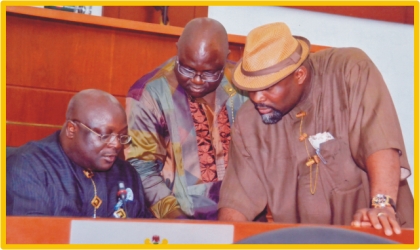
Speaker, Rivers State House of Assembly, Rt. Hon. Otelemaba Amachree (left), former Speaker, Rt. Hon Tonye Harry (middle) and Leder of the House, Hon. Chidi Lloyd, scrutinising the 2013 Appropriation Bill prior to its passage, recently. Photo: Chris Monyanaga
Adamawa
The Lutheran Church of Christ in Nigeria has constructed a health clinic worth N4.5 million in Gombi Local Government Area of Adamawa.
The acting Bishop of Yola Diocese, Reverend Ishaku Bala, who disclosed this at the opening of a three-day conference of the diocese on Friday in Gombi said that the clinic was built to address the health needs of the people in the area.
Bala added that the church had implemented several human capacity buildings programme to improve the living standard of its members across the state.
“The church has also established poultry and fish ponds that will accommodate more than 1000 chickens and different variety of fish,” he said.
Borno
The Defence Headquarters said on Saturday in Abuja that 65 persons suspected to be terrorists had been apprehended by its Special Task Force (STF).
A statement signed by Brig.-Gen. Chris Olukolade, Director of Defence Information, said the terrorists were caught while attempting to infiltrate Maiduguri as they fled their various camps now under attack.
The statement said the arrest was a continuation mission aimed at ridding the nation’s territories of all insurgent activities.
“The facilities have now been occupied by our troops,’’ it said further.
The statement said further that, in another development, troops have engaged and dislodged elements of insurgent groups who carried out the May 7 attacks on citizens in localities such as Gamboru ward.
FCT
A member of Forum of Legal Practitioners, otherwise known as ‘Lex Fora’, has advocated death penalty for rapists.
A former Chairman of the forum in the FCT, Mr Paul Eshiemomoh, who made the suggestion in an interview in Abuja on Sunday, described the act of rape as barbaric and animalistic.
“Because I don’t see any sense in a man going to rape an underage, such people should not be allowed to leave among people in the society Yes, I support imposition of death penalty for rapists because it will serve as deterrent to others,’’ he said.
Eshiemomoh said that the law prescribes maximum sentence of 14 years imprisonment for rapists because it is a major crime, and decried the poor handling of rape cases by some prosecuting agencies, such as the police.
Jigawa
Two hundred and students of National Open University of Nigeria (NOUN), Dutse Campus, matriculated on Saturday for the 2012/13 academic year.
The Coordinator of the Study Centre, Malam Abdullahi Abubakar, said at the matriculation ceremony that the centre, established in 2008 with five students, currently had 751 students.
Abdullahi expressed concern over the low patronage for programmes of the school and appealed to the people to embrace them considering that NOUN was like any other university.
He said that NOUN provided opportunity for both the young and the old to continue their education through the distance learning process.
Kaduna
The Kaduna Electricity Distribution Company (KEDC) has warned that it would punish its staff involved in extorting money from customers.
Addressing the Customers’ Consultative Council at Sabon-Tasha Business Unit forum in Kaduna, the Managing Director of KEDC, Malam Mohammed Idris, said the management was worried by frequent complaints of monetary extortion by its staff.
Idris said the company was determined to deliver quality service to customers and would not allow any bad eggs to tarnish the image of the company and rubbish its efforts to meet the aspirations of its consumers.
Kaduna
The National Board for Technical Education (NBTE), Kaduna, has accredited seven programmes of the Federal College of Agricultural Produce Technology (FCAPT), Kano.
The college was established in 2008 to train middle level manpower in agriculture, post-harvest technology and agricultural produce inspection. The Provost of the college, Alhaji Muhammadu Ibrahim, who disclosed this in Kano on Sunday in an interview said the accreditation was for the institution to award National Diploma in Science Laboratory Technology, Food Technology and Statistics.
He said the college was in the process of developing a curriculum for National Diploma in Produce Post-harvest Technology and Produce Inspection.
Nasarawa
The Federal Road Safety Corps (FRSC), Nasarawa State command, has started a sensitisation campaign on traffic rules and regulations for primary school pupils in Lafia.
Addressing the pupils of Loremm International Primary School, Lafia, on Friday, sector commander, Mr Francis Udoma, advised children to educate their parents on how to drive in accordance with the rules governing driving.
Represented by Mr Basil Igbana, Udoma urged road users to exercise caution as they drive to reduce the rate of accident, and advised road users to make sure their vehicles are in good condition before starting any journey.
In her remarks, the proprietress of the school, Mrs Ego Okafor, who was represented by Mr Bob Nwankwo, described children as “agents of change’’.
Osun
The Osun Commissioner for Home Affairs, Culture and Tourism, Mr Sikiru Ayedun, on Saturday said the state government was preparing to give a facelift to historical sites to boost tourism.
Ayedun who made this disclosure in a telephone interview in Lagos, said the state was blessed with an array of culture, arts and tourism opportunities to make it the number one tourism destination in the country.
The commissioner said it was on the basis of the derivable benefits from the venture that necessitated government’s decision to embark on the project.
Ayedun revealed that government had previously restored sites such as the Olajokun Memorial Park, Osun Grove, “Opa Oranmiyan”, Oke-Mogun shrine in Ile-Ife and the Oluminrin Waterfall in Erin-Ijesa.
Oyo
Three African Congres of Nigeria (ACN) Governors, Babatunde Fashola of Lagos, Rauf Aregbesola of Osun and Kayode Fayemi of Ekiti have pledged support for Gov. Abiola Ajimobi of Oyo State’s urban renewal project.
The governors made the promise on Saturday at a reception at the Obafemi Awolowo Stadium Ibadan, to climax the chieftaincy titles conferred on the governor and his wife.
The governors, who spoke separately, said that Ajimobi had restored the glory of Oyo State, adding that he had achieved the set goals of his administration in two years.
Plateau
Plateau State Governor, Jonah Jang has described Presi
dent Goodluck Jonathan’s declaration of emergency rule in three states as the best decision for the country.
Jang made the declaration while speaking to newsmen on arrival at the Jos Airport after a three-week trip abroad ,last Saturday.
“Our president knows better as the chief security officer of this country, and he has acted in the interest of all citizens.“Without peace, there is no way Nigeria can enjoy the patronage of investors. Peace is a prerequisite for investment, development and growth.“Ours is to support everything the President is doing, so that we can bring total peace to our country,’’ he said.
The governor said he and some others were just back from an investment summit in Canada aimed at attracting investors to the country.
Sokoto
The National Hajj Commission of Nigeria ( NAHCON), has allocated 6,450 seats to Sokoto State for the 2013 Hajj, top official of the pilgrims agency has said.
The Chairman, Sokoto State Pilgrims Welfare Agency (PWA), Alhaji Muntari Maigona, said in an interview in Sokoto on Saturday, that Gov. Aliyu Wamakko had approved over N25 million for the provision of computers and other accessories for the establishment of ultra-modern ICT-compliant Hajj registration centres.
He said that part of the funds would be used for the intensive training of the Hajj registration officials in the state to ensure success of the ongoing biometric registration of all prospective pilgrims.
Zamafara
The Inspector-General of Police, Mohammed Abubakar, says police will now strengthen partnership with communities to identify potential national security threats.
The IG said this on Saturday in Gusau at the opening of a one-day Intelligence Sensitisation and Community Partnership Workshop.
Abubakar, who was represented on the occasion by the AIG North West Zone, Suleiman Fakai, said partnership with communities would now take “central role in preventing and responding to terrorism and reducing citizens’ security concerns”.
The measure, according to him, will also enhance national security, protection of lives and property and stabilise democracy.
Gov. Abdulaziz Yari, who was represented by the Commissioner for Local Government, Muttaka Rini, expressed readiness to always partner with security agencies to ensure peace in the state.
Yari said government would always support the agencies with logistics to enhance their performances in the protection of peoples’ lives and property and ensure peaceful coexistence among the communities.



Rivers State University and the Otonti Nduka Foundation for Values Education jointly hosted a two-day National Conference on 8 and 9 May 2026 to examine the state of values in Nigeria.
The two days conference held at Rivers State University convocation arena brought together academics, policymakers, legal experts and education leaders under the theme _“Trends and Challenges in Upholding Values in Nigeria.”_
The gathering focused on policy gaps, curriculum reform, and the role of ethics in public service and education.
The event opened on Friday with remarks from Vice Chancellor Prof. Chief Isaac Zeb-Obipi, who stressed the need to address declining moral and civic values across Nigeria’s education and public sectors. A book of abstracts for the plenary sessions was also presented to participants.
Key speakers included former Attorney General Chief Dr Kanu Agabi, SAN; NERDC Executive Secretary Prof. Shehu Salisu; Prof. Hauwa Imam, FNAE, of the University of Abuja; former Rivers SUBEB Chairman Ven Dr Fyneface Akah, ; former NIMASA DG Dr Hon. Dakuku Adol-Peterside; and RSU Director of ICT Prof. Sunny Orike.
Discussions centered on integrating values education into schools, tertiary institutions and public institutions, alongside the impact of technology on moral development among young Nigerians. Panel and plenary sessions produced practical recommendations for curriculum and policy reform.
On Saturday, the foundation marked its centenary with the unveiling of the book _Otonti Nduka in History_, launched by Chief Engr. Grant Offor, FNSE. The Nigerian Academy of Education held a ceremonial procession led by its President Prof. Olu Jegede and the Ikwerre Professors Forum.
In a communiqué, participants called for stronger collaboration between government, civil society and academia to mainstream values education nationwide. They recommended reviewing teacher training curricula and expanding digital platforms to promote ethical civic engagement, with the foundation pledging to share the outcomes with education authorities for implementation.
Dignitaries present included Ogbakor Ikwerre Worldwide as Chief Host, Prof. Emeritus Chief T. Uzodimma Nwala, the Ikenga 1 of Mbaise and first philosophy student of Prof. Otonti Nduka, alongside scholars and community leaders.
Amadi Akujobi

The Shell Nigeria Gas Limited, in partnership with the Manufacturers Association of Nigeria, has reaffirmed support for efforts to expand gas distribution infrastructure in Rivers State as part of initiatives aimed at improving access to affordable, cleaner and more reliable energy for industries across the South-South region.
The commitment was highlighted during the SNG–MAN Business Forum held in Port Harcourt, where stakeholders from the industrial and public sectors examined the role of natural gas in driving industrialisation, boosting local production and strengthening energy security.
Speaking at the forum on behalf of the Managing Director of Shell Nigeria Gas Limited, the company’s Head of Gas Distribution, Mr. Chukwuka Amos Ejesi, described natural gas as a critical component of Nigeria’s energy mix and a key driver of sustainable industrial growth.
According to him, Nigeria’s gas development agenda has reached a stage where policy direction must be matched with practical implementation capable of addressing the energy challenges confronting manufacturers.
He noted that pipeline gas offers industries a cleaner, more dependable and cost-effective energy alternative capable of supporting uninterrupted operations, reducing emissions and improving production efficiency.
“Gas is the backbone of manufacturing, and we are encouraged by the growing recognition among stakeholders of the need for cleaner and more reliable energy solutions,” he said.
Ejesi stressed the need for sustained collaboration among energy providers, government institutions and industrial stakeholders to maximise the country’s gas resources for economic development.
He added that improved gas infrastructure would strengthen manufacturing value chains, enhance productivity and promote more competitive industrial operations across Rivers State and the wider South-South region.
Participants at the forum also emphasised the importance of expanding energy infrastructure as a pathway to unlocking industrial capacity, reducing operating costs and promoting sustainable industrial development.
Representing Governor Siminalayi Fubara, the Director-General of the Rivers State Investment Promotion Agency, Dr. Chamberlain Peterside, reaffirmed the state government’s commitment to partnering with private sector investors to revitalise industrial activities in the state.
He identified key projects targeted under the initiative to include the revival of the Ahoada Industrial Park, the New Port City project and the proposed Bonny Industrial Park, all aimed at stimulating economic growth and expanding industrial opportunities along the Bonny corridor.
According to the governor, the long-term vision is to position Rivers State as a leading manufacturing hub in Southern Nigeria through strategic public-private partnerships.
Governor Fubara also commended Shell Nigeria Gas and MAN for sustaining engagements geared towards improving industrial energy access, noting that gas infrastructure development remains central to the state’s economic recovery plans.
He further observed that the gas sector presents enormous opportunities for economic growth, especially as global energy systems continue to shift towards cleaner energy sources.
The governor called on stakeholders to work collectively towards developing a practical and sustainable gas framework capable of supporting the state’s industrial and energy development objectives.
Chairman of MAN, Rivers and Bayelsa Branch, Elder Vincent Okuku, described gas as indispensable to industrial operations, noting that many manufacturers continue to struggle with the high cost of alternative energy sources.
Similarly, President of the Port Harcourt Chamber of Commerce, Industry, Mines and Agriculture, Dr. Chinyere Ngozi Nwoga, said the transition to natural gas had become increasingly necessary for businesses seeking stable and cost-efficient operations.
“Pipeline natural gas provides a more cost-effective and reliable source of energy for industries,” she stated.
Also speaking, former Chairman of MAN in Rivers and Bayelsa States, Mrs. Emilia Akpan, stressed the need to align energy infrastructure development with investment in human capacity.
She maintained that rebuilding the state’s economy would require not only reliable energy supply but also the development of technical skills needed to support long-term industrial growth.
By Kevin Nengia
-
News1 day ago
Obuah’s Victory Excites Former Lawmaker as APC Primaries Conclude in Rivers West
-

 Politics3 days ago
APC PRIMARIES: FUBARA’S WITHDRAWAL, HISTORIC SACRIFICE FOR NATIONAL STABILITY ……. GROUP
-

 News3 days ago
Court Sentences Seven To Death Over Murder Of Cleric In Rivers
-
News1 day ago
105 Nigerians Killed In S/Africa In Seven Years
-

 Sports3 days ago
PH Arsenal Community Set For Streets Procession, Saturday
-

 Politics3 days ago
IPAC Flays INEC Over Election Guidelines Judgement
-

 Politics3 days ago
NDC To Adopt Electronic Voting For Future Primaries
-

 Niger Delta1 day ago
Royal Father Endorses PH Arsenal Community, Pledges To Support