
Nation
THE STATES

Bauchi
The Assistant Inspector-General of Police (AIG) in
charge of Zone 12, Mr Mohammed Gana has urged politicians in Bauchi State to exhibit high sense of responsibility while playing politics.
Addressing representatives of political parties in Bauchi state as part of sensitisation efforts in preparatory to the 2015 general elections, the AIG said that they were expected to make positive contribution for the advancement of Nigeria’s democracy.
Gana, whose zone covers Borno, Bauchi and Yobe states, said a meeting of stakeholders was necessary to discuss ways of ensuring the success of the 2015 general elections.
In his remarks, Bauchi State Commissioner of Police, Alhaji Mohammed Ladan, also advised the politicians to shun violence in the course of their campaigns.
Borno
The Borno State Commissioner for Animal Resources
and Fishery, Alhaji Umar Kyari, has charged the Leather and Allied Products Manufacturers Association of Nigeria (LAPAN), to work toward development of the state and the country at large.
The commissioner, who gave the charge when members of the association paid him a courtesy call in Maiduguri last Wednesday noted that the state was one of the leading producers of hides and skin and also had the highest record of export of the product in the country.
He expressed the willingness of the ministry to partner with the association and urged it to reciprocate the gesture for the development of the state.
Also speaking, Alhaji Modu Mustapha, the Permanent Secretary in the ministry, said efforts would be made to keep adequate record of products being exported, with a view to monitoring developments in the sector.
Jigawa
The Birniwa Local Government in Jigawa State has
embarked on the mobilisation of religious and traditional leaders as change agents towards the eradication of polio in the area.
The council chairman, Alhaji Ali Diginsa, announced this recently in Birniwa at a meeting with members of the council’s polio task force committee.
Represented by Alhaji Lawal Ibrahim, Director of Administration in the council, Diginsa said that the council would focus on border communities in the fight against the disease and urged parents to present their children during the exercise to eradicate the disease in the area.
Manager, National Programme on Immunisation (NPI) in charge of Birniwa, Mr Datti Arobade, said the meeting was aimed at addressing some of the problems recorded during previous exercises.
Kaduna
The Kaduna State Government says it has spent more
than N1.2 billion in 2013 on the drilling of 754 bore holes across the state.
The Commissioner for Water Resources, Mr Ado Audu, said in an interview in Kaduna State that the project was part of intervention measures to address water scarcity in various communities.
He said 680 hand pumps were provided across the 34 local government areas of the state at the cost of more than N837.1 million under the government’s constituency projects intervention programme.
Audu said each of the local councils were provided with 20 bore holes, adding that the projects were 82.9 per cent complete.
Kebbi
The Fakai Local Government Council of Kebbi State says
it has constituted a committee to liaise with neighbouring states to the prevent the spread of diseases in the area.
The Chairman of the council, Alhaji Umaru Marafa, told newsmen in Mahuta last Thursday that the committee would collaborate with Niger and Sokoto states on disease control measures.
“The council had sustained joint regular meetings as well as assistance to border communities in the other states with drugs and personnel as part of efforts to prevent the spread of polio and other diseases in our area,” he said.
Marafa said the measures ensured zero record of polio in the area, adding that the provision of a new hospital in the area by the state government had reduced hardship faced by patients, thereby boosting health care delivery as the Primary Health Centres (PHC) and dispensaries were inadequate.
Kwara
The Chief Justice of Nigeria (CJN), Justice Aloma
Mukthar, has said the late Justice Saidu Kawu had been immortalised through his contributions to the Nigeria law reform.
The CJN revealed this last Thursday, when she paid a condolence visit to the family of late jurist at his Ikokoro family Compound, off Niger Road in IIorin.
Mukthar said that the name of the late jurist would remain indelible in the minds of those in the judiciary described him as a complete gentleman.
The CJN, who described death as inevitable, advised Nigerians to further intensify on good deeds as a way of preparing for death.
The Acting Kwara Grand Khadi, Justice Olohuntoyin Mohammed, offered special prayer for the CJN and for the repose of the soul of the deceased.
Lagos
The Lagos State Chapter of the National Union of Road
Transport Workers (NURTW) has solicited the state government support to eliminate miscreants from the popular Oshodi Motor Park.
The Union Treasurer, Alhaji Musiliu Akinsanya, who made the appeal in Lagos said that miscreants were threatening the peace of the community.
He said, “Some boys from nowhere nowadays use to attack and disturb our peace; we have tried to work with a taskforce to stop their nefarious activities.
“These boys are usually many and their menace has constantly resulted in snatching of people’s bags, stopping of vehicles at night and other nefarious activities.
“We want the government to help the union to dislodge these miscreants from this area and stop them from advancing in their operations,” he added.
Ondo
The Nigeria Union of Journalists (NUJ), Zone B, has
expressed concern over the spate of industrial actions in the country.
The Vice-president of the zone, Mr Dele Atunbi, in Akure in a statement observed that “the industrial actions are pointers to the fact that the industrial atmosphere is cloudy.
“The havoc that industrial action has wreaked on the county’s economy is enormous, particularly the six-month-old ASUU strike, ASUP strike and the just concluded health workers three-day warning strike. “It is, therefore, necessary for the employers and the employees to deliberately create a conducive atmosphere for industrial harmony to reign in the country through equity, justice and fair play,” it said.
Osun
The Peoples Democratic Party (PDP) and All Progressives
Alliance (APC) last Saturday in Osogbo pledged to shun thuggery and rigging in the forthcoming 2014 and 2015 elections in Osun.
While the gubernatorial election is scheduled to hold in Osun in 2014, the people of the state will join the rest of Nigerians for the Presidential and National Assembly election in 2015. The Osun gubernatorial election is slated to hold on August 9.
Mr Diran Odeyemi said that the PDP would play its part towards ensuring that the elections were peaceful and devoid of malpractice.
Also speaking, Oyatomi, who is the APC Director of Publicity, Research and Strategy, said the party had zero tolerance for thuggery, stressing that Governor Rauf Aregbesola believed in the rule of law and attached premium to the conduct of peaceful and hitch-free elections.
Oyo
A Lecturer and Consultant Obstetrician and
Gynaecologist at the College of Medicine, University of Ibadan, Dr Nike Bello, said breast cancer is the greatest women killer world-wide.
Bello says in an interview in Ibadan that one out of eight women in Nigeria developed breast cancer monthly, described the disease as a silent killer which should be controlled.
The gynaecologist defined breast cancer as an uncontrolled growth of breast cells stated that the cells occurred due to mutations or abnormal changes in the genes responsible for regulating the growth of cells and keeping them healthy.
According to her, breast cancer can be treated and managed successfully if detected early and advised women of reproductive age to always examine their breasts immediately after their menses.
Plateau
The Executive Director of Ittijihad Islamic Foundation in
Jos, Alhaji Yusuf Yahaya, has appealed to the Plateau Government to establish almajiri schools in the state.
Yahaya said in Jos last Thursday that establishment of the schools would go a long way in providing basic education to many children.
He said that the foundation decided to establish the schools so that they could contribute their quota in providing education to the children and make them responsible citizens.
Yahaya appealed to corporate organisations, non-governmental organisations and well- meaning Nigerians to support the foundation with learning and teaching equipment.
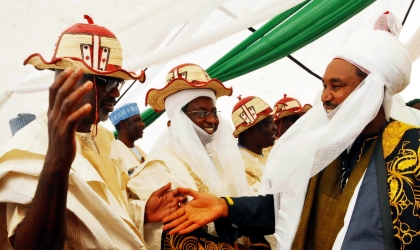
L-R: Governor Liyel Imoke of Cross River State, Governor Lamran Yero of Kaduna State, Governor Emmanuel Uduaghan of Delta State and Governor Ibrahim Shema of Katsina State after the turbaning of Katsina State Governor as Sarkin Fulani Katsina 1. by the Emir of Katsina, Alhaji Abdulmumini Usman in Katsina last Saturday.




The Hydrocarbon Pollution Remediation Project (HYPREP) has commemorated the 15th anniversary of the release of the United Nations Environment Programme (UNEP) Environmental Assessment Report on Ogoniland, reaffirming its commitment to restoring the environment and improving the livelihoods of affected communities.
In a statement signed by the Project Coordinator, Prof Nenibarini Zabbey, to commemorate the anniversary, HYPREP described the anniversary as a significant milestone in Nigeria’s environmental restoration efforts, noting that the project has made remarkable progress in implementing the recommendations of the landmark UNEP report released on August 4, 2011.
The UNEP report had revealed extensive oil pollution across Ogoniland, severe environmental degradation, and serious public health risks resulting from decades of petroleum operations. It also recommended an initial $1 billion fund to commence the cleanup of the affected communities.
According to HYPREP, the Federal Government formally launched the Ogoni clean-up in 2016, while the Project Coordination Office was established in 2017 to drive the implementation of UNEP’s recommendations.
Zabbey said the current administration has continued to prioritise the project under the Renewed Hope Agenda.
Providing an update on the cleanup, the Project Coordinator disclosed that 30 of the 65 contaminated sites identified by UNEP have been fully remediated, while work is ongoing at several medium- and high-risk locations. It also stated that more than 1.5 million mangrove seedlings have been planted as part of what it described as the world’s largest restoration of oil-degraded mangroves, with over 1,000 hectares of shoreline already rehabilitated.
Zabbey further revealed that 49 Ogoni communities have been connected to potable water schemes through multiple water projects and booster stations aimed at providing safe drinking water across the region.
In the health sector, he said the 100-bed Ogoni Specialist Hospital in Kpite and the 43-bed Cottage Hospital in Buan are nearing completion, adding that several existing health facilities have been upgraded with modern medical equipment, while five ambulances have been donated to improve emergency healthcare services. The Project Coordinator also disclosed that a three-year human health biomonitoring study is being conducted in collaboration with the World Health Organization’s International Agency for Research on Cancer (IARC).
On economic empowerment, Zabbey stated that the Project has created more than 8,000 direct jobs and trained thousands of Ogoni youths and women in various vocational and technical skills, including software development, cybersecurity, aviation, commercial diving, seafaring, mechatronics, and creative arts. The project also reported awarding scholarships to more than 1,000 students, providing grants to small businesses, and supporting persons living with special needs through skills acquisition programmes.
The statement further highlighted ongoing legacy projects, including the Ogoni Power Project and the Centre of Excellence for Environmental Restoration, which it said is about 96 per cent complete. HYPREP also welcomed the recent designation of the Ogoni Wetland as a Ramsar Site of International Importance and pledged to continue promoting biodiversity conservation and sustainable management of the ecosystem.
Marking the anniversary, Zabbey said the progress achieved over the past 15 years demonstrates the collective commitment of government, development partners, stakeholders, and local communities to restoring Ogoniland. He called for renewed collaboration to sustain the cleanup effort, promote environmental sustainability, and support the long-term development of the region. 3
-

 News2 days ago
RSG Targets Nine Million Residents in Mosquito Net Distribution Campaign
-

 Oil & Energy2 days ago
Aiyedatiwa Signs New Electricity Bill
-

 Oil & Energy2 days ago
NLNG Commissions Research And Innovation Centre In RSU
-

 Maritime2 days ago
Marine Minister Commends President Tinubu On NPERA Bill Assent
-

 News2 days ago
KenPoly Holds Eight Convocations, August 29
-

 News2 days ago
RSG Begins Another Phase of Projects Commissioning Today
-

 News2 days ago
RMAFC Completes Revenue Sharing Review, Proposes New Pay
-

 Maritime2 days ago
NAGAFF Petitions IGP Over Alleged Maritime Police Harassment