
Nation
Beyond Partisan Opposition Of Boko Haram, Terror, National Security

When one of America’s most legendary civil rights advocates, Malcom X at the peak of his robust advocacy for good governance once said, ‘we owe our knowledge not to those who have agreed but to those who have deferred,” he was merely highlighting the import of alternative views and solutions to human problems and challenges.
Indeed, it also underscores the dictum, none is a reservoir of knowledge and looking further inwards, a rehash of a popular Okrika proverb which says, “Bu bilema Mingi gborianga ani-boke” meaning, the tide that eventually submerges the mangrove rages from not a single source. Therefore, for any people or nation-state to conquer its environment, unshackle itself from lack of knowledge and provide the best in human enterprise and ingenuity that humanity itself can offer, it requires men and women with rare vision, patience and a ‘never-say-die’, spirit. These are those who find no limits to what humanity can achieve.
It is to such people, human civilization today owes most accomplishments by way of inventions and myth breaking. It is to those rare human minds that society owes gratitude for finding answers to most of human needs that seemed impracticable.
These are the pacesetters, inventors and opposition voices who at one time or another preferred different approaches to getting things done and who at moments of seemingly impossible search for the hitherto unknown or little-known, tarry on as positive non-conformists or simply unusuals. But in their creative unusualness emerged most of the inventions society today do enjoy, in science, technology and even politics.
Thomas Edison, the man credited with the invention of the electric bulb among others was unrelenting in his resilience in search for workable clues and answers. That was at a time; many thought that electric bulb would not add any extra value to human life. He was mocked, derided and despised but the positive deviant in him urged him on and not even 250,000 failed attempts as success could sway his resolve. Today, the value of the electric bulb is for all to behold.
As in science and technology so it is in politics, social engineering and indeed governance. In fact, Malcolm X’s theory was meant to engineer in the main, positive opposition that at all times, offers alternative view to societal notions. It is not merely for opposition sake. The main expectation instead is for such opposition to provide alternative views to existing issues urgently demanding societal appraisal and reappraisal.
With such pedigree, the term opposition no longer becomes individualised or institutionalized but a pendulum that swings around quality alternatives to human endeavours on trial. This means, in a country like Nigeria, should there exist a potent opposition built on ideology, not individuals and clicks, nationalism not the familiar desperation for political power and selflessness not the familiar do-or-die posture of being driven to action not by intellect or reason but by desires and appetites, no single political party should govern uninterrupted approval for more than 13 year. It is either that the opposition is content being opposition endlessly or it does not have viable alternatives so can’t provide what it lacks in viable ideas. It is either that the opposition is ethno-religious in character or too regional to source such highly needed national alternatives or it simply lacks the pedigree, intellectual property or the political push to drive such alternative views for the proper understanding and indeed acceptance of the ordinary voter.
Or worst still, may be, the opposition does not meet the expectations of the electorate as a viable alternative, therefore, the voter simply feels safer sticking with the known than the unknown. One of these or all, sum-up the picture of Nigeria’s leading political opposition which rather than work hard to be seen as a viable bank of better alternatives, spends ample time in vain and uninspiring criticism, without providing any meaningful options for societal good.
Nigeria’s supposed leading opposition, the Action Congress of Nigeria (ACN) is one example that conjures this horrible picture and still content that it lacks the wherewithal, integrity and reach to provide a national alternative yet seems desperate to lose its opposition leadership to an even more unwieldy, desperate, power hungry, horribly ambitious and intellectually no better political drivers, hopeful to rest power from a single political party which it wants to make the electorate believe Nigerians do not deserve.
To achieve that tall dream, the ACN and its many disunited, uncoordinated and desperate merger partners have been busy badmouthing virtually any and every government policy, programme or action without sitting back to weigh the implications of their vituperations, the effectiveness of their criticisms and more importantly the measure of attitudinal change their views have effected among Nigerians towards actualising a displacement of the status quo.
Among others, its ever squinting views on Boko Haram, national security and war on terror appear to many, a mixed bundle of confused, directionless outburst, seemingly voiced without proper thinking or simply voiced for criticism sake not bothered about the national security implication of such view-points.
After the United nations (UN) House bombing, in Abuja, among many others last year; the ACN blamed the Federal government for a lack of tactical resolve, dependable intelligence gathering ingenuity and short supply of inspiring political leadership as responsible for the thriving profile of the Boko Haram. It did not suggest any which better way it would have handled the situation, were it in power.
Early this year, when Boko Haram terrorists attacked Christian places of worship, parks and markets with high Igbo ethnic nationality casualties, raising national concerns for likely reprisals, ACN merely criticised the attacks but refused to call it a terrorist siege. It did not suggest which better way it would have fought the war except blaming the ruling government of indecisiveness in tackling insecurity in the land.
Last month, when irked by the increasing spate of terror attacks in key Northern cities, including Kano, Jos and Maiduguru, in which several were killed and public and private property destroyed, Federal Government opted to consider the terror siege as a war on the Nigerian state, the ACN again criticised any likely military force, but did not say what alternative was left.
Curiously, at the peak hours of the merger talks with the Gen Muhammadu Buhari-owned Conference for Progressive Change (CPC) with just a state, in control against others’ with 12 as soon as Northern political elements started the clamour for amnesty for Boko Haram, apparently moved by same dubious political considerations, the ACN quickly jumped at it in support, without suggesting what government must do for victims of the protracted Boko Maram terrorist siege. It was merely in support of Boko Haram amnesty without tinkering where funds would be sourced to finance such unsolicited amnesty, from Boko Haram perspective.
And only last week, when, as many as between 70 and 100 police officers on official duty in search of an ethnic militia cult leaders in Nasarawa State were ambushed and killed, forcing President Goodluck Jonathan to cancel his planned trip to Namibia after cutting-short his working visit to South Africa to be briefed on the security situation, all, the ACN was quoted as saying was to warn the Federal government against plans to impose a state of emergency in many Northern states of Nigeria. No suggestions on what government should have done to stem the orgy of violence and senseless killings, except the known grandstanding to posture itself as a better lover of Northerners than the ruling Peoples Democratic Party (PDP) government.
To its disappointment, President Jonathan, last Tuesday, evening declared state of emergency in the three states of Adamawa, Yobe and Borno, but did not tamper with elected democratic structures as did former President Olusegun Obasanjo in similar circumstances, thus leaving ACN and others with little or nothing to feast on, in negative criticism.
But it seemed the ACN prepared its own opposition speech against the President’s expected broadcast long before the actual air-time when, it insinuated that the emergency rule was meant to dislocate democratic institutions, a suggestion that the nationwide broadcast later addressed to be untrue.
Even so, while, many well-meaning Nigerians; including governors of the affected states welcomed the Federal government’s decision as the most reasonable action to stem the reign of terror and reclaim Nigeria’s territory daily being annexed by foreign terrorists, with local connivance, the ACN stuck to its gun of unrestrained condemnation without offering alternative.
A week earlier, after spirited clashes between the terrorists and armed security men under the aegis of the Multinational Task Force on boarder surveillance in Baga, Borno State left several terrorists dead, the ACN in a statement had invited the International Criminal Court to charge the Nigeria defence institutions and of course, government with war crimes. There, again it made no viable suggestions on how to check the terrorists.
This is not the kind of opposition that can be seen as an alternative to the ruling party’s. It is instead one that makes the PDP, “the devil Nigerians know and are willing to stick to, than the self imposed angels Nigerians are still unsure to see. ACN and others in their emerging merger plans must present a better and more convincing manifesto that can make them national alternatives, not to shore-up as a band of shakeholders with shared political blocks to superintend and recoup such investments.
My Agony is that up till now, opposition politicians have not only failed to show character, drive and conviction as worthy alternative to the ruling government, they have made Nigeria the only thriving democracy where, government and opposition do not ever enjoy bi-partisanship even, on matters of national security, threatened by terrorists’ siege.
Some even say, many in their ranks could go the whole hug to sabotaging government efforts, if only to ensure their negative predictions not necessarily with a better opposite come true. That is not how politics should be played. National security should stand far above political sentiments and partisan adventurism. Period.



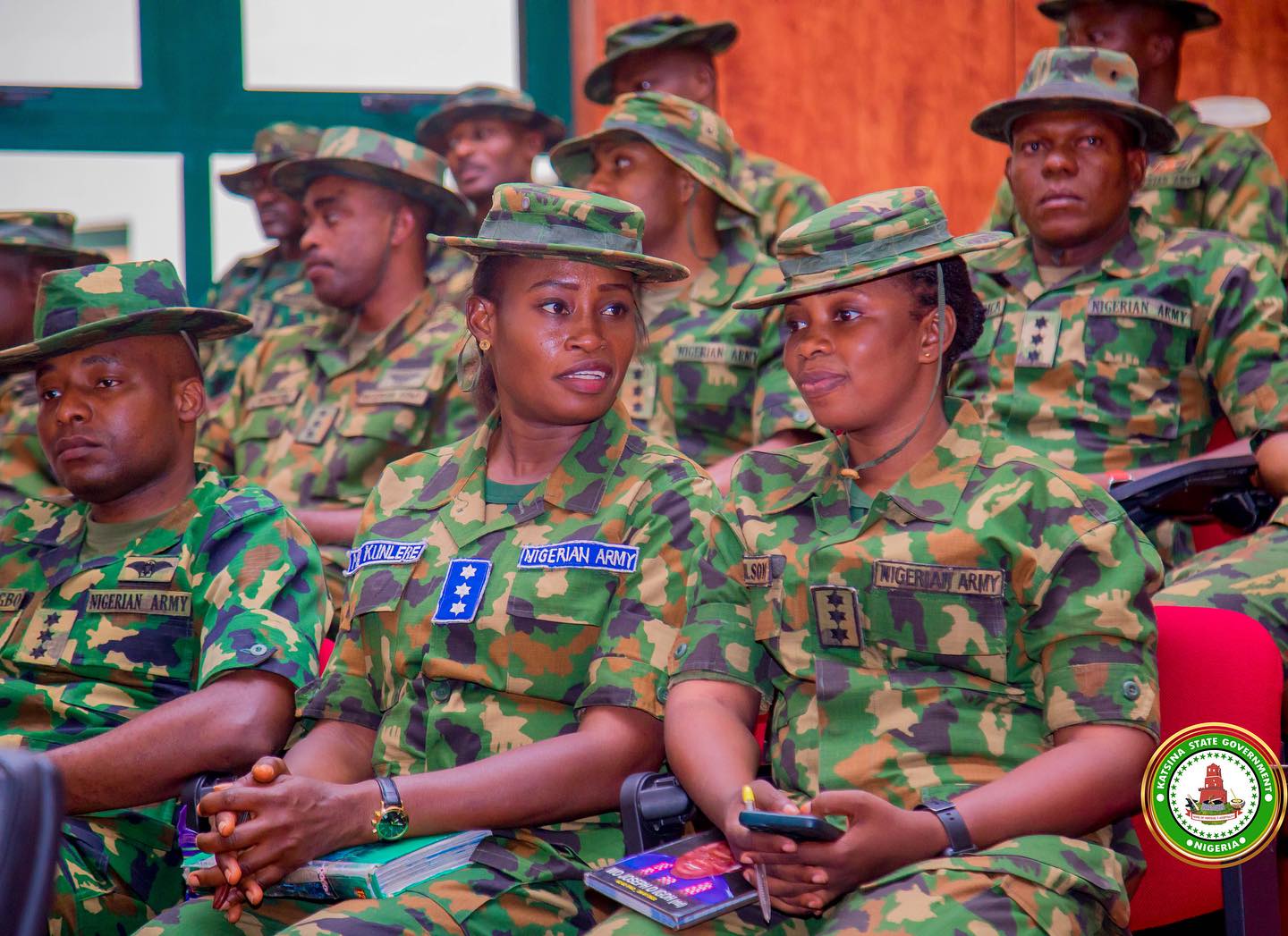
The Nigerian Army has passed out 384 female soldiers of the 90 Regular Recruit Intake (90 RRI) following the successful completion of Exercise SHINING STAR 2026 in Giri, Abuja.
In a post shared on the Nigerian Army’s X handle, yesterday, the Assistant Director, Army Public Relations, Nigerian Army Women Command, Giri, Abuja, Major Nsima Essien, said the passing-out ceremony was held on Wednesday, 28 October 2026, at the Nigerian Army School of Public Relations and Information (NASPRI), Giri, with the Chief of Army Staff (COAS), Lieutenant General W. Shaibu, represented by Major General Umar Gital Yusuf, as the Guest of Honour.
In his address, the Army Chief commended the female personnel for their dedication, resilience, discipline and commitment throughout the training exercise.
He described the successful completion of the exercise as an important milestone in their military careers and reaffirmed the Nigerian Army’s commitment to developing a professional, disciplined and combat-ready force.
He urged the newly trained soldiers to uphold the values of teamwork, courage, loyalty and professionalism, while applying the knowledge and skills acquired during the exercise to their military duties.
Shaibu emphasised the importance of continuous training, physical fitness and operational preparedness in addressing contemporary security challenges before declaring the exercise closed.
Earlier, the Acting Commander of the Nigerian Army Women Command (NAWC), Colonel S. M. Ahmed, welcomed the special guest and other dignitaries to the ceremony.
Ahmed highlighted the significance of Exercise SHINING STAR 2026 in enhancing the physical fitness, military competence, discipline and operational readiness of the female personnel.
He also acknowledged the contributions of the authorities, instructors and other personnel whose efforts ensured the successful conduct of the exercise.
Highlights of the ceremony included obstacle-crossing demonstrations and weapons-handling exercises, during which the female soldiers demonstrated their ability to strip and assemble AK-47 rifles while blindfolded.
The demonstrations showcased the personnel’s physical endurance, confidence, weapons-handling skills and proficiency in basic military tasks.
“A total of 384 female personnel of the 90 RRI participated in the exercise, alongside 14 male personnel from the Headquarters, Directorate of Army Physical Training (HQ DAPT), and 70 male personnel from the 167 Special Forces Battalion, “ Ahmed said.
The ceremony attracted senior military officers from various units and formations, representatives of paramilitary agencies and other invited guests.
Eight male and female personnel who distinguished themselves during the exercise received awards presented by the Acting Commander of NAWC.
The event also featured a vote of thanks delivered by one of the beneficiaries, the presentation of souvenirs and a group photograph to commemorate the successful completion of the exercise.
The exercise forms part of the Nigerian Army’s efforts to strengthen personnel development, improve military competence and enhance operational readiness in response to the country’s evolving security challenges.
As the world marked the 2026 International Day of the Girl Child on Sunday, October 11, 2026, a non-governmental organisation, Stand Up for Women Society (SWS) has intensified its campaign against child marriage, urging schoolgirls to prioritise education, protect their rights and develop skills for a better future.
The organisation joined the global observance of the day under the theme, “International Day of the Girl Child: End Child Marriage and Invest in Girls’ Rights,” with a sensitisation programme at Government Girls Secondary School, Oromenike, D-Line, Port Harcourt, Rivers State.
Led by its Vice Chairperson, Daba Benebo, the group engaged the students in discussions on the dangers of early marriage, teenage pregnancy, sexual abuse and other challenges that threaten the education, safety and development of the girl child.
Speaking during the programme, Benebo urged the students to reject early marriage and remain focused on their studies, stressing that education would empower them to make informed decisions about their lives and future.
She cautioned the girls against allowing anyone to deprive them of their right to education and dignity, advising them to report cases of harassment, abuse and other violations of their rights to the appropriate authorities.
Benebo assured the students that SWS remained available to support them whenever they encountered violations of their rights.
She also encouraged them to maintain discipline and responsible conduct while avoiding behaviours that could expose them to negative influences and jeopardise their future.
Beyond formal education, the SWS vice chairperson urged the students to acquire vocational skills that could provide additional opportunities for economic independence and help them navigate future challenges.
The sensitisation programme, enlivened by singing, dancing and to share their views and experiences on issues affecting the girl child interactive sessions, provided an opportunity for the students to share their views and experiences on issues affecting the girl child.
One of the major issues raised during the discussion was the appropriate age for marriage. While some participants maintained that 18 years was the constitutionally approved age, the discussion highlighted the need to consider not only age but also the maturity, preparedness and responsibilities associated with marriage.
The speaker stressed that marriage required adequate mental and emotional preparation, as well as the capacity to shoulder its responsibilities.
She therefore advised the students to concentrate on acquiring a sound education before considering marriage, noting that education would equip them with the knowledge and skills needed to make responsible decisions and manage family life.
The issue of teenage pregnancy also featured prominently during the question-and-answer session.
In addressing the subject, the speaker explained that pregnancy could occur even at the age of 12, using the example to underscore the vulnerability of young girls to the consequences of early sexual activity.
She advised the students to avoid sexual intercourse and prioritise their education, personal safety and future aspirations.
The discussion also examined the difficulties some girls encounter when living with hostile spouses, relatives or guardians.
Benebo encouraged the students to cultivate patience, humility and diligence, noting that these qualities could help them navigate difficult situations and build a brighter future.
However, she warned that patience and humility should never be interpreted as an obligation to endure violence, abuse or degrading treatment.
She urged girls experiencing hostile or abusive living conditions to seek help from their parents, trusted adults or appropriate support services rather than remain in environments that could expose them to physical or emotional trauma.
“When such happens, please return to your parents and engage in petty trade or learn a skill to support your education rather than stay in a hostile environment,” Benebo stressed.
The programme also underscored the importance of protecting girls from early marriage and other harmful practices that can disrupt their education, compromise their well-being and limit their opportunities in life.
It also reinforced the need for families, schools, communities and relevant organisations to work together to ensure that girls have access to education, vocational training, protection and the support they need to realise their potential.
For SWS, the message was clear: empowering the girl child begins with protecting her rights, investing in her education and equipping her with the confidence and skills to make informed choices about her future.
Stories by Kevin Nengia
The Egberipapa Foundation has unveiled a mass transit scheme aimed at easing transportation difficulties and improving connectivity among communities in the three Kalabari local government areas of Asari-Toru, Degema and Akuku-Toru in Rivers State.
The initiative, established by former Caretaker Committee Chairman of Akuku-Toru Local Government Council, High Chief Sobomabo Jackrich, popularly known as Egberipapa, is designed to make transportation more accessible and affordable for residents across the Kalabari area.
The scheme was launched on Monday, October 12, 2026, and is expected to address longstanding transportation challenges confronting residents, particularly those in riverine and hard-to-reach communities.
Communities expected to benefit from the initiative include Krakrama, Minama, Angulama, Sangama, Omekwe-Tariama and Omekwe-Ama.
The project is expected to ease movement within and beyond the Central Group area, while providing residents with a more convenient means of transportation for their daily activities.
For decades, transportation difficulties have posed significant challenges to several Kalabari communities, making movement between settlements both cumbersome and expensive. These challenges have also affected commercial activities, social interactions and access to essential services.
The introduction of the mass transit scheme is therefore expected to provide relief to residents, strengthen inter-community connections and stimulate economic activities across the benefiting communities.
Beyond improving mobility, the initiative could contribute to community development by facilitating the movement of people and goods, supporting local businesses and enhancing social and economic interactions within the Kalabari area.
As the scheme gets underway, attention will be focused on its implementation, accessibility and sustainability, as well as its capacity to deliver lasting transportation benefits to the target communities.
The initiative represents a potentially significant step towards addressing transportation challenges and promoting grassroots development across the Kalabari Kingdom.
-

 Sports4 days ago
Nigerian Trio Target Titles At PFL Africa Finals
-
 Education4 days ago
FCE Yola Graduates 3,555 Teachers , Seeks Upgrade to University
-

 Niger Delta4 days ago
Diri Restates Stance On Lagos-Calabar Coastal Highway
-

 Niger Delta4 days ago
C’River, NUJ Pay Tribute To Late Guardian Editor
-

 News4 days ago
NDLEA Recovers Tons Of Illicit Drug Consignments In Nine States
-

 Opinion4 days ago
Checking Voter Apathy In Nigeria’s Electoral Process
-

 Politics4 days ago
2027: DICKSON’S EX-ALLY VOWS TO WORK AGAINST NDC INTEREST IN BAYELSA
-
Opinion5 hours ago
Ancestorial Worship: My Take (1)