
News
Rivers CJ Pardons 24 Inmates Of PH Correctional Centre

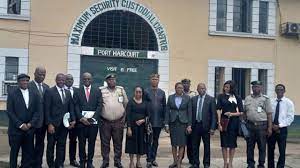
The Rivers State Chief Judge , Justice Simeon Chubuizor Amadi, has granted pardon to 24 awaiting trial inmates at the Port Harcourt Correctional Centre.
Speaking at a special gaol delivery exercise, last Friday at the Port Harcourt Maximum Correction Centre, Justice Amadi said that the special gaol delivery exercise was part of activities designed by the state judiciary to mark this year’s Easter celebration.
He explained that the exercise was in compliance with the provisions of the Criminal Justice Release From Custody Special Provision Act, Cap 40 laws of Federation of Nigeria 2024 and section 34 sub section 1 of the Rivers State Administration and Criminal Justice Law of No.7 of 2015 to conduct gaol delivered exercise in Port Harcourt correctional centre.
The state chief judge recalled that on November 2, 2023, the same exercised was conducted where 55 inmates were released from custody, adding that the gaol delivery exercise has a special place in the justice administration system.
Justice Amadi stated that the exercise underscores the commitment of his administration and the state judiciary at large in ensuring that justice is rightly served and to ensure that the correctional centre is not overcrowded.
According to him, the state judiciary under his watch is dedicated to ensuring that every individual irrespective of their status has right to interface in the society as law abiding citizen.
“Today we have the chance to offer compassion dignity and extend the hand of hope to those who have erred in the past that they deserve to have a change for the features.
“Our correctional center should not be warehouses for breeding ground criminal. Rather it should be an institutions for transformations where individuals can be and reflect on their actions and learn from their past mistakes and receive the necessary tools and support for a better living.
“With the collaboration among stakeholders involved in the criminal justice administration, the judiciary, the Correction Services, law enforcement agencies, legal aids organisations and community leaders must work hand in hand to ensure justice prevail and that they should create a safe and equitable service delivery as they embark on this gaol delivery exercise”, he stated.
The chief judge disclosed that the names of the freed inmates were compiled by a joint committee where all the stakeholders were represented.
Justice Amadi advised the freed inmates to be of good behaviour as they unite with their family and friends and avoid any act and misbehaviour that may bring them back to the custody, adding that they may not be lucky the second time.
“Change your behavior and do not go back to the behavior that will bring you back to the Correctional center again”, he admonished.
Earlier in his welcome address, the State Controller of the Port Harcourt Correctional Centre, Mr Felix Lawrence, thanked the Chief Judge for taking his time to visit the Centre, saying the gaol delivery exercise is essential in decongesting prisons.
By: Akujobi Amadi & Kiadum Edookor



The Chief of Army Staff (COAS), Lt.-Gen. Waidi Shaibu, has tasked troops of Operation SAVANNAH SHIELD to dominate the battlespace and intensify offensive operations against kidnappers, bandits and other criminal elements in the North Central region.
Shaibu gave the directive yesterday during his maiden operational visit to the Headquarters, Joint Task Force North Central (JTF-NC), at Sobi Barracks, Ilorin.
This is contained in a statement by the Acting Director, Army Public Relations, Col. Appolonia Anele, in Abuja, yesterday.
Shaibu said the Nigerian Army would remain resolute in its constitutional responsibility of safeguarding lives and property, stressing that troops must sustain pressure to decisively deny criminal elements freedom of action.
He assured personnel of continued deployment of combat enablers and operational resources to enhance clearance operations and dismantle criminal hideouts across Kwara and Niger states.
The COAS reaffirmed his commitment to troop welfare, noting that improved welfare remained critical to sustaining morale, operational effectiveness and combat readiness.
He urged the troops to remain disciplined, professional and loyal to the Constitution and the democratically elected government.
Earlier, the Theatre Commander, JTF-NC Operation SAVANNAH SHIELD, Maj.-Gen. Yakubu Yahaya, commended the COAS for his strategic leadership and support.
Yahaya assured that troops would remain committed and steadfast in restoring peace and stability in the region.

The Nigerian Navy says it is expanding training and infrastructure to address emerging security threats and strengthen operational efficiency across formations and units nationwide.
The Chief of Naval Staff, Vice Adm. Idi Abbas, spoke during the inauguration of projects at the Nigerian Navy Basic Training School (NNBTS) in Onne, Rivers as part of activities marking the Nigerian Navy’s 70th anniversary.
Abbas, represented by the Flag Officer Commanding, Naval Training Command (NAVTRAC), Rear Adm. Ebiobowei Zipele, said the projects reflected significant progress made by the navy since its establishment in 1956 from the British Royal Navy.
“Training and infrastructure have improved significantly to meet contemporary security challenges and fulfil the navy’s constitutional responsibilities.”
According to him, the anniversary provides the navy an opportunity to reflect on its achievements and contributions over the past seven decades.
Projects inaugurated included a remodelled female trainees’ hostel accommodating more than 500 occupants and an expanded golf course upgraded from one to nine holes.
Others were the NNBTS fuel dump, Chief Boatswain’s Mate House, renovated pharmacy department and a new theatre block at the Naval Medical Centre, Onne.
Abbas described the new theatre as a major milestone for the navy’s medical services.
“Previously, injured personnel requiring surgeries were referred outside the facility.
“With this theatre, surgeries can now be conducted within the base.’’
He added that a 30KVA inverter had also been installed to guarantee uninterrupted electricity supply at the training school.
The naval chief assured officers, ratings and trainees that the navy leadership remained committed to their welfare and wellbeing.
“These infrastructure upgrades show the commitment of the Chief of Naval Staff to addressing operational and welfare challenges promptly,” he said.
In addition, NAVTRAC distributed educational materials to pupils of Community Primary Schools One and Two, Ogale, in Ebubu-Eleme area of Rivers.
Items distributed included exercise books, school bags and other writing materials as part of the navy’s civil-military engagement initiative.
Zipele said the outreach was designed to strengthen relations between the navy and host communities while supporting children’s education.
“Education remains critical to national growth and youth empowerment. Some of these pupils may eventually serve in the Nigerian Navy,” he said.
He noted that the initiative demonstrated the navy’s commitment to educational development, peace, security and sustainable community relations.
Zipele urged the pupils to remain disciplined, focused and committed to their studies while embracing patriotism, integrity and hard work.
He thanked the Ebubu community for its continued support for the naval training command headquarters and the navy.
-
News20 hours ago
Obuah’s Victory Excites Former Lawmaker as APC Primaries Conclude in Rivers West
-

 Politics3 days ago
APC PRIMARIES: FUBARA’S WITHDRAWAL, HISTORIC SACRIFICE FOR NATIONAL STABILITY ……. GROUP
-

 News3 days ago
Court Sentences Seven To Death Over Murder Of Cleric In Rivers
-
News21 hours ago
105 Nigerians Killed In S/Africa In Seven Years
-

 Sports3 days ago
PH Arsenal Community Set For Streets Procession, Saturday
-

 Politics3 days ago
IPAC Flays INEC Over Election Guidelines Judgement
-

 Politics3 days ago
NDC To Adopt Electronic Voting For Future Primaries
-

 Politics3 days ago
Ex-IGP Defects To SDP After APC Primary Fiasco