Connect with us

Editorial

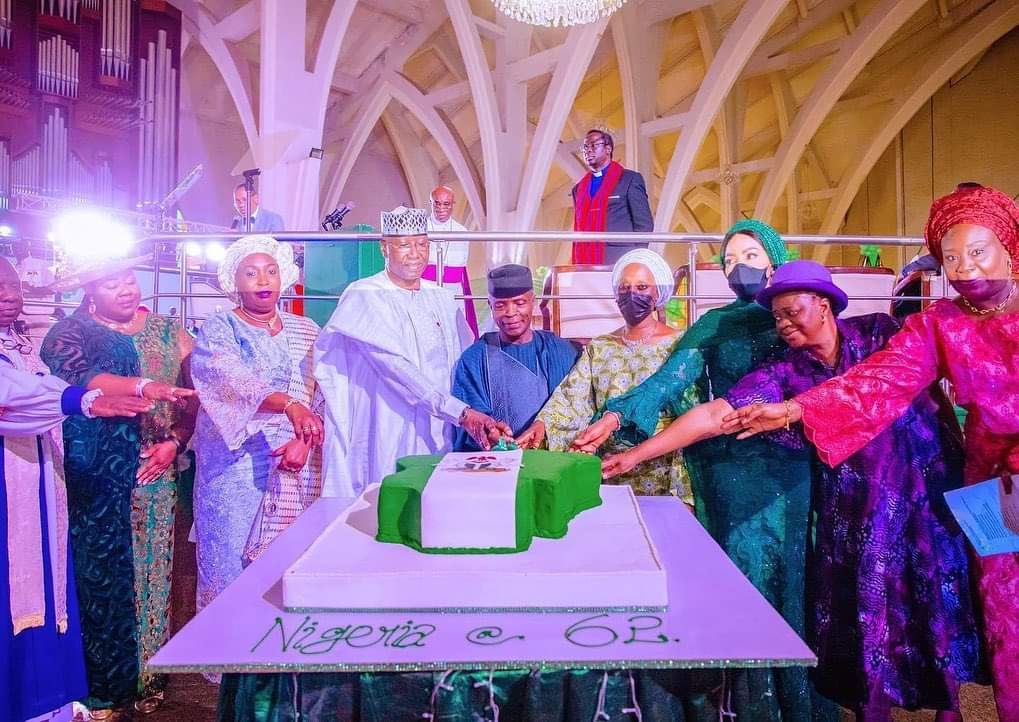
Hurray, Nigeria Is 62!

Published

on

Instead of grappling with the elevating issues of development, the country’s over 200 million population and more than 250 ethnic nationalities are smouldering with dissatisfaction about the present, and anxious about a precarious future. Now, the grand promise and hope of “unity in diversity” lie in bloody ruins, and separatist agitations have again taken a centre stage in national politics. If the years of military dictatorship are seen as “years eaten by locusts,” then the inhumane descent of Nigeria today can be said to be “more years eaten by the locusts.”
Every sector of our national life has been affected, from governance to the economy, security and national cohesion. Setbacks and deficits in each area of development define the country. Traumatised, abused and oppressed, young people have lost hope in the country. Just like in 1966, Nigeria is once again on the fast track to the point of no return. All Nigerians should be well-meaning enough to embark on conscientious sober reflection on the state of the nation.
Successive leaders have abandoned our founding fathers’ dream of Nigeria and replaced it with a motive for self-aggrandizement. The country is torn apart, the people are poor, life and property are insecure, and life is worthless. Now and then, we witness Nigerians loathe their country and spit out the worst abuse on their homeland. While the wealthy have acquired foreign citizenship for themselves and their families, others are working frantically to do so or emigrate from Nigeria.
This is Nigeria for the next generation of leaders: a disillusioned, morally weak, socially divided, religiously lost and economically stupefied country. This is not the way of a truly independent nation. To chart a path to progress, however, Nigeria needs people with big dreams, especially those who do not want to do things the usual way. To justify any independence claim, Nigerians must first determine the basis for their assertion to independence.
Nigeria’s problems are foundational. What we have is a corporate catastrophe. The country is a complicated, intricate, and flummoxing organism where wrongs rule and doing right is impossible. Do the different people who make up the nation see themselves as Nigerians in the first place? Or do they profess allegiance to their clan or tribe as their most basic identity? Nigerians require a sense of national pride and ethos that draws on all the values, spirits, and cultures of different peoples.
To this end, the political class and ruling elite must not place one part of the country above other parts or treat other parts as second-class citizens. Leadership is not racial domination or selfish power imbalances; rather, it is a tendency to truly carry out a mission for the common good. President Muhammadu Buhari should accept that under his leadership, Nigeria has witnessed its worst reversal ever. Leaders and followers must do their best to ensure that they aspire to a new and better Nigeria.
As she commemorates the 62nd anniversary of independence, Nigeria’s top priority should be leadership in Africa and the black world. The country is naturally given this leadership role, and she has indeed played a convincing role in her past activities on the African continent and abroad. Leaders should look to the exemplary and inspiring role this country can play 50 years from now. However, this will only happen if Nigeria shakes off the incompetence, and greed ingrained in its leadership.
What is there to celebrate is the tenacity of Nigerians in their decision to have their country despite a repeated siege by various outlaws. These Nigerians include farmers and locals trapped in terrorist and bandit enclaves, schoolchildren being hunted back and forth, disillusioned women and children in IDP camps, soldiers in trenches and police officers who sacrifice their lives, and lonely Nigerians who every day hope in God that this too will pass. It is these Nigerians who hold this country together and deserve the greatest courtesy.
Economically, Nigeria has fallen behind its peers. Diversification gave way to a single product model. Agriculture was once the backbone of the country and its defunct regions, contributing more than 60 per cent of Gross Domestic Product (GDP) in 1960. Today, it is a paltry 22.13 per cent of nominal GDP by June 2021. The Central Bank of Nigeria says oil and gas contributed less than 1.0 per cent of GDP and 6.65 per cent of export earnings in 1961, but contributed 47.72 per cent of GDP and 98.72 per cent of export earnings in 2000.
Despite successive governments’ efforts to industrialise the country and achieve sustainable economic growth, stakeholders in the real sector believe that the economy is gradually declining. Industrialisation, seen as the only means to achieve economic growth and development, remains unfulfilled 62 years after the founding of the nation. The scarcity of industry, stunted growth in manufacturing, rising unemployment, and lack of food and investment, among others, remain a great challenge.
Infrastructure has failed to pace with the tremendous population growth assessed at 45.14 million by the United States Census Bureau in 1960, to the estimated 211 million in 2021. Roads, airports, ports, and power are inadequate, requiring $3 trillion to fix, says the African Development Bank. In human development, failure is writ large. Whereas the poverty level was 15 per cent at independence, it averaged 27.2 per cent from 1980 to 2010 and reached 69 per cent by 2011.
Nigerians must vote wisely in the next year’s general elections by choosing a good leader. They have to be astute in their voting and avoid elevating needless issues. Nigerians should never again elect nepotistic, tribalistic and religious fundamentalists into governance. We need to salvage and retrieve our country from imminent collapse and looming disaster. The election next year is yet another opportunity to vote candidates that can transform the country and eliminate the pains the citizens are currently going through.
The duty to save our nation is a moral responsibility. A great nation is built based on the character of its people. If Nigeria has to be great, everyone has to take responsibility; everyone has to commit to doing what is fitting. This is a fundamental moral obligation to the state. That is what true independence means.

Continue Reading

Editorial

As NDG Ends Season 2

Published

on

On 20 February, the second edition of the Niger Delta Games (NDG) kicked off in Benin City, Edo State, with over 3,000 athletes from the nine oil-producing states of the Niger Delta region competing for honours across 16 sporting disciplines. Tagged ‘NDG Edo 2026’, the Games were scheduled to continue until the 27th (today), when the curtain would finally be drawn on proceedings. The event is sponsored by the Niger Delta Development Commission (NDDC) and organised by consultants Dunamis Icon.
Edo State is taking its turn as host following the maiden edition held in Uyo, Akwa Ibom State, the previous year. The inaugural edition was widely hailed as a resounding success, owing to the remarkable competitiveness and excitement it generated amongst the states of the region and, in particular, the young athletes who showcased impressive talent, prowess, and potential across a range of sporting events.
The maiden edition represented, in many respects, a new horizon and a breath of fresh air in efforts to engage and harness the talents and energies of the region’s youth towards positive endeavours that offer genuine prospects for career development. For a full week, young athletes from across the Niger Delta had the opportunity to compete in an environment where they freely expressed and explored their abilities, mingled with one another, and had the chance to connect socially and culturally.
It is for this reason that the NDDC and their consultants, Dunamis Icon, can be said to have hit the bull’s eye with the concept behind the Games. Beyond serving to engage the youth and identify promising athletes for the region, the competition has the capacity to produce athletes well capable of representing the national flag on international and continental stages.
The NDG presents opportunities that the states of the region must embrace wholeheartedly. Beyond venturing into the hinterlands to scout for promising young athletes, sporting facilities across the various states now have the opportunity to be tested and utilised on an annual basis, whilst host states enjoy the privilege of developing, upgrading, and maintaining existing facilities with the support of the sponsors.
As the Games draw to a close at the end of their second season, it is hoped that this regional sporting festival will continue to be guided by the vision and mission upon which it was founded, particularly its commitment to creating opportunities for untapped talents within the region. It is encouraging to note the organisers’ insistence that only athletes within the stipulated age bracket of 20 years and under are permitted to participate. No effort should be spared in ensuring that age falsification and the desperation to win at any cost are firmly discouraged.
Whilst commending the NDDC and Dunamis Icon for the considerable efforts already invested in ensuring that the NDG is not only successful but sustainable, it is expected that this second edition would mark an improvement upon the last, with the shortcomings witnessed in Uyo not being permitted to recur.
The NDG represents both an opportunity and a challenge to a region that prides itself as one of the country’s foremost nurseries of sporting talents. It is a chance to begin producing world-class athletes once again and to introduce names that will not only remind us of, but ultimately succeed the celebrated stars of previous generations across various disciplines — among them Adokiye Amiesimaka, Daniel Igali, Ojadi Oduche, Obisia Nwamkpa, Chioma Ajunwa, and Jeremiah Okorududu, to name but a few.
Just as the leadership of the NDDC has challenged the NDG to begin producing Olympic athletes for the country, we can only wholeheartedly concur that the Games possesses everything necessary to serve as a platform for unearthing future stars, and nothing less should be expected of it.
It is worth noting that the continued growth and credibility of the NDG will depend, in no small measure, on the rigour and transparency with which it is administered. Governance, accountability, and adherence to the founding principles of the competition must remain non-negotiable priorities for all stakeholders involved, from the sponsors and organisers through to the participating state delegations.
The role of the participating state governments in this regard cannot be overstated. Whilst the NDDC and Dunamis Icon provide the structural framework and financial backing that make the Games possible, it is the states themselves that bear the primary responsibility of identifying, nurturing, and presenting their finest young athletes for competition.
Governors and sports commissioners across the nine participating states must therefore treat the NDG not as a mere ceremonial obligation, but as a serious and strategic investment in the human capital of their respective populations. Only through sustained grassroots scouting programmes, well-funded state sports academies, and consistent domestic competitions can the region hope to maximise the full potential of what the NDG offers.
The private sector, too, has a meaningful role to play in the long-term sustainability of the Niger Delta Games. Whilst the NDDC’s sponsorship provides an essential foundation, the involvement of corporate organisations — particularly those with significant commercial interests in the region — would serve to deepen the financial base of the competition and reduce its vulnerability to the funding uncertainties that have historically plagued sporting initiatives in Nigeria.
Partnerships with brands, media organisations, and international sports bodies could further raise the profile of the Games, attract wider coverage, and open doors for the region’s most gifted athletes to access exposure, training opportunities, and platforms that extend well beyond the Niger Delta itself.
Ultimately, the Niger Delta Games carries with it the hopes and aspirations of an entire region and its young people. If nurtured with care, integrity, and sustained investment, it has every potential to become one of the most significant youth sporting platforms on the continent, and a genuine conveyor belt for the next generation of Nigerian sporting greatness.
Continue Reading

Editorial

Beginning A New Dawn At RSNC 

Published

on

The premises of the Rivers State Newspaper Corporation (RSNC), publishers of The Tide Newspaper, are wearing a refreshing new look as work begins on the re-erection of a perimeter fence. This development is more than a physical upgrade. It is a strong statement that the safety and dignity of a historic public institution are once again being taken seriously.
For many years, the corporation operated without a proper perimeter fence. The old fence was demolished about a decade ago during an urban renewal drive under the administration of Chibuike Rotimi Amaechi. The intention at the time was to relocate and properly situate the fence away from pedestrian walk, but the long-term consequences were not fully anticipated.
The absence of a fence exposed the premises to serious risks. Workers reported frequent cases of trespass, theft of office items, and unrestricted movement by unauthorised persons. In an environment where sensitive editorial and production work is carried out, such openness became a major concern rather than an advantage.
Statistics from internal records suggest that incidents of petty theft and vandalism rose sharply during this period, accounting for an estimated 30 per cent increase in maintenance costs over the years. Staff morale also suffered, as many employees felt unsafe working late hours, especially during night production schedules.
The return of the perimeter fence will bring immediate relief. It will provide controlled access to the premises, protect valuable equipment, and ensure that staff can work with peace of mind. Businesses and members of the public who visit the corporation for adverts, publications, and official transactions will also enjoy a more orderly and secure environment.
A secured workplace is known to improve productivity. Studies in public institutions show that improved security can raise staff efficiency by up to 20 per cent. For a newspaper organisation that works against tight deadlines, this improvement is both necessary and timely.
The Rivers State Government deserves commendation for funding this fencing project. The Tide is one of the oldest state-owned newspapers in Nigeria and has, over the decades, projected and promoted government policies, programmes, and public enlightenment campaigns. Such an institution deserves to be properly funded and equipped to perform at its best.
As the fencing work progresses, the government should look beyond this single intervention. There is a strong case for the total renovation of the corporation’s ageing buildings. This effort can build on the visible successes recorded in the ongoing renovation of the state Secretariat Complex, which will improve the working conditions of many civil servants.
Equally urgent is the replacement of obsolete equipment at the newspaper publishing firm. Most of the machines in use today were provided at the inception of the corporation several decades ago. Technology has moved on, but the tools of the trade have largely remained the same.
All the major printing machines and computers are old and can no longer function efficiently. Frequent breakdowns slow production and increase costs. A total replacement is required to return the organisation to the path of progress and competitiveness in a fast-changing media industry.
Attention should also be given to the rotary printing machine purchased during the Amaechi administration. Sadly, the machine never worked for a single day due to the absence of a vital component. Replacing this missing part would put the machine on stream, making it useful not only to the newspaper but also to the wider information needs of the government.
There is also a clear need for operational vehicles, power generating plant, and additional staff. Over the years, the corporation has lost more than 60 per cent of its workforce to retirement, death, and the prolonged freeze on civil service recruitment during the last administration of Chief Nyesom Wike. Without urgent replacement, service delivery will continue to suffer.
The Publication Department, which formerly produced calendars, diaries, and exercise books for schoolchildren, should be revived. In the past, the department generated substantial funds that helped sustain the establishment before it became defunct.
Much credit must go to the Acting General Manager, Stella Gbaraba, for demonstrating capacity and discipline in managing the outfit. A staff member of the state Ministry of Information, she has shown herself to be a quintessential administrator whose leadership has stabilised the corporation. She deserves to be celebrated.
Her performance once again confirms the long-held view that leaders appointed from within the civil service often understand public institutions better and perform more effectively than those brought in from outside. With sustained government support, competent leadership, and the right investments, The Tide can reclaim its pride of place as a strong voice in Rivers State and beyond.
Continue Reading

Editorial

Sustaining OBALGA’s Ban On Street Trading 

Published

on

The total ban on all forms of street, roadside trading, and hawking activities in and around the Okoro-Nu-Odo Flyover, along the Rumuodomaya Road leading to the Obio/Akpor Council Secretariat, and within the affected corridors, is yielding desired results. This decisive action has brought about a transformation that many residents had long given up hope of ever witnessing. The change is not merely cosmetic but represents a fundamental shift in how public spaces are being managed in this crucial part of the city.
The prohibition has not only curbed the mess created by the traders, it has restored the beauty of the area. The Chairman of Obio/Akpor Local Government Area, Hon. Dr Gift O. Worlu, deserves commendation for the feat. It takes considerable courage to make unpopular decisions in the interest of the greater good, and this is precisely what the chairman has demonstrated. His willingness to tackle this longstanding problem head-on sets a positive example for other local government leaders across the state.
It is common knowledge that the affected area is one of the gateways into Port Harcourt. On a typical day, to get in or get out of the city posed a terrible situation that left motorists and commuters utterly frustrated. First impressions matter greatly, and this passageway should reflect the status of Port Harcourt as a major city. Instead, what greeted visitors and residents alike was a chaotic scene that did little to inspire confidence in the city’s governance or planning.
How the place got to that level over the years is left for everyone’s imagination. But the local government which is just a stone’s throw from there allowed it to degenerate so badly. We cannot help but wonder what those in authority were thinking as the situation spiralled out of control. The proximity of the council secretariat to the problem area makes the previous neglect all the more baffling and inexcusable.
An outsider coming into Port Harcourt may be wondering what has gone wrong with the place. Sometimes it took several hours to navigate the area whereas ordinarily it should take a shorter time. This is not the image any city should project to visitors, investors or even its own residents. The economic cost of such traffic congestion, not to mention the sheer waste of people’s time and energy, must have been substantial over the years.
It was really an eyesore. So when the council chairman came up with the directive that trading activities should cease while the traders must vacate the place permanently, we think it was a decision taken for the good of all. While some may argue that the traders have a right to earn their living, this right cannot supersede the collective rights of thousands of road users who endured needless suffering daily. The common good must sometimes take precedence over individual interests.
All we ask from the chairman is to ensure that his actions are sustainable. Lack of sustainability and political will are usually the bane of many good policies of government. If this is sustained it will be the first of its kind. History is littered with well-intentioned initiatives that started with fanfare only to fizzle out when the initial enthusiasm waned or when those responsible moved on to other priorities.
As a way to sustain the measures taken so far, those who have been displaced should be relocated so they do not find their way back to the same location. It may not be enough to take them out without providing alternative places for them. A truly comprehensive solution must address both the symptom and the root cause. Simply scattering traders without offering them viable alternatives is a recipe for their eventual return, and the whole exercise would have been in vain.
Arrests and prosecutions that are being effected should continue to serve as deterrent to others. The actions of Obio/Akpor chairman show that the council means business. When people see that there are real consequences for flouting regulations, they are far more likely to comply. This is not about being heavy-handed but about establishing clear boundaries and enforcing them consistently and fairly.
Thankfully, the chairman had reportedly included the Oil Mill Market and the Eleme Junction areas as well. On the whole, the action of the council chairman in sanitising the mentioned areas is simply laudable. Other places of focus where street trading and related issues go on are Rumuola, Rumuolumeni, Choba, Rumuodara, Rumuokwuta, Ozuoba, Rumuosi/Rumuekini, Rumukwurushi, and Artillery/Woji. There should be consistent application of order and safety standards at the above-mentioned areas.
Another place to be sanitised is the Mbiama Market. This is also one area that is terrible particularly on Tuesdays when trading occurs there. It is hard for motorists and commuters to navigate the place. How to get out of that location is usually a problem that turns what should be a straightforward journey into an ordeal. The situation at Mbiama represents another glaring example of how uncontrolled commercial activity can bring an entire area to its knees.
Sadly, the local governments are complicit because they are the ones that would give people the spaces to trade in exchange for money. The Ahoada West Local Government Area chairman where Mbiama is situated should borrow a leaf from his Obio/Akpor counterpart by taking drastic measures to end the trading there or ensure that movements are guaranteed when trading activities go on in the locality. It is hypocritical for councils to profit from these arrangements while turning a blind eye to the chaos they create. Revenue generation should never come at the expense of public order and safety.
There needs to be sanity on these concourses. This will bring a lot of relief to travellers on these roads. It does not speak well of us as it portrays the state as a no-man’s land or unorganised or even a people that lack decency. We are better than this, and our public spaces should reflect our aspirations rather than our failings.
In the long run, a well-coordinated approach involving local governments, security agencies, and urban planners will be required to maintain these gains. Public enlightenment should go hand in hand with enforcement so that residents understand that these measures are not punitive but protective. When order becomes a habit rather than an exception, Port Harcourt and its surrounding communities will be better places to live, work and travel through.
Unwavering commitment from all stakeholders are required. The traders themselves must recognise that operating in designated markets is not a punishment but a more dignified and organised way of conducting business. Residents and road users must support enforcement efforts rather than sympathising with violations out of misplaced sentimentality. The local governments must remain vigilant and resist any temptation to relax standards or make exceptions that could unravel the progress made.
Continue Reading

Trending