
News
Blasphemy: Kaduna, Osun CAN Protest Sokoto Killings, Attack On Kukah

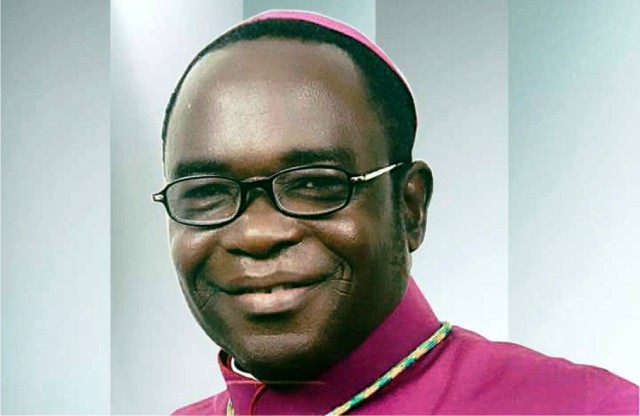
The Christian Association of Nigeria (CAN), Kaduna State chapter and Christians in Osun State, yesterday, staged peaceful protest through prayers against killings of a student, Miss Deborah Samuel and the attacks on a Catholic Church where Bishop Matthew Hassan Kukah is in charge.
Fielding questions from reporters shortly after the prayer session, Vice Chairman, Kaduna State chapter of CAN, Rev. Father Chris Annger, blamed politicians and religious extremists for the attacks.
“A situation where individuals will take laws into their hands to waste life that’s given by God previously is what the Kaduna State chapter of the CAN is gathered here to say it’s not acceptable; it’s not right and should be condemned by every right thinking Nigerians on the face of the earth. That is why we are here”.
Commenting on the attack on a Catholic Church in Sokoto and the safety of Kukah, Annger said, “When we learnt that a Catholic Church is attacked in Sokoto, it’s very clear that that attack was on Bishop Matthew Kukah because he’s the one who’s like a voice to the voiceless in this country.
“He’s speaking truth to power every day. So, that attack was directly or indirectly on him. So, people coming out to condemn him or his speech and things like that, probably, you will know that it’s something that has been conceived.
“It’s just giving birth on account of this incident otherwise it is something that people have within themselves about Kukah because of the way and the manner he has been approaching issues in the country.
“So, the attack on the church was to a large extent, an attack on Kukah. We are calling on the Nigeria government to charge those in charge of carrying guns or agencies responsible for taking care of us, to be up and doing and protect the life of Kukah and every believer as well as every Nigerian to be protected from this menace. It’s unacceptable”.
On the alleged another blasphemy in Bauchi, Annger said, “It is serious but it’s one of the things when a government that’s not upright in its position to securing the state. These are the things that come up. In the first place, it like a religious crisis after…after that we have issue of Boko Haram and after that we have issues of banditry which we are presently struggling with. In every state there is no safety on our roads, everywhere.
“To travel from Kaduna to Abuja or any part of the country, is a challenging thing. Now, we have issue of killing in the name of blasphemy. We don’t know whether it’s another strategy to eliminate believers in Christ because it’s worrisome.
“More worrisome because of the fact that people who ordinarily that would have commented on issues like these are silence. The government is not talking or doing enough to curtail this menace. It’s quite challenging. So, we don’t know if it’s another strategy.
“But I want to believe that in the same way that other strategies failed, this one will fail because nobody has the right to take life in the name of anything. We have a law to be followed by every individual who’s part of this nation and that has to be respected.
“We used to live harmoniously in the past but politics has set in. So, sometimes politics can take issues to some levels. We have politicians that can use anything for their gains and we have religious extremists that they want to, in the name of their God, they want to kill. Sometimes, I began to wonder.
“I have a God that I have faith and confidence in that I feel He protects me. He leads me and direct me, and I know that I am limited. I cannot protect Him and fight for Him but we have people that are proud to say that they are fighting for their God.
“You have killed somebody in the name of God but when arrested people are protesting so that you can be release. They don’t want you to be killed in the name of the same God that you kill for. What an irony. So, politics can set in and religious extremists too can bring in crisis”.
Annger explained, “We are people of God to thank God for life and to thank God for what has recently happened in Sokoto, Deborah Samuel, who was gruesomely killed by Islamic extremist on account of blasphemy.
“So, we are here to first pray for survival of those who are alive and also let the world know that it’s not the best way to go by killing because we are living in a country where there are rules as constitution. I think as a patriotic Nigerians, we have what is guiding us that has to be respected.”
Similarly, members of the Christian Association of Nigeria in Osun State, held a peaceful protest at the secretariat of the association, demanding that those involved in the recent killing of Deborah Samuel in Sokoto State be punished according to the law.
Addressing the protesters, Osun CAN Chairman, Bishop Amos Ogunrinde, declared that the killing of late Deborah was barbaric and ungodly.
He said, “We want to declare that the killing of Deborah Samuel is ungodly, is an oppression on the people of other faiths, and we want to demand justice for the gruesome killing.
“We have come together today enmass to represent the Christian community in the state of Osun to express our feeling. We felt that the killing of Deborah is a great injustice to humanity, not only to Christians alone, but to humanity, because life is sacred.
“We want the perpetrators of this evil to be brought to book, to be brought to justice. Let them be tried, let them be prosecuted and the law should take its course, so, that this act of barbarism will stop in Nigeria.”
Similarly, members of the Redeemed Christian Church of God, Osun Province 10 in Osogbo, had staged a peaceful protest against the killing of Deborah in Sokoto, calling for an end to any form of brutality under the guise of religion.
During the protest, members of the church held placards with different inscriptions such as ‘No killings in the name of God,’ ‘Let’s live together in peace,’ ‘God is watching,’ and ‘Let’s be our brothers’ keeper,’ among others.
Speaking with newsmen during the protest which was held at the Liberation Cathedral, the Province 10 Headquarters, Osogbo, the Pastor-in-charge of the province, Felix Afe-Johnson, said the protest was held in compliance with the directive of the RCCG leadership.
He further said, “They (RCCG leadership) asked us to just do peaceful protest to let everybody know that we don’t support the murdering of that young girl in Sokoto State.
“And we are not in support of bloodshed and all manner of vices going on in the country. We will prevent reoccurrence, when everyone keeps to his or her religion. We should not dabble into Islam and the Muslims should not dabble into Christianity since we are all pursuing same goal and ensure that there is peace.”



Nigerians were among more than 140 residents injured after Iran launched multiple ballistic missiles and unmanned aerial vehicles at the United Arab Emirates, at the weekend.
This raised fresh fears for thousands of Nigerians living and working in the Gulf nation.
The UAE Ministry of Defence disclosed last Saturday that its air defence systems intercepted several missiles and drones fired from Iran, describing the attack as a major escalation in the ongoing regional tensions.
In a statement posted on its official X handle, the ministry said its air defence units engaged nine ballistic missiles and 33 drones during the latest assault on March 14.
It added that the attacks left six people dead and 141 others injured, including foreign nationals.
“The UAE air defence systems on March 14 engaged nine ballistic missiles and 33 UAVs launched from Iran,” the ministry stated.
“Since the onset of this blatant Iranian aggression, UAE air defences have engaged 294 ballistic missiles, 15 cruise missiles, and 1,600 UAVs launched from Iran,” UAE added.
According to the ministry, those killed in the attacks included citizens of the UAE as well as foreign nationals from Pakistan, Nepal and Bangladesh.
“Although the authorities did not specify the exact locations where the casualties occurred, the ministry said the injured victims were from several countries, including Nigeria.
Others affected include residents from Egypt, Sudan, Ethiopia, the Philippines, Pakistan, Iran, India, Bangladesh and Sri Lanka.
The list also included Azerbaijan, Yemen, Uganda, Eritrea, Lebanon, Afghanistan, Bahrain, Comoros, Türkiye, Iraq, Nepal, Oman, Jordan, Palestine, Ghana, Indonesia and Sweden.
The Tide reports that this development has sparked concern among Nigerian communities in the UAE, where thousands of citizens live and work in sectors such as construction, hospitality, logistics and trade.
Data from Nigeria’s diaspora commission shows that the UAE remains one of the largest destinations for Nigerian migrants in the Middle East, particularly in the emirates of Dubai, Abu Dhabi and Sharjah.
The Nigerian government had in recent years raised concerns over the safety and welfare of its citizens in the country following diplomatic tensions and visa restrictions affecting Nigerians.
Saturday’s attacks have now heightened anxieties within the diaspora community, especially as the Gulf region faces growing military confrontations.
In its statement, the UAE Ministry of Defence said the country remained fully prepared to confront any threats to its security.
“The Ministry of Defence remains fully prepared and ready to deal with any threats and will firmly confront any attempts to undermine state security in a manner that ensures the protection of its sovereignty, security and stability, and safeguards its national interests and capabilities,” the ministry said.
In a separate update, the ministry noted that its defence systems were still actively intercepting missiles and drones.
“UAE air defences are dealing with Iranian ballistic and cruise missiles and drones,” it said.
Regional media reports indicate that the attacks form part of a wider escalation of hostilities between Iran and Western-backed forces in the Middle East.
According to Al Jazeera, Iran has continued sustained missile and drone strikes across the Gulf despite protests from neighbouring states.
The strikes were said to be in retaliation for military operations launched by the United States and Israel against Iranian positions in the region.
Tehran targeted several Gulf countries, including Saudi Arabia, Qatar and the UAE, late on Friday and into Saturday.
The attacks also caused infrastructural damage in parts of the UAE.
Meanwhile, Iran’s elite military wing, the Islamic Revolutionary Guard Corps, warned that US interests in the UAE would remain legitimate targets.
Iranian state media reported that the group issued the warning after US forces attacked Iranian-controlled islands.
The IRGC specifically mentioned ports, docks and military installations linked to the United States as potential targets.
It also urged residents in the UAE to evacuate areas around ports and military facilities to avoid civilian casualties.
Security analysts say the growing exchange of threats and strike across the Gulf could destabilise the region’s economic and aviation activities if the conflict escalates further.
Nigeria’s Ministry of Foreign Affairs has yet to issue an official statement on the incident as of the time of filing this report.

Rivers State Governor, Sir Siminalayi Fubara, has charged the five new commissioners sworn-in last Wednesday to put in their best for the development of the State.
Fubara gave the charge during the swearing-in of the commissioners at the Executive Council Chambers of the Government House, Port Harcourt, last Wednesday.
This followed the successful screening of the five commissioners by the Rivers State House of Assembly, last Tuesday.
The five commissioners are Tonye Bellgam, Prof. Temple Nwofor, Dr. Peters Nwagor, Mr. Lekue Kenneth, and Sir Amairigha Edward Hart.
The Tide reports that the governor had sent nine commissioner-nominees to the Assembly for screening, but the Assembly confirmed only five nominees and rejected the nomination of four over various allegations.
Those rejected by the Assembly are Prof. Dantonye Alasia, Mrs. Charity Demua, Mr. Tamuno Williams, and Otonye Amachree.
The governor congratulated the new commissioners on their appointment, noting that their thorough screening by the Rivers State House of Assembly was a proof of their capabilities.
He urged them to deploy their wealth of experience in various fields and put the State on a fast lane of development.
“Ordinarily, I am supposed to charge you on your responsibilities and how to operate. But that has been taken care of by the screening at the Assembly.
“I believe that going through one of the most rigorous screenings, it is enough to say that for those of you who succeeded, you are fit and ready to deliver to our dear State.
“So there is no further charge. The screening was the charge, so I wish you the best as I don’t expect anything less than the best from you,” Fubara said.

The Nigerian Navy has intensified its crackdown on crude oil theft and illegal bunkering, destroying a reactivated illegal refinery site in Rivers State and intercepting suspected stolen petroleum products in Calabar, Cross River State.
The Director of Naval Information, Capt Abiodun Folorunsho, disclosed this in a statement released in Abuja, yesterday.
Folorunsho said personnel of the Nigerian Navy Ship SOROH, operating under Operation DELTA SENTINEL, destroyed a reactivated illegal refinery site at Okolomade Community in Abua-Odual Local Government Area of Rivers State.
He said the action followed credible intelligence that a previously dismantled illegal refining site had resumed operations.
According to him, an Anti–Crude Oil Theft team deployed to the location discovered that the dismantled refining oven had been reconstructed.
“Further exploitation of the area led to the discovery of additional refining equipment and storage facilities containing about 3,000 litres of product suspected to be illegally refined Automotive Gas Oil (AGO),” he said.
Folorunsho added that the illegal refining infrastructure, including ovens, storage tanks, hoses, connected pipes and newly acquired metal components used for illegal refining, was destroyed in line with operational procedures.
He said personnel of the Nigerian Navy Ship Victory, in another operation, intercepted about 3,950 litres of suspected stolen petroleum products at the Nigerian Ports Authority area in Calabar, Cross River State.
He said the interception was based on credible intelligence on suspected siphoning of petroleum products from vessels berthed at the port.
The naval patrol team, according to him, swiftly deployed to the area and traced the illegally siphoned products to a trailer park within the port facility.
“On sighting the naval patrol team, the suspected perpetrators fled the scene, after which the area was cordoned off and the illegally siphoned products secured,” he said.
Folorunsho said further inspection led to the recovery of about 3,950 litres of Automotive Gas Oil stored in drums and jerrycans, which had been evacuated to the naval base for further necessary action in line with extant regulations.
He noted that the successes aligned with the directive of the Chief of the Naval Staff, Vice Adm. Idi Abbas, to intensify operations against crude oil theft and other maritime crimes across Nigeria’s maritime domain.
Folorunsho reiterated the Navy’s commitment to sustaining the operational tempo of Operation DELTA SENTINEL through intensified surveillance, patrols and intelligence-driven operations aimed at combating crude oil theft, illegal bunkering and other forms of economic sabotage.
-
 News5 days ago
Navy Destroys Illegal Refinery In Rivers, Intercepts Stolen Fuel In C’ River
-

 News5 days ago
You’re The Backbone Of Our Society, Fubara Salutes Mothers On Mothering Sunday
-

 Rivers5 days ago
County Grammar School Old Boys Elect New Executive
-

 Environment5 days ago
Illegal Buildings On Embassies’ Land Will Be Demolished – Wike
-

 Politics5 days ago
HUNDREDS OF LATE BAYELSA DEP GOV’S KINSMEN DUMP PDP FOR APC
-

 Politics5 days ago
A’Court Voids Rep’s Sack Over Defection To APC
-

 Politics5 days ago
You’re Misleading Nigerians, APC Slams ADC Over Poverty Rate Report
-

 Sports5 days ago
We ‘ill No Longer Pay Athletes Training Grants In Foreign Currency- NSC