
Business
$5.9bn Rail Loan: Senate Summons Amaechi Over S’East Exclusion

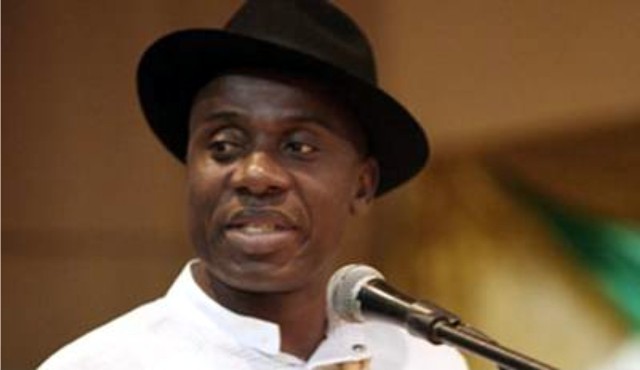
The Senate has summoned the Minister of Transportation, Rotimi Amaechi to explain why the eastern rail corridor was omitted in current government borrowing plan.
The Senate said the Minister should appear before its Committee on Foreign and Local Debts to explain details of the loan to be obtained from China Exim Bank.
The invitation followed a motion raised during plenary by Sen. Enyinnaya Abaribe, who claimed that the Eastern Corridor Rail Line was completely excluded from the Federal Government 2016-2018 External Borrowing Plan.
The Tide source recalls that President Muhammadu Buhari had in a letter to the Senate dated April 21, said that the China Exim Bank had approved 5.9 billion dollar loan for rail projects across the country.
Abaribe while presenting the motion observed that the loan being sought only covered the western corridor, excluding the eastern corridor which runs from Port Harcourt to Maiduguri.
According to him, since the loan will be repaid for by all sections of the country, every part of Nigeria should be taken into consideration.
Abaribe noted that the Railway Master Plan developed by the Ministry of Transport was not referred to in the current borrowing plan.
He argued that for the railway project to have meaningful impact on the development of the country, it should cover all parts of Nigeria.
Contributing, the Deputy Senate President, Mr Ike Ekweremadu, said the rail project should cover all the corridors.
“I’m aware that the Federal Government is committed to rehabilitating and upgrading the railway infrastructure in Nigeria since Obasanjo’s regime, but the eastern line still remains in the old gauge, it is not on the standard gauge,” he said.
Ekweremadu said for every part of Nigeria to have standardised railway lines, “we must agree to obtain the necessary loan that will give us standard gauge in all parts of the country.
“We must ensure that all parts of the country are connected so that people can move from one part to another”.
However, Sen. Gbenga Ashafa faulted the motion, saying it contained inadequate and inaccurate information.
He said that when the present administration came to power, it took into cognisance the Aba-Onitsha rail line.
“Let us do away with ethnic sentiments. All areas must be covered. Government is a continuum; the master plan is on ground.
“All sectors will be covered as promised by the Federal Government. The loans must be secured and approved,” he said.
In his remarks, President of the Senate, Dr Bukola Saraki, said that “at the leadership level we are taking up this matter with the executive.



Business
Jonathan, Diri, Others Laud Firm’s Milestone in Bayelsa …Says Project Will Drive Industrialisation, Create Jobs



-

 News4 days ago
RSG Targets Nine Million Residents in Mosquito Net Distribution Campaign
-

 Oil & Energy4 days ago
Aiyedatiwa Signs New Electricity Bill
-

 Oil & Energy4 days ago
NLNG Commissions Research And Innovation Centre In RSU
-

 Maritime4 days ago
Marine Minister Commends President Tinubu On NPERA Bill Assent
-

 News4 days ago
KenPoly Holds Eight Convocations, August 29
-

 News4 days ago
RMAFC Completes Revenue Sharing Review, Proposes New Pay
-

 News4 days ago
RSG Begins Another Phase of Projects Commissioning Today
-

 Maritime4 days ago
NAGAFF Petitions IGP Over Alleged Maritime Police Harassment