
Featured
Why We’re Building Industrial Court -Wike

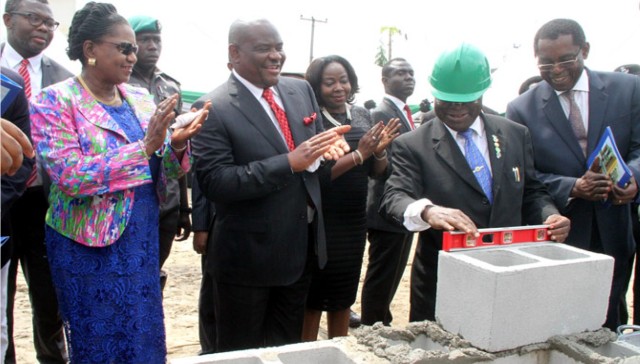
The Rivers State Governor, Chief Nyesom Wike says the State government is constructing the National Industrial Court because of the need to create and provide an enabling social and economic environment for the development of the state.
Wike said though such responsibility lies on the shoulders of the federal government which has over the years shirked its duties of touching the lives of Rivers people, yet the state government decided to bridge the gap.
The state governor who laid the foundation for a four storey ultra-modern court building located at the central business district on Wednesday in Port Harcourt, decried the failure of the federal government to contribute its quota in the development of the state.
He made the observation Wednesday during the groundbreaking ceremony for the construction of the National Industrial Court, NIC, which will be funded by the state government.
He said, everything points to the fact that Rivers State does not count in the development programmes of the federal government. And this
has sadly been the situation for decades. Yet, we produce the bulk of the resources that are sustaining the entire country and funding multi-billion naira development projects in other states of the federation.
“And so, our position is that, while we shall continue to demand for a fair treatment and commensurate recompense for our contributions to the national pool of resources, we cannot but endeavour to put our development destiny in our own hands, even if it means spending money on projects that should be initiated, funded and maintained by the federal government or its agencies.
The governor explained that the state government decided to take over the responsibility of the federal government in building the court because of the love, passion and commitment to develop the state.
Besides, he argued that 90 per cent of the cases in the Yenagoa Division of the National industrial Court emanates from Rivers State.
Against this backdrop, he noted that when the court is built and completed it would reduce the hassles of going to Bayelsa by litigants, and bring justice closer to them.
According to him, “the need therefore to have a functional NIC in Port Harcourt to peacefully settle labour and industrial relations disputes, enhance industrial harmony and engender economic development cannot be overstated”.
He used the ceremony to call on the federal government to do more for the state considering the fact that it produces the major source of sustenance to the nation, while maintaining that, “we cannot but endeavour to put our development destiny in our own hands, even if it means spending, money on projects that should be initiated, funded and maintained by the federal government or its agencies”.
On his part, President of the NIS, Justice Babatunde Adejumo praised Governor Wike for being exemplary, as he urged other governors to emulate the gesture shown by Wike in ensuring that agencies of government are not left to rot.
He promised that when the National Industrial Court comes on board it will reduce the challenges faced by litigants who travel outside the state.
Justice Adejumo informed that two judges have been transferred to the state to work in two courtrooms allocated by the Rivers Chief Judge.
On their parts, Rivers State Chief Judge, Justice Adama Iyayi-Laminkanra and the State Attorney General, Mr. Emmanuel Aguma commended Chief Wike for investing in justice delivery through the provision of quality facilities for the judiciary.
The new NIS building comprises of a five storey building occupying a total floor area of 920 square metres, with four court rooms, judges chambers, car parks, lifts and is disabled-friendly. It is expected to be completed in December 2017.



Governor of Rivers State, Sir Siminalayi Fubara, has reaffirmed the unwavering commitment of his administration to peace, unity, security, and inclusive development as Rivers State marked its 59th anniversary, last Wednesday.
In a goodwill message issued on Wednesday to commemorate the anniversary, Governor Fubara stated that despite the challenges faced over the years, the people of Rivers State have continued to demonstrate resilience, strength, and an enduring spirit of unity that has sustained the state since its creation.
The Governor noted that the strong bond of brotherhood among the various ethnic nationalities of the state, including the Ijaw, Ikwerre, Ogoni, Etche, Ekpeye, Andoni, Kalabari, and others, remains one of Rivers State’s greatest strengths and a critical foundation for peace, stability, and progress.
He further observed that Rivers State has remained a major driver of Nigeria’s economy for decades, not only because of its abundant oil and gas resources, but also because of the exceptional contributions of its people across diverse sectors including academia, jurisprudence, business, entertainment, public service, and sports.
Governor Fubara assured the people that his administration will continue to prioritize policies and programmes that promote peace, protect lives and property, and expand development across all parts of the state. He emphasized that governance must be people centered and impactful, with equal attention given to every Local Government Area of the state.
The Governor also paid tribute to the elders and founding leaders of the state for preserving the spirit of unity and coexistence over the years, while urging the youths to remain hopeful, responsible, and actively committed to building a greater Rivers State through innovation, hard work, and patriotism.
He equally acknowledged the invaluable role of women in strengthening families, communities, and society, describing them as indispensable partners in the continued growth and stability of the state.
Governor Fubara called on all Rivers people to use the occasion of the anniversary as a moment of reflection and renewed commitment to peaceful coexistence, mutual respect, dialogue, and collective progress, stressing that the unity and future of Rivers State must always rise above personal interests and political differences.
Rivers State was created on May 27, 1967, by General Yakubu Gowon.


The Rivers State Government has distributed science equipment and materials to all senior secondary schools across the state to support students during the ongoing West African Examinations Council exams and to strengthen practical learning.
Flagging off the distribution at the Rivers State Senior Secondary Schools Board premises in Port Harcourt, on Monday, the State Commissioner for Education, Dr. Peters Nwagor, said the move demonstrates Governor Siminalayi Fubara’s commitment to improving education standards in the State.
Nwagor said the materials were approved and provided by the state government specifically to boost the teaching and learning of science subjects, describing science education as the foundation for technological advancement, innovation, and national development.
“No society can compete globally without deliberate investment in science and technology,” the Commissioner stated.
He commended the governor for consistently prioritising the education sector by providing tools needed for effective teaching and hands-on learning.
The Commissioner directed principals to ensure that the equipment are used strictly for practical lessons in their schools, warning that any principal or administrator found diverting, hoarding, or selling the materials wil face disciplinary action under public service regulations.
Nwagor also warned against examination malpractice, saying any principal found aiding or encouraging malpractices will be decisively sanctioned.
“We must collectively restore the dignity and credibility of our educational system,” he said.
Also speaking, Chairman, Rivers State Senior Secondary Schools Board, Tony Egwurugwu, urged school heads to make judicious use of the materials for students’ benefit.
He thanked the State Government for providing the resources, and assured that monitoring mechanisms would be put in place to ensure the materials serve their intended purpose.
In his own remarks, a Board Member for Technical Education, Nwisabari Bani Samuel, expressed appreciation to the governor for prioritising education and acknowledged the Commissioner’s role in advancing education development in the State.
He said the distribution covers all senior secondary schools in the State and is intended to improve students’ performance in both internal and external science examinations.
Akujobi Amadi
-
News1 day ago
Obuah’s Victory Excites Former Lawmaker as APC Primaries Conclude in Rivers West
-

 Politics3 days ago
APC PRIMARIES: FUBARA’S WITHDRAWAL, HISTORIC SACRIFICE FOR NATIONAL STABILITY ……. GROUP
-

 News3 days ago
Court Sentences Seven To Death Over Murder Of Cleric In Rivers
-
News1 day ago
105 Nigerians Killed In S/Africa In Seven Years
-

 Sports3 days ago
PH Arsenal Community Set For Streets Procession, Saturday
-

 Politics3 days ago
IPAC Flays INEC Over Election Guidelines Judgement
-

 Politics3 days ago
NDC To Adopt Electronic Voting For Future Primaries
-

 Niger Delta1 day ago
Royal Father Endorses PH Arsenal Community, Pledges To Support