
Nation
THE STATES

Benue
The police in Benue State yesterday confirmed the
killing of 82 people in Egba community of Agatu LGA by gunmen suspected to be herdsmen who attacked the village on Sunday.
State Police Commissioner, Hyacinth Dagala, told our correspondent shortly after an assessment of the damages in the area that the death toll had risen to 82 while 25 others were receiving treatment in hospitals.
“I went there today to see things for myself and I can tell you that 82 people were killed while 25 others are in the hospital,” he said.
Dagala said calm had returned to the area with security operatives on the watch out to avoid further break down of law and order.
The PDP deputy governorship candidate, John Ngbede, a native of the area who accompanied the police commissioner on the visit lamented the extent of destruction and appealed to the federal government to assist the community.
Borno
The Shehu of Borno, Alhaji Abubakar Garbai Al-Amin
El-kanemi, yesterday urged the new President of the Nigeria Labour Congress (NLC) Comrade Ayuba Wabba to justify the confidence repose in him by Nigerian workers.
The Shehu said the election of Wabba was an honour to the Borno Emirate Council and its people.
Wabba is the Zanna Ma’amalama of Borno, (Ambassador of Borno Emirate)
A statement by Alhaji Zanna Laisu, Secretary of Borno Emirate, said with a track record of selfless service and dedication, the new NLC chair had all it takes to lead the congress.
“We congratulate you on your recent victory which did not come as a surprise. While we would continue to pray for you to succeed, we urge you to see this rare opportunity as a call to service.
You must set the pace for a reinvigorated civil service that will ensure peaceful working relationship and job satisfaction among various stakeholders,” the statement said.
Kaduna
Governor Mukhtar Ramalan Yero of Kaduna State has
commenced distribution of 4.6million Long Lasting Insecticide Nets (LLINs) to households in the state.
Speaking at the flag-off at Kujama in Chikun LGA yesterday, Yero who was represented by his deputy, Ambassador Nuhu A. Bajoga, said the gesture was aimed at reducing infant and maternal mortality.
According to him, the state government in year 2010 distributed mosquito-treated nets to about 80% of the women, assuring that his administration would ensure that every household gets the net this year as part of efforts to fulfil the Roll Back Malaria crusade.
The governor’s media aide, Ahmed Maiyaki, also at a news conference in Kaduna yesterday said the administration was struggling to fund about 76 road projects inherited from previous administrations.
About 31 of the projects he said were awarded by late governor, Patrick Ibrahim Yakowa, while the rest were approved by governors Ahmed Mohammed Makarfi and Mohammed Namadi Sambo.
Kano
The Kano State High Court has fixed March 31 for
ruling on a no- case application filed by the lawyer of the teen bride, accused of killing her husband and three others.
Wasila Tasi’u, 14, was arrested for allegedly killing her husband, Umar Sani and three others by adding poisonous substance to their meal.
She is being charged with culpable homicide, an offense punishable by death under Section 221(a) of the Penal Code.
During the court sitting yesterday, the defence counsel, Barrister Hussaina Ibrahim Aliyu, in an application requested the court to discharge the accused person, saying the witnesses presented by the prosecution lack credibility.
She said the witnesses failed to prove to the court how the accused killed her husband, as there was no evidence on record as required by Section 21(a) of the Criminal Procedure Code (CPC).
However, the prosecution counsel, Lamido Abba Soron Dinki, countered the application of no case submitted by the defence counsel.
Kebbi
Secretary to the Kebbi State Government and Chair
man, State Agency for the Control of AIDs (SACA), Alhaji Garba Rabiu said yesterday that the state has recorded a steady reduction in HIV/AIDS infection.
Speaking at the inauguration of HIV/AIDS State Management Team (SMT) by Governor Saidu Dakingari, the SSG said government would work to eradicate the disease.
He said the inauguration of the SMT was a clear evidence of the government’s commitment to health care delivery.
“We are grateful to the governor for his support which led to reduction in the prevalence rate of the disease.
“Recall that the president directed the National Agency for the Control of AIDS to come up with a plan that will guide the nation in owning HIV/AIDS response without much reliance on international donors. Against this background, a presidential comprehensive response plan was developed and states were directed to constitute SMT to move HIV/AIDS response forward to ensure ownership and sustainability of response”, he said.
Kwara
Wife of the All Progressives Congress (APC) presi
dential candidate, Mrs. Aisha Buhari, yesterday called for proper education of the party’s supporters on its symbol and logo, saying the APC’s support base is the masses.
Mrs. Buhari who paid a courtesy visit to Governor Abdulfatah Ahmed of Kwara State as part of her two-day citizens outreach and town hall meetings in Kwara State noted that the masses who make up the party’s backbone include illiterate and rural people who have no access to television or the social media.
She recalled that many people who joined the APC were from different political parties where they used different slogans. She said, “The illiterate can hardly identify where they are now. So it is so important for us to educate the electorate about the broom (the APC logo). Our major supporters are the masses, masses, masses and masses, especially knowing the presidential candidate of the mega party. He was in ANPP, then CPC and now APC which is not easy for people that are not literate to identify easily”.
Mrs. Buhari who noted that the forthcoming election revolves around women who according to her constitute 55 per cent of the registered voters, said they must be educated on how to vote.
Lagos
Doctors in Lagos State government-owned hospitals
yesterday began an indefinite strike, saying however that it was not meant to make people suffer but to communicate their grievances to government on unpaid salaries and welfare.
The doctors only partially attended to patients in some hospitals yesterday but full activities were on at the Lagos State University Teaching Hospital (LASUTH) Ikeja when Daily Trust visited.
Chairman of the Medical Guild, Dr. Biyi Kufo, said the industrial action was precipitated by the action of the state government which withheld the doctors’ May 2012 and August/September 2014 salaries.
Oyo
Members of the Arewa community in the South-West
converged in Ibadan yesterday to declare support for the candidature of retired General Muhammadu Buhari and Professor Yemi Osinbajo of the APC.
As early as 8 am, the Lekan Salami Stadium, Adamasingba, Ibadan was filled with the supporters who sang and danced as they chanted: ‘Sai Buhari! Sai Baba!! Sai Buhari! Sai Baba!!’
Their leader, Alhaji Hassan Isiaka, the Sarkin Kudun Yamma, said the Arewa community was supporting Buhari’s election bid in their belief that the former military Head of State had the qualities to restore sanity in national life which according to him, is presently at its lowest ever.
He lamented the spate of corruption in the country, saying the nation needs an urgent positive change.
“We are very hopeful that General Buhari is sincere and capable of leading the country out of its present messy situation,” he said.
Plateau
The Independent National Electoral Commission (INEC)
said yesterday that the Permanent Voters Cards (PVCs) of Governor Jonah Jang of Plateau State and Gwong Gwom Jos, Da Jacob Gyang Buba, are ready.
INEC Deputy Director, Voter Education and Publicity, Osaretin Imahireyereobo, who spoke at a workshop on violence-free election, organized by National Emergency Management Agency (NEMA) in Jos, said the PVC of the governor had arrived the state alongside that of the Gwong Gwom Jos.
“The cards are part of the PVCs for Kanke, Jos-North and Jos-South Local Government Areas of the state,” he said.
Imahireyereobo, who led demonstration of the card reader, said, “The PVC of Governor Jang is in my possession and is ready for delivery anytime from now. They arrived today (Monday) and we will distribute all the cards to the owners.”
Sokoto
Over N3.8 billion has been expended in the payment
of allowance to 6,866 physically challenged persons in the Sokoto State in the past seven years, Governor Aliyu Wamakko said.
He said the beneficiaries include lepers, deaf and blind people, who receive N6,500 monthly allowance.
The governor, who spoke during the payment of monthly allowance to 340 physically challenged persons in Silame Local Government Area of the state, said the government spent N45.8 million monthly on allowances to members of the group across the 23 local government areas.
The governor pointed out that the gesture had had positive impact on families and society.
“The introduction of monthly allowance to physically challenged persons has brought succour to their families and reduced the number of people begging on the streets,” he said.
He stressed the need for them to ensure judicious use of the monthly allowance.
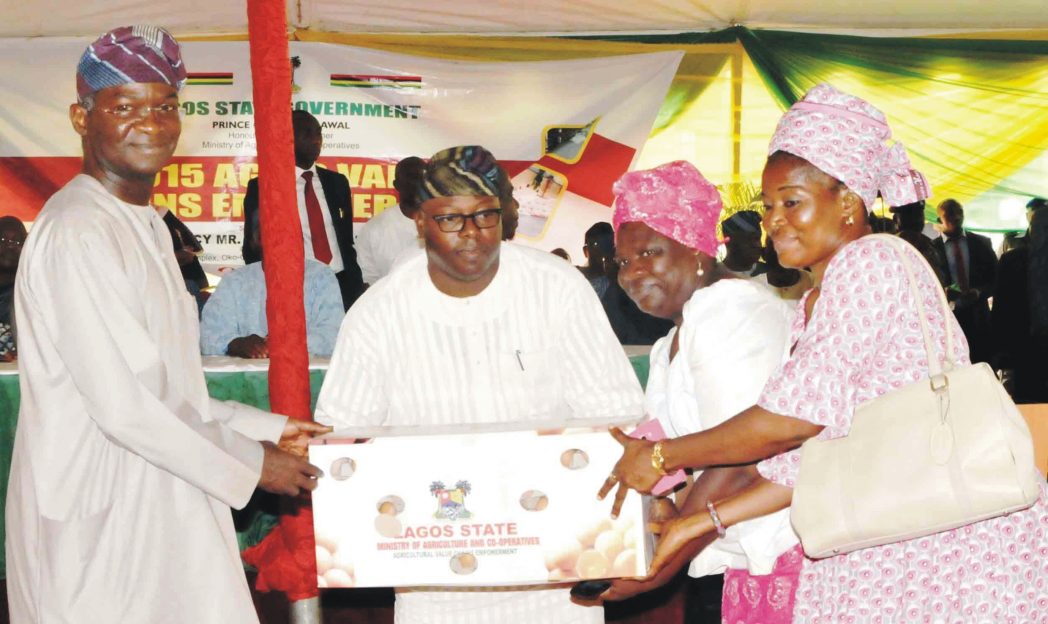
L-R: Governor Babatunde Fashola of Lagos State, assisted by Lagos State Commissioner for Agriculture, Prince Gbolaham Lawal in presenting agricultural products to beneficiaries, Mrs Adenike Bolaji and Mrs Esther Abraham, at the 2015 Agric Value Chain Empowerment Programme in Lagos, yesterday. Photo: NAN



The Hydrocarbon Pollution Remediation Project (HYPREP) has announced that the mangrove wetlands in Ogoniland have been officially designated a Ramsar Site of International Importance by the Secretariat of the Ramsar Convention on Wetlands.
The designation, according to HYPREP, underscores the global ecological significance of Ogoniland’s mangrove wetlands and highlights ongoing restoration efforts aimed at addressing environmental degradation in the area.
In a press statement issued by the Project Coordinator of HYPREP, Prof Nenibarini Zabbey, the recognition was described as a major milestone for the agency, the people of Ogoni and other stakeholders working towards environmental restoration in the region.
Zabbey explained that the mangrove wetlands, which cover more than 31,700 hectares, consist of islands, tidal creeks, mudflats and mangrove forests that support a wide range of biodiversity. The ecosystem provides habitat for several species including fin fish, shellfish, crustaceans, crocodiles, turtles and the endangered grey parrot.
He noted that beyond biodiversity conservation, the wetland also provides essential ecosystem services such as fisheries production, flood control, water purification and carbon storage. According to him, the international recognition will further support local livelihoods, promote ecotourism and bring global attention to the region.
The HYPREP coordinator disclosed that the designation followed a meticulous process that began in 2024 when the project submitted a memorandum to the National Council on Environment seeking support for the recognition of the Ogoni wetlands as a Ramsar site.
Following the council’s review and approval, the Honourable Minister of Environment and Chairman of HYPREP’s Governing Council, Balarabe Abbas Lawal, formally wrote to the Ramsar Convention Secretariat requesting international recognition of the wetlands.
After a comprehensive ecological assessment, the Ramsar Secretariat granted the designation, officially recognising the Ogoniland wetlands as one of the world’s sites of international importance.
Zabbey said the recognition would strengthen ongoing environmental restoration efforts in the area and encourage stronger conservation measures and sustainable management of the wetlands for the benefit of present and future generations.
He added that the designation also fulfils a key recommendation of the United Nations Environment Programme (UNEP) Environmental Assessment Report on Ogoniland, marking another significant step in the implementation of the report’s recommendations.
The HYPREP project coordinator reaffirmed the agency’s commitment to restoring the Ogoni environment through the remediation of oil-polluted land, shorelines and mangrove ecosystems.
He also called for collective responsibility and stakeholder support to sustain the progress of the Ogoni cleanup programme and facilitate the development of a comprehensive and sustainable management plan for the Ogoni mangrove wetlands.

The Permanent Secretary, Rivers State Ministry of Social Welfare and Rehabilitation, Mrs Lauretta Davies-Dimkpa, has attributed the successes of the 12-day programme organised for adolescent girls aimed at eliminating Female Genital Mutilation(FGM) in some parts of the State to the ability of the respective stakeholders to take ownership of the programme.
Mrs Davies-Dimkpa, who dropped the hint in an interview at the end of the programme in Elele-Alimini Community in Emohua Local Government Area on Saturday, said the event had a buy-in component, an ownership mentality, whereby facilitators, staff, and everyone involved took ownership of the project.
She explained that the Rivers State Ministry of Social Welfare and Rehabilitation, in collaboration with the United Nations Children’s Fund (UNICEF) and the United Nations Population Fund (UNFPA) had packaged a series of training sessions for adolescent girls aimed at ending the practice of Female Genital Mutilation (FGM) in some communities across the State.
According to her, the initiative was designed to educate young girls on the harmful effects of the practice and empower them to become advocates against it within their communities.
She noted that the programme, which lasted for several weeks, targeted adolescent girls from different local government areas where the practice is still prevalent, stressing that
data collected by UNICEF and the Ministry revealed that Female Genital Mutilation is still practised in some parts of the State, prompting the need for intensified sensitisation and community engagement.
Mrs Davies-Dimkpa explained that the programme adopted a “train-the-trainer” approach where adolescent girls were educated on the dangers of the practice and encouraged to share the knowledge with their peers, families and communities.
“This is a programme by the Rivers State Ministry of Social Welfare and Rehabilitation with support from UNICEF and UNFPA to train adolescent girls towards ending Female Genital Mutilation, which is still practised in some local government areas,” she said.
She further explained that each participating local government area had a three-day training session, with the exercise running for a total of 12 days.
The local government areas, where the programme took place, she noted, included Ahoada West, Abua-Odual, and Emohua, adding that the initiative is part of broader efforts by the state government and development partners to eliminate harmful traditional practices and protect the rights and wellbeing of girls.
She revealed that prior to the training of the adolescent girls, the Ministry and its partners had also engaged community facilitators, including older women and men, to sensitise them on the dangers associated with Female Genital Mutilation.
According to her, the involvement of community leaders and adults is essential in addressing the cultural and social factors that sustain the practice.
Speaking on the response of the participants, the permanent secretary expressed satisfaction with the level of engagement and enthusiasm shown by the girls throughout the training sessions.
She noted that many of the participants said they were learning about the harmful effects of Female Genital Mutilation for the first time.
“The girls are between the ages of 12 and 17 and from the interactions we had with them, they were very excited. Some of them are hearing these things for the first time and never knew that the practice is harmful,” she said.
She expressed optimism that the knowledge gained from the training would enable the girls to serve as advocates for change within their communities.
She added that the Rivers State Government, alongside its partners, would continue to intensify efforts and expand community-based interventions aimed at ending the practice across the State.
Meanwhile, the participants for Emohua Local Government Area were drawn from Elele-Alimini, Egbeda, Rumuji, Ibaa, Rumuekpe, Rumuakunde, Eligbarada, and Ogbakiri Communities.
The participants,who spoke in separate interviews described the training as eye-opening, noting that it helped them better understand issues surrounding adolescent health, personal hygiene, reproductive health, and the harmful consequences of Female Genital Mutilation.
Favour Azukwu from Rumuekpe community, said the programme provided a deeper understanding of the dangers associated with the practice, particularly its impact on the health and wellbeing of girls and women.
She explained that the training sessions exposed participants to the medical, social and psychological effects of Female Genital Mutilation, including severe bleeding, infections and complications during childbirth.
She revealed that she personally experienced the practice at the age of 12 and suffered heavy bleeding afterwards, an experience that has strengthened her determination to advocate for its eradication.
According to her, many communities still practise Female Genital Mutilation because it is perceived as a cultural tradition, despite the dangers associated with it.
“I do not support Female Genital Mutilation because there are many dangers involved. I experienced severe bleeding when it was done to me as a child.
Another participant, Glory Ken, a 16-year-old secondary school student from Rumuji community, said the programme broadened her understanding of several important topics affecting adolescents.
She explained that beyond the discussion on Female Genital Mutilation, the training also focused on issues such as personal hygiene, reproductive health, peer education, and self-care.
According to her, the sessions helped participants understand the importance of making informed health decisions and supporting one another as peer educators.
“I learned about many things that affect young people in society and how to take care of myself. I also learned that Female Genital Mutilation is harmful to our health. The message I am taking back to my community is that this practice should stop,” she said.
Also speaking, Goodness Kenjika Nyeche described the programme as very impactful.
She noted that the training equipped participants with the skills and confidence to educate others about the harmful effects of Female Genital Mutilation.
She said she plans to organise sensitisation among adolescents in her community, particularly girls between the ages of 10 and 19, to ensure they understand the dangers associated with the practice.
“I learned many things from this programme and I feel very good about it. I will educate other young girls in my community and help them understand why Female Genital Mutilation should not continue,” she said.
For Queen Dike from Ibaa community, the programme helped clarify misconceptions surrounding the practice.
She explained that in some communities, the practice is still referred to as circumcision and is viewed as part of cultural identity.
She said the training helped participants understand that Female Genital Mutilation involves the cutting or removal of parts of the female genital organs and that it has serious health consequences.
She stressed that awareness and education are key to ending the practice, especially among communities that continue to uphold it as tradition.
“I think the programme is very helpful because many people still believe it is part of culture. More awareness is needed so people can understand why it should stop,” she said.
Another participant, MyJoy Echika Amadi, said the programme provided critical information about adolescent health and the dangers associated with Female Genital Mutilation.
She described the initiative as enlightening and said it encouraged young people to become advocates for change in their communities.
According to her, participants were encouraged to use various platforms such as churches, peer groups, schools and community gatherings to spread awareness about the harmful effects of the practice.
“This programme has enlightened us about the dangers of Female Genital Mutilation. I will do my best to create awareness in my community and encourage people to stop the practice,” she said.
Many of the participants emphasised that the knowledge gained during the programme has empowered them to challenge harmful traditions and promote healthier practices among young people.
They also called on the Rivers State Government, development partners and civil society organisations to sustain the sensitisation campaigns and extend the training to more communities across the State.
According to them, empowering young people with the right information will play a critical role in eliminating Female Genital Mutilation and protecting the rights, health and dignity of girls in Rivers State.
The participants expressed appreciation to the Rivers State Ministry of Social Welfare and Rehabilitation, UNICEF and UNFPA for organising the programme and for investing in the wellbeing and future of adolescent girls in the State.

-

 Business1 day ago
NERC Amends Order on Meter Tampering, Power Bypass For Discos
-

 News2 days ago
Police Arrest Nigerian, Two Others For Kidnapping In Edo
-

 Business1 day ago
Nigeria, AFC sign $1.3 billion deal to build alumina refinery
-

 Rivers1 day ago
KENPOLY Rector Promises To Prioritise Students’ Welfare
-

 Business1 day ago
NCDMB Signs Mgt Deal With Radisson, Edison…As Board’s 204 Rooms Hotel Open December 2026
-

 Rivers1 day ago
Don, Stakeholders Urge Environmental Laws In N’Delta
-

 Rivers1 day ago
ADIAFRICA Flags-off Free Eye Screening Outreach In PH
-

 News2 days ago
NDLEA Arrests Ex-Councillor With 40kg Skunk, Recovers Drugs In Diapers