
Nation
THE STATES

FCT
The Christian Association of Nigeria (CAN) last
Wednesday urged Christians and Muslims to co-exist peacefully in the interest of national unity.
Pastor Ayo Oritsejafor, the President of the association made the call during a one day interactive session with religious leaders, political parties and security agencies in Abuja.
Our correspondent reports that the event was organised by “Think Nigeria Christian-Muslim Movement’’, an NGO.
Oristejafor said the two main religious bodies should ensure that their members were guaranteed protection in the country.
“ We must make a commitment to each other publicly, that Christians are safe in Muslim-dominated areas and Muslims are also safe in Christian-dominated areas,” he said.
Gombe
The Director of the Lake Chad Research Institute
(LCRI), Maiduguri, Dr Oluwasina Olabanji, has said that Nigeria will produce 1.5 million tonnes of wheat by 2017 as part of efforts to reduce the importation of the commodity.
Olabanji made this known at this year’s Wheat Farmers’ Field Day at the Dadin Kowa Irrigation Dam in Yamaltu/Deba Local Government Area of Gombe State.
Olabanji said the institute planned to cultivate 150,000 hectares of wheat using 75,000 wheat farmers in 2015/2016 season, while production would increase to 300,000 hectares in 2017.
“The wheat value chain aims at increasing productivity of wheat from two tonnes per hectare in 2013 to five tones to six tonnes per hectare by 2017and national production from the current 150,000 tonnes to 1.5 million metric tonnes in 2017 and to transform the wheat to major high income generation industrial crop for farmers.”
Kano
The Emir of Daura in Katsina State, Alhaji Farouk
Umar Farouk, last Wednesday described the newly constructed Kano city gates as monuments to be preserved and safeguarded.
He made the remark while inaugurating the gates situated at different locations in Kano.
He said, “Daura and Kano are sharing many things in common given the revered status of the former being the origin of the seven Hausa states of which the latter is a prominent member.’’
He said preservation of cultural heritage made people to remember their identity and progeny, adding that the gates were symbolic monuments depicting the city’s ancient treasures.
Kogi
A senior Medical Consultant Ophthalmologist, Fed
eral Medical Centre (FMC), Lokoja, Dr Osayande Osawe, has urged governments to increase awareness to prevent blindness through glaucoma.
He made the call in an interview with the News Agency of Nigeria (NAN) on Wednesday in Lokoja on the sidelines of this year’s World Glaucoma Week.
Osawe emphasised the need to prevent our eyes from glaucoma rather than seeking for cure, adding that glaucoma is incurable.
He said it was difficult defining glaucoma because of its complexity in the manner in which it attacked and made the eyes to become blind.
Kwara
Governor Abdulfatah Ahmed of Kwara State
has reiterated his administration’s commitment to partner with non-governmental organisations in promoting infant and maternal healthcare in the state.
Ahmed restated this commitment at the inauguration of Maternity Referral Centre built by Esso Exploration and Production Nigeria Limited in Ilorin last Wednesday.
The project was executed in partnership with Nigerian National Petroleum Corporation and Shell Nigeria Exploration and Production Company in collaboration with Kwara State Government.
Ahmed described the project as an intervention that would give birth to hope and midwife succour, especially in rural and district communities.
The governor said the significance of the referral centre laid in the fact that child and maternal health was a major index of any efficient system.
According to him, pregnant women and infants are some of the most vulnerable in the society, especially in rural communities.
Lagos
The Arewa Traditional Institution in Lagos last
Wednesday said it was not part of its values for a Sarki to go about visiting and attending political rallies and meetings.
At a news conference in Lagos, the Sarki Hausa of Lagos, Alhaji Aminu Yaro-Dogarai, advised anyone with such an exalted position to play the role of a father and not to be partisan.
He frowned at the activities of some people he called impostors, who were trying to smear the image of the institution.
Yaro-Dogarai said it was disheartening to see people claiming to hold the exalted and highly esteemed office of the traditional Arewa institution visiting and attending political rallies and meetings wearing full traditional regalia.
“It is dishonorable for a bonafide Sarki institution to participate in active partisan politics,’’ he said, noting that it should rather act as a father to all politicians, irrespective of their political class or affiliation.
Nasarawa
The Nasarawa State chapter of the Peoples Democratic
Party (PDP), has appealed to Labaran Maku, the former Minister of Information, to return to the party in the interest of the state.
Senator Solomon Ewuga, Director General, PDP governorship Campaign Organisation, made the appeal on behalf of the party at a media briefing last Wednesday in Lafia.
He urged Maku to jettison his governorship ambition on the platform of All Progressive Grand Alliance (APGA) and return to the PDP which he said, ‘kept him in public service for 14 years.’
He said that the APGA governorship flag bearer should appreciate God and the PDP for the special favour bestowed on him.
Ewuga expressed dismay that Maku had made the PDP which developed his political career his enemy by using religion and ethnicity to sow seed of discord amongst the people of the state.
Niger
The National Agency for Food and Drug Administration
and Control (NAFDAC) in Niger State has stopped the mop up of tomato pastes suspected to be dangerous for consumption.
It said it stopped the mop up following instructions from its national headquarters to avoid panic among the people.
An official of the agency, Mr Dadi Mullah, told newsmen in Minna last Wednesday that it was awaiting directives from the headquarters to resume the mop up.
The agency started the mop up of the suspected killer tomato pastes in circulation in the state on Tuesday.
“The management of NAFDAC is strategising on how to mop up these products without causing market panic.”
Ogun
The Manufacturers Association of Nigeria (MAN), Ogun
State chapter, yesterday commended the Federal Government for reducing electricity tariff by 50 per cent.
The President of the association, Mr Wale Adegbite, told newsmen in Ota that the “step was a welcome development’’.
Adegbite said that the Nigerian Electricity Regulatory Commission (NERC) had finally listened to the complaints of manufacturers.
“But, what the NERC has done is to reverse the increase the commission did in January, so it is not really a reduction,’’ he said.
Adegbite said that there was need for the Federal Government to create enabling environment like provision of stable electricity, good roads and adequate security.
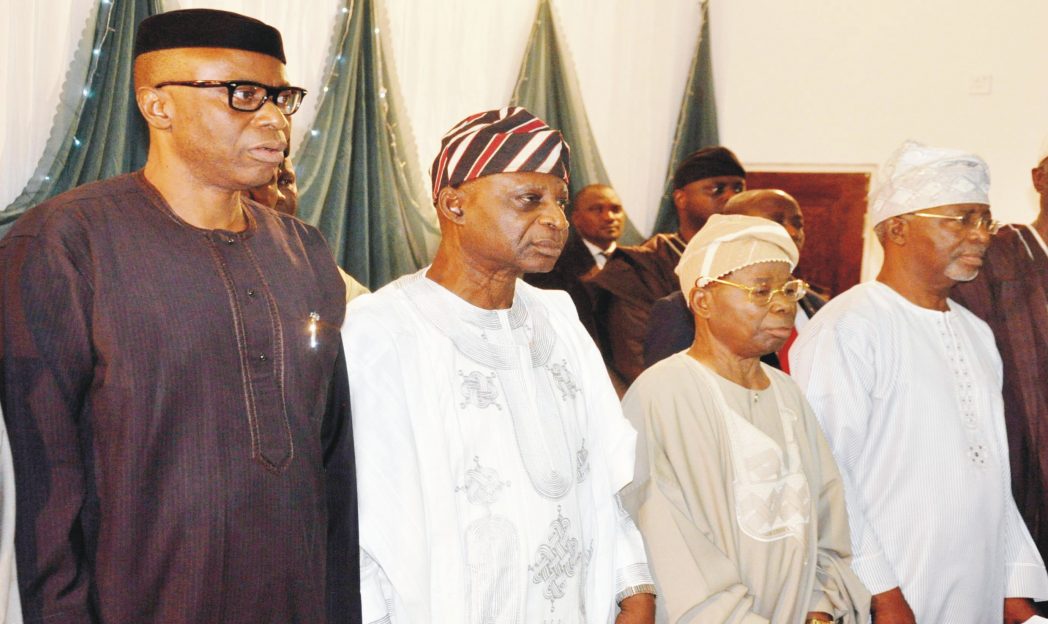
R-L: Governor Olusegun Mimiko of Ondo State; Yoruba Leaders, Senator Femi Okunrounmu, Prof. Dupe Olatubosun and Dr Frederick Fasehun, at a post National Conference Summit in Lagos, yesterday. Photo: NAN



The Hydrocarbon Pollution Remediation Project (HYPREP) has commemorated the 15th anniversary of the release of the United Nations Environment Programme (UNEP) Environmental Assessment Report on Ogoniland, reaffirming its commitment to restoring the environment and improving the livelihoods of affected communities.
In a statement signed by the Project Coordinator, Prof Nenibarini Zabbey, to commemorate the anniversary, HYPREP described the anniversary as a significant milestone in Nigeria’s environmental restoration efforts, noting that the project has made remarkable progress in implementing the recommendations of the landmark UNEP report released on August 4, 2011.
The UNEP report had revealed extensive oil pollution across Ogoniland, severe environmental degradation, and serious public health risks resulting from decades of petroleum operations. It also recommended an initial $1 billion fund to commence the cleanup of the affected communities.
According to HYPREP, the Federal Government formally launched the Ogoni clean-up in 2016, while the Project Coordination Office was established in 2017 to drive the implementation of UNEP’s recommendations.
Zabbey said the current administration has continued to prioritise the project under the Renewed Hope Agenda.
Providing an update on the cleanup, the Project Coordinator disclosed that 30 of the 65 contaminated sites identified by UNEP have been fully remediated, while work is ongoing at several medium- and high-risk locations. It also stated that more than 1.5 million mangrove seedlings have been planted as part of what it described as the world’s largest restoration of oil-degraded mangroves, with over 1,000 hectares of shoreline already rehabilitated.
Zabbey further revealed that 49 Ogoni communities have been connected to potable water schemes through multiple water projects and booster stations aimed at providing safe drinking water across the region.
In the health sector, he said the 100-bed Ogoni Specialist Hospital in Kpite and the 43-bed Cottage Hospital in Buan are nearing completion, adding that several existing health facilities have been upgraded with modern medical equipment, while five ambulances have been donated to improve emergency healthcare services. The Project Coordinator also disclosed that a three-year human health biomonitoring study is being conducted in collaboration with the World Health Organization’s International Agency for Research on Cancer (IARC).
On economic empowerment, Zabbey stated that the Project has created more than 8,000 direct jobs and trained thousands of Ogoni youths and women in various vocational and technical skills, including software development, cybersecurity, aviation, commercial diving, seafaring, mechatronics, and creative arts. The project also reported awarding scholarships to more than 1,000 students, providing grants to small businesses, and supporting persons living with special needs through skills acquisition programmes.
The statement further highlighted ongoing legacy projects, including the Ogoni Power Project and the Centre of Excellence for Environmental Restoration, which it said is about 96 per cent complete. HYPREP also welcomed the recent designation of the Ogoni Wetland as a Ramsar Site of International Importance and pledged to continue promoting biodiversity conservation and sustainable management of the ecosystem.
Marking the anniversary, Zabbey said the progress achieved over the past 15 years demonstrates the collective commitment of government, development partners, stakeholders, and local communities to restoring Ogoniland. He called for renewed collaboration to sustain the cleanup effort, promote environmental sustainability, and support the long-term development of the region. 3
-

 News2 days ago
RSG Targets Nine Million Residents in Mosquito Net Distribution Campaign
-

 Oil & Energy2 days ago
Aiyedatiwa Signs New Electricity Bill
-

 Maritime2 days ago
Marine Minister Commends President Tinubu On NPERA Bill Assent
-

 Oil & Energy2 days ago
NLNG Commissions Research And Innovation Centre In RSU
-

 News2 days ago
KenPoly Holds Eight Convocations, August 29
-

 News2 days ago
RSG Begins Another Phase of Projects Commissioning Today
-

 News2 days ago
RMAFC Completes Revenue Sharing Review, Proposes New Pay
-

 Maritime2 days ago
NAGAFF Petitions IGP Over Alleged Maritime Police Harassment