
Nation
THE STATES

Borno
The Borno State Police Command said it had put in place
all necessary machinery for peaceful conduct of the February general elections in the state.
The Police Commissioner in the state, Mr Clement Adoda, stated at a sensitisation meeting with officials of political parties in the state that the command was also looking at possibilities of seeking additional personnel from other states to beef up security during the polls.
The commissioner also said that the military could be drafted to provide additional support should the situation degenerate.
“The military is always on standby in every situation. “But if there is the need for the military assistance to civil authority during the elections, be rest assured of our preparedness to invite them,” Adoda said.
He said that the meeting was aimed at enlightening politicians on the need to avoid violence during the polls.
FCT
Civil Society Organisations (CSOs) have frowned at the
monumental fraud and looting of the oil treasury without significant action to identify, prosecute and punish culprits.
Convener of Protest To Power Movement (P2PM), Mr Jaye Gaskia, made this known in Abuja at a news conference recently.
The conference was jointly organised by the Civil Society Legislative Advocacy Centre (CISLAC), P2PM and State of the Union Coalition (SOTU) to mark three years of fuel subsidy protest.
He said treasury looting could not have happened without the collaboration and protection of highly placed political officials.
According to Gaskia, the NNPC, Department of Petroleum Resources (DPR), Petroleum Product Pricing Regulation Agency (PPPRA), Federal ministries of Petroleum and Finance were not left out of the looting.
He said that no official had been implicated or disciplined on this issue.
He said any claim paid on subsidy since the downturn of oil prices in the international market would be regarded as fraudulent payment because the landing cost of fuel had reduced.
According to him, Nigeria is sufficient in producing refined oil in the country but our crude oil is being refined overseas due to corruption.
Kaduna
The Federal Government has said it had released N3
billion for disbursement to victims of 2011 post-election violence in Kaduna State.
The Vice President, Namadi Sambo made the disclosure at the 40th anniversary of Emir of Zazzau, Alhaji Shehu Idris, on the throne held at the Emir’s palace, Zaria, Kaduna State.
Sambo, who was represented by Governor Muktar Yero of Kaduna State, said the money which was already in the coffers of the state government would be disbursed to the affected victims accordingly.
He stressed the need for people to live in peace with one another to enable government at all levels to provide the dividend of democracy to the electorate.
While congratulating the Emir for attaining 40 years on the throne, Sambo attributed the success recorded by the Emirate to patience, fairness, justice and truthfulness.
Kano
The Kano State Government has approved over N17 mil
lion for the purchase of JAMB forms and training of candidates who will benefit from the forms, the Commissioner for Justice, Mr Maliki Umar, said.
Umar made the disclosure in Kano while briefing newsmen on the outcome of the state’s Executive Council Meeting.
He said the council had also approved over N186 million for the upkeep of public and voluntary schools in the state.
He added that “the council also approved N2.1 million for renovation of dental centre and eye clinic at Murtala Muhammed Specialist Hospital.’’
Katsina
The Katsina State Inter-faith Committee has denied the
destruction of a Church in Matazu Local Government Area by the Katsina Urban and Regional Planning Development Authority (KURPDA).
The Chairman of the committee, Alhaji Isah Dodo stated this in Matazu during a visit to the area.
He said that the committee was mandated by the state government to investigate and ascertain the true picture of the matter.
He explained that the affected area was a pathway between a school and staff quarters of the church.
Dodo further explained that the church decided to fence the school and the staff quarters, thereby, blocking the pathway which had been in existence for more than 20 years.
Kebbi
The Kebbi State branch of the Miyetti Allah Cattle Breed
ers Association of Nigeria (MACBAN) has commended the Kebbi Government for the establishment of the Ministry of Animal Husbandry and Fisheries.
In a statement issued in Birnin Kebbi the Chairman of the association, Alhaji Muhammad Gwandu said that the new ministry would go a long way to boost livestock and fisheries production in the state.
The statement added that the new ministry would also boost family’s income, generate employment and improve nutrition in-take of the people of the state.
Ondo
The new Vice-Chancellor of the Adekunle Ajasin
University, Akungba Akoko (AAUA), Ondo State, Prof. Igbekele Ajibefun, has assumed duty.
The Deputy Vice-Chancellor (Administration), Prof. Francis Oyabade, led other principal officers and students of the institution to receive Ajibefun at the Senate Chambers where prayers were offered for a successful tenure.
The vice-chancellor, who was accompanied by his wife, Bosede, expressed gratitude to God for the appointmen,t and thanked Governor Olusegun Mimiko for appointing him to serve the state at another level after completing his tenure as the rector of the state polytechnic.
Ajibefun promised to justify the confidence reposed in him by driving the university toward fulfilling the vision and mission of its founding fathers.
Plateau
The Plateau State Head of Service (HOS) Ezekiel Dalyop
has described the biometric of the state workforce as ‘a huge success.’
Speaking with newsmen in Jos, Dalyop said the exercise which commenced in 2012 was tasking.
He said: “As a pioneering exercise, the biometric has not been easy but it has been a huge success in the sense that we have been able to identify clearly those who are genuine workers. “As at the state level, we have almost concluded the entire exercise.
“The report of the appeal panel on the exercise had been reviewed by another committee and has been submitted to the government.
Dalyop said the exercise was aimed at sanitising the state workforce, leave a legacy behind by identifying genuine workers.
“At the first count, we arrived at 11,000 workers certified as genuine, leaving about 6,000 plus workers who needed to answer questions raised by the committee.
Sokoto
The Sokoto State police command in has warned politi
cal parties against the illegal use of sirens.
Spokesman for the Command, DSP Al-Mustapha Sani, gave the warning in a statement in Sokoto on Wednesday, following complaints about the use of sirens by some candidates.
The statement stated that “ in Sokoto State, only the governor, his deputy, the speaker of the state House of Assembly, CP, AIG, the Brigade Commander and the Sultan are legally allowed to use the sirens while on movement. Anyone outside this exclusive list who uses sirens does so illegally and stands to face the consequences according to the laws of the land.”
The statement also warned political parties against moving with youths wielding various types of weapons during their activities
Zamfara
The Zamfara State Universal Basic Education Board
(SUBEB) has commenced training of 150 teachers on Information and Communication Technology (ICT) and its applications to education.
Public Relations Officer of the board, Alhaji Kabir Mayanchi, who made the disclosure in Gusau, said the training was to assist the primary and junior secondary school teachers to improve their knowledge of ICT.
He added that the training became necessary considering the fact that majority of primary school teachers in the state lacked basic requirement of computer literacy.
The image maker expressed optimism that the training would enhance the quality of education and boost the acquisition of basic ICT skills by teachers.
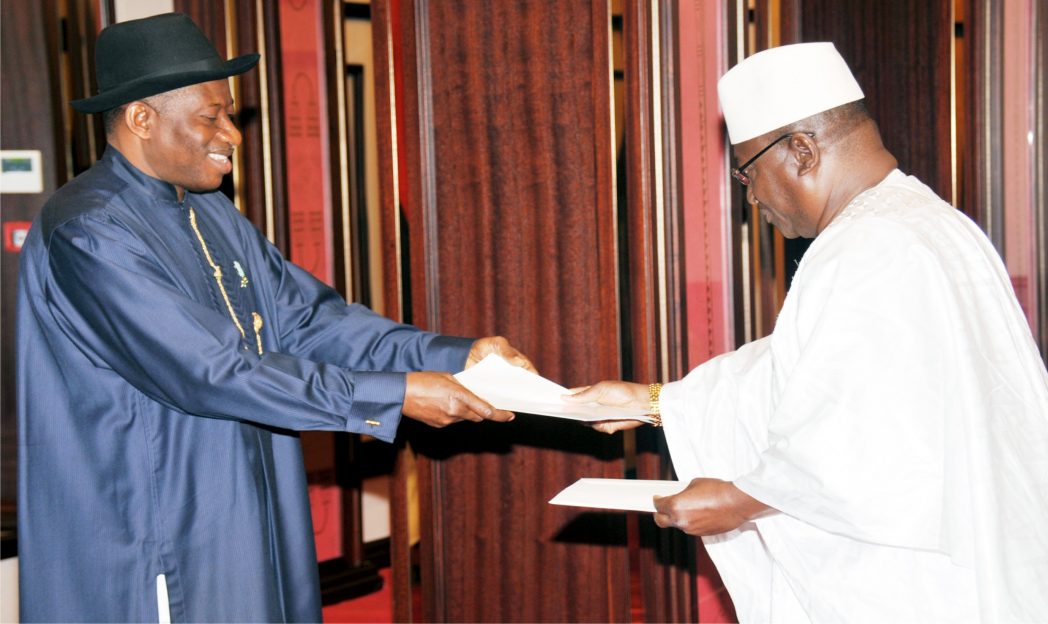
President Goodluck Jonathan (left) receiving letter of credence from the new Ambassador of Guinea Conakry, Mr Gaoussou Toure, in Abuja recently

Nation
Rumuaholu Community Denies Land Grabbing Allegations, Accuses Obio/Akpor Chairman of Interference in Land Dispute


The Rivers State Commissioner for Education, Dr. Peters Nwagor, has commended the orderly conduct of the ongoing 2026 West African Senior School Certificate Examination in the state and urged schools to sustain the standard.
Dr. Nwagor gave the commendation on Tuesday during a monitoring tour of selected secondary schools in Port Harcourt and environs where the WAEC exam is ongoing.
The commissioner, who was accompanied by directors and monitors from the Ministry of Education, said he was impressed with the peaceful atmosphere at the centres visited.
“The students conducted themselves properly and wrote their papers under conducive conditions. Invigilators and supervisors also performed their duties professionally,” he stated.

Nwagor noted that the Rivers State Government had invested heavily to ensure the smooth and credible conduct of the examination across the state
He urged candidates to reciprocate government’s effort by shunning all forms of examination malpractice and focusing on their studies.
“Government has done so much to ensure successful examinations in our schools. Students should take advantage of it by remaining focused,” the commissioner said.
While no case of malpractice was recorded in the centres inspected, Dr. Nwagor warned that any principal, teacher, invigilator, or official caught aiding malpractice would face strict sanctions in line with regulations.
He also commended school administrators, teachers, WAEC officials, and security personnel for upholding the integrity of the process.
Centres visited included County Grammar School, Ikwerre/Etche; Government Comprehensive Secondary School, Borokiri; Government Secondary School, Borokiri; and Pabod Model Secondary School.
-

 Niger Delta2 days ago
Warri Airport Manager Disputes Air Peace Bird Strike Claim
-

 News2 days ago
Nigeria Won’t Surrender Any Territory To Criminals -Tinubu
-

 News2 days ago
FG Begins Trial Of Over 600 Terrorism Suspects
-

 Rivers2 days ago
79th IAUE Inaugural Lecture: Prof Anero Advoctes Tuition-Free Education For Children
-

 Politics2 days ago
Parties’ Deregistration: How Justice Lifu Overruled Appeal Court Justices
-

 Politics2 days ago
ADC: Okonkwo Rejects Amaechi As Presidential Running Mate, Withdraws Support
-

 News2 days ago
Rivers Judges Commence Annual Vacation, July 20
-

 Politics2 days ago
2027: Tinubu’s Projects Give APC Edge In South East – Yilwatda