
News
Ebola: NUT, Others Oppose Sept 22 Resumption Date

The Federal Government, teachers and some parents across the country have sharply disagreed over the new September 22 resumption date for primary and secondary schools announced by the Federal Government last week
While the Federal Government says that all necessary measures have been put in place to check any possible outbreak of Ebola, given that there is no known cases of the virus in any part of the country, both the teachers and parents are jittery and are asking for caution, as the scare remains palpable in most cities and communities.
In fact, the Nigeria Union of Teachers (NUT) has threatened to proceed on an indefinite nationwide strike, if the government insists on the September 22, resumption date, while some parents have said that their children will not be allowed to resume until the government can guarantee that there is no known cases in the country again.
But the Federal Government, again, yesterday, said that the September 22 resumption date for primary and secondary schools in the country would not be extended because there are no strong reasons for such an extension.
Minister of Health, Professor Onyebuchi Chukwu, who stated this while briefing State House correspondents after the weekly Federal Executive Council meeting, insisted that those who have reasons to believe that the schools should not re-open on that date should forward same to the Federal Government.
The Nigerian Medical Association, the NUT as well as other professional bodies have called for the extension of the resumption date for primary and secondary schools until the country is free of the Ebola Virus Disease (EVD).
But speaking after the FEC meeting, Chukwu said those calling for the extension of the schools resumption date were being driven by “irrational fears”.
He said unlike other countries where the disease is transmitted through community contact, Nigeria’s case was different and there was no cause for worry.
He said: “The minister of education, after meeting with the commissioners for education from the 36 states and FCT decided when public schools should open, which is 22nd of September. In taking that decision, they considered the information that was given by the Federal Ministry of Health that there is actually no reason now, with the expert information we have at hand, why schools cannot resume earlier than the original date of October 13. I think people should just allow us to do the work we have been doing very professionally.
“It was based on advice given by the Ministry of Health that the minister of education took the original decision that it was going to be in October and nobody quarreled with the minister. Now, the minister, based on expert advice, has come back to say the resumption date will now be September 22 and some people are now quarrelling with it. I think we should allow the authorities to do their job. It is not an ordinary matter to be discussed the way we want to discuss it.
“If you have any evidence why there is need to review it (the resumption date of schools), supply such evidence to the minister of health and we will look at it.
He added that at the moment, there are still 490 people under surveillance in Port Harcourt while those under surveillance in Lagos have reduced to only 16.
Government’s decision was, however, met with displeasure, especially as private school proprietors, teachers, parents and stakeholders differ on whether or not schools will be free from EVD by then. However, President, NUT, Mr. Michael Alogba, says that the decision “is not a good idea at all and students should not resume until there is no single case of Ebola in the country.”
“The Federal Government has done really well in combating the scourge but I would have expected them to stick to the October 13 resumption date because we are still at a point where we are worried about the outbreak in Rivers State and the spread to other states.
The NUT has threatened to go on strike if the Federal Government fails to put in place measures to protect its members and pupils from contracting the deadly Ebola Virus Disease before the resumption of schools.
On Tuesday, the House of Representatives directed its Committee on Education to take another look at the September 22 resumption date in view of the fact that the EVD had yet to be contained in the country.
Before Alogba spoke, the committee Chairman, Aminu Usman, said that the committee would meet with the leadership of the Nigerian Medical Association and the Federal Ministry of Education over the September 22 date.
Alogba said the NUT had already written the Federal Government about its position on the September 22 date.
He warned that if the new date was not extended by Monday, the NUT national executive council would meet on Tuesday in Abuja to take a drastic action.
The NUT chairman said, “In any sane society, decision such as this will not be taken until the government and all stakeholders have met and discussed the issue at stake and are sure that the nation is scientifically and medical free from the scourge.
“But this is not the case in our country. When they arrived at the early October 13 date, they wrote us and we agreed with their argument but when this new date was given, they did not because of the influence of some powerful school owners who put pressure on them (Federal Government) to announce the September 22 date.
“You are aware of what is happening at the Obafemi Awolowo University. How are we sure that there is no primary or secondary school pupil that has had contact with an Ebola patient.
It would be recalled that the Federal Government had called on stakeholders in the education sector to put measures in place to create an Ebola-free school environment for children. Each state ministry of education is expected to train, at least two officials from every school on how to handle any suspected case of Ebola as well as embark on immediate sensitisation of all teaching and non-teaching staff on preventive measures.
The Education Minister, Mallam Ibrahim Shekarau, who made this known, said “All primary and secondary schools, both public and private, should be provided with a minimum of two blood pressure measuring equipment by the states’ ministries of education. These ministries should determine the number of such equipment required and forward same to the Federal Ministry of Education. The Federal Ministry of Education will liaise with the Federal Ministry of Health to ensure that appropriate equipment is procured.
“Regular washing of hands is part of the preventive measures and there must be steady supply of water in schools. All states should ensure that this is put in place as the schools reopen.”
But despite this preventive measures, educationists and parents are still skeptical about allowing students to resume as more still need to be done to ensure the safety of the children.
Also, the All Nigeria Confederation of Principals of Secondary Schools (ANCOPSS) has expressed reservations on the September 22 resumption date announced by the Federal Government.
In a telephone interview with our correspondent yesterday, the National Secretary, Mr. Kevin Nwankwo said there has yet to be evidence of any preventive measure taken by the states to curb the spread of the Ebola Virus Disease. He therefore urged government to rescind its decision on the announced date.
“Until yesterday, there was nothing to show that teachers are being trained. I am not aware of sanitisers or training in any school yet.
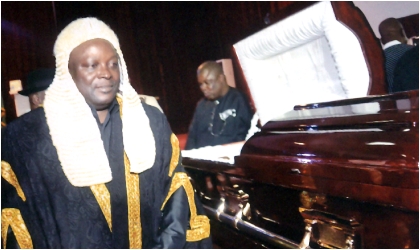
Speaker, Rivers State House of Assembly, Rt Hon Otelemaba Amachree , paying his last respects to the body of late first Speaker of the State Assembly, Late Chief R.R.Briggs, during a valedictory session in Port Harcourt. Photo: Chris Monyanaga



Nigeria’s crude oil production has surged to an 11-month high in May, 2026, with the country exceeding its Organisation of the Petroleum Exporting Countries (OPEC) production quota.
The average crude oil production recorded during the month of May represents 102 per cent of Nigeria’s 1.5mbpd of production quota allocated by the OPEC.
The production report released by the Nigerian Upstream Petroleum Regulatory Commission (NUPRC), yesterday, disclosed that Nigeria’s oil production averages 1,530,354 barrels of crude oil and 170,446 barrels of condensates per day (bpd).
According to the report, this brings the total combined production to 1, 700, 800 barrels per day and consolidating Nigeria’s position as Africa’s largest oil producer.
The report said the production performance during the review period remained robust, with combined crude oil and condensate output ranging between a low of 1.51 million bpd and a peak of 1.86 million bpd.
It said the May 2026 production figures represented the highest recorded by Nigeria since July 2025, when output surged to 1,712,282.
“In strict crude oil terms (excluding condensates), the 1.53 million barrels recorded in May 2026 represents the highest Nigeria has witnessed since January 2025 when crude oil production hit 1.538mbpd.
“The latest crude oil production statistics thus represents a 15-month high on a month on month basis, production rose by 2.77 per cent in May 2026 as against 1.48mbpd in April,” it said.
The report said the broader production trend over the last five months had also remained positive.
It said combined crude oil and condensate output increased from 1.48 million bpd in February to 1.54 million bpd in March, 1.66 million bpd in April, and then 1.7 million bpd in May, underscoring sustained growth in Nigeria’s hydrocarbon production levels.
According to the report, among production streams, Bonny Terminal led the pack with a total blend of 293,870 bpd, closely followed by Forcados Terminal at 289,900 bpd, Qua Iboe ranked third with 173,360 bpd, while Escravos Oil Terminal contributed 135,470 bpd.
It said the Odudu (Amenam Blend) completed the top five production streams, accounting for 63,250 bpd during the month under review.
The NUPRC attributes the rise in production to a sustained positive momentum as operations remained stable throughout the reporting period with no significant pipeline or facility outages recorded.
Additionally, all previously scheduled turnaround maintenance activities had been successfully completed, contributing to improved operational reliability and production efficiency.
The House of Representatives, yesterday passed a landmark constitutional amendment bill to establish state police nationwide, marking a significant milestone in Nigeria’s decades-long debate over decentralising policing and strengthening internal security.
The bill, titled “A Bill for an Act to Alter the Constitution of the Federal Republic of Nigeria, 1999 to Provide for the Establishment of State Police and for Related Matters (Sixth Alteration) Bill, 2026,” was approved during consideration at the Committee of the Whole, presided over by Speaker of the House, Rt. Hon. Tajudeen Abbas.
Voting commenced after the Deputy Speaker and Chairman of the House Committee on Constitution Review, Hon. Benjamin Kalu, presented the report on the proposal and canvassed support from lawmakers, stressing the need for a more decentralised policing framework to effectively address the country’s growing security challenges.
The exercise was conducted manually, with members raising their hands to indicate their positions. At the end of the voting, 289 lawmakers voted in support of the bill, one member abstained, while none voted against it, reflecting overwhelming bipartisan backing for the far-reaching reform.
The proposed amendment seeks to fundamentally restructure Nigeria’s policing architecture by creating both Federal and State Police formations.
One of the bill’s key provisions amends Section 214 of the 1999 Constitution to formally establish the Federal Police and the State Police. Under the proposal, the National Assembly would be empowered to prescribe the structure, organisation, administration and powers of the Federal Police, while also providing the legal framework and minimum standards for the establishment and operation of state police services.
The bill stipulates that no state police formation shall commence operations unless it is established by a law enacted by the relevant State House of Assembly and certified as complying with national minimum standards prescribed by an Act of the National Assembly.
It further provides that until a state police force becomes operational, the Federal Police shall continue to exercise policing powers and responsibilities within such states.
In a bid to preserve the autonomy of state police formations and prevent undue federal interference, the bill limits federal intervention in states’ internal security affairs. Under the proposal, the Federal Police may intervene only where there is a complete breakdown of law and order, upon the request of a governor or where a state police force becomes unable to function due to administrative, financial or other operational challenges.
The amendment also proposes significant changes to the police’s appointment and command structure.
Under the amended Section 215 of the Constitution, the Inspector-General of Police would be appointed by the President on the advice of the Nigeria Police Council from among serving members of the Federal Police, subject to confirmation by the National Assembly.
Similarly, a State Commissioner of Police would be appointed by a governor on the advice of the Nigeria Police Council from among serving officers of the State Police, subject to confirmation by the respective State House of Assembly.
The bill empowers governors to issue lawful directives to State Commissioners of Police on matters relating to public safety and the maintenance of law and order. However, where a commissioner considers such directives unlawful or inconsistent with accepted policing standards, the matter may be referred to the Nigeria Police Council, whose decision shall be final.
The proposal also amends Section 84 of the Constitution by replacing references to the “National Police Council and the Federal Police Service Commission” with the “Nigeria Police Council and the Police Service Commission.”
The passage of the bill by the House represents one of the most far-reaching security reforms contemplated since the return to democratic rule in 1999 and is expected to rekindle nationwide debate on issues relating to funding, accountability, operational control and safeguards against abuse.
With the House’s approval, the constitutional amendment bill will now proceed to the Senate for concurrence. Thereafter, it must secure the endorsement of at least two-thirds of the State Houses of Assembly and receive presidential assent before becoming part of the Constitution of the Federal Republic of Nigeria.
If eventually enacted, the legislation would usher in a new era of multi-layered policing in Nigeria and could redefine the country’s approach to tackling banditry, terrorism, kidnapping and other forms of violent crimes through a more localised security architecture.

The Federal Government has declared today, public holiday to commemorate Nigeria’s 27 years of unbroken democratic rule.
This is contained in a statement in Abuja, by the Permanent Secretary, Ministry of Interior, Magdalene Ajani.
Ajani said that the Minister of Interior, Dr Olubunmi Tunji-Ojo, made the declaration on behalf of the federal government.
Tunji-Ojo reaffirmed the federal government’s commitment to the preservation of democratic ideals, rule of law, transparency, accountability and inclusive governance.
He assured that the ministry in collaboration with relevant security agencies woulsd continue to take appropriate measures in maintaining and strengthening Nigeria’s internal security.
The minister noted that a secured and stable environment was essential to democracy and national development.
He urged Nigerians to see the holiday as an opportunity for civic reflection.
“As we mark this historic day, every Nigerian is encouraged to remain law-abiding, uphold the institutions that sustain our democracy, and remember that the strength of any democracy lies ultimately in the character of its citizens,” he said.
He also said that June 12 every year remained a significant day in Nigeria’s history in honour of the courage, resilience and sacrifices of Nigerians whose efforts made democratic governance possible.
“Their legacies continue to inform the values and responsibilities of the Nigerian state,”Tunji-Ojo added.
-
Nation5 days ago
Asarama Kingdom Condemns Gruesome Murder of A Commercial Vehicle Driver
-
Rivers5 days ago
Monarch Raises Alarm Over Defamatory Politics … Urges For Unity In Ogoni
-
News5 days ago
Nigeria, Ethiopia Seal Agreement To Transfer 100 Nigerian Prisoners
-
News5 days ago
Nigeria No Longer Safe For Drug Cartels – Marwa
-
News5 days ago
Xenophobia: 268 Nigerian Returnees Arrive In Lagos From S’Africa
-

 News5 days ago
FG Declares Today Public Holiday To Mark Democracy Day
-
Women5 days ago
Nigerian Women And Dividends Of Democracy
-
Business5 days ago
FG Approves $1 Bn AFCFTA Credit Facility For Nigerian Exporters