
Nation
THE STATES

Bauchi
The Bauchi State Director of National Orientation
Agency (NOA), Hajiya Jummai Bello, has called on the people of the state to imbibe the spirit of peaceful co-existence.
Bello who said this in Bauchi last Tuesday, during an interview said that no meaningful development could take place in an atmosphere of rancour and hatred.
She said the agency was committed to sensitising the people of the state on the need to use cultural diversities as a tool for the development of the state.
“Our campaign is geared towards the propagation of the Federal Government’s transformation agenda. We try to entrench positive attitude, peaceful co-existence among people due to the decay that cut across the strata, “ she said.
Borno
Eighteen persons were feared dead after suspected Boko
Haram militants attacked a community along the Alau Dam -Alau Ngawo Fate in Jere Local Government Area of Borno on Sunday night.
A village head in the area, Malam Ibrahim Modu,told newsmen that the attackers invaded the community at about 10p.m. last Sunday before carrying out their evil act.
He said the invaders divided themselves into groups with some attacking residents while others set fire on the houses.
The spokesman for the 7 Division of Nigerian Army, Col. Mohammad Dole, confirmed the attack.
Ekiti
The National Drug Law Enforcement Agency (NDLEA)
on Monday warned residents of the state against indulging in hard drugs.
The State Commander of the NDLEA in Ekiti, Mr Bamidele Akingbade, who gave the warning in an interview in Ado-Ekiti assured that said the agency would step-up efforts toward sensitising residents on the dangers of indulging hard drugs.
The agency, he said, would partner with some radio and television stations in the state in its public enlightenment drive.
He said the sponsored radio and television programmes would also educate the public on the dangers of cultivating, selling and smoking Indian hemp and urged the residents of the state to expose drug peddlers in their midst to the appropriate authorities.
Jigawa
The Jigawa State Government said it spent N75 million
on nomadic education in 2013.
A statement signed by the Alhaji Ali Manu, the Executive Secretary of the state Agency for Nomadic Education, in Dutse indicated that N36.6 million was spent on the construction of eight blocks of classrooms, headmaster’s offices and furniture.
The statement said that N9.3 million was used to procure and distribute instructional materials to all the schools in the state.
It said that N7.2 million was spent on the renovation of two blocks of classrooms in Guraja nomadic school and N6.2 million on furniture in its nine zonal offices.
Kano
The Kano State Government has approved money for
media campaign against increasing rate of rape cases in the state.
The state Commissioner for Justice, Alhaji Maliki Kuliya, told newsmen in Kano last Monday, that the measure was necessary in order to sensitise the public on the problem as no fewer than 100 rape cases were recorded in Kano state between November and December, 2013.
He urged parents and Islamic scholars to take up the challenge by sensitising their wards and members of the public on the alarming rate of the menace in the state.
“The most disturbing thing is that most of the suspects are people that are known to the victims. So parents need to watch where their children go to or whom they relate with,’’ he said.
Katsina
The Katsina State Government last Monday distributed
reflective jackets, helmets and boots to 3,500 registered commercial motorcyclists operating in the state.
Distributing the items to the beneficiaries in Katsina, the Chairman, Committee on Sanitisation of commercial motorcyclists and tricycle operators, otherwise known as ‘’Okada and Keke NAPEP’’ in the state, Alhaji Alhassan Muhammad, said that the items were given free of charge.
Muhammad said that the beneficiaries were selected from the 34 local government areas of the state, adding that the gesture was aimed at regulating the operations of commercial motorcyclists in the state.
Responding on behalf of the beneficiaries, the Chairman of Amalgamated Commercial Motorcycle Riders and Owners Association of Nigeria (ACOMORAN) in the state, Alhaji Dikko Kofar-Sauri, commended the state government for the gesture.
Kogi
The Kogi State Government last Monday said it had or
dered for 40 new trucks as part of efforts to strengthen the activities of the State Sanitation and Waste Management Agency.
The Commissioner for Environment and Natural Resources, Abudulrama Huya, said in Lokoja that the trucks, on arrival, would be deployed to 40 strategic locations to ensure clean environment.
He said the vehicles would come in from China and Germany, adding that the state government would engage more people to clean the streets to enhance cleanliness in the state.
The Managing Director of the State Waste Management Board (SWMB), Mrs Florence Joseph, also said that the agency had only three trucks and urged people in the state to be patient as the delivery of the new trucks would positively impact on their operations.
Niger
Eleven members of J’amatul Izalatul Bidia Wa Ikamati
Sunnah (JIBWIS) from Kebbi lost their lives in an auto crash in Suleja, Niger, on Sunday.
The accident occurred when the victims were returning to Kebbi after attending an education appeal fund programme in Abuja.
The unit commander of the Federal Roads Safety Corps (FRSC), Mr Edwin Nwokike,in Suleja, told newsmen that the incident involved a Toyota Hiace bus conveying members of JIBWIS from Abuja to Suru in Kebbi and a Volkswagen Gulf car coming from Minna and going to Suleja.
The unit commander said that the driver of the Gulf car was alone and died on the spot; nine passengers in the Toyota bus also died on the spot, and one other died in the hospital, while nine sustained injuries.
Ogun
The Chief Judge of Ogun State, Justice Olatokunbo
Olopade, last Monday in Abeokuta charged Magistrates in the state to be proactive and firm while shunning corruption in the discharge of their duties.
She advised the magistrates to carry out researches so as to be in tune with the latest trends in the legal profession, stating that the magistracy was an important and vital part of the judiciary because of its closeness to the grassroots.
She regretted that magistrate courts were becoming “a grave source of embarrassment and a sign of failure of the criminal justice system,’’ attributing delays in trials to the poor attitude of some magistrates to work.
Ondo
Governor Olusegun Mimiko of Ondo State has urged
chiefs and people of Akure kingdom to support and cooperate with the new regent of the land, Princess Adetutu Adesida.
Mimiko said during a homage to the regent last Monday in Akure that the supports would bring more peace and development in the kingdom.
He said that the reign of the late Oba Adebiyi Adesida, although very short, brought an “unprecedented development” to the land in the areas of sustainable peace and infrastructure development.
The governor said that the late monarch enjoyed tremendous support from his subjects and stressed that he was able to record more successes because of his tenacity of purpose and zeal to develop Akure and make it a befitting state capital.
Plateau
The Plateau State Independent Electoral Commission
(PLASIEC) has cleared 574 persons to contest chairmanship and counsellorship positions in the January 30 local government elections.
The commission’s chairman, Peter Dalyop, said in Jos that 39 persons did not scale through the screening exercise.
Some of the chairmanship candidates who were not cleared include Mrs Rose Yakubu Chollom, the All Peoples’ Congress (APC) candidate for Barkin-Ladi Local Government and her Vice, Dung Stephen.
Zamfara
The Emir of Kaura-Namoda, Zamfara State, Alhaji Ahmad
Asha, has warned village and district heads in the emirate against all forms of corrupt practices.
The emir who gave the warning when he addressed the traditional rulers in Kaura-Namoda said it was only by shunning corruption that they would earn the respect of their subjects.
He particularly warned them against tampering with the financial assistance given to the less privileged known as Zakkat by the state government and disclosed that the emirate would inaugurate a monitoring committee to ensure that the funds were not tampered with.
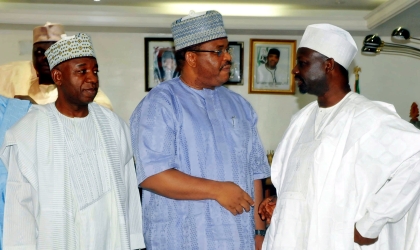
L-R: Permanent Secretary, Ministry of Works, Alhaji Abubakar Mohammed, Minister of Works, Mr Mike Onolememen and Governor Ibrahim Dankwambo of Gombe State, during his visit to the Minister yestersday. Photo: NAN.



Rivers State University and the Otonti Nduka Foundation for Values Education jointly hosted a two-day National Conference on 8 and 9 May 2026 to examine the state of values in Nigeria.
The two days conference held at Rivers State University convocation arena brought together academics, policymakers, legal experts and education leaders under the theme _“Trends and Challenges in Upholding Values in Nigeria.”_
The gathering focused on policy gaps, curriculum reform, and the role of ethics in public service and education.
The event opened on Friday with remarks from Vice Chancellor Prof. Chief Isaac Zeb-Obipi, who stressed the need to address declining moral and civic values across Nigeria’s education and public sectors. A book of abstracts for the plenary sessions was also presented to participants.
Key speakers included former Attorney General Chief Dr Kanu Agabi, SAN; NERDC Executive Secretary Prof. Shehu Salisu; Prof. Hauwa Imam, FNAE, of the University of Abuja; former Rivers SUBEB Chairman Ven Dr Fyneface Akah, ; former NIMASA DG Dr Hon. Dakuku Adol-Peterside; and RSU Director of ICT Prof. Sunny Orike.
Discussions centered on integrating values education into schools, tertiary institutions and public institutions, alongside the impact of technology on moral development among young Nigerians. Panel and plenary sessions produced practical recommendations for curriculum and policy reform.
On Saturday, the foundation marked its centenary with the unveiling of the book _Otonti Nduka in History_, launched by Chief Engr. Grant Offor, FNSE. The Nigerian Academy of Education held a ceremonial procession led by its President Prof. Olu Jegede and the Ikwerre Professors Forum.
In a communiqué, participants called for stronger collaboration between government, civil society and academia to mainstream values education nationwide. They recommended reviewing teacher training curricula and expanding digital platforms to promote ethical civic engagement, with the foundation pledging to share the outcomes with education authorities for implementation.
Dignitaries present included Ogbakor Ikwerre Worldwide as Chief Host, Prof. Emeritus Chief T. Uzodimma Nwala, the Ikenga 1 of Mbaise and first philosophy student of Prof. Otonti Nduka, alongside scholars and community leaders.
Amadi Akujobi

The Shell Nigeria Gas Limited, in partnership with the Manufacturers Association of Nigeria, has reaffirmed support for efforts to expand gas distribution infrastructure in Rivers State as part of initiatives aimed at improving access to affordable, cleaner and more reliable energy for industries across the South-South region.
The commitment was highlighted during the SNG–MAN Business Forum held in Port Harcourt, where stakeholders from the industrial and public sectors examined the role of natural gas in driving industrialisation, boosting local production and strengthening energy security.
Speaking at the forum on behalf of the Managing Director of Shell Nigeria Gas Limited, the company’s Head of Gas Distribution, Mr. Chukwuka Amos Ejesi, described natural gas as a critical component of Nigeria’s energy mix and a key driver of sustainable industrial growth.
According to him, Nigeria’s gas development agenda has reached a stage where policy direction must be matched with practical implementation capable of addressing the energy challenges confronting manufacturers.
He noted that pipeline gas offers industries a cleaner, more dependable and cost-effective energy alternative capable of supporting uninterrupted operations, reducing emissions and improving production efficiency.
“Gas is the backbone of manufacturing, and we are encouraged by the growing recognition among stakeholders of the need for cleaner and more reliable energy solutions,” he said.
Ejesi stressed the need for sustained collaboration among energy providers, government institutions and industrial stakeholders to maximise the country’s gas resources for economic development.
He added that improved gas infrastructure would strengthen manufacturing value chains, enhance productivity and promote more competitive industrial operations across Rivers State and the wider South-South region.
Participants at the forum also emphasised the importance of expanding energy infrastructure as a pathway to unlocking industrial capacity, reducing operating costs and promoting sustainable industrial development.
Representing Governor Siminalayi Fubara, the Director-General of the Rivers State Investment Promotion Agency, Dr. Chamberlain Peterside, reaffirmed the state government’s commitment to partnering with private sector investors to revitalise industrial activities in the state.
He identified key projects targeted under the initiative to include the revival of the Ahoada Industrial Park, the New Port City project and the proposed Bonny Industrial Park, all aimed at stimulating economic growth and expanding industrial opportunities along the Bonny corridor.
According to the governor, the long-term vision is to position Rivers State as a leading manufacturing hub in Southern Nigeria through strategic public-private partnerships.
Governor Fubara also commended Shell Nigeria Gas and MAN for sustaining engagements geared towards improving industrial energy access, noting that gas infrastructure development remains central to the state’s economic recovery plans.
He further observed that the gas sector presents enormous opportunities for economic growth, especially as global energy systems continue to shift towards cleaner energy sources.
The governor called on stakeholders to work collectively towards developing a practical and sustainable gas framework capable of supporting the state’s industrial and energy development objectives.
Chairman of MAN, Rivers and Bayelsa Branch, Elder Vincent Okuku, described gas as indispensable to industrial operations, noting that many manufacturers continue to struggle with the high cost of alternative energy sources.
Similarly, President of the Port Harcourt Chamber of Commerce, Industry, Mines and Agriculture, Dr. Chinyere Ngozi Nwoga, said the transition to natural gas had become increasingly necessary for businesses seeking stable and cost-efficient operations.
“Pipeline natural gas provides a more cost-effective and reliable source of energy for industries,” she stated.
Also speaking, former Chairman of MAN in Rivers and Bayelsa States, Mrs. Emilia Akpan, stressed the need to align energy infrastructure development with investment in human capacity.
She maintained that rebuilding the state’s economy would require not only reliable energy supply but also the development of technical skills needed to support long-term industrial growth.
By Kevin Nengia
-
News1 day ago
Obuah’s Victory Excites Former Lawmaker as APC Primaries Conclude in Rivers West
-

 Politics3 days ago
APC PRIMARIES: FUBARA’S WITHDRAWAL, HISTORIC SACRIFICE FOR NATIONAL STABILITY ……. GROUP
-

 News4 days ago
Court Sentences Seven To Death Over Murder Of Cleric In Rivers
-
News2 days ago
105 Nigerians Killed In S/Africa In Seven Years
-

 Sports3 days ago
PH Arsenal Community Set For Streets Procession, Saturday
-

 Politics3 days ago
IPAC Flays INEC Over Election Guidelines Judgement
-

 Politics3 days ago
NDC To Adopt Electronic Voting For Future Primaries
-

 Niger Delta1 day ago
Royal Father Endorses PH Arsenal Community, Pledges To Support