
News
Widening A Killing Field …Mark’s Death-Penalty Call For Oil Thieves

Since Nigeria discovered crude oil in commercial quantities in Oloibiri in today’s Bayelsa State in the early 50’s, the country’s life has depended largely on what has come to be known as black gold. Indeed, the sustenance, survival and growth of her economy and peoples today is determined by foreign exchange earnings from exports of crude and sale of its refined products to the people.
Crude oil has a history of annexure with impunity, and of systemic denial of peoples of the areas it was sourced. Infact, a visit to Oloibiri would force the first timer to shudder if indeed the product is a curse to the people or blessing only to others, not the people.
That systemic marginalisation, manifested profoundly in the infrastructural decay of host communities and the flamboyance of oil company workers, mostly multi-nationals whose houseboats, were the first source of electricity light, in the usually dark horizon of the once peaceful fishing villages.
With the high economic power of such foreigners, as against the abysmally woeful purchasing power of the locals, the girl became an easy prey to red-eyed multi-nationals who on a near-frequent basis, mindlessly induced the vulnerable lot into early prostitution, while productive young people became their reluctant pimps, escorts or ferry canoe-men for their escapades into the interiors.
But the desecration of the once self-content oil bearing areas was not limited to the socio-economic front. The environmental impact was very huge and indeed threatened the only occupations the people knew, fishing, farming, basket weaving, canoe making and the like. The usually green vegetations turned black as they were totally polluted, resulting in lifeless rivers, farm lands, unfit for fishing and farming, even as the wells, which the locals depended on for drinking water, turned brown.
If the socio-economic and environmental factors were demeaning and made peoples of the oil bearing communities second-class citizens, in their own country, their denial of political space was even more frustrating. Being minorities, it required a thoughtful majority to grant them political space to push the protest, but same was denied even before they were made.
That was on account of a pre-reached resolution by those majority tribes expected to do right. That resolution simply tagged oil as A Gift from God. To whom? A natural treasure. Whose? Hence unbefitting of the special place Agricultural success enjoyed.
Merely because, being majority, those who lacked the said natural and later national gift said so, oil producing areas were willfully denied control of the God given land’s resources as was the case in the days of the groundnut pyramids, cocoa and all. From between 50 percent and 100 percent enjoyed, derivation to oil producing areas, crawled from zero percent, one and half percent, 3 percent, 5 percent and today 13 per cent.
Of course, these were not without protests. Infact, it was when all civil protests made by the people, attracted from the powers that be, the usual response, ‘something is in the pipeline’ that the thoroughly suffocated youth went, in search of the content of the pipelines, directly aggravated also by their systemic denial of sources of livelihood.
Of course, no slave driver willingly frees a good slave without a fight, and so the federal authorities kicked. It was the resultant threat which that face-off posed to the easy sucking of the crude for export and survival of the nation that hastened amnesty for Niger Delta militants.
This brief background has become necessary because of fresh calls to include, oil theft among offences that must attract capital punishment. The question being, can one steal something that belongs to none? A gift from God to all? Like the Air? If there indeed are armed oil thieves, is it not safe to say, that the federal government that forcefully converted a people’s land’s natural gift to a national inheritance are the first culprits?
Without such military might (armed) could the federal government forcefully take what it did not own? (robbery). Were the peoples of the Niger Delta, given the opportunity to decide whether they wished to be a part of the forced amalgamation called Nigeria and for which crude-oil sourced there-from must be for all? Is Nigeria willing to pop that question to the oil bearing communities? To know, if they would wish to surrender their heritage in a Sovereign National Conference?
Last week, Nigeria’s Senate President David Mark canvassed death penalty as punishment for oil theft, due to the damaging effects of the crime to the nation’s survival.
In canvassing capital punishment for crude oil thieves, the key consideration is the threat which the practice poses to the economy of Nigeria, not the marginalisation it’s exploitation and sale had caused to the people whose farmlands and rivers remain the drilling fields with attendant woes. To make oil theft a capital offence therefore, the treasure should first be given to its owners, who alone should complain of the theft of their inheritance and backed by the central government.
What lack of patriotism? I can imagine many wondering. Fact is, wrong as oil theft may be, making it an offence that will attract death penalty is over-widening the nation’s killing fields, and there’s no telling how many Nigerians would be innocent.
Theft or armed robbery flourishes partly because there are willing patrons of the loot the thieve brings. Armed robbery is expensive, so a starter requires a criminally minded rich sponsor for arms. Like armed robbery, crude oil theft is a multi-dimensional crime that covers many skilled and unskilled participants in the banking sector, government, the security forces, multi-nationals, the local refinery owner called ‘kpo-fire,’ the rural trader buying and selling the product, the oil company staff willing to compromise trust for extra earnings, the marketer who mixes adulterated products, the NNPC staff detailed to the discharge point, the tanker driver who sells some drums on the way, and indeed the unemployed youth forgotten by his country, seeking a livelihood, the hard way.
Such is the chain. Such, the number of those likely to be affected. The difference between armed robbery and oil theft however, is that, in the case of the latter, it has always been perceived as a stolen property which when restolen constitutes no offence. This is perhaps why those involved believe that they are merely taking a bit of what has been forcefully made a general gift for all.
Therefore, it will require more than imposition of death penalty to change that mindset. It will require a total remediation of the Niger Delta environment, an acceptance of guilt by the federal government, and an agreement that the product belongs to the owners of the land and rivers the gift was sourced, based on global law who alone should determine what percentage to share or pay in taxes. It is when that ownership is established based on natural law, that an oil thief should be killed for forcefully taking what belongs to another. That too, has a caveat.
The crime must result in the death of the owner to attract the death penalty. Except in very few instances, such is the key ingredient that defines capital punishment in the United States of America (USA) whose democracy we’ve copied.
Perhaps a cursory look at offences that fit the redline will help. (additional facts from the web)
The following are offences that attract either death penalty or life imprisonment in the US
. Causing death by using a chemical weapon
.killing a member of Congress, the Cabinet or the United States Supreme Court
.Kidnapping a member of Congress, Cabinet of the United States Supreme Court resulting in death
.Conspiracy to kill a member of the Congress, Cabinet of the US Supreme Court resulting in death
.Causing death by using an explosive
.Causing death by using an illegal firearm
.Genocide
.First Degree Murder
.Murder perpetrated by poison or lying wait
.Murder that is willful, deliberate, malicious and premeditated
.Murder in the perpetration of or in the attempt to perpetrate any arson, escape kidnapping, treason, espionage, sabotage, aggravated sexual abuse or sexual abuse, child abuse, burglary or robbery
. Murder perpetrated as part of a pattern or practice of assault or torture against a child or children
.Murder committed by a federal prisoner or an escaped federal prisoner sentenced to 15 years to life or a more severe penalty
.Assassinating the President or member of his staff
.Kidnapping the President or a member of his staff resulting in death
.Killing persons aiding federal investigation or state correctional officers
.Sexual abuse resulting in death
.Sexual exploitation of children resulting in death.
.Torture resulting in death
.War crimes resulting in death
.Crimes against humanity
.Attempting, authorising or advising the killing of any officer, juror, or witness in cases involving continuing criminal enterprise, even if such killing does not occur.
Thus, as it may be that a country’s laws are depended largely on its peculiar problems, frustrations, needs, experiences, hopes and fears, and oil theft a major crime against our economy, the offence does not require a capital punishment or a separate law to tackle. The country’s criminal code provides for ways and means of checking theft and robbery, and attracts a death penalty if that crime results in the death of another.
What is required instead is proper policing of our oil and gas production infrastructure by competent, patriotic and indeed God fearing security operatives.
My Agony is that the first victims of such law would be the unemployed youth daily engaged to locally refine crude oil and not all others in the chain that make the theft possible. Or do you not know that the oil thieves and security men posted to such red zones may not be best of friends, but are never enemies in combat, except when the thief is greedy, the security, too pious. And they are few.


News
Rivers DPOs Receive Awards For Outstanding Performance In Crime Prevention …As Students, Media Group Honour CSP Worgu, CSP Yusuf


Two Divisional Police Officers (DPOs) in Rivers State have been honoured by separate groups for their contributions to security, crime prevention and improved community-police relations in their respective areas of responsibility.
The beneficiaries are the DPO of Afam Police Division, CSP Endurance Worgu and his counterpart at Oyigbo Police Division, CSP Bello Yusuf.
CSP Worgu was honoured by a group of students under the aegis of Rivers State Graduate Students Associations for what they described as his commitment and outstanding performance in the discharge of his duties.
The students, led by Chidi John Enyie, Esq. said CSP Worgu was selected based on his track record and status as one of the longest-serving young DPOs of Rivers State origin.
According to the group, CSP Worgu has made significant contributions to the protection of lives and property in the area since assuming office following the #EndSARS period.
The students said they were particularly impressed by the improvement in community-police relations under his leadership, noting that professionalism had remained a key feature of his service.
Enyie represented by Comrade Briggs Soku, said the students community was pleased to identify with a Rivers indigene who had distinguished himself in the police force.
He said the students considered it necessary to encourage and celebrate CSP Worgu because of his achievements as a young Rivers man excelling in a profession that many people from the state were often reluctant to join.
Receiving the award at his office in Afam, CSP Worgu expressed gratitude to God and the students for finding him worthy of the honour.
The DPO said the recognition had boosted his morale and encouraged him to sustain his efforts towards maintaining peace and security in the area.
He said he least expected the honour, particularly because it came from the students, adding that the recognition would further motivate him to serve the people better.
CSP Worgu assured residents of Afam that the police would sustain the existing peace in the area.
He appealed to members of the public to support the police by providing credible and timely information, stressing that useful information from residents would make the job of security personnel easier.
Meanwhile, the Ikwerre/Etche Media Association has also honoured the DPO of Oyigbo Police Division, CSP Bello Yusuf, for his efforts in tackling criminal activities in the area.
The media group presented the award following the swift tracking and arrest of five suspected kidnappers who had allegedly terrorised residents of the Kom-Kom axis and other parts of Oyigbo.
The group commended CSP Bello for what it described as his determined efforts to restore confidence and security in the affected communities, particularly Kom-Kom and Obeama.
According to the group, the arrest of the suspects demonstrated the DPO’s commitment to tackling criminality and safeguarding residents.
The media association said residents had received the development with relief, noting that the police action had sent a strong message to criminal elements operating in the area.
Responding, CSP Yusuf appreciated the group for the recognition and reaffirmed that there would be no room for criminality in Oyigbo.
He also commended the media for its role in disseminating credible information to the public, saying the media had remained supportive of the police in the fight against crime.
CSP Yusuf warned criminal elements operating in Oyigbo to leave the area or be prepared to face the full weight of the law.
He assured residents that the police would continue to pursue criminals and work to dismantle their hideouts, regardless of where they might be operating.

The 5000 Achievers Christian Forum and Colleges of Bishops, Archbishops and Apostles, a Christian interdenominational organisation, has endorsed President Bola Ahmed Tinubu and all candidates of the All Progressives Congress (APC) in Rivers State for the 2027 general elections.
International President of the forum, Archbishop Lucky Aroh, disclosed this during the ordination and consecration of three new Bishops, as well as an award ceremony held in Port Harcourt.
Aroh said the performance of the APC-led Federal Government had endeared the party to the organisation, prompting the forum to declare its support for President Tinubu and other APC candidates in Rivers State.
He said the forum would support all APC candidates in the state during the 2027 elections and urged Nigerians to vote for the party.
Aroh, who is also the General Overseer of Caring Peoples Church, Port Harcourt, charged the newly consecrated Bishops to see their new positions as a great responsibility and dedicate themselves to the advancement of the kingdom of God.
He cautioned them against conduct capable of bringing their offices into disrepute, stressing that their activities would be closely watched by members of the public.
“As Bishops, the eyes of the public are on your activities. You must therefore conduct yourselves in a manner worthy of your calling,” he said.
Also speaking, the International Coordinator of the forum, Bishop Saint Robinson, urged the newly consecrated Bishops to work diligently towards winning souls for the kingdom of God.
Robinson, who was the guest speaker at the event, stressed that the activities of Bishops must at all times be guided by godly principles.
He also called on members of the church to support and cooperate with the newly consecrated Bishops in the discharge of their responsibilities.
The Secretary of the College, Apostle Elizabeth Ayadi Abaye, said the organisation was established to advance the kingdom of God and promote spiritual development.
According to her, the forum has organised several crusades, conferences, prayer meetings, ordinations, consecrations, enthronements, empowerment programmes and other spiritual development activities across the country as part of efforts to win souls for Christ.
Abaye said the organisation has members across the world and disclosed that more programmes had been scheduled to promote the spiritual development and wellbeing of humanity.
The three Bishops consecrated at the ceremony were Prince Alban Chike, Testimony Omenihu Shedrach and Prince Ifemena.
Among those honoured at the event were the Chairman of the Community Development Committee (CDC), Abali Community, Port Harcourt City Local Government Area, Manuchimso Prince Lemmy Wopara, and Clifford Oko Jaja, Coordinator of the 5,000 House-to-House for President Tinubu.
By: John Bibor
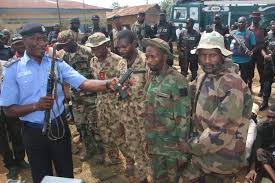
The Rivers State Police Command has arrested a 49-year-old suspected fake soldier, Andrew Atausi, and several other suspects in connection with various criminal activities, including kidnapping, armed robbery, cultism, one-chance robbery and the alleged murder of police officers.
The State Commissioner of Police, CP Olugbenga Adepoju, disclosed this in Port Harcourt, recently during a press briefing at the Command Headquarters, where he said the arrests formed part of the operational achievements recorded by the Command between June and August 2026.
Adepoju said Atausi was arrested on August 10 by police operatives along Ada George, Port Harcourt, while dressed in military uniform and driving a Toyota Hilux painted in Army colours.
The Commissioner said investigation revealed that Atausi was not a member of the Armed Forces, adding that he was suspected to be a serial car snatcher, with three suspected stolen vehicles recovered from him.
He said the recovered vehicles included three Toyota Hilux vehicles without registration numbers and a Toyota Corona Premio with registration number BNY 380 ES, noting that the chassis and engine numbers of the vehicles had allegedly been tampered with.
Adepoju added that an axe and military accoutrements were also recovered from Atausi, as investigation continued into the circumstances surrounding the vehicles and other items recovered from him.
On the June 29 attack on police officers at Aluu Division, the Commissioner said three members of the gang allegedly responsible for the incident had been arrested by operatives of the Violent Crime Response Unit, VCRU-AKU.
The suspects, identified as Maduabuchi Emeka, 34, alleged gang leader; Doctor Chinedu Owhor, 42, and Kamachi Joe, 28, alleged armourer, reportedly led operatives to their hideout at Omagwa where two AK-47 rifles stolen during the attack were recovered.
Adepoju recalled that two police officers were killed during the Aluu attack, while others were wounded and one officer had his leg amputated, stressing that efforts were ongoing to apprehend the fourth suspect.
On kidnapping, the Commissioner said five members of a suspected kidnapping syndicate were arrested in Oyigbo Local Government Area, adding that they allegedly confessed to operations in Kom-Kom, Railway, Obeama and Afam communities.
He said two other suspects from the same network, Anele Ogbogu, 35, alleged to be the gang’s armourer, and Kenneth Eke, 38, were arrested on July 27, with one AK-47 rifle and one SMG rifle recovered.
The Commissioner further disclosed the arrest of suspects in connection with alleged firearm offences, armed robbery, cultism and one-chance robbery, with firearms, ammunition and other exhibits recovered during the operations.
Adepoju assured residents that the Command would sustain intelligence-led, proactive and community-oriented policing in collaboration with other security agencies, while urging members of the public to continue providing credible information that would assist the police in combating crime across Rivers State.
By; King Onunwor
-

 News3 days ago
RSG Targets Nine Million Residents in Mosquito Net Distribution Campaign
-

 Oil & Energy3 days ago
Aiyedatiwa Signs New Electricity Bill
-

 Maritime3 days ago
Marine Minister Commends President Tinubu On NPERA Bill Assent
-

 Oil & Energy3 days ago
NLNG Commissions Research And Innovation Centre In RSU
-

 News3 days ago
KenPoly Holds Eight Convocations, August 29
-

 News3 days ago
RSG Begins Another Phase of Projects Commissioning Today
-

 News3 days ago
RMAFC Completes Revenue Sharing Review, Proposes New Pay
-

 Maritime3 days ago
NAGAFF Petitions IGP Over Alleged Maritime Police Harassment