
Politics
Why Orji Kalu, Arthur Eze Parted Ways

The dramatic emergence of a member of the House of Representatives, Mrs. Uche Ekwunife as the flag-bearer of the Progressives Peoples’ Alliance (PPA) in the February 2010 governorship election in Anambra State was the proverbial last straw that irredeemably broke down the relationship between a former Governor of Abia State, Chief Orji Uzor Kalu and chief PPA financier in the state, Prince Arthur Eze, The Tide source has uncovered.
Eze, an international oil tycoon had at a colourful ceremony in Awka at the weekend led hordes of PPA supporters, including his protégé and south east chairman of the party, Chief Austin Ndigwe, to dump PPA. They instantly embraced the Peoples Democratic Party (PDP) which has lately been on a roller coaster in the state.
Investigations reveal that the relationship between Kalu and Arthur Eze had lately been frosty; with the later openly complaining that he had been edged out of running of the party in Anambra State. Eze had also reportedly frowned at the handling of the last party congress where his choice lost out to Hon. Tony Igboka who emerged chairman.
The billionaire businessman had somehow managed to comport himself but that the centre gave the moment it dawn on him that Ekwunife had by the sleight of the hand trounced his candidate and nephew, Okey. That was when Ezenukpo realised he had overstayed his welcome in PPA, volunteered a source.
Ezenukpo (Arthur Eze) was miffed by the fact that Ekwunife, a PDP member who joined the party a few hours to the PPA primary crushingly defeated his nephew Okey, whom Orji Kalu had sworn to hand the ticket. It was based on this pact that Ezenukpo pumped millions of naira into Anambra PPA at a time nobody would risk touching it with a pole, no matter how long.
“What was more, Ezenukpo was totally exasperated at the obvious helplessness of his legman Ndigwe who, though regional chairman was at the primary checkmated and rendered powerless by the party’s state chairman, Chief Tony Igboka, who became chairman, protests by Eze and Ndigwe notwithstanding,” a source close to the oil tycoon offered.
The source revealed that Arthur Eze felt particularly betrayed that, having invested so much time and money into the PPA project, Kalu clandestinely approached Emeka Etiaba and Ekwunife to contest the party’s governorship ticket with his nephew for whom he had already secured the ticket.
“We got information on how Senator Annie Okonkwo, for whom Ekwunife is keeping the ticket, brought money. Plenty of it. Once the money came, Kalu now began to look the other way as Igboka and other party officers on their side hijacked the delegates’ tags and gave them to PDP members to vote in PPA primary! That was how a PDP member became our flag-bearer overnight,” lamented one PPA officer.
Indications that all was not well with PPA emerged a couple of months ago during the state congress of the party where Igboka, a former member of Anambra State House of Assembly, was returned in very controversial circumstances. Brushing aside several spirited attempts by Eze through Ndigwe to make the party’s national leadership in Abuja reject Igboka, the party forwarded his name to the Independent National Electoral Commission as the authentic chairman.
The stakes heightened last month when Ndigwe confronted the party’s deputy national chairman for setting up a committee in Anambra State chapter of the party without his knowledge. Apart from being threatened with expulsion, Ndigwe, according to party sources, from that time was never brought into the picture of goings on in Anambra PPA. This, the sources insist, largely contributed to the humiliating defeat suffered by Eze’s nephew in the hands of a rookie PPA member, Mrs. Uche Ekwunife.
However, another source close to the former Abia State governor dismissed as “hogwash” suggestions that Kalu shortchanged Arthur in the running of Anambra PPA.
“What nonsense!” fumed the source. “Ezenukpo for sure thinks this is the Abacha era where he played God. He is a very notorious godfather. Imagine that his lack of stomach for democracy made him install Uzuawka (Ndigwe) chairman of Awka south LGA even when all knew that they won not more than four wards in the council.. He bribed his way to the tribunal and got judgment in his protégé’s favour.
“This is 2009, for crying out loud! How would a party grow by remaining the personal property of a political relic? For God’s sake, we are talking about PPA that produced two governors and several members of the National Assembly. You want to keep the party in your bedroom? We said, No! Open it up. Let Okeke and Okafor join so we can become a household name in the South east, and then Nigeria. We are tired of exhuming mummified political fathers. If he’s chosen to return to his vomit in PDP, good luck. We in PPA can’t be bothered,” he declared.
From the ashes of defeat, however, Arthur Eze, who is not new to the turbulence in politics, has reportedly moved on. Aside from donating a whopping N10 million to PDP, the billionaire tycoon whose company owns Block OML 109, located just 12 miles off the shores of Nigeria, has reportedly vowed to stop PPA from winning Anambra “even if that would cost him N2 billion.”
Those who should know insist that Eze is not a man that shies away from spending sprees particularly when his ego has been bruised. “OML 109, encompassing some 773 square kilometers, is estimated to hold over 2.2 billion barrels of crude oil, so you know what that means” a source quipped.
Eze was clearly the most influential figure from the South east from the regime of General Ibrahim Babangida through that of the late General Sani Abacha. When Eze wasn’t ordering pilots of his now defunct Triax Airlines around, he was “sacking” military administrators who failed to do his bidding.
He has consistently supplied oxygen to Ndigwe’s political life beginning from the early 1990s when he bulldozed the former PPA officer into becoming the chairman of Awka South council in Anambra State. He was also reportedly instrumental in installing Ndigwe’s sister, Eucharia Anazodo chairman of Abuja Municipal Area Council (AMAC) during the Babangida regime.



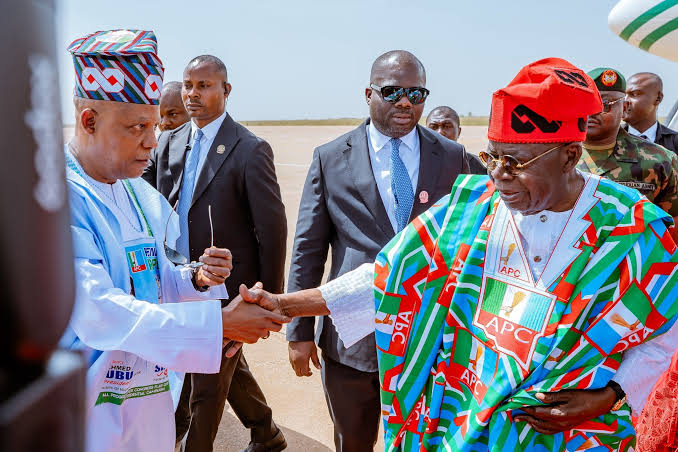
The campaign rally, held at the Kaduna Township Stadium, attracted Vice-President Kashim Shettima, APC governors, party leaders, federal and state lawmakers, political stakeholders and supporters from across the country.
The flag-off marks the beginning of the APC’s drive to secure a second presidential term for President Tinubu, with the party expected to promote its achievements, defend its economic reforms and outline its policy priorities under the proposed Renewed Hope 2.0 agenda.
Kaduna’s selection for the campaign launch underscores the strategic importance of the North-West, a region with a substantial voting population and considerable influence on presidential election outcomes.
The APC faces a significant challenge in Kaduna, where the Peoples Democratic Party’s presidential candidate, Alhaji Atiku Abubakar, defeated President Tinubu in the 2023 election. The rally therefore provides the ruling party an opportunity to strengthen its grassroots structures and regain electoral support in the state.
Addressing supporters, Vice-President Shettima appealed to Northern voters, highlighting President Tinubu’s political relationships with prominent Northern leaders, including Alhaji Abubakar, Mallam Nuhu Ribadu and the late President Muhammadu Buhari.
The Vice-President’s appeal reflects the APC’s determination to consolidate its support in the North as the party intensifies preparations for the presidential contest.
The Renewed Hope 2.0 agenda is expected to feature prominently in the campaign, providing a platform for President Tinubu to explain his administration’s economic policies and outline plans for another term.
However, the President’s record on economic reforms, rising living costs, petrol prices, employment, infrastructure and insecurity is expected to attract considerable scrutiny during the electioneering period.
-

 Education2 days ago
FCE Yola Graduates 3,555 Teachers , Seeks Upgrade to University
-

 Sports2 days ago
Nigerian Trio Target Titles At PFL Africa Finals
-

 Niger Delta2 days ago
Diri Restates Stance On Lagos-Calabar Coastal Highway
-

 Niger Delta2 days ago
C’River, NUJ Pay Tribute To Late Guardian Editor
-

 News2 days ago
NDLEA Recovers Tons Of Illicit Drug Consignments In Nine States
-

 Opinion2 days ago
Checking Voter Apathy In Nigeria’s Electoral Process
-

 Politics2 days ago
2027: DICKSON’S EX-ALLY VOWS TO WORK AGAINST NDC INTEREST IN BAYELSA
-

 Politics2 days ago
2027: GROUP PLEDGES 40,000 SUPPORTERS FOR COALITION CANDIDATES IN RIVERS