
News
Actualising Bodo-Bonny Road Project

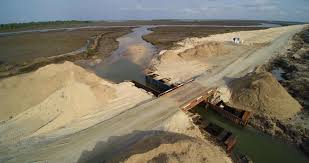
Barring any obstacles, the 37.9km Bodo – Bonny Road project will be completed and
delivered in August, 2022. The assurance was given during the inspection of the facility by the Director, Road Designs, Federal Ministry of Works and Housing, Omotayo Awosanya. He said sufficient funds were available to deliver the project at the guaranteed time.
The N120. 6 billion project handled by German construction giant, Julius Berger, traversing Bodo, Opobo, Andoni to Bonny Island in Rivers State, has 14 bridges. According to Awosanya, with the extensive works already done by the contractors so far, Nigerians would not be disappointed. The Bodo–Bonny Road is a major federal road that successive governments lacked the political will to execute.
The Bodo — Bonny Road project is a public-private partnership arrangement, in which the Federal Government and the Nigeria Liquefied Natural Gas Company Limited (NLNG) will each bear 50 per cent of the total cost to complete the bridge. However, the NLNG has indicated interest to fully fund the project and deduct the cost from taxes to the Federal Government.
The Tide welcomes the NLNG’s bold initiative, especially against the backdrop that the Bodo – Bonny Road project, conceived about 40 years ago, had been one of the failed projects that vividly accentuate the long-standing negligence of Rivers State in particular and the Niger Delta in general by successive Nigerian governments. Truly, the importance of the road cannot be over-emphasised.
We laud the Rivers State Governor, Chief Nyesom Wike, for providing the enabling conditions in the state which gave impetus to the commencement of work on this long-awaited project. The Federal Government is likewise commended for conceding to the demands of the government and people of Rivers State to flag off the construction of the road.
Equally commended is the NLNG for showing enthusiasm and cooperation in financing the landmark project. It is hoped that other companies will emulate it. This is a demonstration that the private sector can drive the infrastructural needs of Nigeria. Since the authorities alone cannot plug Nigeria’s intimidating infrastructure deficit, the private sector should be enabled to lead in the provision of infrastructure development while the government serves as an enabler and catalyst.
Besides its primacy to the enhancement of the economic base of the nation, the road, linking five local government areas including Khana, Okrika, Eleme, Andoni and Bonny, will also connect the mainland Rivers State to a tremendous section of the riverine part of the state; in fact, one of the most difficult terrains in the Niger Delta.
It is vile that over-and-above the perennial cries of the communities in that axis, is the accessibility burden on the foremost gas company in West Africa – NLNG – and its ancillary firms. This should have lodged on the conscience of the nation a pang of avoidable guilt. The undertaking is only the latest in a series of similarly transformational infrastructure partnerships ongoing across the country.
Without a doubt, the road has a very significant economic role to play in the state and Nigeria in general when completed. Hence, any attempt to politicise it should be spurned. The NLNG has to be committed to this work since it will be more salutary to it. Much money would certainly be saved from the transportation of equipment and other operational activities between its Port Harcourt base and Bonny, the operational area.
It needs not be accentuated that a massive construction of this magnitude will create jobs directly for engineers, artisans, and labourers; and indirectly for food vendors and suppliers, transporters, quarry operators and so many others in the construction value chain. Already, Julius Berger has expressed that over 300 Rivers youths would otherwise be engaged in the project in January 2021. Certainly, that will go a long way to empower the youths.
Also, upon termination, the project will permanently transform the lives of thousands of Nigerian citizens in and around Bonny Island. It will similarly attenuate the hardship faced by commuters along the Bodo – Bonny axis; facilitate the operations of the NLNG, and bring considerable gains to the lives of farmers, traders, school children and travellers. In actual fact, the construction is evidence of the blossoming peace in the Niger Delta.
Additionally, the road will go a long way to avert the frequent loss of lives on the high sea, eliminate piracy and promote businesses in the area. Of course, huge is the tourist potential that a road to Bonny can harness, while alleviating the misery of the Ibanis. That is why all availed communities should shun selfish interest, cooperate and own the project. Similarly, chiefs, impacted local government councils, youths and the state government have to pull through to ensure perfect harmony towards its consummation.
We find it politic that this project is realised during the life of the present administration. If President Muhammadu Buhari must break the jinx and effectuate his promise for change, he must impede all obstacles to the actualisation of the Bodo – Bonny Road. In that wise, initial land and compensation matters must be perfected. Affected communities have to be taken along, while the security needs of the project should be facilitated to avoid obstructions of any kind.
As earnings from gas become more and more substantial, it is only essential that the Federal Government rises to the occasion. The administration that can provide this road will surely go down in history as the one that conquered the odds and made the difference that mattered most to the Niger Deltans and Nigerians.


The Rivers State chapter of the All Progressives Congress Christian Leaders Forum has expressed strong confidence in the capacity of All Progressives Congress (All Progressives Congress) candidates in the state to deliver effective governance if elected into office in the coming elections.
The State Coordinator of the forum, Archbishop Lucky Aroh, made this known during a breakfast and thanksgiving meeting held in Port Harcourt, where leaders gathered to pray for the stability of the party and the safety of its candidates ahead of the 2027 general elections.According to him, the meeting was convened to seek divine intervention for peace, unity, and security among APC candidates across Rivers State.
“Today we are praying for APC stability in Rivers State and the security of our candidates that have been elected to contest the 2027 elections. It is a breakfast meeting,” Aroh said.
He further expressed optimism that the party’s candidates would not disappoint the people if entrusted with leadership responsibilities.
“They will not fail when elected into office. We are here as fathers of the land to let them know, and I must tell you the truth that these are the authentic people that will do well in Rivers State,” he added.
Speaking earlier, the National Chairman of the forum, Professor Olanrewaju Abraham, commended the Rivers State chapter for organizing the programme, noting that the national body of the forum believes strongly in the power of prayer.
He stated that political leadership provides an opportunity to influence society positively, including advancing moral and spiritual values, while expressing confidence that APC candidates at all levels would emerge victorious in the upcoming elections.
Also speaking, the Rivers State Women Leader of the APC, Hon. Darling Amadi, praised the forum for its commitment to prayers for peace, stability, and the protection of party candidates.
Represented by the Deputy Women Leader of the party in the state, she described the initiative as commendable and urged other political and support groups within the party to emulate the gesture in promoting unity and stability.
By: John Bibor, Menebe Emmanuel & Fortune Paibi
Prominent businessman and philanthropist, Elder Anthony Osagwe-Ogo, was celebrated in grand style as he marked his 70th birthday anniversary, with distinguished Nigerians, business leaders, and golf enthusiasts gathering to honour his remarkable contributions to society.
The colourful celebration took place at the Port Harcourt Golf Club, where friends, associates, and well-wishers converged to pay tribute to the revered elder statesman.
Chairman of the occasion, High Chief (Dr.) Ikenna Okafor, described the celebrant as a detribalised Nigerian whose generosity, humility, and commitment to humanity have earned him admiration across different communities and backgrounds.
According to Dr. Okafor, Pa Osagwe-Ogo’s impact on society and the development of his community remains unparalleled. He noted that members of the golfing community are proud to be associated with a father figure who consistently promotes the welfare and well-being of those around him.
He further stated that the history and growth of the Port Harcourt Golf Club cannot be told without acknowledging the significant role played by the celebrant, whose wisdom, encouragement, and leadership have helped sustain the club over the years.
“We are here to celebrate a man who has impacted humanity positively, a peace-loving individual and an epitome of hope for the younger generation. We pray to emulate his virtues. Today, we celebrate a bridge-builder, a trailblazer, and an iconic leader whose life continues to inspire many,” Dr. Okafor said.
He expressed delight at the large turnout of guests from various walks of life, describing it as a testament to the respect and affection Pa Osagwe-Ogo commands within and beyond Rivers State.
In his response, the celebrant, Pa Anthony Osagwe-Ogo, expressed profound gratitude to God for preserving his life and granting him the privilege of attaining the milestone age of 70.
He also thanked members of the Port Harcourt Golf Club, family members, friends, and associates for identifying with him during the celebration and for their unwavering support over the years.
The event featured the cutting of the birthday cake, presentation of awards to deserving members of the club, goodwill messages, and moments of celebration among guests.
The ceremony was attended by notable personalities from the business community, the golfing fraternity, and other sectors, all of whom joined in celebrating the life and legacy of the respected elder statesman.
Rivers State Governor, Sir Siminalayi Fubara, and the Permanent Secretary of the Rivers State Ministry of Information and Communications, Dr. Honour Kuru Sirawoo, have been honoured with awards of recognition in connection with the 2026 Democracy Day celebrations held in Port Harcourt.
The awards, which formed part of activities marking Nigeria’s Democracy Day on June 12, were formally presented on Tuesday at the Ministry of Information and Communications in Port Harcourt.
Presenting the awards was Hon. Abdul Hameed Oladipupo Alli, popularly known as “Mr. Nigeria,” Publisher of Asiwaju Trumpet Magazine and Achievers World International Magazine.
Governor Fubara was recognised for his efforts in sustaining peace, stability, and a conducive political atmospherJohn Bibor / Menebe Emmanuel / Fortune Paibie in Rivers State. The organisers noted that his administration has fostered harmony and strengthened civic participation across the state.
Dr. Sirawoo, on the other hand, was honoured for his exemplary administrative leadership and significant contributions to effective information management within the Ministry of Information and Communications.
Representing Dr. Sirawoo at the presentation ceremony, Dr. Christian Davies received the award on his behalf and expressed gratitude for the recognition. He described the honour as a reflection of Dr. Sirawoo’s unwavering commitment to professionalism, excellence, and dedicated public service.
Dr. Davies assured the organisers that the award would be formally conveyed to the Permanent Secretary.
The event also featured the presentation of commemorative publications highlighting major governance and civic milestones in Rivers State, including Easter celebrations, Workers’ Day activities, the Governor’s third anniversary in office, and Democracy Day programmes.
Organisers of the awards commended the Rivers State administration for what they described as sustained peace, political stability, and improved civic engagement, noting that these achievements have contributed significantly to the state’s continued development.
By: Jessica Sambol
-

 Niger Delta4 days ago
Warri Airport Manager Disputes Air Peace Bird Strike Claim
-

 News4 days ago
Nigeria Won’t Surrender Any Territory To Criminals -Tinubu
-

 News4 days ago
FG Begins Trial Of Over 600 Terrorism Suspects
-

 Politics4 days ago
Parties’ Deregistration: How Justice Lifu Overruled Appeal Court Justices
-

 Rivers4 days ago
79th IAUE Inaugural Lecture: Prof Anero Advoctes Tuition-Free Education For Children
-

 Politics4 days ago
ADC: Okonkwo Rejects Amaechi As Presidential Running Mate, Withdraws Support
-

 Politics4 days ago
2027: Tinubu’s Projects Give APC Edge In South East – Yilwatda
-
News4 days ago
Forum Expresses Confidence In APC Candidates’ Performance In Rivers