
News
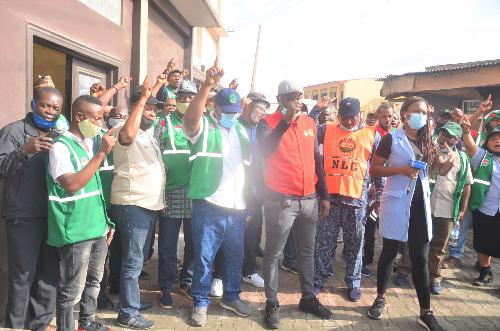
Organised Labour Suspends Petrol, Electricity Tariff Hike

JOINT COMMUNIQUE ON THE RESOLUTION OF TRADE DISPUTE BETWEEN THE FEDERAL GOVERNMENT OF NIGERIA (FGN) AND THE ORGANIZED LABOUR REPRESENTED BY THE NIGERIA LABOUR CONGRESS (NLC) AND THE TRADE UNION CONGRESS (TUC) HELD AT THE STATE HOUSE BANQUET HALL ON SUNDAY, 27TH SEPTEMBER 2020
A Bipartite Meeting between the FGN and the two Labour Centres – Nigeria Labour Congress (NLC) and Trade Union Congress of Nigeria (TUC),
Having been convened at the Banquet Hall, State House, Abuja to discuss emerging labour issues arising from recent cost – reflective Electricity Tariff adjustments and deregulation of the downstream sector of the Petroleum Industry,
Recognizing the public outcry and protest over the recent Federal Government twin policies on Electricity Tariff Reform and full implementation of deregulation of the downstream sector of the Nigerian Oil and Gas Industry resulting in the planned nation-wide industrial action by Organised Labour,
Bearing in mind the spiral and negative impact of COVID-19 pandemic on world economy,
Further bearing in mind that due to impact of COVID-19 pandemic the world is undergoing socio-economic transition which has affected price stability, sustainability of enterprises, employment, and other socio-economic indices,
Acknowledging that the spiral and negative impact of COVID-19 pandemic on the global economy has given rise to the need for a new socio-economic order,
Recognising the need to sustain enterprises for retention and creation of jobs as well as sustainable growth and development,
Acknowledging the need for social concertation between the Federal Government and workers’ representatives, namely the two Labour Centres – The NLC and TUC,
To aid in the dialogue and communication, the Federal Government side made presentations to show the state of economy and the drive behind the recent cost – reflective Electricity Tariff adjustments and deregulation of the downstream sector of the Petroleum Industry,
Bipartite meeting to address and resolve the issues in dispute between the FG and Labour Centres were held on September 15, 24, and 27, 2020,
After exhaustive deliberations on the issues raised by Labour Centres, the FGN stated that it has fashioned out palliatives that would ameliorate the sufferings that Nigerian workers may experience as a result of the cost – reflective Electricity Tariff adjustments and deregulation of the downstream sector of the Petroleum Industry. The palliatives will be in the areas of transport, power, housing, agriculture and humanitarian support.
After thorough debates and negotiations on various issues raised by all parties, the following resolutions were reached and mutually adopted:
ELECTRICITY TARIFF REFORMS
The parties agreed to set up a Technical Committee comprising Ministries, Departments, Agencies, NLC and TUC, which will work for a duration of two (2) weeks effective Monday 28th September 2020, to examine:
the justifications for the new policy in view of the need for the validation of the basis for the new cost reflective tariff as a result of the conflicting information from the fields which appeared different from the data presented to justify the new policy by NERC;
metering deployment, challenges, timeline for massive roll – out.
The Technical Committee membership is as follows:
Mr Festus Keyamo, SAN – Hon. Minister of State Labour & Employment – Chairman
Mr Godwin Jedy-Agba – Hon. Minister of State Power – Member
Prof. James Momoh – Chairman National Electricity Regulatory Commission – Member
Engr. Ahmad Rufai Zakari – SA to Mr. President on Infrastructure – Member/Secretary
Dr. Onoho’Omhen Ebhohimhen – Member (NLC)
Comrade Joe Ajaero – Member (NLC)
Comrade Chris Okonkwo – Member (TUC)
1no. Representative of DISCOS – Member
The Terms of Reference (ToR) are as follows:
To examine the justification for the new policy on cost – reflective Electricity Tariff adjustments.
To look at the different Electricity Distribution Company (DISCOs) and their different electricity tariff vis-à-vis NERC order and mandate.
Examine and advise Government on the issues that have hindered the deployment of the six million meters.
To look into the NERC Act under review with a view to expanding its representation to include organized labour.
The Technical sub – committee is to submit its report within two (2) weeks. During the two weeks, the DISCOs shall suspend the application of the cost – reflective Electricity Tariff adjustments.
The meeting also resolved that the following issues of concern to Labour should be treated as “stand – alone” items:
The 40% stake of Government in the DISCO and the stake of workers to be reflected in the composition of the DISCO’s Boards.
An all-inclusive and independent review of the power sector operations as provided in the privatization MOU to be undertaken before the end of the year 2020, with Labour represented.
That going forward, the moribund National Labour Advisory Council (NLAC) be inaugurated before the end of the year 2020 to institutionalize the process of tripartism and socio dialogue on socio – economic and major labour matters to forestall crisis
DOWNSTREAM SECTOR DEREGULATION
Consequent upon the critical review of the various challenges of the downstream sector of the Nigeria oil and gas industry vis a vis the incalculable losses associated with a subsidy regime the Country has been incurring in terms of, stifled growth in the downstream sector, diminished human capital development and massive financial leakages and flight. This is in addition to the dire financial circumstances of the Federation that precludes any ability to sustain any subsidy on PMS and making deregulation of PMS inevitable. Consequently, the Parties agreed to the following:
All parties agreed on the urgency for increasing the local refining capacity of the nation to reduce the overdependency on importation of petroleum products to ensure energy security, reduce cost of finished products, increase employment and business opportunities for Nigerians.
To address (1) above, NNPC to expedite the rehabilitation of the nation’s four refineries located in Port Harcourt, Warri and Kaduna and to achieve 50% completion for Port Harcourt by December 2021, while timelines and delivery for Warri and Kaduna will be established by the inclusive Steering Committee.
To ensure Commitment and transparency to the processes and timelines of the rehabilitation exercise, the management of NNPC has offered to integrate the national leadership of the Nigeria Union of Petroleum and Natural Gas Workers (NUPENG) and Petroleum and Natural Gas Senior Staff Association (PENGASSAN) into the Steering Committee already established by the Corporation.
A Validation team comprising the representatives of the NNPC, Nigeria Extractive Industries Transparency Initiative (NEITI), Infrastructure Concession Regulatory Commission (ICRC), NUPENG and PENGASSAN will be established to monitor progress of the rehabilitation of the refineries and the pipelines/strategic depots network and advice the Steering Committee periodically.
Post rehabilitation, NNPC shall involve the PENGASSAN and NUPENG in the process of establishing the operational model of the Nation’s refineries.
The Federal Government will facilitate the delivery of licensed modular and regular refineries, involvement of upstream companies in petroleum refining and establishing framework for financing in the downstream sector.
NNPC to expedite work on the Build Operate and Transfer framework for the nation’s pipelines and strategic depots network for efficient transportation and distribution of Petroleum products to match the delivery timelines of the refineries as agreed.
The Federal Government and its agencies to ensure delivery of 1 million CNG/LPG AutoGas conversion kits, storage skids and dispensing units under the Nigeria Gas Expansion Programme by December 2021 to enable delivery of cheaper transportation and power fuel. A Governance Structure that will include representatives of organized Labour shall be established for timely delivery.
GENERAL INTERVENTION
To cushion the impacts of the downstream sector deregulation and tariffs adjustment in the power sector, the Federal Government will implement the following:
A specific amount to be unveiled by the FGN in two weeks’ time will be isolated from the Economic Sustainability Programme Intervention Fund and be accessed by Nigerian Workers with subsequent provision for 240,000 under the auspices of NLC and TUC for participation in agricultural ventures through the CBN and the Ministry of Agriculture. The timeline will be fixed at the next meeting.
Federal Government will facilitate the removal of tax on minimum wage as a way of cushioning the impacts of the policy on the lowest vulnerable.
Federal Government will make available to organized labour 133 CNG/LPG driven mass transit buses immediately and provide to the major cities across the Country on a scale up basis thereafter to all States and Local Governments before December 2021.
Housing: 10% be allocated to Nigerian workers under the ongoing Ministry of Housing and Finance initiative through the NLC and TUC.
Consequently, the NLC and TUC agreed to suspend the planned industrial action.
ORGANISED LABOUR;
___________________ __________________
Ayuba Wabba, mni Quadri Olalaye
NLC PRESIDENT TUC PRESIDENT
_________________ __________________
Emmanuel Ugboaja Musa Lawal Ozigi, mni Secretary General NLC Secretary General TUC
_________________ __________________
Williams E. Akporeha Festus Osifo
NUPENG President PENGASSAN President
___________________ __________________
Martin Uzoegwu Chris N. Okonkwo
President NUEE President, SSAEAC
FOR GOVERNMENT:
__________________ _______________________
Timipre Sylva Festus Keyamo, SAN
Hon. Min. of State Petroleum Hon. Min. of State Labour & Employment
__________________ _____________________
Alh Lai Mohammed Godwin Jedy-Agba
Hon. Min. of Information & Culture Hon. Min. of State Power
_________________________
Sen. (Dr.) Chris Nwabueze Ngige, OON, MD.
Honourable Minister of Labour & Employment
_______________________________
Boss Mustapha
Secretary to the Government of the Federation


The Rivers State chapter of the All Progressives Congress Christian Leaders Forum has expressed strong confidence in the capacity of All Progressives Congress (All Progressives Congress) candidates in the state to deliver effective governance if elected into office in the coming elections.
The State Coordinator of the forum, Archbishop Lucky Aroh, made this known during a breakfast and thanksgiving meeting held in Port Harcourt, where leaders gathered to pray for the stability of the party and the safety of its candidates ahead of the 2027 general elections.According to him, the meeting was convened to seek divine intervention for peace, unity, and security among APC candidates across Rivers State.
“Today we are praying for APC stability in Rivers State and the security of our candidates that have been elected to contest the 2027 elections. It is a breakfast meeting,” Aroh said.
He further expressed optimism that the party’s candidates would not disappoint the people if entrusted with leadership responsibilities.
“They will not fail when elected into office. We are here as fathers of the land to let them know, and I must tell you the truth that these are the authentic people that will do well in Rivers State,” he added.
Speaking earlier, the National Chairman of the forum, Professor Olanrewaju Abraham, commended the Rivers State chapter for organizing the programme, noting that the national body of the forum believes strongly in the power of prayer.
He stated that political leadership provides an opportunity to influence society positively, including advancing moral and spiritual values, while expressing confidence that APC candidates at all levels would emerge victorious in the upcoming elections.
Also speaking, the Rivers State Women Leader of the APC, Hon. Darling Amadi, praised the forum for its commitment to prayers for peace, stability, and the protection of party candidates.
Represented by the Deputy Women Leader of the party in the state, she described the initiative as commendable and urged other political and support groups within the party to emulate the gesture in promoting unity and stability.
By: John Bibor, Menebe Emmanuel & Fortune Paibi
Prominent businessman and philanthropist, Elder Anthony Osagwe-Ogo, was celebrated in grand style as he marked his 70th birthday anniversary, with distinguished Nigerians, business leaders, and golf enthusiasts gathering to honour his remarkable contributions to society.
The colourful celebration took place at the Port Harcourt Golf Club, where friends, associates, and well-wishers converged to pay tribute to the revered elder statesman.
Chairman of the occasion, High Chief (Dr.) Ikenna Okafor, described the celebrant as a detribalised Nigerian whose generosity, humility, and commitment to humanity have earned him admiration across different communities and backgrounds.
According to Dr. Okafor, Pa Osagwe-Ogo’s impact on society and the development of his community remains unparalleled. He noted that members of the golfing community are proud to be associated with a father figure who consistently promotes the welfare and well-being of those around him.
He further stated that the history and growth of the Port Harcourt Golf Club cannot be told without acknowledging the significant role played by the celebrant, whose wisdom, encouragement, and leadership have helped sustain the club over the years.
“We are here to celebrate a man who has impacted humanity positively, a peace-loving individual and an epitome of hope for the younger generation. We pray to emulate his virtues. Today, we celebrate a bridge-builder, a trailblazer, and an iconic leader whose life continues to inspire many,” Dr. Okafor said.
He expressed delight at the large turnout of guests from various walks of life, describing it as a testament to the respect and affection Pa Osagwe-Ogo commands within and beyond Rivers State.
In his response, the celebrant, Pa Anthony Osagwe-Ogo, expressed profound gratitude to God for preserving his life and granting him the privilege of attaining the milestone age of 70.
He also thanked members of the Port Harcourt Golf Club, family members, friends, and associates for identifying with him during the celebration and for their unwavering support over the years.
The event featured the cutting of the birthday cake, presentation of awards to deserving members of the club, goodwill messages, and moments of celebration among guests.
The ceremony was attended by notable personalities from the business community, the golfing fraternity, and other sectors, all of whom joined in celebrating the life and legacy of the respected elder statesman.
Rivers State Governor, Sir Siminalayi Fubara, and the Permanent Secretary of the Rivers State Ministry of Information and Communications, Dr. Honour Kuru Sirawoo, have been honoured with awards of recognition in connection with the 2026 Democracy Day celebrations held in Port Harcourt.
The awards, which formed part of activities marking Nigeria’s Democracy Day on June 12, were formally presented on Tuesday at the Ministry of Information and Communications in Port Harcourt.
Presenting the awards was Hon. Abdul Hameed Oladipupo Alli, popularly known as “Mr. Nigeria,” Publisher of Asiwaju Trumpet Magazine and Achievers World International Magazine.
Governor Fubara was recognised for his efforts in sustaining peace, stability, and a conducive political atmospherJohn Bibor / Menebe Emmanuel / Fortune Paibie in Rivers State. The organisers noted that his administration has fostered harmony and strengthened civic participation across the state.
Dr. Sirawoo, on the other hand, was honoured for his exemplary administrative leadership and significant contributions to effective information management within the Ministry of Information and Communications.
Representing Dr. Sirawoo at the presentation ceremony, Dr. Christian Davies received the award on his behalf and expressed gratitude for the recognition. He described the honour as a reflection of Dr. Sirawoo’s unwavering commitment to professionalism, excellence, and dedicated public service.
Dr. Davies assured the organisers that the award would be formally conveyed to the Permanent Secretary.
The event also featured the presentation of commemorative publications highlighting major governance and civic milestones in Rivers State, including Easter celebrations, Workers’ Day activities, the Governor’s third anniversary in office, and Democracy Day programmes.
Organisers of the awards commended the Rivers State administration for what they described as sustained peace, political stability, and improved civic engagement, noting that these achievements have contributed significantly to the state’s continued development.
By: Jessica Sambol
-

 Niger Delta2 days ago
Warri Airport Manager Disputes Air Peace Bird Strike Claim
-

 News2 days ago
Nigeria Won’t Surrender Any Territory To Criminals -Tinubu
-

 News2 days ago
FG Begins Trial Of Over 600 Terrorism Suspects
-

 Rivers2 days ago
79th IAUE Inaugural Lecture: Prof Anero Advoctes Tuition-Free Education For Children
-

 Politics2 days ago
Parties’ Deregistration: How Justice Lifu Overruled Appeal Court Justices
-

 News2 days ago
Rivers Judges Commence Annual Vacation, July 20
-

 Politics2 days ago
ADC: Okonkwo Rejects Amaechi As Presidential Running Mate, Withdraws Support
-

 Politics2 days ago
2027: Tinubu’s Projects Give APC Edge In South East – Yilwatda