
Featured
Wike Tackles Insecurity In Ogoni …Inspects 2nd Term Inauguration Venue …Abe Lauds Gov On Peace Initiative …RSG Withdraws Charge Against Lloyd

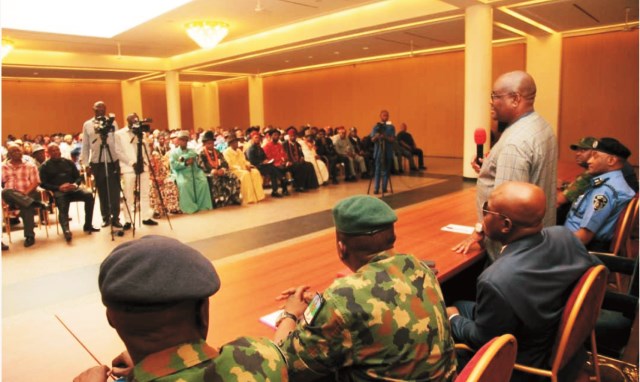
The Rivers State Governor, Chief Nyesom Wike, has declared that his administration is working with security agencies to tackle rising insecurity and cultism in Ogoniland.
Addressing Ogoni Political Leaders, Traditional Rulers and Youth Groups, yesterday, at the Government House, Port Harcourt, Wike said the government was deploying all necessary machinery to restore peace in the troubled area.
He said: “All of the persons involved in cultism are known by the community leaders. We are coming after them to restore peace to Ogoni communities.
“This time, no effort will be spared. Attention is on the Ogoni area to check the rising insecurity. All through yesterday, the State Security Council met, and resolved on the best way to tackle the cultists”.
The governor charged community leaders to also work out modalities to tackle cultism, saying that the state government would give them full support to achieve desired results.
He warned against the illegal removal of government-recognised chiefs by unauthorised persons, saying that such illegal actions lead to conflicts that degenerate into insecurity.
He regretted the situation in Eleme where a government-recognised traditional ruler was illegally removed by some unauthorised persons.
Wike said that the state government was taking measures to reach out to traditional rulers who were not recognised by government, so that they can contribute to the promotion of security in their respective communities.
The governor, however, noted that part of the problem in Ogoniland was the planned resumption of oil production.
He said that he has received a letter from the National Security Adviser on the commencement of production at OML 11, and noted that he was not duly informed on the process.
Wike added that going forward, the state government and Ogoni people should be carried along on the OML 11 issue, saying that dialogue would yield better results.
He said: “I got a letter from the National Security Adviser. Part of the problem is OML 11. I have written back to them, and said you did not inform me when you were going there. If you want to go into a community, tell me as a governor. But even if there will be, we need to sit down and resolve issues.
“I have told the Federal Government that they cannot use force in doing everything. We need to sit down and resolve issues. As a government, we are losing revenue no doubt, but the people must be involved so that everyone is part of what is happening. I will not support anything that will make Ogoni people not to benefit from their resources. I will not do anything to betray the people who have given me their mandate. I will never do that”.
Rivers State Commissioner of Police, Usman Belel urged the people to support the security agencies to fight insecurity, and called for confidential information to help the security agencies track down cultists in the area.
He said cultism was not a way of life, but a criminal action that would be checked by the security agencies.
Chairman of the Supreme Ogoni Council of Chiefs, King Godwin Giniwa assured the Rivers State governor that Ogoni people would support his drive to promote peace and security in the area.
Meanwhile, ahead of activities to herald his swearing in for a second term, Rivers State Governor, Chief Nyesom Wike, yesterday, inspected the venue for the State Thanksgiving Service.
The governor, who was accompanied by the Senator-elect, Dr Sandy Onoh (Cross River Central) moved round the Yakubu Gowon Stadium where officials were getting the facility ready for the historic event.
Wike later inspected the Obi Wali Cultural Centre, which will host the State Variety Night.
At the Real Madrid Football Academy, Wike was impressed with the level of work.
The academy is almost ready for commissioning.
Meanwhile, the Senator representing Rivers South East Senatorial District in the National Assembly, Magnus Abe has commended Governor Nyesom Wike for his call on all opposition political parties and politicians to work with his administration for the sake of peace and security in the state.
Abe, who made the commendation during a stakeholders’ meeting of his faction of the All Progressives Congress (APC) in Bera, Gokana Local Government Area of Rivers State, stated that from the governor’s recent statements and actions, he believes that the state chief executive was sincere with the Olive branch he offered to opposition parties.
According to him, “From what I have seen of the governor, from the things that he has said and from the actions he has taken, I want to give him the benefit of doubt. I believe that he is sincere, and I think that all sincere Rivers men and women should also make whatever sacrifice and contribution that they can make to help us get this state back on track.
“This is not about politics. It is not about who lost and who won. It is about how we can make it possible for the ordinary Rivers man or woman to be able to survive and go about their businesses without fear in this state,” Abe explained.
He called on all Rivers people to support the state government in returning peace and security in Rivers State; just as he admonished APC members in the state to join hands in rebuilding the party’s structure so that everyone can benefit.
Abe stated further, “I am prepared to make any sacrifice and do anything that will contribute to rebuilding the APC properly in a manner that respects the rights and the obligations, commitments and support of party members across the state.”
Abe also thanked them for ‘their steadfast’ support to the party and for their determination and commitment to the party, which he said, contributed to the victory of President Muhammadu Buhari in the last general election.
Also, the Rivers State Government has withdrawn one of the three charges bordering on malicious destruction of public property brought against the former leader of the state House of Assembly and a chieftain of All Progressives Congress (APC), Dr Chidi Lloyd.
This followed an application ‘nolli prosecue’ brought before a state High Court, presided over by Justice Chinwendu Nworgu, yesterday, to withdraw from the continued prosecution of the matter by the state government.
The counsel to the state government, Mr Adeyemi Damilare told the court that the state government was no longer interested in continuing with the prosecution, and urged the judge to strike out the matter.
He told the court that the state government, through the attorney general of the state, has the right to withdraw from any prosecution on behalf of the state when the need arises.
Counsel to the accused, Mr Azundah Onyekwere, did not oppose the application to withdraw from the case.
Ruling on the matter, the trial judge, Justice Chinwendu Nworgu struck out the matter as requested by the state government.
In an interview with newsmen outside the court room, counsel to Chidi Lloyd, averred that even though the court has struck out the matter, they were worried that the state government might resurrect the matter later.
According to him, “this is the fourth time the state government was entering ‘nolli prosecue’ against Chidi Lloyd and later came up with the matter again”, and appealed that the matter should no longer be resurrected under any guise.
It would be recalled that the state government had recently withdrawn murder charges against the embattled factional state chairman of All Progressives Congress (APC), Hon Ojukaye Flag-Amachree as part of efforts to promote genuine reconciliation and peace in the state.
Akujobi Amadi & Dennis Naku



Governor of Rivers State, Sir Siminalayi Fubara, has reaffirmed the unwavering commitment of his administration to peace, unity, security, and inclusive development as Rivers State marked its 59th anniversary, last Wednesday.
In a goodwill message issued on Wednesday to commemorate the anniversary, Governor Fubara stated that despite the challenges faced over the years, the people of Rivers State have continued to demonstrate resilience, strength, and an enduring spirit of unity that has sustained the state since its creation.
The Governor noted that the strong bond of brotherhood among the various ethnic nationalities of the state, including the Ijaw, Ikwerre, Ogoni, Etche, Ekpeye, Andoni, Kalabari, and others, remains one of Rivers State’s greatest strengths and a critical foundation for peace, stability, and progress.
He further observed that Rivers State has remained a major driver of Nigeria’s economy for decades, not only because of its abundant oil and gas resources, but also because of the exceptional contributions of its people across diverse sectors including academia, jurisprudence, business, entertainment, public service, and sports.
Governor Fubara assured the people that his administration will continue to prioritize policies and programmes that promote peace, protect lives and property, and expand development across all parts of the state. He emphasized that governance must be people centered and impactful, with equal attention given to every Local Government Area of the state.
The Governor also paid tribute to the elders and founding leaders of the state for preserving the spirit of unity and coexistence over the years, while urging the youths to remain hopeful, responsible, and actively committed to building a greater Rivers State through innovation, hard work, and patriotism.
He equally acknowledged the invaluable role of women in strengthening families, communities, and society, describing them as indispensable partners in the continued growth and stability of the state.
Governor Fubara called on all Rivers people to use the occasion of the anniversary as a moment of reflection and renewed commitment to peaceful coexistence, mutual respect, dialogue, and collective progress, stressing that the unity and future of Rivers State must always rise above personal interests and political differences.
Rivers State was created on May 27, 1967, by General Yakubu Gowon.


The Rivers State Government has distributed science equipment and materials to all senior secondary schools across the state to support students during the ongoing West African Examinations Council exams and to strengthen practical learning.
Flagging off the distribution at the Rivers State Senior Secondary Schools Board premises in Port Harcourt, on Monday, the State Commissioner for Education, Dr. Peters Nwagor, said the move demonstrates Governor Siminalayi Fubara’s commitment to improving education standards in the State.
Nwagor said the materials were approved and provided by the state government specifically to boost the teaching and learning of science subjects, describing science education as the foundation for technological advancement, innovation, and national development.
“No society can compete globally without deliberate investment in science and technology,” the Commissioner stated.
He commended the governor for consistently prioritising the education sector by providing tools needed for effective teaching and hands-on learning.
The Commissioner directed principals to ensure that the equipment are used strictly for practical lessons in their schools, warning that any principal or administrator found diverting, hoarding, or selling the materials wil face disciplinary action under public service regulations.
Nwagor also warned against examination malpractice, saying any principal found aiding or encouraging malpractices will be decisively sanctioned.
“We must collectively restore the dignity and credibility of our educational system,” he said.
Also speaking, Chairman, Rivers State Senior Secondary Schools Board, Tony Egwurugwu, urged school heads to make judicious use of the materials for students’ benefit.
He thanked the State Government for providing the resources, and assured that monitoring mechanisms would be put in place to ensure the materials serve their intended purpose.
In his own remarks, a Board Member for Technical Education, Nwisabari Bani Samuel, expressed appreciation to the governor for prioritising education and acknowledged the Commissioner’s role in advancing education development in the State.
He said the distribution covers all senior secondary schools in the State and is intended to improve students’ performance in both internal and external science examinations.
Akujobi Amadi
-
News2 days ago
Obuah’s Victory Excites Former Lawmaker as APC Primaries Conclude in Rivers West
-

 Politics4 days ago
APC PRIMARIES: FUBARA’S WITHDRAWAL, HISTORIC SACRIFICE FOR NATIONAL STABILITY ……. GROUP
-

 News4 days ago
Court Sentences Seven To Death Over Murder Of Cleric In Rivers
-
News2 days ago
105 Nigerians Killed In S/Africa In Seven Years
-

 Sports4 days ago
PH Arsenal Community Set For Streets Procession, Saturday
-

 Niger Delta2 days ago
Royal Father Endorses PH Arsenal Community, Pledges To Support
-

 Politics4 days ago
IPAC Flays INEC Over Election Guidelines Judgement
-

 Politics4 days ago
NDC To Adopt Electronic Voting For Future Primaries