Connect with us

Business

Stakeholder Laments Infrastructure Deficit In Maritime Industry

Published

on

The Executive Vice Chairman of SIFAX Group, Dr Taiwo Afolabi, has urged the Federal Government to provide solutions to the huge infrastructure deficit in the maritime sector.
He said that effective resolution of the infrastructure deficit would facilitate the implementation of the Executive Order on Ease of Doing Business.
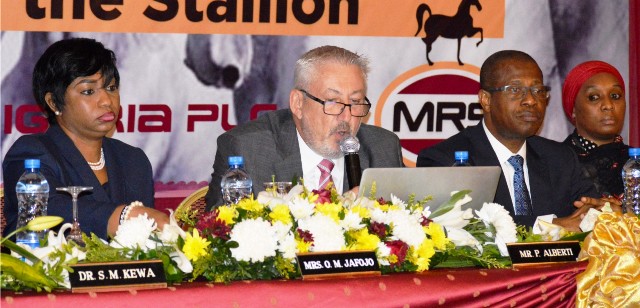
Afolabi, a terminal operator, made the plea at the Annual Maritime Conference held on Friday.
The Tide source reports that, the Executive Order came from the Acting President, Prof. Yemi Osinbajo to facilitate trade.
“The huge infrastructure deficit has led to deplorable access roads, faulty cargo scanner, non-existent rail system, non-functional truck bay and others which conspired to negatively impact on the service delivery efficiency.
“These challenges are the major reasons we gathered today to address, because our sector cannot continue to reel under the burden of infrastructural decay if we want to contribute meaningfully to the economy and fulfil the industry’s potential.
“I commend the efforts of the Federal Government in reforming the maritime industry, especially with the Executive Order signed by the Acting President.
“It is an acknowledgment of the fact that things must be done differently.
“However, infrastructure deficit would negate the good intentions of the government if the problems listed above are not strategically and urgently addressed,” he said.
Afolabi said that one of the key objectives of the conference was to promote the culture of intellectual discourse in the country’s maritime industry.
According to him, the conference was organised to address issues affecting the industry with the support of stakeholders such as clearing agents, shippers, investors and workers as well as the community.
He said that, the United Nations had compelled the International Maritime Organisation (IMO), its affiliate responsible for regulating the global maritime industry.
Afolabi said that over 90 per cent of world’s trade was transported by sea, stressing that maritime industry was strategic to maritime nations in terms of its contributions to the economic growth and development of nations.
He said that the contributions of the sector to the country’s Gross Domestic Product (GDP) were still low when compared with its huge potential and opportunities.
The Chairman of the occasion, Mrs Margaret Onyema-Orakwusi,  who is the Chairman of Ship Owners Forum, described the maritime industry as a big source of revenue for the economy.
“Maritime is an industry that accommodates different occupations and that is why we need to accommodate other departments to enable them find solutions to the problems in the industry.
“I am asking Afolabi to expand the conference to accommodate other departments to understand maritime operations and solve the problem of accessing loans in the maritime industry,” Onyema-Orakwusi said.
Ms Hadiza Usman, the Managing Director of Nigerian Ports Authority, commended the SIFAX boss and acknowledged the contributions the conference had made to  the industry.
Usman, who was represented by Mr Stanley Yitnoe, Assistant General Manager, Business Desk of NPA, said that he had also created numerous awareness of the important of maritime industry in the Nigerian economy.
She commended Afolabi for his resourcefulness in constantly improving the business at the ports in spite of the recent downturn in the economy.
“Afolabi is indeed a great example for youths to emulate.
“The port industry had witnessed significant improvements in port infrastructure  and revenue generation since the concession of Nigerian ports to private operators in 2006,” she said.
Usma said that there was the need for extensive infrastructure overhaul and promised that NPA would bring out the much-desired change to actualise government’s development goals.
Retired Major Henry Afolabi, the Executive Director, SIFAX Haulage & Logistics Ltd., expressed concern about inadequate and decaying port access roads and neglect of inter-modalism.
“The current bad state of port access roads calls for concern, especially the two ports in Lagos which received over 70 per cent of the total cargo throughout in the country.
“The bad state of the port access roads in Lagos has impacted adversely on human health especially port users,” Ajetunmobi said.
NMASA boss, Dr Dakuku Peterside, said the agency would continue to safeguard the country’s territorial waters.
Peterside, represented by Mr Anthony Ogabi, a Director in NIMASA, said that NIMASA would work to gain back the Category `C’ position which Nigeria lost in the International Maritime Organisation (IMO).
He said that the agency had a Memorandum of Understanding (MoU) with the Nigerian Navy to stop piracy attacks in the country’s territorial waters which had given room for more ships to call in Nigerian Ports.


Continue Reading

Business

Nigeria’s Inflation Drops to 15.06%

Published

on

Three States Record Lowest rates Published 16 Mar 2026 By  Dave Ibemere 3 min read The NBS has revealed that inflation rates dropped again in February 2026 The bureau noted that both headline and food inflation eased on a year-on-year basis Inflation was lowest in Katsina, Imo, and Ebonyi, while the highest was recorded in Kogi.
 Nigerian economy, the stock market, and broader market trends. The National Bureau of Statistics (NBS) has revealed that Nigeria’s inflation rate slowed further in February 2026. According to the bureau in its latest CPI report, the headline inflation dropped slightly to 15.06% from 15.10% in January 2026. Nigeria’s inflation eases to 15%, offering relief to households. It was 11.21 percentage points lower than the 26.27% recorded in February 2025. From breaking news to viral moments.  On a month-on-month basis, inflation stood at 2.01% in February, up from -2.88% in January, showing that prices rose at a faster pace than the previous month. Nigerian stock market records weekly gain as turnover hits N164.8billion Urban vs Rural Inflation NBS noted that urban inflation stood at 15.53% year-on-year, down from 28.49% in February 2025, while rural inflation was 13.93%, compared with 22.73% in the same period last year. Every month, urban inflation rose to 2.55% in February from 2.72% in January, while rural inflation eased to 0.71% from -3.29%. Food Inflation Food inflation dropped to 12.12% year-on-year in February, down sharply from 26.98% in February 2025. Monthly, food prices rose by 4.69%, higher than the -6.02% recorded in January. The NBS attributed the moderation to slower price increases in staples such as beans, cassava tuber, yam flour, crayfish, millet flour, cowpeas, and okazi leaf. The twelve-month average for food inflation was 19.08%, compared with 37.40% in February 2025. States breakdown for All Items The states with the highest all-items inflation rates were: Kogi (23.57%) Benue (22.85%) Anambra (22.09%) The lowest rates were recorded in: READ ALSO Naira appreciates by N27 against US dollar as external reserves cross $50bn Katsina (7.78%) Imo (11.66%) Ebonyi (11.71%) On a month-on-month basis, the highest increases were in Enugu (5.92%), Ogun (4.39%), and Anambra (4.11%), while declines were seen in Zamfara (-2.14%), Bauchi (-1.23%), and Katsina (-1.06%). Food staples contribute less to inflation as prices moderate in February. Photo: Bloomberg Source: Getty Images State Breakdown for Food Inflation Food inflation was highest in: Kogi (26.91%) Adamawa (23.12%) Benue (21.89%) The lowest food inflation rates were seen in: Katsina (5.09%) Bauchi (7.09%) Imo (7.65%) Month-on-Month Food Inflation The states with the highest month-on-month increases in food inflation were: Bayelsa (8.81%) Ebonyi (8.51%) Edo (7.72%) The states that recorded declines were: Katsina (-0.70%) Nasarawa (0.17%) Kano (1.39%) Food price changes across markets in Nigeria Earlier, The  Tide source reported that due to Ramadan, staple food prices across the country are recording sharp increases as Muslims begin the Ramadan fasting season Ramadan is not only a period of abstinence from food and drink, but also a time for ‘reflection, discipline and heightened devotion’ Several traders in Abuja, Taraba, and Kaduna states are taking advantage and have hiked price. The NBS has revealed that inflation rates dropped again in February 2026 The bureau noted that both headline and food inflation eased on a year-on-year basis Inflation was lowest in Katsina, Imo, and Ebonyi, while the highest was recorded in Kogi.
Continue Reading

Business

NDCCTMA, NDDC MDS Challenge Niger Delta Indigenes On Investment In The Region 

Published

on

The Nigeria Delta Chamber of Commerce, Trade, Mines and Agriculture  (NDCCTMA), and the Niger Delta Development Commission ( NDDC ) have challenged Niger Delta entrepreneurs to close the gap in Gross Domestic Products (GDP) differences between the region and that of the South Western part of the country by coming home to invest.
The bodies made the call at a Business Round Table organized by NDDCTMA, in Port Harcourt.
Chairman of NDDCTMA, Ambassador Idaere Gogo Ogan, said to close the gap between the south west region which he said has a GDP seize of about #59 trillion and that of the Niger Delta which is about #34 trillion was to massively invest in the region.
He said no other persons can  do this except sons and daughters from the region.
“For me I believe in statistics,I believe in data and everyday I looked at the data concerning development in Nigeria and from the GDP point of view, the South West has #59 trillion, that is the seize of the south west region economy, the second region following them is the Niger Delta region with GDP seize of #34 trillion,so there is a yearning gap of #25 trillion that separates the south west and the Niger Delta region, that is why we are here.”
Ogan said the region has the capacity to close the gap and even surpassed it but regretted that indigenes of the region have chosen to ignore it in terms of investment.
“We need to close that gap .If we close that gap and even surpassed it,all the negative problems of militancy and unemployment will automatically erase”, he stated.
Ogan noted that the event was organized to remind the people that past efforts of militancy and agitations have not led the region to any where saying “that is why we are gathered here in this room”.
Also speaking, the Managing Director/Chief Executive Officer, NDDC, Dr Samuel Ogbuku urged indigenes of the region not to use the problem of insecurity as an excuse to continue to deny the region of investment  as every part of the country have in one time or the other experienced crisis.
Ogbuku said most indigenes have displayed high level of unpatriotism towards the region by taking investments that would have benefited the people to either Lagos or Abuja.
“With little threat we have left the city, we have gone to Lagos,we have moved  our families to Abuja and Lagos. If you go round GRA all the property, you will see,”to let to let”most of them are now empty “he said.
The NDDC MD said despite the fact that people from the region are doing well in the oil and gas, banking and other sectors, its impact are not being felt at home because they are stationed outside the region.
By; John Bibor
Continue Reading

Business

Cash Handouts Unproductive For Sustainable Agricultural Development – Engineer Kii

Published

on

Rivers State by its natural disposition is gifted with strategic economic advantage, particularly in  agricultural potentials and fortunes. This informs successive governments’ interest in  developing the agricultural sector, such as the School to Land Program, the Shongai Project, among several others.
The objective is to engender and leverage the sector  beyond mere subsistence practices into a full thriving economy, with the engagement and involvement of the youthful and productive population.
The Farm to Future Agro Based Training for Rivers youths by the present administration is notably one of the most pragmatic efforts of the Rivers State Government to engage the prospective creative capital of both the natural and human resources in the agricultural sector for sustainable development.
The concept, premised on the imperative of maximizing the huge agrarian prowess of the state, targets creation of sustainable livelihood for the teeming youth of the state. The project is also intended to achieve the chore needs of food sufficiency and job creation in the state.
This implies a significant deviation from the acculturised norm of expectations of financial benefits as the outcome of government programs and policies.
The tenets of the program are expressly difined in concept and practice as shown in the phases of its execution.
However, some beneficiaries of the project recently staged a protest, allegdging unpaid largesse, diversion of funds and perceived slighting by the Rivers State Ministry of agriculture. The said protest has stirred up concerns among stakeholders about how people view  government policies.
Many see the protest  as an attempt to create tension around the program and sabotage its original objectives.
Stakeholders and commentators are of the view that the Rivers State is in dire need of development in every critical sector, as such the  Ministry of Agriculture and its partners should be given the benefit of the doubt to implement the project to its logical conclusion without being hauled with accusations.
The former Commissioner for Agriculture, Engineer Victor Kii who was at the fore of driving the program has in a press statement debunked the allegations and sued for calm, restraint and understanding. Engineer Kii assured the participants that the empowerment phase will be implemented as soon as administrative normalcy is restored.
He commended the participants for their commitment and discipline during the training and urged them to uphold the norms of the program rather than misrepresenting its intentions.
Some pundits who commented on the recent development decried the fact that many people  still hold on to the notion that  incentives billed to create sustainable impact through skills based programs, should be given out as  largess, without adroit supervision of its utility function. This practice  has however created a culture of economic doldrum, dependency and servitude in the past.
Thus the idea of seen the Rivers Farm to Future project  as a mere quixotic experiment for cash benefits  without achieving set goals is counter productive. Such opportunistic thinking have stunted government efforts  over the years in achieving long term objectives of development.
As disclosed by the former commissioner for Agriculture in his detailed explanation, the Farm to Future project was strategically designed to address this culpable deficit in institutional planning and consolidation of results.
The former commissioner gave an  explicit description of the nexus of operation of the program.
As revealed by him;  ” The program is a strategic intervention to equip young people in Rivers with practical skills and to nurture a new generation of agricultural entrepreneurs. 500 beneficiaries received intensive agri business training in the first phase.”
 He pointed out that the program was conceived and designed in line with global best practices which de emphasizes indiscriminate cash handouts for beneficiaries. Rather it promotes practical engagements in agricultural activities and business initiatives.
At the end of the training in February, beneficiaries were encouraged either individually or in cooperative clusters to identify value chain for establishment of viable businesses.
They were also asked to produce structured business proposals for perusal and review by the ministry of agriculture and appointed consultants, after which successful proposals would be forwarded to the Bank of Agriculture with Rivers State Government providing guarantees.
The strategies for implementation include field inspections and evaluation for beneficiaries who had already commenced practical activities in identified locations.
The approach was to discourage the commonplace ideology of diverting funds meant for specific projects for unrelated purposes, thereby undermining the conscious exploration of creative potentials into long term benefits.
The process was however temporary interrupted by the dissolution of the Rivers State Executive Council and the ongoing renovation of the Rivers State Secretariat complex but the profound optimism and positive expectations that are the hallmark of the project remains sacrosanct.
Engineer Kii assures.
By: Beemene Taneh
Continue Reading

Trending