
News
Senate Opposes Troops Deployment To Gambia

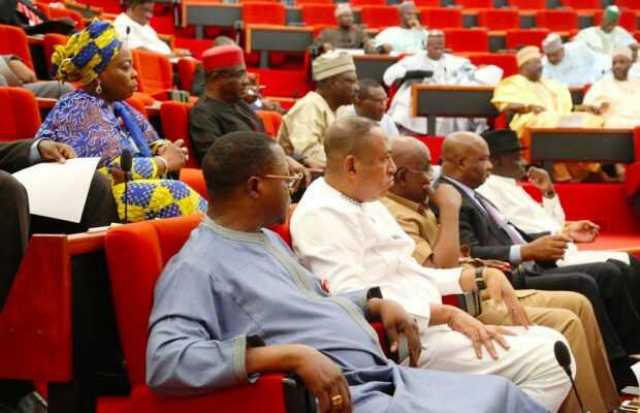
The Senate yesterday opposed President Muhammadu Buhari’s deployment of troops to The Gambia without approval of the National Assembly.
The Federal Government had deployed troops to The Gambia, if President Yahya Jammeh refused to leave office and handover to President-elect, Adama Barrow by January 19.
Speaking during plenary, Senator Chukwuka Utazi (PDP-Enugu), who raised a Point of Order said that President Buhari violated the constitution by deploying troops to Gambia without approval of the National Assembly.
”Section 5 of the Constitution stipulates “subject to the provisions of this constitution, the executive powers of the federation shall be vested in Mr President.
“Section 4 notwithstanding the foregoing provisions of this section, a President shall not declare a state of war between the Federation and another country except with the sanction of a resolution of both Houses of the National Assembly sitting in a joint session.
”Except with the prior approval of the Senate, no member of the Armed Forces of the federation shall be deployed on combat duty outside Nigeria.
He said that it was “an affront to the Constitution to ask that this country will go on a warfare in another country.”
”And we have failed even when the Senate has been co-operating with the executive. But let it be on record that if anything of this nature happens in this country, that this National Assembly has to be informed properly in writing.”
Saraki, while responding, faulted Utazi’s claims and argued that President Buhari was still acting within the confines of the law. He said President Buhari can deploy troops, as long as the operation does not exceed seven days.
Quoting Section 5(5) of the 1999 Constitution as amended, Saraki maintained that until the expiration of seven days, no one can fault the action of the President.
Saraki argued: “The point made is noted, but the explanation concerning the constitution is confusing. I believe the constitution gives room for the president, within seven days for such an action to come before us.”
Section 5(5) quoted by Saraki reads: “Notwithstanding the provisions of subsection (4) of this section, the President, in consultation with the National Defence Council, may deploy members of the armed forces of the Federation on a limited combat duty outside Nigeria if he is satisfied that the national security is under imminent threat or danger. Provided that the President shall within seven days of actual combat engagement, seek the consent of the Senate and the Senate shall thereafter give or refuse the said consent within fourteen days. “
Saraki was countered by the Deputy President of the Senate, Ekweremadu. He warned that as parliamentarians, it is wrong to subject the Senate to ridicule, adding that setting a bad precedence will hurt them in the future.
Also relying on Section 5(4)(b) of the 1999 Constitution as amended, Ekweremadu said the President cannot deploy troops outside the country without any prior approval from the National Assembly.
Section 5(4)(b) of the 1999 Constitution as amended reads: “Except with the prior approval of the Senate, no member of the armed forces of the Federation shall be deployed on combat duty outside Nigeria.”
According to the deputy senate president, “This has nothing to do with war and we are not at war with anybody, but for you to send the Nigerian armed forces outside Nigeria, this Senate must be told. But it is happening in The Gambia. They need the approval of the Senate because that is not war.
“War comes in when you are talking about section 5 of the constitution and the president does not need our approval. He can go to war on our behalf and come back later. But for you to deploy them to The Gambia, you must seek the approval of the Senate,” Ekweremadu added.
No official position was taken by the Senate on the issue. Saraki did not allow other lawmakers to contribute to the debate. He did not rule either on the issue, but moved ahead to accommodate other businesses of the day.
Contributing, Deputy Senate President, Ike Ekweremadu said “the operational one as it affects us here is the (b) which says except with the prior approval of the Senate, no member of the armed forces of the federation shall be deployed on combat duty outside Nigeria’’.
”This has to do with war and we are not at war with anybody, but for you to send the Nigerian armed forces outside Nigeria, this senate must be told.
Ekweremadu said that though it was happening in the Gambia, they needed the approval of the Senate because that was not war.
He explained that a war situation was when you are talking about Section 5 and the president does not need our approval.
”He can go to war on our behalf and come back later. But for you to deploy them to Gambia you must seek the approval of the Senate.’’
Meanwhile, Adama Barrow took the oath of office as Gambia’s President yesterday at its embassy in neighboring Senegal, calling for international support as regional troops prepared to back him in a showdown with incumbent Yahya Jammeh, who has refused to step down.
Barrow’s appeal that could trigger a military push into Gambia by West Africa’s ECOWAS bloc, which has said it is ready to remove Jammeh by force if necessary.
Jammeh, in power since a 1994 coup and whose mandate ended overnight, initially conceded defeat to Barrow following a Dec. 1 election before back-tracking, saying the vote was flawed. Overnight talks to persuade him to stand down failed, despite his increasing political isolation.
“This is a day no Gambian will ever forget,” Barrow said after taking the oath, which was administered by the president of Gambia’s bar association. “Our national flag will now fly high among the most democratic nations of the world.
“I hereby make an explicit appeal to ECOWAS, the (African Union) and the UN… to support the gov and people of the Gambia in enforcing their will, restoring their sovereignty and constitutional legitimacy,” he said.
ECOWAS and the African Union have said they will recognize Barrow from Thursday.
Senegal’s army, which has deployed hundreds of soldiers at the Gambian border, said on Wednesday it would be ready to cross into its smaller neighbor, which it surrounds, from midnight. Ghana has also pledged troops.
A senior military source in Nigeria, which pre-positioned war planes and helicopters in Dakar, told Reuters that regional forces would only act once Barrow had been sworn in.
Barrow gave the oath in a tiny room in Gambia’s embassy in the Senegalese capital, Dakar, and many of those present broke into the Gambian national anthem once he had completed it.
Outside the building on a residential street amid a heavy security presence, dozens of Gambians listened to the ceremony through loudspeakers.
“It’s very sad to be swearing in a president in someone else’s country. I am happy and sad at the same time,” said Fatou Silla, 33, a businesswoman who fled Gambia with her son a week ago.
Fearing unrest, thousands of Gambians have fled the country, the United Nations estimates, and diplomats said its Security Council would on Thursday vote on a resolution backing ECOWAS’s efforts.
A senior aide to Barrow said that, once sworn in, arrangements would be made for him to return to Gambia though it was unclear how he would travel.
At a bar in the Gambian capital Banjul’s popular Senegambia strip, people crowded around a television to watch the swearing in and cheered and danced when it was over.
“I’m so happy there’s a new government,” said a cashier who only gave her name as Fama. “We have been suffering for 22 years and now things will be different.”
During the brief inauguration speech, Barrow asserted his new role as commander and chief of Gambia’s armed services, ordering soldiers to stay calm and remain in their barracks. Those who did not would be considered rebels, he said.
As tour companies pressed on with the evacuation of hundreds of European holidaymakers, shops, market stalls and banks in Banjul remained closed while police circulated in trucks and soldiers manned checkpoints.
It was unclear what Jammeh’s next move would be.
He faces almost total diplomatic isolation and a government riddled by defections. In the biggest loss yet, Vice President Isatou Njie Saidy, who has held the role since 1997, quit on Wednesday, a government source and a family member told Reuters.
Gambia’s long, sandy beaches have made it a prime destination for tourists but Jammeh, who once vowed to rule for “a billion years”, has also earned a reputation for rights abuses and stifling dissent.
He has ignored pressure to step aside and offers of exile.
However, Senegalese troops moved across the border into The Gambia yesterday, an army spokesman said after the UN Security Council backed West African efforts to ensure that the country’s defeated leader Yahya Jammeh hands over power.
“They entered this afternoon” Colonel Abdoul Ndiaye told newsmen after Adama Barrow was sworn in as Gambian President at his country’s embassy in Dakar despite Jammeh’s refusal to stand down.



The Rivers State chapter of the All Progressives Congress Christian Leaders Forum has expressed strong confidence in the capacity of All Progressives Congress (All Progressives Congress) candidates in the state to deliver effective governance if elected into office in the coming elections.
The State Coordinator of the forum, Archbishop Lucky Aroh, made this known during a breakfast and thanksgiving meeting held in Port Harcourt, where leaders gathered to pray for the stability of the party and the safety of its candidates ahead of the 2027 general elections.According to him, the meeting was convened to seek divine intervention for peace, unity, and security among APC candidates across Rivers State.
“Today we are praying for APC stability in Rivers State and the security of our candidates that have been elected to contest the 2027 elections. It is a breakfast meeting,” Aroh said.
He further expressed optimism that the party’s candidates would not disappoint the people if entrusted with leadership responsibilities.
“They will not fail when elected into office. We are here as fathers of the land to let them know, and I must tell you the truth that these are the authentic people that will do well in Rivers State,” he added.
Speaking earlier, the National Chairman of the forum, Professor Olanrewaju Abraham, commended the Rivers State chapter for organizing the programme, noting that the national body of the forum believes strongly in the power of prayer.
He stated that political leadership provides an opportunity to influence society positively, including advancing moral and spiritual values, while expressing confidence that APC candidates at all levels would emerge victorious in the upcoming elections.
Also speaking, the Rivers State Women Leader of the APC, Hon. Darling Amadi, praised the forum for its commitment to prayers for peace, stability, and the protection of party candidates.
Represented by the Deputy Women Leader of the party in the state, she described the initiative as commendable and urged other political and support groups within the party to emulate the gesture in promoting unity and stability.
By: John Bibor, Menebe Emmanuel & Fortune Paibi
Prominent businessman and philanthropist, Elder Anthony Osagwe-Ogo, was celebrated in grand style as he marked his 70th birthday anniversary, with distinguished Nigerians, business leaders, and golf enthusiasts gathering to honour his remarkable contributions to society.
The colourful celebration took place at the Port Harcourt Golf Club, where friends, associates, and well-wishers converged to pay tribute to the revered elder statesman.
Chairman of the occasion, High Chief (Dr.) Ikenna Okafor, described the celebrant as a detribalised Nigerian whose generosity, humility, and commitment to humanity have earned him admiration across different communities and backgrounds.
According to Dr. Okafor, Pa Osagwe-Ogo’s impact on society and the development of his community remains unparalleled. He noted that members of the golfing community are proud to be associated with a father figure who consistently promotes the welfare and well-being of those around him.
He further stated that the history and growth of the Port Harcourt Golf Club cannot be told without acknowledging the significant role played by the celebrant, whose wisdom, encouragement, and leadership have helped sustain the club over the years.
“We are here to celebrate a man who has impacted humanity positively, a peace-loving individual and an epitome of hope for the younger generation. We pray to emulate his virtues. Today, we celebrate a bridge-builder, a trailblazer, and an iconic leader whose life continues to inspire many,” Dr. Okafor said.
He expressed delight at the large turnout of guests from various walks of life, describing it as a testament to the respect and affection Pa Osagwe-Ogo commands within and beyond Rivers State.
In his response, the celebrant, Pa Anthony Osagwe-Ogo, expressed profound gratitude to God for preserving his life and granting him the privilege of attaining the milestone age of 70.
He also thanked members of the Port Harcourt Golf Club, family members, friends, and associates for identifying with him during the celebration and for their unwavering support over the years.
The event featured the cutting of the birthday cake, presentation of awards to deserving members of the club, goodwill messages, and moments of celebration among guests.
The ceremony was attended by notable personalities from the business community, the golfing fraternity, and other sectors, all of whom joined in celebrating the life and legacy of the respected elder statesman.
Rivers State Governor, Sir Siminalayi Fubara, and the Permanent Secretary of the Rivers State Ministry of Information and Communications, Dr. Honour Kuru Sirawoo, have been honoured with awards of recognition in connection with the 2026 Democracy Day celebrations held in Port Harcourt.
The awards, which formed part of activities marking Nigeria’s Democracy Day on June 12, were formally presented on Tuesday at the Ministry of Information and Communications in Port Harcourt.
Presenting the awards was Hon. Abdul Hameed Oladipupo Alli, popularly known as “Mr. Nigeria,” Publisher of Asiwaju Trumpet Magazine and Achievers World International Magazine.
Governor Fubara was recognised for his efforts in sustaining peace, stability, and a conducive political atmospherJohn Bibor / Menebe Emmanuel / Fortune Paibie in Rivers State. The organisers noted that his administration has fostered harmony and strengthened civic participation across the state.
Dr. Sirawoo, on the other hand, was honoured for his exemplary administrative leadership and significant contributions to effective information management within the Ministry of Information and Communications.
Representing Dr. Sirawoo at the presentation ceremony, Dr. Christian Davies received the award on his behalf and expressed gratitude for the recognition. He described the honour as a reflection of Dr. Sirawoo’s unwavering commitment to professionalism, excellence, and dedicated public service.
Dr. Davies assured the organisers that the award would be formally conveyed to the Permanent Secretary.
The event also featured the presentation of commemorative publications highlighting major governance and civic milestones in Rivers State, including Easter celebrations, Workers’ Day activities, the Governor’s third anniversary in office, and Democracy Day programmes.
Organisers of the awards commended the Rivers State administration for what they described as sustained peace, political stability, and improved civic engagement, noting that these achievements have contributed significantly to the state’s continued development.
By: Jessica Sambol