
Nation
THE STATES

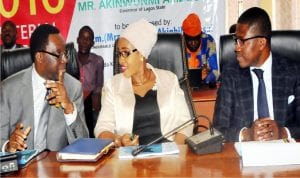
L-R: Lagos State Commissioner for Information and Strategy, Mr Steve Ayorinde, Commissioner for Youth and Social Development, Mrs Uzamat-Yusuf and the Permanent Secretary, Youth and Social Development, Hakeem Muri Okunola, at a news conference by Lagos Commissioner for Youth and Sports to mark one year of Governor Akinwunmi Ambode in office, in Lagos yesterday.
Bauchi
Bauchi State is to train 900 women across the 20 Local
Government Areas in new trades to make them self reliant.
Hajiya Asabe HAmma, the Commissioner for Women Affairs in the State, disclosed this in an interview with newsmen in Bauchi.
According to her, the training would be in new “marketable trades” that would require small amounts as capital.
She said that the number of participants would be based on the size and population of each local government.
Hamma said that women development officers at the local government levels would be charged with the responsibility of selecting those to be trained.
Ekiti
A Muslim cleric, Malam Abdul’kareem Adeleke, said he
was optimistic that the current economic challenges facing the country would soon be over.
Adeleke, of the Central Mosque, Ikole, Ekiti State, spoke with newsmen after the Jumat prayers.
He appealed to Nigerians to endure the hardship and urged the rich to always support the poor in the society.
According to him, the rich have a duty to support government in alleviating poverty and to assist the needy with food, cash and other things that could improve their condition.
He cautioned the less privileged in the society against engaging in crime as means of survival saying God would not be pleased with such act.
FCT
A 55-year old farmer, Aminu Ma’aji has appeared in a Kado
Grade 1 Area Court for alleged mischief.
Ma’aji, who resides in Gwarimpa village, pleaded not guilty to the one-count charge of mischief.
The Prosecutor, Zeera Douglas, told the court that Peter Omobighe of Gwarimpa village, reported the matter at Gwarimpa Police Station on February 27.
Douglas said that the defendant deliberately removed the roof of Omobighe’s room, who is his tenant, without any reason to do so.
He said that rainfall destroyed all his property, which included mattress , kitchen cabinet, electronic cabinet, gas cooker, standing fan, two seater chairs, all valued N86,000.
The prosecutor added that the crime was punishable under Section 327 of the Penal Code.
The presiding officer, Malam Abubakar Sadiq, granted bail to the accused in the sum N50,000 with a surety in like sum.
Kano
The Legal Aid Council of Nigeria has successfully resolved
14 out of the 22 cases it received in Kano State in March, the state Coordinator, Alhaji Abubakar Umar, has said.
Umar told newsmen in Kano that the council received eight criminal cases and 14 civil cases in the month under review.
The coordinator added that the 14 resolved cases comprised of five criminal and nine civil ones.
According to him, the 14 cases were resolved through arbitration while the remaining ones were still ongoing in court.
He also said that most of the civil cases were over inheritance, marriage, debt, land dispute among others.
Katsina
Funtua Local Government Area of Katsina State has
inaugurated a response committee as part of its efforts toward preventing the prevalence of Lassa fever in the area.
The acting chairman of the council, Alhaji Abba Lawal, who inaugurated the committee, said its members were selected based on their proximity to the people.
“They would be able to quickly inform the authorities of any outbreak”, he said.
Lawal said the council, through its health, water and sanitation departments, had embarked on educating food vendors and individual families as well as other rural dwellers on the dangers of Lassa fever and the prevalence of other communicable diseases.
“Public lectures, interactive sessions and house-to-house mobilisations are being conducted to educate the people.
Kwara
The Kwara Governor, Abdulfatah Ahmed has urged
religious bodies to join hands with the government to move the nation forward.
Ahmed made the call at the 2016 Nigerian Baptist Convention in Ilorin.
Governor Ahmed, who was represented by his Deputy, Elder Peter Kisira, charged religious organisations to entrench good governance and play complementary roles to the government.
The governor said that the government was ready to partner any religious body or organisation to achieve all- round development of the state.
Lagos
Ato Arinze, a specialist in sculpture, has called on the Federal
Government to provide stiffer penalties for cross-border theft of art works.
Arinze told newsmen in Lagos that government’s intervention was necessary to curtail the nefarious act.
“Our artefacts are being stolen daily and it is crossing Nigerian borders without check.”
He advised artists in the country to properly document their works, so as to make the task of identifying them easier.
The artist added that most stolen art works taken across Nigeria’s borders were difficult to trace because of poor documentation by owners.
Nasarawa
The National Directorate of Employment (NDE) in Lafia,
disbursed resettlement tools and equipment worth N1.5 million to 18 graduate trainees of vocational skills programme in Nasarawa State.
The Acting Director-General of NDE, Mr Kunle Obayan, who distributed the tools, said that the gesture was to enable the unemployed graduate trainees become self reliant and contribute their quota to national development.
Obayan, who was represented by the agency’s Director of Special Public Works, Mr Monday Dalyop, said that the Federal Government was planning to create employment opportunities for unskilled and unemployed Nigerians, hence the need for the gesture.
“NDE came into existence in 1986, saddled with the responsibilities of training people especially the youths and women in different skills acquisition programmes in the country.
Niger
The Niger State Police Command has arrested a suspected
robber, Gideon Ezechukwu, who allegedly uses the Hijab as camouflage during operations.
Police Public Relation Officer in the state, ASP Bala Elkanah, made this known during an interview with newsmen in Minna.
“On April 13, 2016 at about 6.00am one Gideon Ezechukwu of Dutsen Kura Gwari, Minna who dressed in women hijab was arrested by the police.
“The suspect was arrested while trying to escape with an allegedly stolen red colour Jincheng motorcycle (rubber rubber),’’ he said.
Plateau
The Plateau Government has closed down 62 poultry
farms and destroyed more than 190,000 birds affected by bird flu across the state, an official has confirmed.
Director, Veterinary Services, in the state’s Ministry of Agriculture,Dr Doris Bitrus, told newsmen in Jos that the disease had continued to spread.
She attributed that spread to the non-compensation of farmers, whose farms were affected by the disease in 2015.
“With compensation not coming, most farmers now prefer selling their sick birds to the marketers,” she said.
She explained that the disease was more prevalent in Jos South, Jos North, Jos East and Bassa Local Government Areas of the state.
According to her, government is working toward promoting more biosafety measures to check the spread of the disease.
Ogun
A 28-year-old man, Tunde Oduntan, who allegedly
punched off a commercial motorcyclist’s incisors, has been hauled up before an Abeokuta Magistrates’ Court.
The court, however, granted the accused a bail of N100,000 with two sureties in like sum.
The accused, whose address is unknown, is facing a charge of unlawful assault.
The prosecutor, Insp. Augustin Ozimini, told the court that the accused had on April 15 at about 3.20 p.m. beat up the commercial motorcyclist, Abu Joseph, and removed two of his teeth in the process with punches.
Yobe
The Chief of Air Staff, Air Marshal Sadiq Abubakar,
said that the Federal Government’s intervention in the welfare of the Internally Displaced Persons was to enable them to return to their communities.
Abubakar stated this at the handing over of relief materials to the IDPs in Damaturu.
Abubakar was represented by Air Commodore Paul Dimfwina, Commander 79 Composite Group Nigeria Air Force, Maiduguri.
He said that the donation was in fulfillment of a presidential mandate given to the Comptroller-General of Customs to transfer items seized by the Customs and legally forfeited to the government for the use of IDPs in various camps across the North-East.
Abubakar said that the intervention should be seen as laying foundation for full relocation of the displaced persons to their communities.




The Hydrocarbon Pollution Remediation Project (HYPREP) has commemorated the 15th anniversary of the release of the United Nations Environment Programme (UNEP) Environmental Assessment Report on Ogoniland, reaffirming its commitment to restoring the environment and improving the livelihoods of affected communities.
In a statement signed by the Project Coordinator, Prof Nenibarini Zabbey, to commemorate the anniversary, HYPREP described the anniversary as a significant milestone in Nigeria’s environmental restoration efforts, noting that the project has made remarkable progress in implementing the recommendations of the landmark UNEP report released on August 4, 2011.
The UNEP report had revealed extensive oil pollution across Ogoniland, severe environmental degradation, and serious public health risks resulting from decades of petroleum operations. It also recommended an initial $1 billion fund to commence the cleanup of the affected communities.
According to HYPREP, the Federal Government formally launched the Ogoni clean-up in 2016, while the Project Coordination Office was established in 2017 to drive the implementation of UNEP’s recommendations.
Zabbey said the current administration has continued to prioritise the project under the Renewed Hope Agenda.
Providing an update on the cleanup, the Project Coordinator disclosed that 30 of the 65 contaminated sites identified by UNEP have been fully remediated, while work is ongoing at several medium- and high-risk locations. It also stated that more than 1.5 million mangrove seedlings have been planted as part of what it described as the world’s largest restoration of oil-degraded mangroves, with over 1,000 hectares of shoreline already rehabilitated.
Zabbey further revealed that 49 Ogoni communities have been connected to potable water schemes through multiple water projects and booster stations aimed at providing safe drinking water across the region.
In the health sector, he said the 100-bed Ogoni Specialist Hospital in Kpite and the 43-bed Cottage Hospital in Buan are nearing completion, adding that several existing health facilities have been upgraded with modern medical equipment, while five ambulances have been donated to improve emergency healthcare services. The Project Coordinator also disclosed that a three-year human health biomonitoring study is being conducted in collaboration with the World Health Organization’s International Agency for Research on Cancer (IARC).
On economic empowerment, Zabbey stated that the Project has created more than 8,000 direct jobs and trained thousands of Ogoni youths and women in various vocational and technical skills, including software development, cybersecurity, aviation, commercial diving, seafaring, mechatronics, and creative arts. The project also reported awarding scholarships to more than 1,000 students, providing grants to small businesses, and supporting persons living with special needs through skills acquisition programmes.
The statement further highlighted ongoing legacy projects, including the Ogoni Power Project and the Centre of Excellence for Environmental Restoration, which it said is about 96 per cent complete. HYPREP also welcomed the recent designation of the Ogoni Wetland as a Ramsar Site of International Importance and pledged to continue promoting biodiversity conservation and sustainable management of the ecosystem.
Marking the anniversary, Zabbey said the progress achieved over the past 15 years demonstrates the collective commitment of government, development partners, stakeholders, and local communities to restoring Ogoniland. He called for renewed collaboration to sustain the cleanup effort, promote environmental sustainability, and support the long-term development of the region. 3
-

 News2 days ago
RSG Targets Nine Million Residents in Mosquito Net Distribution Campaign
-

 Oil & Energy1 day ago
Aiyedatiwa Signs New Electricity Bill
-

 Oil & Energy1 day ago
NLNG Commissions Research And Innovation Centre In RSU
-

 Maritime1 day ago
Marine Minister Commends President Tinubu On NPERA Bill Assent
-

 News2 days ago
KenPoly Holds Eight Convocations, August 29
-

 News2 days ago
RSG Begins Another Phase of Projects Commissioning Today
-

 News2 days ago
RMAFC Completes Revenue Sharing Review, Proposes New Pay
-

 Maritime1 day ago
NAGAFF Petitions IGP Over Alleged Maritime Police Harassment